
Search results for lave
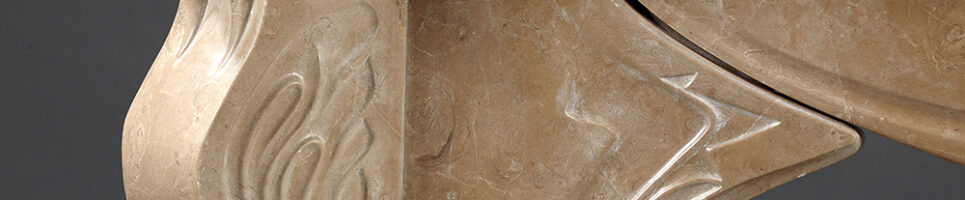
Guimard’s Marble Fireplaces – 1
11 April 2026
All photos owned by the authors or by the Cercle Guimard Archives and Documentation Center must, without exception, be approved by the Cercle Guimard for any publication project, regardless of the medium.
A comprehensive study of Guimard’s work in the field of marblework has yet to be undertaken. It is nevertheless clear that this field held his interest just as much as other areas of decorative art. Guimard worked with marble craftsmen from very early on, at least since the construction of Victor Rose’s tomb in 1892, and we know that he designed funerary monuments until 1929 (the project for the commemorative monument to the Victory of the Marne). This article provides an overview of his creations in the more limited field of marble fireplaces. A second article will discuss the recent restoration of the engraved decoration on a fireplace in the Trémois building (1909–1910).
We are not aware of any marble fireplaces in any of Guimard’s early architectural works, but it is quite possible that some existed. The first designs specifically created by Guimard may date back to the interior work on Castel Béranger (1895–1898). Guimard’s use of fireplaces there was in no way innovative: it followed well-established conventions for apartments and private residences, where the combination of the fireplace and the mantelpiece above it persisted from the 18th to the 19th century[1]. But as we saw previously, the presence of heat vent grilles indicates that the apartments at Castel Béranger had a mixed heating system, with radiators in the basement and fireplaces in the main rooms. These elements of the fixed decor, though not very efficient, were long considered indispensable to a private interior and were therefore used occasionally or during the shoulder seasons. The list of contractors recorded in the Castel Béranger portfolio mentions “Hénault. – Marblework,” followed by this note: “Following the death of Mr. Hénault, the marble fireplaces were executed by Mr. Maybon[2].” This latter firm, whose workshops and showroom were located on Rue Saint-Sabin in the 11th arrondissement, specialized in “artistic and commercial fireplaces.”
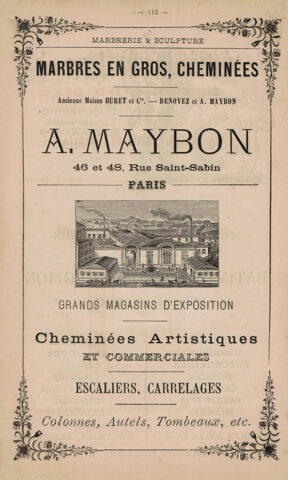
Sales brochure from Albert Maybon Marble Works, 46–48 Rue Saint-Sabin, undated. Private collection.
For the 1900 Paris World fair, an advertising brochure published by the same company listed the various categories in which it exhibited its products.
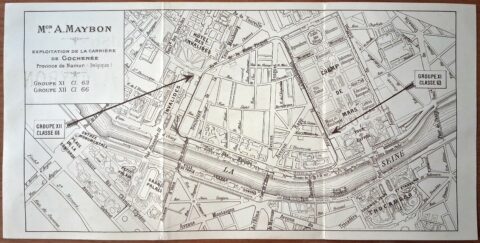
Advertising brochure for Maison A. Maybon, published for the 1900 World’s Fair in Paris. Private collection.
Within Group XII, Class 66—dedicated to the permanent decoration of public buildings and residences—featured, among other exhibits, Guimard’s display, which included several interior fragments, including a bedroom and its marble fireplace. A particularly well-crafted label, now preserved at the Forney Library, confirms that the fireplace was on display at Guimard’s exhibition booth.
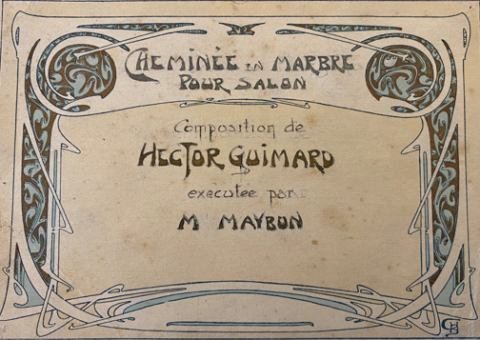
Poster for Hector Guimard’s pavilion at the 1900 World Fair. Geo Dorival Collection. Forney Library.
At Castel Béranger, the fireplaces with marble mantels from the A. Maybon company were found in the bedrooms and living rooms of the apartments. The other rooms were fitted with mantels made of glazed stoneware (produced by Alexandre Bigot) or cast iron (produced by the Durenne foundry in Sommevoire). The mantels in the bedrooms, which are fairly simple, feature classic inserts made of flat white earthenware tiles.
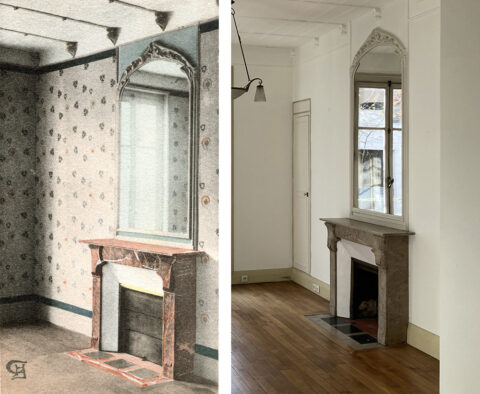
Left: View of a bedroom in the apartment at the corner of Rue La Fontaine and the Béranger hamlet, on the second floor of the Castel Béranger, Hector Guimard, *L’Art dans l’Habitation moderne/Le Castel Béranger* (Castel Béranger portfolio), pl. 35 (detail), Librairie Rouam, 1898. Private collection.
Right: view of a bedroom in an apartment on the first floor of Castel Béranger featuring a marble fireplace with a narrower section clad in earthenware tiles. Photo by F. D.
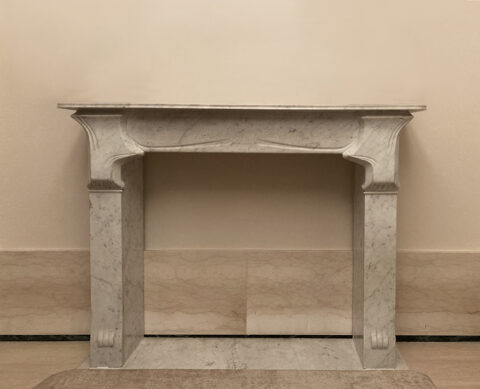
A marble mantelpiece modeled after those in the bedrooms of Castel Béranger, acquired by Hector Guimard Diffusion. Photo and computer graphics by F. D.
This design is also featured in the rooms of Castel Val, with a unique twist: the color of the marble varies from room to room. To the best of our knowledge, this 1904 building by Guimard is the last to feature this fireplace design from the Castel Béranger period.
Apart from this building, perhaps for an exhibition, Guimard experimented with creating a narrowing effect using three flat plates of glazed lava.
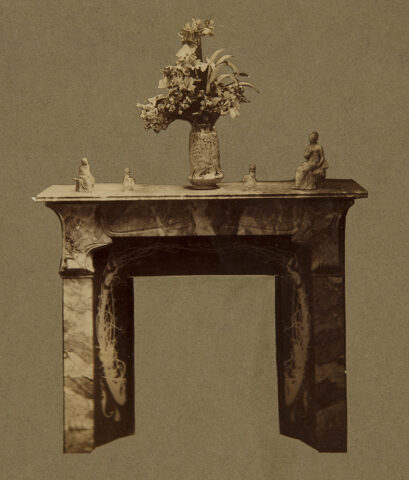
Marble fireplace modeled after those in the bedrooms of Castel Béranger, with a narrower section featuring glazed lava stone panels. Bibliothèque des Arts Décoratifs, donated by Adeline Oppenheim-Guimard, 1948. Photo by Laurent Sully Jaulmes (detail).
Significant fragments of this glazed lava vessel have been recovered and are now in a private collection.
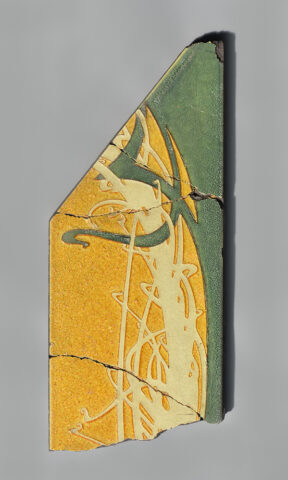
A fragment of the glazed lava trim from a fireplace typical of the bedrooms at Castel Béranger. Private collection. Photo by F.D.
The fireplaces in the living rooms, which are more elaborate, feature a cast-iron or glazed terracotta insert crafted by Gilardoni & Brault.
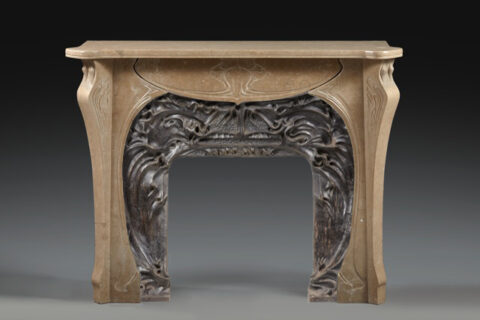
A marble fireplace model from Castel Béranger with a bronze-finished cast-iron insert by Durenne. Collection of the Saint-Dizier Museum. Photomontage created using photographs from the Auction France sale of the former Plantin collection, September 2015.
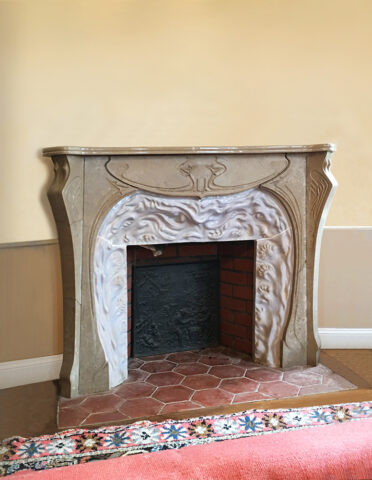
Castel Béranger-style marble fireplace with a glazed terracotta insert in the living room of Castel Val (1903). Photo and computer-generated image by F. D.
Presumably to save money, the decorative elements on these two marble mantelpiece designs from Castel Béranger are primarily engraved in grooves. Guimard reused them for several years in other buildings. At the same time, however, he also used wood for a mantelpiece (at Castel Val) and, most notably, from around 1900 to 1908, glazed lava, which allowed him to add color to these mantelpieces in a subtle way.
However, the appeal of carved and engraved marble remained strong, and around 1904, new designs emerged in line with the evolution of his style. Those at Castel d’Orgeval are very simple and feature flat earthenware panels for the insert.
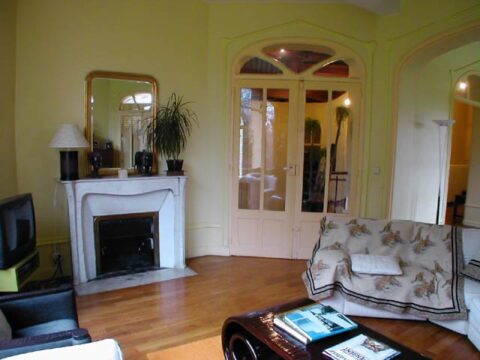
Living room at Castel d’Orgeval. Photo from a real estate agent. All rights reserved
Depending on the budget allocated and the room in which they are located, the mantelpieces in other homes vary in opulence.
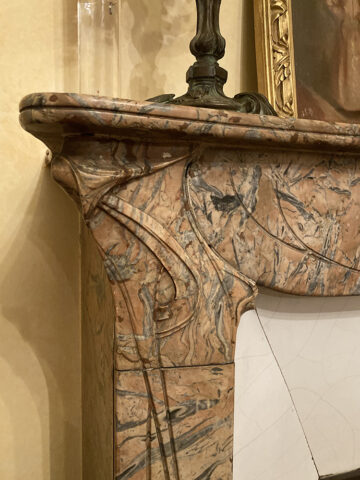
Fireplace on the ground floor of the villa on Rue Jean Doyen in Eaubonne (c. 1907–1908). The mantelpiece is made of simple flat ceramic tiles. Photo by F. D.
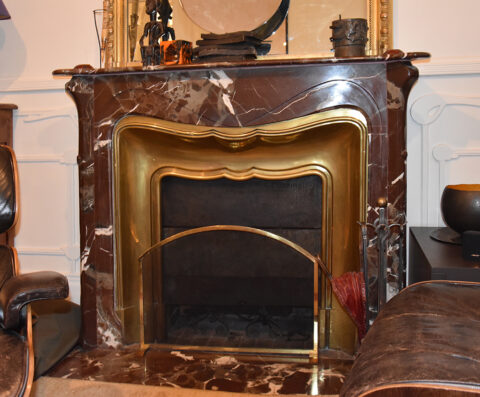
Marble mantelpiece with a brass insert at the Deron-Levent Hotel (1907–1908), 8 Villa de La Réunion, Paris’s 16th arrondissement. Photo by F. D.
These marble mantelpieces foreshadow the designs that appeared in the drawings featuring the standard sizes listed in the *Fontes artistiques de Guimard* catalog, published by the Saint-Dizier foundry in 1908. These standard sizes, designed to fit the most common mantelpiece models on the market, are presented across three plates, two of which bear the following note: “The marble can be obtained from: Société Anonyme des Usines et Carrières — Devillers et Cie — Marpent (Nord)[3].” On these plates, Guimard shows four different mantelpiece models adapted to three groups of inserts. The tallest and widest are the GA and GC, which are the same size (96 cm high and 110 cm wide). The GB model is of intermediate height and width (93 cm high by 100 cm wide).
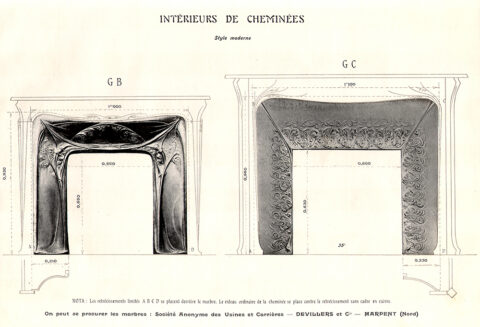
GB and GC chimney flue inserts, from the catalog of Guimard’s Artistic Cast Iron Works, Saint-Dizier Foundry, plate 61. Private collection.
As for the GI, GH, GG, and GE series, they are all the same height (90 cm), and their width increases by 5 cm with each model (from 75 to 90 cm).
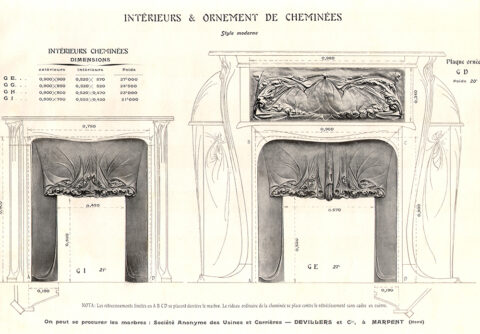
GI and GE chimney inserts, from the catalog of Guimard’s Artistic Cast Iron Works, Saint-Dizier Foundry, plate 62. Private collection.
For this final series, Guimard also designed a more monumental mantelpiece model featuring an ornate cast-iron panel at the top. The *Fontes Artistiques* catalog presents it in the widest GE model (above), but we also know of a narrower version with the GI insert (below).
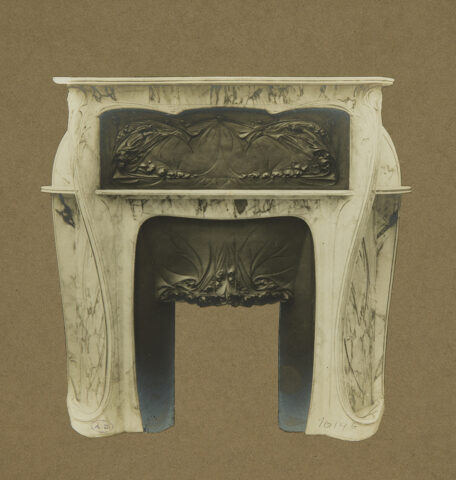
Marble fireplace with a GI-style insert and a GD-style decorative panel. Bibliothèque des Arts Décoratifs, donated by Adeline Oppenheim-Guimard, 1948. Photo by Laurent Sully Jaulmes (detail).
But it soon becomes clear that the fireplace mantel designs shown in the plates of the artistic cast iron catalog are merely illustrative, as Guimard created a wide variety of different models. For example, within the GI, GH, GG, and GE series of narrower designs, we know of another mantel model that was actually produced (though its location is unknown) and is, in contrast, extremely simple.
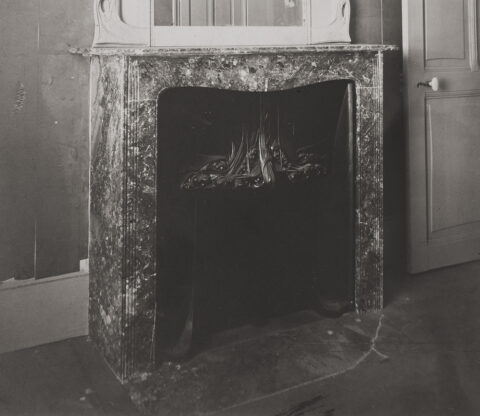
Marble fireplace with a GH-style insert, photograph taken in Guimard’s workshops at 12 Avenue Perrichont-prolongée. Bibliothèque des Arts Décoratifs, donated by Adeline Oppenheim-Guimard, 1948. Photo by Laurent Sully Jaulmes (detail).
For a GC insert, Guimard also designed a model for a mantel featuring bronze brackets at the corners.
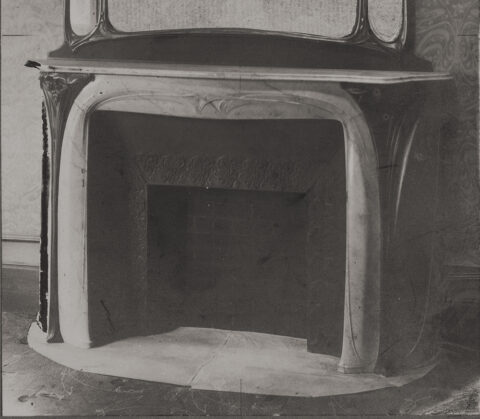
Marble fireplace 1017 with a GC insertt and bronze brackets, photograph taken in Guimard’s workshops at 12 Avenue Perrichont-prolongée. Bibliothèque des Arts Décoratifs, donated by Adeline Oppenheim-Guimard, 1948. Photo by Laurent Sully Jaulmes (detail).
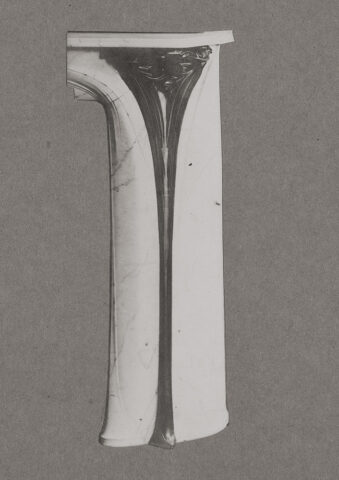
Detail of the bronze brackets on the marble mantelpiece 1017. Bibliothèque des Arts Décoratifs, donated by Adeline Oppenheim-Guimard, 1948. Photo by Laurent Sully Jaulmes (detail).
This fireplace, numbered 1017, was installed in the living room of the Hôtel Guimard on Avenue Mozart. It is, in fact, the only fireplace in the hotel, as Guimard opted for central heating to save space in the modestly sized rooms of this very small property.
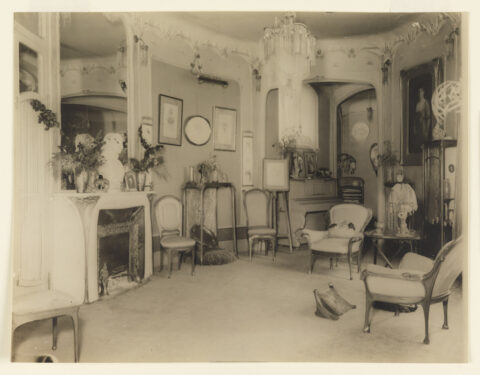
Old photograph of the living room at the Hôtel Guimard, 122 Avenue Mozart, featuring the 1017 fireplace. Cooper-Hewitt Museum, New York, donated by Adeline Oppenheim-Guimard. All rights reserved.
Another document is likely a photo montage featuring a cutout from a retouched photo of a marble coat model, superimposed on a photo (itself cut out) of a GC insert.
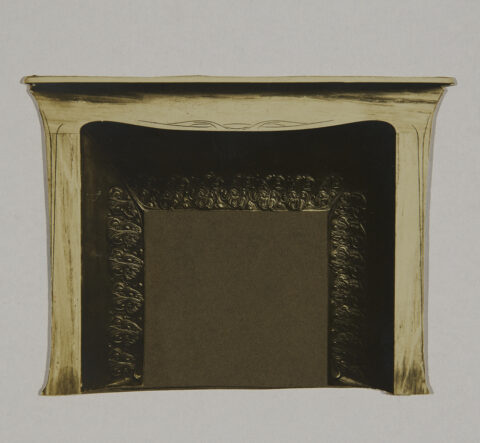
Probable photo montage of a mantelpiece on a GC insert. Bibliothèque des Arts Décoratifs, donated by Adeline Oppenheim-Guimard, 1948. Photo by Laurent Sully Jaulmes (detail).
For GB inserts, the marble mantels have also presented with variations.
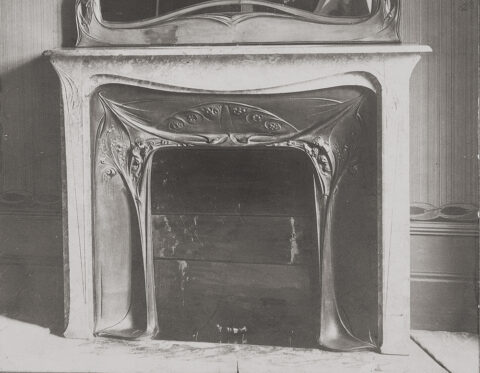
Marble fireplace 1013. Bibliothèque des Arts Décoratifs, photograph taken in Guimard’s studios at 12 Avenue Perrichont-prolongée, donated by Adeline Oppenheim-Guimard, 1948. Photo by Laurent Sully Jaulmes (detail).
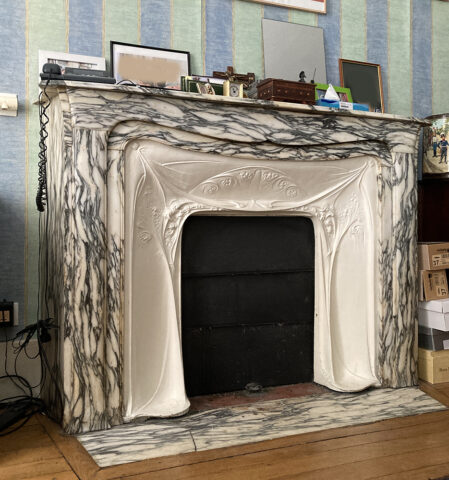
Fireplace with a GB insert in an apartment in the Trémois building (1909–1910). Photo by F.D.
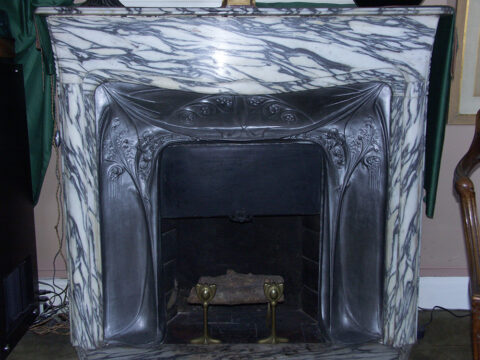
Fireplace with a GB-style insert, in an apartment at 17 Rue La Fontaine (1909–1911). Photo by F. D.
Among the photographs donated by Adeline Oppenheim to the Bibliothèque des Arts Décoratifs in 1948 is another mantel design with a refined silhouette that may have been photographed as a plaster model during the design phase.
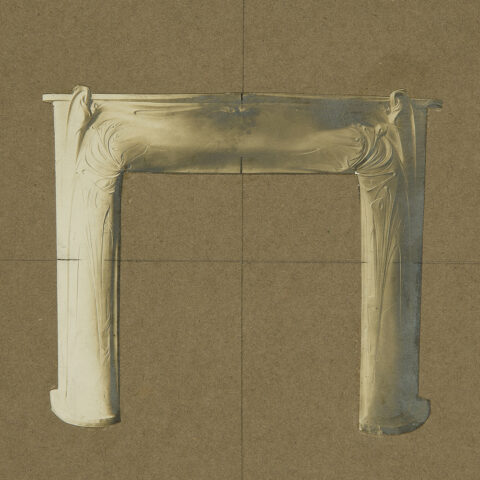
Probably a plaster model for a marble mantelpiece. Bibliothèque des Arts Décoratifs, donated by Adeline Oppenheim-Guimard, 1948. Photo by Laurent Sully Jaulmes (detail).
These photographs, donated by Adeline Oppenheim-Guimard, are mounted on a sheet of heavy paper on which Guimard handwrote the model’s name and assigned it a number. This presentation suggests that he was planning to produce a catalog of fireplaces, just as he was considering others: chandeliers, hardware, mirror frames, vases, furniture, cutlery, and even tombs, for which the stonework would necessarily have to be commissioned from stonemasons. Most of these catalog projects never came to fruition, but they stand as an important testament, on the one hand, to Guimard’s desire to expand the scope of his creations almost infinitely, and on the other, to his wish to make them accessible to as many people as possible through mass production. On the eve of World War I, he was thus at the helm of a vast array of designs suitable for furnishing rental properties—whether modest or luxurious—as well as private mansions, all while maintaining tight control over the costs of their furnishings.
It is also worth noting that for his marble fireplaces, Guimard once again called upon contractors from northern France, as he did for the mosaics in the vestibules and halls of the Castel Béranger (De Smet in Lille), the earthenware versions of the Chalmont planters (De Bruyn in Lille), and the rugs and carpets (Honoré Frères and later Parlant & Biron in Tourcoing).
One cannot help but suspect the existence of a network of connections of which Louis Coilliot, the Lille-based ceramics dealer and client of Guimard, was likely a part.
Another telling sign that Guimard was closely connected to the marble industry is that in early 1908, just as the catalog of artistic castings published by the Fonderie de Saint-Dizier was about to be released, an unsigned article appeared, purportedly covering the 1907 Salon des Artistes Décorateurs but in fact devoted almost entirely to commenting on Guimard’s exhibition at that salon. No doubt due to a lack of access to the major decorative art journals of the time, which typically excluded the architect, it ended up in an obscure trade journal for the marble industry. This text offers a eulogy of the “Guimard Style” with an enthusiasm its creator had never enjoyed, not even when it was in vogue. The praise is so effusive that if Guimard was not the author himself, he must have firmly guided the writer’s pen and provided all the necessary arguments.
After the war, there is no evidence that Guimard created any new fireplace designs. In all areas of his work, he continued to reuse his older designs while occasionally—though rarely—creating new ones. The list of businesses at the Village Français town hall, built for the 1925 Exposition of Modern Decorative Arts, includes a fireplace manufacturer, the Société Industrielle des Pyrénées, but it is unlikely that Guimard designed a model specifically for this occasion. He continued, however, to use this heating method, as fireplaces are still present in a prestigious building such as the one at 18 Rue Henri Heine (1926), where the Guimards lived from 1930 to
Frédéric Descouturelle
with the participation of Olivier Pons
Notes
[1] Its origins can even be traced back to Jules Hardouin-Mansart’s renovation of Louis XIV’s apartment at the Grand Trianon in the late 17th century. [2] Originally from Belgium, Albert Maybon’s marble company operated a quarry in Flaumont-Waudrechies, in the Nord department, in 1900. (source: Burgundy-Franche-Comté Regional Inventory). At the Paris World’s Fair, the company, representing Belgium, exhibited two marble columns from the Gochenée quarry near Namur (source: official exhibition catalog, Group XII, Class 66, fixed decoration of public buildings and dwellings). [3] The Société anonyme des usines et carrières Devillers et compagnie was a Belgian company founded in 1893 and operating in Marpent (Nord). This company is cited by Guimard in a letter published by La Construction Moderne in 1913 as one of the companies that made the greatest sacrifices to market the models designed by Guimard. It was dissolved in 1910 (National Archives of the World of Work). However, it likely continued under a new name, as the Société des carrières et marbreries de Marpent took it over in 1927 (Hauts-de-France Inventory, Presentation of the Municipality of Marpent).Translation: Alan Bryden
Hector Guimard’s hardware fittings — Part One: the locks and doorknobs of Castel Béranger
All photos belonging to the authors or to the Cercle Guimard Archives and Documentation Center must be approved by the Cercle Guimard in the event of a publication project, regardless of the medium
After compiling an inventory of the hardware fittings at the hôtel Mezzara and requesting an auction house that a new misattribution to Hector Guimard [1] be removed, we wanted to summarize what we know about the hardware fittings created by the architect. Our knowledge of this subject has progressed in recent years, but we may modify this article in the future. Despite the uncertainties that remain, we have chosen to work chronologically and by manufacturer. This study will eventually be included in a book devoted to Guimard’s fixed decorations.
During his early period of architectural creation, i.e., before Castel Béranger (1895-1898), Guimard does not seem to have created any specific hardware designs, unlike what he had done for his ceramic decorations produced by Muller & Cie[2]. He therefore used those available in the manufacturers’ extensive catalogs, simply avoiding historical styles.
The first “Guimard” models therefore appeared with Castel Béranger, his first modernist building, for which he insisted on designing every detail, taking on both an artistic and industrial challenge. In fact, apart from the hinges on the doors and cupboards, none of the hardware in Castel Béranger came from a pre-existing commercial catalog designed by an anonymous industrial artist. As with the other fixed decorative items (ceramics, fireplaces, moldings, wallpaper, Lincrusta-Walton, etc.), the number of apartments to be furnished (36) was sufficient to justify the financial investment in creating new designs.
As evidenced by the list of contractors provided by Guimard in the introduction to the Castel Béranger portfolio[3], the company chosen was the prestigious Maison Fontaine, which, in its current communications, claims to be the oldest artistic locksmith’s in Europe. It was founded in 1740 by Mr. Lavollée at 269 Rue Saint-Honoré in Paris, then taken over in 1842 or 1846 by François and Joseph Fontaine, moved in 1854 to 13 Rue Molière, then in 1866 to 181 Rue Saint-Honoré in Paris, where it is still located today. Through successive ownership changes and shareholder changes, it has had various names: Fontaine et Quintart in 1889, then H. E. et L. Fontaine in 1891, Maison Fontaine H. E. & L. Fontaine in 1895, and finally Maison H. et L. Fontaine frères et Vaillant in 1899[4]. When the Castel Béranger portfolio was printed in 1898, Guimard still referred to the company as “H. et L. Fontaine.”

Hector Guimard, L’Art dans l’Habitation moderne/Le Castel Béranger (portfolio of Castel Béranger), table of plates (detail), Librairie Rouam, 1898. Private collection.
Two years later, on the occasion of the World Exhibition in Paris, in August 1900, Fontaine published an extract from its catalog featuring numerous modern designs.
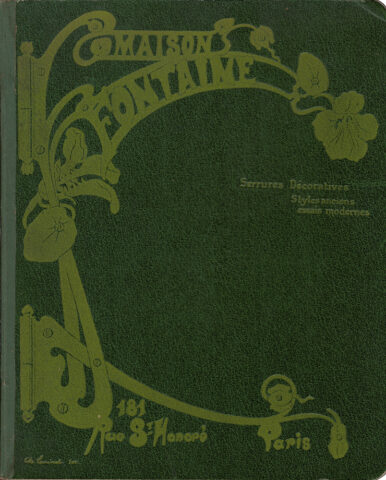
Cover of the Fontaine catalog published in August 1900. “Maison Fontaine/Decorative locks/Antique styles/Modern designs/181/Rue St-Honoré/Paris.” Private collection.
The first page gives the name of the company, which was then “Fontaine Frères & Vaillant,” and mentions the presence of the factory and modeling workshop in Boulogne-sur-Seine.
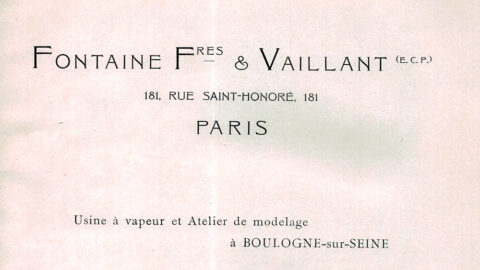
First page of the Fontaine catalogue (detail) published in August 1900. Private collection
On an invoice from 1912, the company name was simplified to “Fontaine & Vaillant.” For convenience, we will refer to the company as Fontaine in the rest of this article.
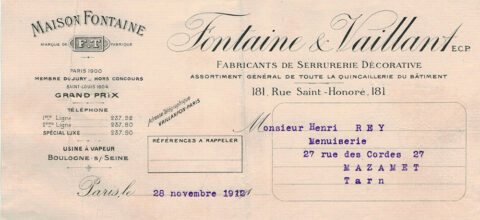
Letter head of an invoice by the Maison Fontaine, dated 28 November 1912 Private collection
A detail of this header shows the “F.T” mark constantly used by the Fontaine company, which had been acquired from the Fromentin company when its business was bought out.
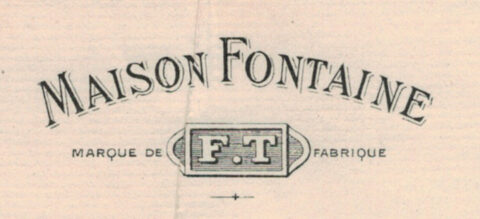
Detail of a header of an invoice by Maison Fontaine, dated 28 November 1912. Private collection
On commercially available parts, the “F.T” mark appears in the form of a plate similar to that on the header, or as a stamp.
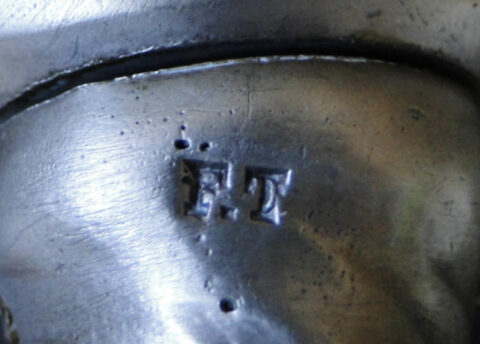
Stamp « F.T » on the handle of an Eriksson espagnolette edited by Fontaine Private collection
At the time of Castel Béranger, although the serial production of models for this building implicitly foreshadowed their reuse by Guimard for other contemporary buildings[5], the architect did not envisage publishing them in a catalog. He made an exception for the surface-mounted lock model that appears in the August 1900 extract from the Fontaine catalog.
This lock appears on plate 585 alongside other modern models. Five of them are by Alexandre Charpentier, who applied his talent as a medalist to rectangular surfaces. Three others were designed by Christian Eriksson, including two double lock models. One of them, entitled La Curiosité (No. 214), features a highly detailed, figurative, even symbolist decoration.

Plate 585 from the Fontaine catalog excerpt, August 1900. Private collection.
In contrast, Eriksson’s lock No. 244 is much simpler, as four mounting brackets are arranged around standard parallelepipedal steel safe and strike plate models.
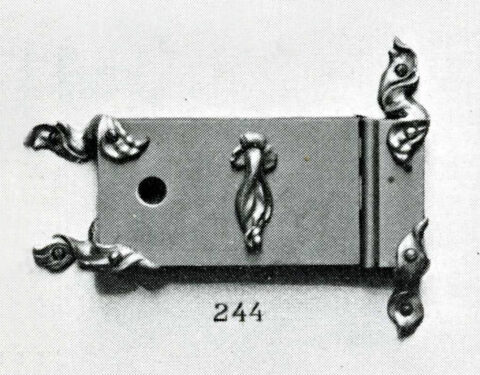
Christian Eriksson, lock n° 244, pl. 585 extract of the Fontaine catalogue, August 1900. Private collection
These spark-shaped brackets bear a strong resemblance to those created by Guimard for a similar lock model, listed in the Fontaine catalog with a later number (No. 276). Guimard’s, which are simpler, appear to be made of a malleable material that was applied and twisted by hand onto the lock and woodwork[6]. As for the door cover, it gives the impression of hanging from its fixing point.
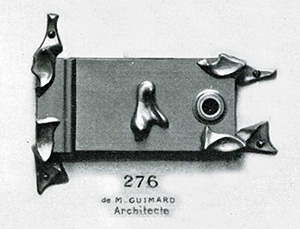
Hector Guimard, lock n° 276, pl. 585 extract from the Fontaine catalogue, August 1900. Private collection.
In the Castel Béranger portfolio, Guimard presents a colored version of his lock. The box and strike plate appear bordered by a gold trim that matches the color of the brass mounting brackets[7].
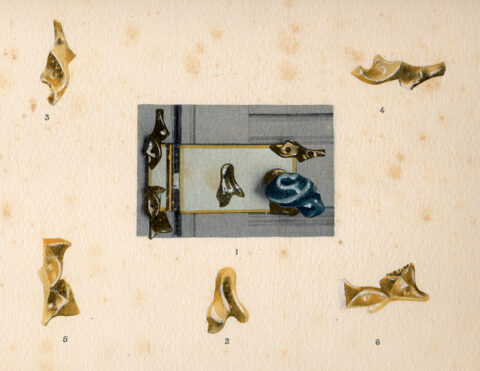
Hector Guimard, L’Art dans l’Habitation moderne/Le Castel Béranger (portfolio of Castel Béranger), pl. 56 (détail), Librairie Rouam, 1898. Private collection
These brackets appear to hold the lock in place, but in reality, they serve little more than a decorative purpose, as the safe and strike plate are actually secured to the door frame by sturdy screws that are not visible.
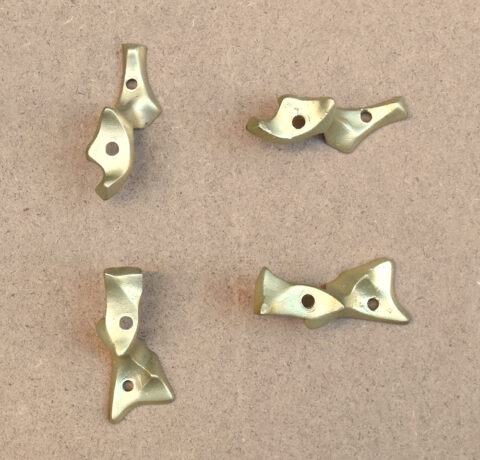
Stripped mounting brackets from Guimard lock no. 276, brass. Private Collection
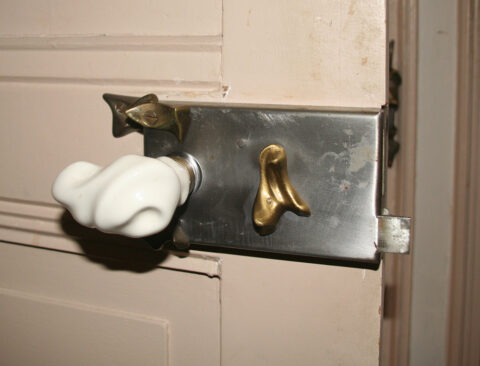
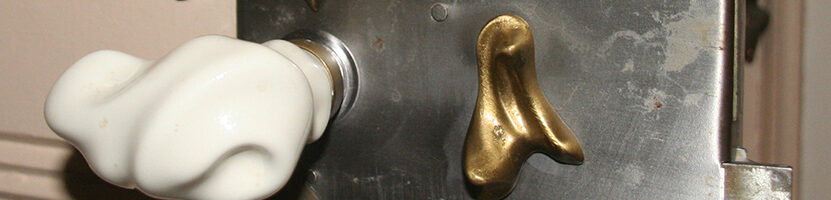
Guimard lock no. 276 with mounting brackets and entrance cover at Castel Béranger. The porcelain doorknob is a modern replica. Photo by Ondine Schneider.
For these locks at Castel Béranger, Guimard created a porcelain knob design in two colors: white and blue.
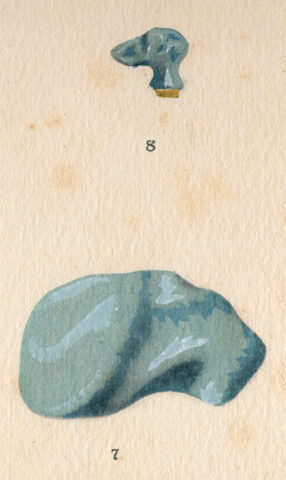
Hector Guimard, L’Art dans l’Habitation moderne/Le Castel Béranger (portfolio du Castel Béranger), pl. 56 (detail), Librairie Rouam, 1898. Private collection.
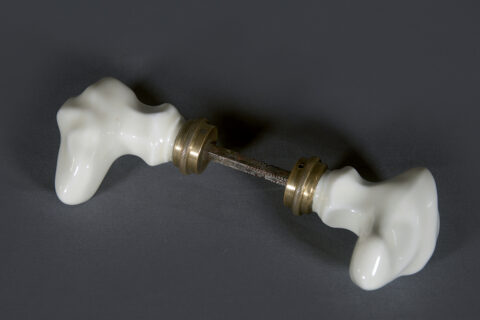
Two Guimard/Sauzin doorknobs, marked “S” and “Z” under the ferrule.
Private collection. Photo F. D.
These buttons were produced by Sauzin[8] but were not sold outside of Guimard’s orders. Sauzin was a fairly old company at the time, as two patents were filed in 1868 for a porcelain tap and a ceramic kiln, at two different addresses in the 10th arrondissement of Paris. The production plant already existed in Montreuil-sous-Bois in 1875, before going bankrupt in 1876. Twenty years later, in 1896—at the time of the construction of the Castel Béranger—Charles Sauzin filed a patent for a double knob with a claw and locking screw, which could not be removed. The company headquarters had then moved to 16 rue de la Folie-Méricourt in the 11th arrondissement. Louis Masson succeeded Charles Sauzin between 1899 and 1903, and later, the company came under the management of O. Vandenbossche, attested from 1921 onwards.
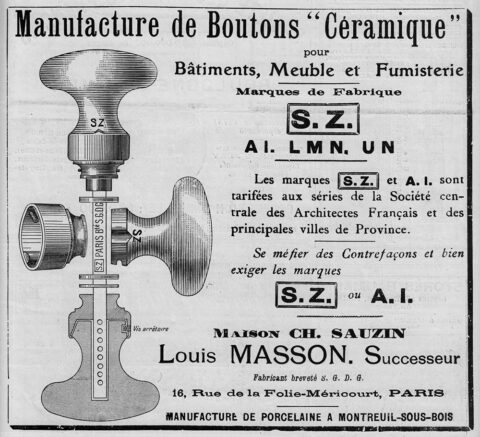
Ad for the Maison Sauzin published in La Construction Moderne 9 February 1913. Private collection.
These buttons (associated with Fontaine locks no. 276) can be found on two buildings chronologically close to Castel Béranger: Castel Henriette and the Hotel Roy. But unlike most of the other hardware items created for Castel Béranger, Guimard used them until World War I, even though they were gradually relegated from reception areas in favor of new brass door handle models. Their more innocuous form than his other creations from this early Art Nouveau period allowed them to blend seamlessly into his stylistic developments.
Guimard also had a brass (or bronze) version made for use at the Coilliot house in Lille. Due to their entirely metallic nature, it is possible that these knobs were produced by the Fontaine company.
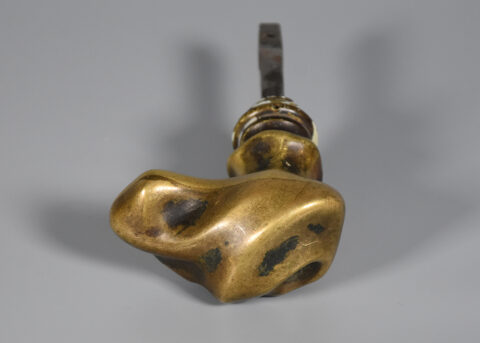
Brass (or bronze) doorknob from the Coilliot company in Lille (1898-1900). Coll. Hector Guimard Diffusion. Photo F. D.
A few years later, when fitting out buildings on Rue Gros, Rue La Fontaine, and Rue Agar, as well as the Hôtel Mezzara and then the Villa Hemsy in Saint-Cloud, Guimard wanted to market this porcelain knob. He therefore entrusted its production to another company: Paquet in Grenoble. Founded in 1872, we know about its production thanks to a catalog dated 1912, which reveals that the company specialized in metal items for the building industry. It offered only five models of doorknobs, only three of which were made of porcelain, which suggests that it probably sourced its porcelain from a subcontractor. Their assembly used the “LP mount” (probably the initials of the company’s founder), which was reputed to be indestructible. The company continued to operate at least until the 1930s.
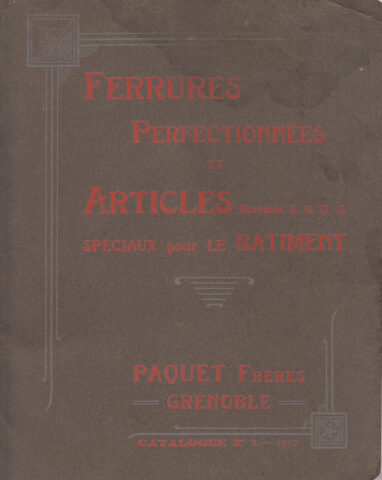
Catalogue n° 3 of the Maison Paquet in 1912, cover. Private collection.
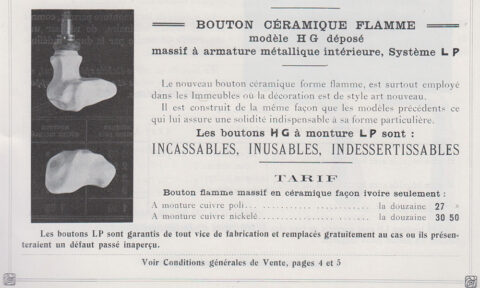
Catalogue n° 3 of the Maison Paquet in 1912, p. 63. Private collection.
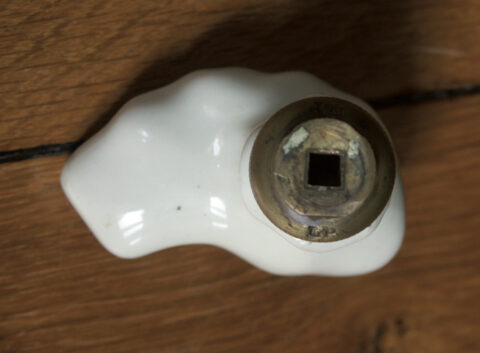
Guimard door knob /Paquet, marque « LP » on the ferrule, hôtel Mezzara. Photo F. D.
At Guimard’s request, Paquet undertook in letters dated February 22 and April 11, 1911, to refer to his knob as the “Modèle Style Nouveau H. G.”[9]. However, although the wording used in the published catalog retained the architect’s initials, the reference to “Style Nouveau” was removed. Paquet only offered it in ivory white and gave it the commercial name “flamed ceramic knob.” While this descriptive name is certainly satisfactory, the true explanation for the dynamic shape of this doorknob was not revealed until much later. In the obituary he wrote for him, published in the first issue of the magazine L’Architecture d’aujourd’hui in May-June 1945, Adolphe Dervaux, a colleague and friend of Guimard, wrote:
“So what was the doorknob supposed to be, if not an easy lever that fits in the hand? He would take a little soft clay and press his fingers into it: voilà, the doorknob! “
This experiment can easily be repeated: taking a lump of modeling clay in the left hand gives the general shape of the knob, before passing it to the right hand to imprint the thumb and middle finger. Despite its asymmetrical shape, this knob can thus be easily manipulated with both hands and used on either side of the door. With this simple hardware accessory, Guimard radically broke with tradition in the field of decorative art. Its regular presence on the art market [10] has made it one of Guimard’s best-known creations, and copies continue to be sold.
Around 1900, and undoubtedly also on the occasion of the World’s Exhibition, the Fontaine company, in addition to the catalog excerpt mentioned above, produced a portfolio, a prestigious publication bringing together some of the most beautiful models that had been the subject of collaboration.
Portfolio Fontaine M, s.d. (c. 1900). Musée Fontaine. Photo F. D.
This time, the portfolio included several Guimard designs created for Castel Béranger, including the porcelain knobs for the locks, but without mentioning the name of their manufacturer.
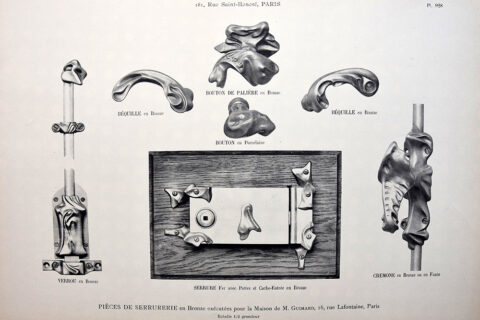
Portfolio plate Fontaine M, undated (c. 1900). Fontaine Museum. Photo F. D.
The other Guimard models featured in this illustration will be the subject of a future article.
Frédéric Descouturelle
in collaboration with Olivier Pons
We express our thanks to Christine Soulier, in charge of decorative hardware at the Maison Fontaine.
Notes
[1] See our article on Eriksson hardware.
[2] Many of the ceramic decorations in Guimard’s early villas are featured in the Muller & Cie catalog (see our article from 2020 on this subject). However, as this catalog dates from 1904, we do not know precisely when Guimard actually made his designs available to the public.
[3] Hector Guimard, L’Art dans l’Habitation moderne/Le Castel Béranger, Librairie Rouam, 1898.
[4] See the Musée d’Orsay entry on the Maison Fontaine. The initials H, E, and L refer to Henri, Émile, and Lucien Fontaine, sons of Joseph Fontaine.
[5] With the notable exception of the Villa Berthe in Le Vésinet.
[6] It would be risky to claim that Guimard simplified Eriksson’s door handles and door covers or that, on the contrary, Eriksson “enriched” Guimard’s. As we noted in our article on Eriksson’s hardware, the two artists followed parallel ideas that emphasized manual modeling; Eriksson, faithful to his training as a sculptor, remained more figurative, while Guimard was more abstract.
[7] The Castel Béranger portfolio and the Fontaine portfolio list them as being made of bronze.
[8] See Descouturelle, Frédéric; Pons, Olivier, La Céramique et la lave émaillée d’Hector Guimard, pp. 82-83, Éditions du Cercle Guimard, 2022.
[9] Adeline Oppenheim Guimard papers. New York Public Library.
[10] In the 1980s and 1990s, the prospect of easy money led the tenants of Castel Béranger to strip the building of all its doorknobs. All those currently in place are copies made around 2000 during restoration work.
Bibliography
Hector Guimard, L’Art dans l’Habitation moderne/Le Castel Béranger (portfolio of Castel Béranger), Librairie Rouam, 1898.
Fontaine catalog, “Maison Fontaine/Decorative locks/Antique styles/Modern designs/181/Rue St-Honoré/Paris,” August 1900.
Fontaine portfolio, “Maison Fontaine/181/Rue St-Honoré Paris/M,” undated (c. 1900).
Paquet catalog no. 3, 1912.
La Construction Moderne, February 9, 1913.
Dervaux, Adolphe, “Hector Guimard animateur,” L’Architecture d’aujourd’hui, no. 1, May-June 1945, p. 28.
Thiébaut, Philippe, collective work edited by, Guimard, catalog of the exhibition “Guimard” in Paris from April 13, 1992, to July 26, 1992, and in Lyon from September 23, 1992, to January 3, 1993, Paris, Musée d’Orsay/RMN, 1992.
Descouturelle, Frédéric; Pons Olivier, La Céramique et la Lave émaillée d’Hector Guimard, Éditions du Cercle Guimard, 2022.
Translation : Alan Bryden
Hector Guimard and Muller & Cie at the Castel Béranger: the end of a collaboration.
8 November 2024
As soon as they were completed in 1898, the facades of Castel Béranger caught the attention of passersby on Rue La Fontaine[1]. It must be said that their richness, both in terms of polychromy and ornamentation, was a stark contrast to the facades of the neighboring apartment buildings. At Castel Béranger, aquatic, botanical, medieval, and fantastical motifs[2] intertwine to enliven the cast iron, ceramics, and ironwork adorning the facades. This picturesque style, promoted by the public authorities at the time, even earned Castel Béranger one of the prizes in the 1898 facade competition organized by the City of Paris [3].
However, this rich decoration, which brought international fame to Castel Béranger and Hector Guimard, was not what the architect had originally planned. The elevations of the facades in the building permit submitted by Guimard in March 1895, which can currently be seen on display at the Paris Archives[4], prove this. The existence of these documents is not a discovery, as they have been known for a long time and are available for consultation. However, their high-definition scanning, carried out as part of the organization of this exhibition for the Guimard year, revealed an aborted ceramic decoration project. This was to be carried out mainly in collaboration with Muller & Cie, a company with which Hector Guimard had been working until then. Recent work by Frédéric Descouturelle and Olivier Pons, published in the book La Céramique et la Lave émaillée d’Hector Guimard[5], identifies most of the models that were to be used.
The initial Castel Béranger project
The Castel Béranger was commissioned by Élisabeth Fournier, a bourgeois woman from the Auteuil neighborhood. A widow wishing to invest her capital in real estate, at the end of 1894 she turned to the architect Hector Guimard, who also lived in the neighborhood, to build an apartment building on Rue La Fontaine.
With no constraints imposed by the client, the young architect designed a project based on the principles of Viollet-le-Duc’s rationalist school. The facade features picturesque architecture with medieval references, combined with a polychromatic effect achieved using different materials, painted cast iron and ironwork, and glazed ceramic decorations.
Before his trip to Brussels in the summer of 1895, Hector Guimard submitted the building permit for the Castel Béranger to the Paris Municipality during the second half of March[6]. This included plans for the different levels (basement plan, ground floor plan, standard floor plans, fifth and sixth floor plans) as well as elevations of the street and courtyard facades. It reveals a U-shaped building consisting of two structures organized around a courtyard, connected by a staircase. The building is aligned with the street, while the courtyard is open on the side of the Béranger hamlet.
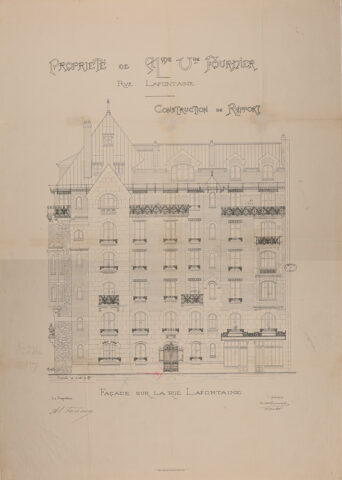
Elevation of the facade on Rue La Fontaine of the Castel Béranger, building permit, March 15, 1895, Paris Archives.
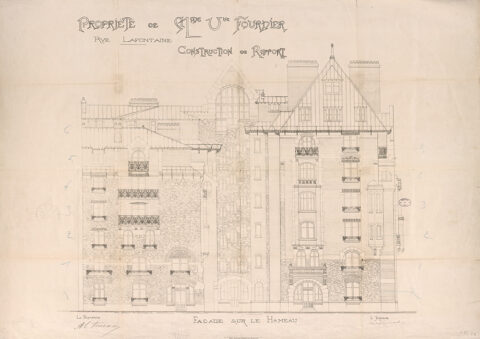
Elevation of the facade on the Béranger hamlet of Castel Béranger, building permit, March 15, 1895, Paris Archives.
These drawings from the building permit are detailed enough to give a fairly accurate idea of the design that was planned at the time. The ironwork on the railings and the entrance gate reflect an undefined style that is fairly conventional and less daring than that of the Hôtel Jassedé, built two years earlier at 41 Rue Chardon-Lagache. However, floral stylizations can be seen.
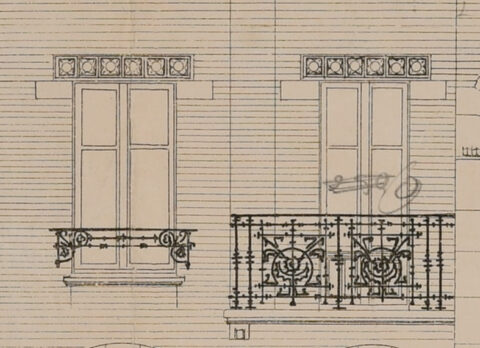
Elevation of the facade on Rue La Fontaine of the Castel Béranger (detail), building permit, March 15, 1895, Paris Archives.
The flower and leaves of the sunflower, the main motif of the Hôtel Jassedé decor, can indeed be recognized once again. It is possible that, from an economic standpoint, Guimard had planned to have the central motifs, which are repeated multiple times on the facades, made of cast iron. In any case, this is what he did in the final version of the balcony railings.
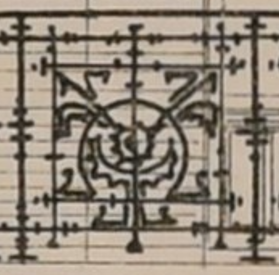
Central motif of the railings on the facades of Castel Béranger, elevation of the facade on Rue La Fontaine (detail), building permit, March 15, 1895, Paris Archives.
The ironwork on the gate is also not very inventive, with its evenly spaced vertical bars. Only at the top do two spiral motifs radiating outwards give it a more dynamic appearance.
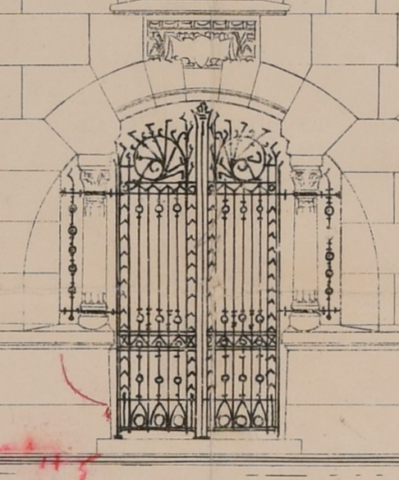
Gateway to Castel Béranger, elevation of the facade on Rue La Fontaine (detail), building permit, March 15, 1895, Paris Archives.
Above the storefronts of the two small shops in the last bays on the right, Guimard planned for a large sign to be inserted in front of a metal lintel. He designed a decoration interrupted by two smaller sign spaces placed in front of the spandrels of the first-floor windows.
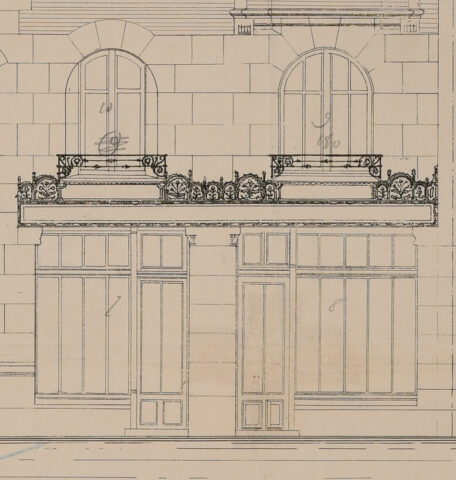
Shop on the ground floor of Castel Béranger, elevation of the facade on Rue La Fontaine (detail), building permit, March 15, 1895, Paris Archives.
This decoration is also naturalistic, with repeating floral motifs in two sizes. Probably intended to be in glazed ceramic, they appear to be framed by ironwork ending in semicircles, serrated like certain leaves, and separated from each other by floral spikes.
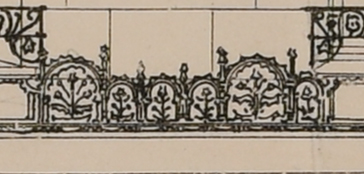
Decor of the shop sign on the ground floor of Castel Béranger, elevation of the façade on Rue La Fontaine (detail), building permit, March 15, 1895, Paris Archives.
Castel Béranger and Muller & Cie
As shown in the building permit plans, numerous ceramic elements were planned for the facades. Thanks to the book devoted to Guimard’s ceramics and glazed lava[7], several elements of the original decoration have been identified in the Muller & Cie catalogs: metopes adorning the lintels, metopes decorating the spandrels, finials and friezes decorating the vestibule. These elements, produced and marketed by Muller & Cie, were designed and used by Guimard to decorate some of his projects prior to Castel Béranger.
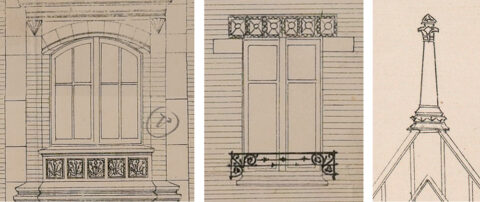
Metopes and finials designed by Guimard and produced by Muller & Cie, shown in the facade elevations of the building permit for the Castel Béranger, building permit for the Castel Béranger, facade on Rue La Fontaine (windows) and facade on Hameau Béranger (finials), March 15, 1895, Paris Archives.
In the initial project, Guimard had planned to reuse the lintel design created in 1893 for the Hôtel Louis Jassedé on Rue Chardon-Lagache[8]. As two years earlier, the metope model listed as number 13 in the second Muller & Cie catalog was to adorn the metal lintels of the windows of the Castel Béranger. The design of the facades shows that the metopes were to be enclosed in screwed iron frames, similar to the corbelled lintel of the Villa Charles Jassedé, also built in 1893.
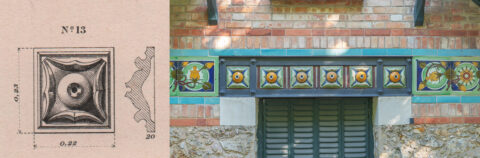
Metope no. 13 designed by Hector Guimard and published by Muller & Cie; left: Muller & Cie, metope no. 13, Muller & Cie catalog no. 2, 1904, coll. Le Cercle Guimard; right: lintel of the Hôtel Jassedé, 1893, 41 rue Chardon-Lagache. Photo N. Christodoulidis.
The model used to decorate the spandrel of certain windows is metope no. 35 by Muller & Co. It was also used at the Hôtel Jassedé to embellish the base of the building. Although its appearance contrasts sharply with model no. 13, it was indeed designed by Guimard, as evidenced by the price list in the 1904 Muller et Cie catalog, which associates each model with the name of the architect who designed it.
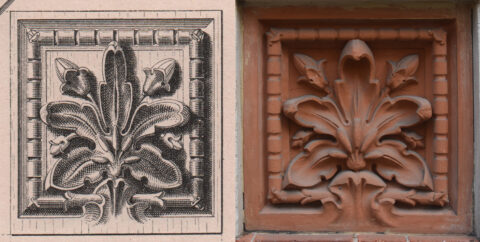
Metope no. 35 designed by Hector Guimard and published by Muller & Cie; left: Muller & Cie, metope no. 35, Muller & Cie catalog no. 2, 1904, coll. Le Cercle Guimard; right: base of the Hôtel Jassedé, 1893, 41 rue Chardon-Lagache. Photo F. Descouturelle.
As is the case today, the pavilion roof at the left end of the building bordering La Fontaine Street was to be crowned with a ridge finial. Unlike the current finial, which appears to be made of cast iron, the original was to be made of ceramic and manufactured by Muller & Co.
The lack of detail in its representation in the building permit elevations makes it impossible to identify with certainty the model that was to be used. However, we can still hypothesize that it was a new transformation of finial no. 23 designed by Gustave Raulin[9] for the schools in Ivry-sur-Seine (1880-1882).
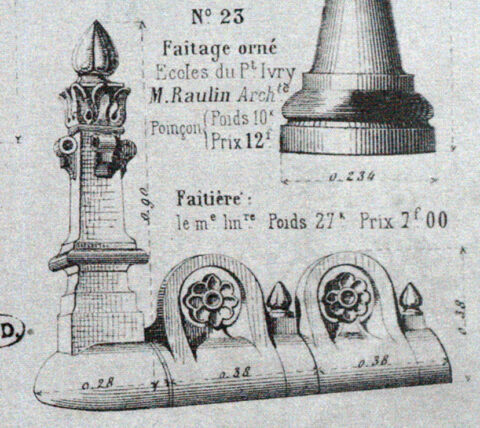
Roof finial no. 23 designed by Gustave Raulin for the schools of Ivry, Muller & Cie catalog no. 1, pl. 12, 1895–1896, coll. Bibliothèque des Arts décoratifs.
After using this model at the café-concert restaurant Au Grand Neptune in 1888, Guimard also used it to crown the roof of the Charles Jassedé villa in Issy-les-Moulineaux[10].
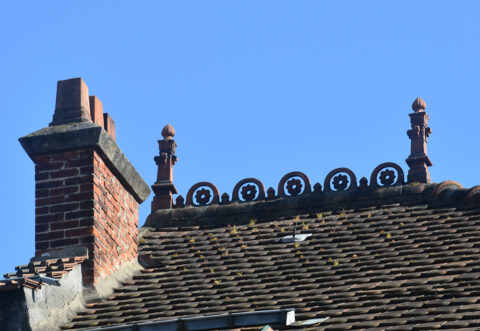
Roof of Charles Jassedé’s villa with finial no. 23 in Issy-les-Moulineaux, 1893. Photo by F. Descouturelle.
Shortly before, for the Hôtel Jassedé, he had transformed this finial by removing the side scrolls and adding scrolls taken from finial no. 22 in the Muller & Cie catalog.
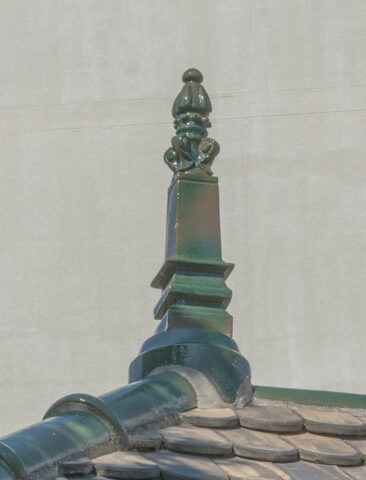
Current state of a ridge finial on the Hôtel Jassedé, 41 rue Chardon-Lagache, Paris, 1893. Photo by N. Christodoulidis.
Although seemingly quite different from this latter variant, the design of the first version of the finial for Castel Béranger bears many similarities to the original finial no. 23. Like Raulin’s model, Guimard’s design features an end that resembles a flower bud. Both prototypes feature a spread of leaves at their base. The main difference lies in the round[11], elongated section and the absence of scrolls on the shaft.
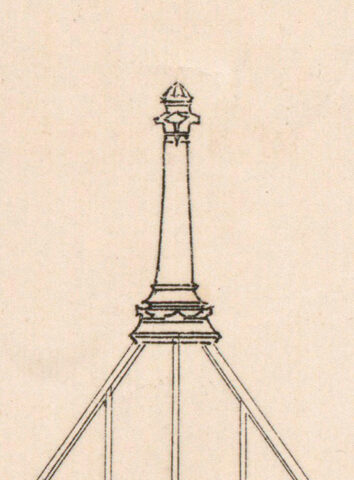
Finial of the Castel Béranger, building permit, elevation of the courtyard façade, March 15, 1895, Paris Archives.
The walls of the vestibule, meanwhile, were initially intended to feature a design very different from the current one, consisting of bubbling sandstone panels created by Bigot. In a more traditional style, the walls were to be decorated with five horizontal floral friezes. Their appearance is similar to that of the vertical cloisonné panels used by the architect in 1891 to border the windows of the veranda of the Hôtel Roszé[12]. This is the model published under No. 127 in the second Muller & Cie catalog. Guimard seems to have planned to separate these friezes with beds of glazed bricks, in the style of the vestibule at 66 rue de Toqueville in Paris, created by Muller & Cie in 1897 under the direction of architect Charles Plumet[13].
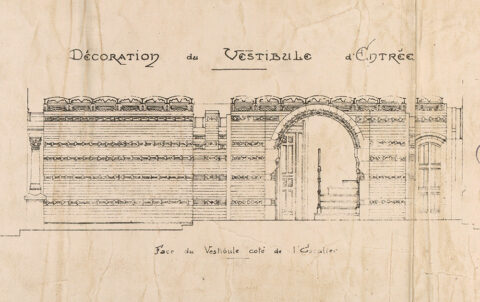
Cross-section of the vestibule and hall of Castel Béranger, building permit, undated, detail, Paris Archives
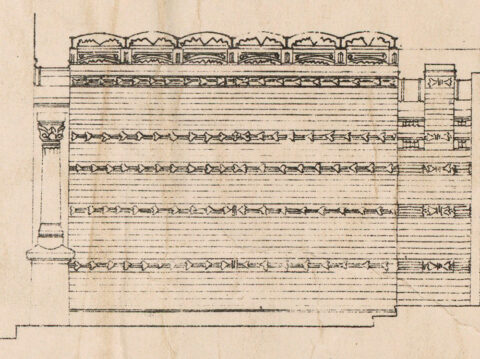
Cross-section of the entrance hall of Castel Béranger, building permit, undated, detail, Paris Archives

Panel no. 127 designed by Hector Guimard and published by Muller & Cie, Muller & Cie catalog no. 2, 1904, coll. Le Cercle Guimard.
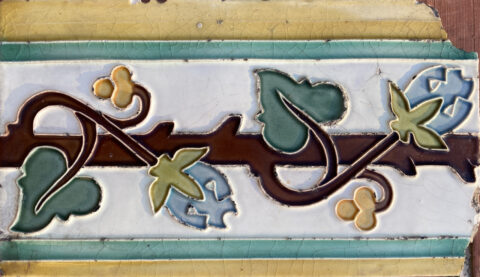
Detail of panel no. 125, cloisonné enameled earthenware, produced by Muller & Co., Le Cercle Guimard collection. Photo by F. Descouturelle.
Two tympanums and a ceramic metope model, visible on the facade elevations of the Castel Béranger building permit, have not yet been identified in the Muller & Cie catalogs. It is likely that these pieces were also to be produced by the company[14]. However, it is also possible that Guimard had already planned to commission Gilardoni & Brault to produce them.
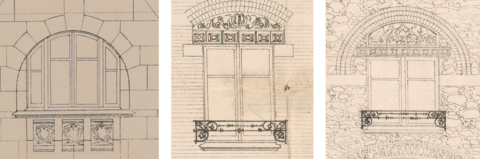
Metopes and tympanums designed by Guimard for the Castel Béranger, to be produced by an as yet unidentified company, building permit for the Castel Béranger, March 15, 1895, Paris Archives
During his stay in Brussels, Hector Guimard had the opportunity to meet architects Victor Horta and Paul Hankar, leading figures of Belgian Art Nouveau. In particular, he found in Horta’s work an integration of decoration and structure that was unparalleled elsewhere and which revolutionized his vision of modern architecture. After this trip, Guimard abandoned the figurative botanical decorations designed under the influence of Nancy[15] in favor of ornamentation that tended more toward abstraction. He borrowed the whip-like line motif from Horta, but he also drew on other, older sources[16].
Thus, upon his return to Paris, Guimard redesigned the entire interior of the Castel Béranger, following the principle of the total work of art that had so impressed him in Horta’s work. In addition to designing the elements for the decoration and layout of the apartments (wallpaper, window handles, door handles, stained glass windows, fireplaces, etc.), the architect transformed all the ornamentation on the facades and in the vestibule.
Unlike the interior design, it was impossible for the architect to modify the plans that had already been drawn up, as the structural work had begun as soon as he returned from Belgium. A careful comparison of the plans and facades drawn up for the building permit with those published in the Castel Béranger portfolio[17] reveals that the layout of the spaces and the overall volume of the buildings are almost identical. The slight notable modifications (openings, turrets, chimney stacks, volume of the courtyard side of the building) are certainly the result of the natural process of the project, leading the architect to constantly question his work. These therefore undoubtedly appeared during the drawing up of the working plans for the structural work craftsmen, probably produced before Guimard’s departure for Belgium.
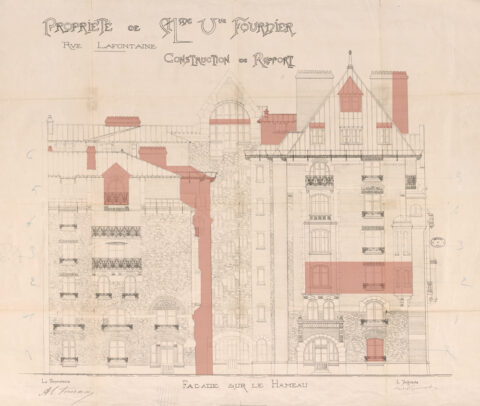
Elevation of the facade of Castel Béranger in the hamlet of Béranger, building permit, March 15, 1895, Paris Archives. Color coding of structural modifications (in red).
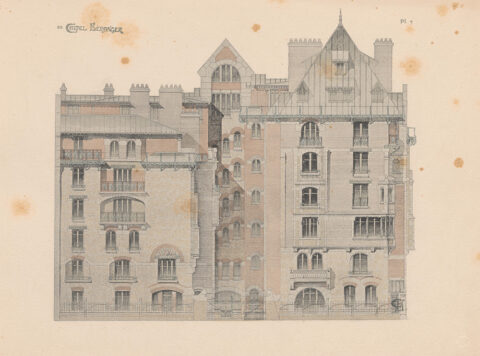
Elevation of the facade of Castel Béranger in the hamlet of Béranger, portfolio of Castel Béranger, pl. 7, 1898, ETH Library Zurich.
If we compare the drawings of the facades in the building permit application with those published after construction in the Castel Béranger portfolio, we see that all of the ironwork originally planned was replaced by alternative designs. The floral character disappeared in favor of a new style, partly abstract and partly fantastical.
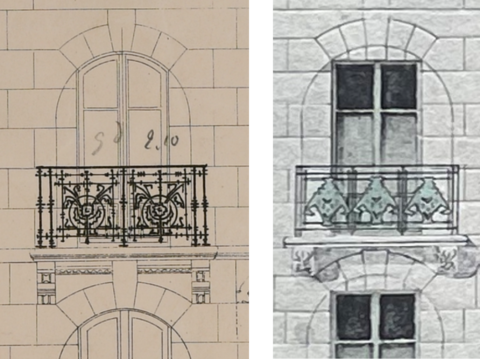
Modifications to the design of the railings; left: elevation of the facade on Rue La Fontaine, building permit, March 15, 1895, Paris Archives; right: elevation of the façade on Rue La Fontaine, Castel Béranger portfolio, pl. 2, 1898, Bibliothèque du Musée des Arts Décoratifs.
Similarly, all the ceramic decorations specified in the building permit were replaced. Guimard then ended his collaboration with Muller & Cie, even though a few months earlier he had been considering placing an order with them. This break was all the more surprising given that, until then, he had exclusively used Muller & Cie for all his projects requiring architectural ceramics: the café-concert restaurant Au Grand Neptune (1888), the Roszé hotel (1891), the Jassedé hotel (1893), the Charles Jassedé villa (1893), the Delfau hotel (1894), and the Carpeaux gallery (1894-1895). This change of suppliers benefited two competing companies. The first was Gilardoni & Brault, a tile factory which, like Muller & Cie, had diversified into architectural decoration. Metopes No. 13, produced by Muller and initially intended for window lintels…
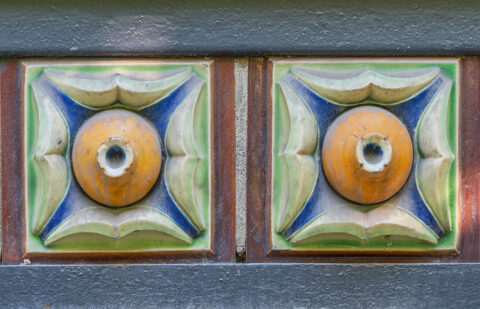
Metope no. 13 published by Muller & Cie, window lintel of the Hôtel Jassedé, 41 rue Chardon-Lagache, Paris, 1893. Photo N. Christodoulidis.
…were thus replaced by new metopes, also encased in iron blades.
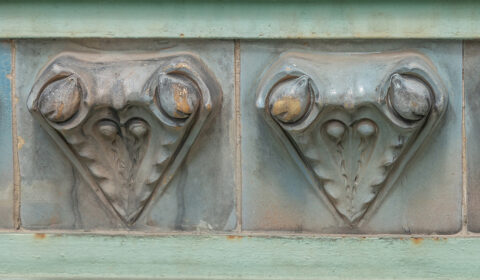
Metope probably produced by Gilardoni & Brault, window lintel from Castel Béranger. Photo by N. Christodoulidis.
As for the metopes No. 35 planned as spandrels for certain windows, they too have been replaced by new models.
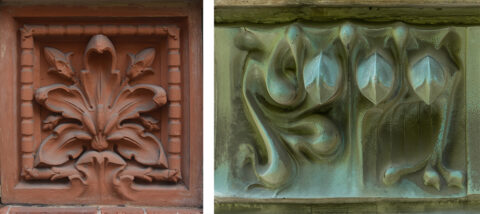
Left: metope no. 35 produced by Muller & Co. and used for the base of the Jassedé hotel (41 rue Chardon Lagache, 1893), originally intended to adorn the spandrels of certain windows of the Castel Béranger; Right: metope produced by Gilardoni & Brault, ultimately used to decorate the spandrels of some of the windows of Castel Béranger. Photos by F. Descouturelle and N. Christodoulidis.
The second company Guimard turned to was Alexandre Bigot’s, which was still new but whose reputation was rapidly growing. It worked exclusively with glazed stoneware and was firmly positioned in the modern style.
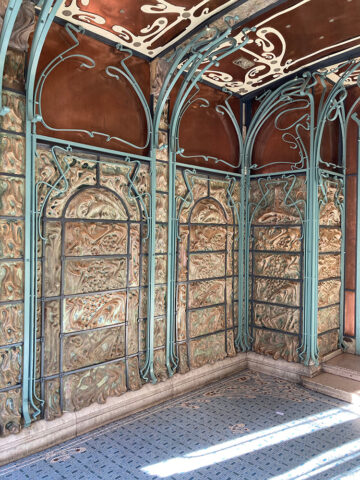
Entrance hall of Castel Béranger, glazed sandstone by A. Bigot. Photo by F. Descouturelle.
Why did this collaboration with Muller & Cie come to an end?
There is no obvious explanation for this breakup. The reasons cannot be technical, since Gilardoni & Brault offered the same types of products as Muller & Cie, available in plain terracotta, glazed earthenware, and glazed stoneware. It is also doubtful that the break was solely for stylistic reasons. While Guimard’s sudden change in style may have come as a surprise to Muller & Cie, we know from its catalogs that the company welcomed new stylistic trends and produced a considerable number of modern designs.
On the contrary, until then, Gilardoni & Brault’s products had remained rather cautiously eclectic. Could this tile factory, suddenly enamored with modernity, have “poached” Guimard? In any case, the large order for his stand at the 1897 Ceramics Exhibition[18] confirms his interest in the architect’s new style, as he did not hesitate to bear the cost of manufacturing numerous molds. For several years, the company even supported Guimard’s research into shaped pieces, particularly vases.
Other, undoubtedly more petty reasons can be put forward to explain the emergence of a disagreement between the architect and Muller & Cie. First of all, Guimard may have been annoyed by the liberties taken by the tile factory with regard to his designs. The company did not hesitate to modify some of the architect’s designs and to create new models in a similar style, undoubtedly without paying him for them[19].
From Muller & Cie’s point of view, Guimard’s previous models had probably not been as successful as expected. When Guimard, instead of continuing to amortize them at Castel Béranger, proposed to create and publish new ones, the company may have backed away from an investment it considered too risky, choosing to end its seven-year collaboration with Guimard.
Maréva Briaud, Doctoral School of History, University of Paris 1 Panthéon-Sorbonne (ED113), IHMC (CNRS, ENS, Paris 1).
Notes
[1] “Curious onlookers and astonished passers-by stopped to examine this original façade at length, so different from the surrounding houses.” L. Morel, “L’Art nouveau,” Les Veillées des chaumières, May 17, 1899, p. 453.
[2] This aspect will be discussed in a presentation at the Guimard study day organized by the Paris City Hall on December 3, 2024, and in the article that will follow.
[3] The results of the competition were not announced until 1899, and Guimard immediately had them engraved on the façade of the Castel Béranger.
[4] Guimard, architectures parisiennes, exhibition at the Archives de Paris, organized in partnership with Le Cercle Guimard, from September 20 to December 21, 2024. See also the exhibition journal available on site: Le Cercle Guimard. Exposition aux archives de Paris, no. 4, September 19, 2024.
[5] F. Descouturelle, O. Pons, “Guimard et Muller & Cie,” La Céramique et la lave émaillée d’Hector Guimard, Paris, Le Cercle Guimard, 2022.
[6] The building permit plans are dated March 10, 1895, and the facades are dated March 15, 1895.
[7] F. Descouturelle, O. Pons, op. cit.
[8] Ibid., p. 34.
[9] Hector Guimard was attached to Gustave Raulin’s studio during his studies at the École des Beaux-Arts.
[10] F. Descouturelle, O. Pons, op. cit., p. 42.
[11] The current finials on the roof of the Jassedé hotel garage are round in section. They are finial no. 4 in the 1903 Muller & Cie catalog, pl. 16, and may be the version of the model redesigned by Guimard ten years earlier.
[12] F. Descouturelle, O. Pons, op. cit., p. 31.
[13] Ibid, p. 21.
[14] Muller et Cie was able to produce any model on request.
[15] Guimard’s representations of flora are figurative but do not achieve the precision of Émile Gallé’s naturalistic drawings. They even slightly anticipate the stylizations of Eugène Grasset.
[16] See the article “Guimard and the auricular style” published on our website.
[17] H. Guimard, L’Art dans l’habitation moderne/Le Castel Béranger, Paris, Librairie Rouam, 1898. These watercolor plans are generally accurate but occasionally deviate from reality.
[18] National Exhibition of Ceramics and All Arts of Fire in 1897 in Paris, at the Palais des Beaux-Arts.
[19] F. Descouturelle, O. Pons, op. cit., p. 48.
Translation : Alan Bryden
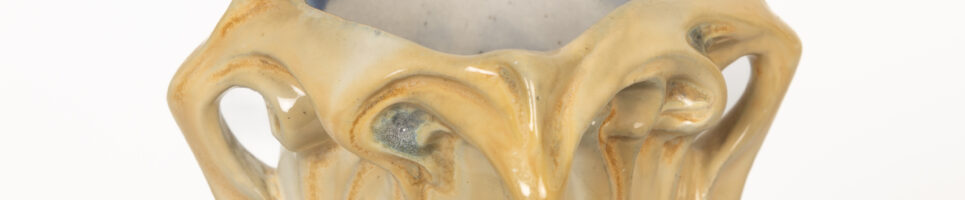
Acquisition of a previously unseen copy of a Hector Guimard’s Cerny vase
2 April, 2025
As the deadline for submitting bids for a long-term lease on the Hotel Mezzara was rapidly approaching we continued our efforts, with regard to enriching our collections. Following the purchase of a section of a candelabra and its glass cover from the metro by Le Cercle Guimard[1], it is now the turn of our partner Fabien Choné to acquire, this time at auction[2], a new work by Guimard: a period copy of the Cerny vase.
Cerny is one of three designs created by Guimard for the Manufacture de Sèvres around 1900[3]. Production spanned a decade, and our research in the institution’s archives has enabled us to estimate that no more than fifteen copies of the vase were manufactured by Sèvres during this period[4].
The appearance of an original copy of Cerny’s vase is therefore a minor event in itself, allowing us to identify and document the tenth copy to have survived to the present day. Made of glazed stoneware, it is characterized by a mustard yellow glaze enhanced by discreet blue crystallizations nestled in the hollows of the neck and highlighting its base, a color scheme that brings it closer to the examples preserved by the museums of Sèvres and Limoges.
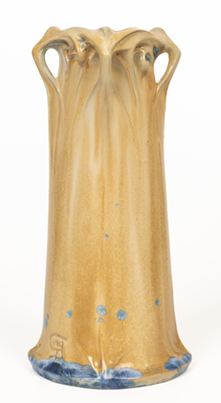
Cerny vase auctioned on 13 March 2025. Photo étude Metayer-Mermoz.
At its base is the traditional HG monogram—which adorns all of Guimard’s Sèvres productions—as well as the Manufacture’s own marks on the bottom: the triangular S 1904 stamp, which allows it to be dated, and the rectangular SÈVRES stamp.
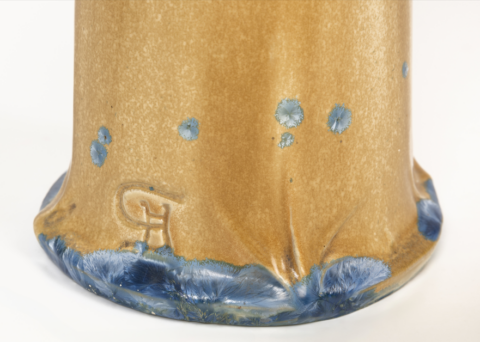
HG monogram engraved at the base of the vase. Photo étude Metayer-Mermoz.
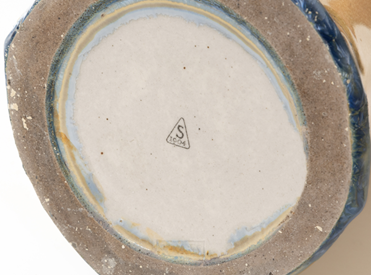
Base of the vase bearing the two marks of the Manufacture de Sèvres. Photo étude Metayer-Mermoz.
An accident in the past necessitated restoration work last year—which we will return to shortly—involving the partial reconstruction of one of the four handles forming the neck.
The originality of this vase lies in its history and provenance, which, unusually for this type of object, are known thanks to family accounts.
Through direct descent, this vase comes from the former collection of Mr. Numa Andoire (Coursegoules 1908 – Antibes 1994), a soccer player and professional coach, famous for winning the French Championship in 1951 and 1952 while coaching the Nice team, OGC Nice, as well as the French Cup in 1952.

The Nice team in 1931. On the right, Numa is standing leaning on the wall. Photo all rights reserved.
The family story has it that the vase was given to Numa Andoire in 1927 by French President Gaston Doumergue (1863-1937) during a soccer tournament held to mark the unveiling of Antibes’ World War I memorial. The monument, whose centerpiece is a statue of a soldier sculpted by Bouchard[5], was built at the foot of Fort Carré and still overlooks the football field of the same name.
The regional and local press reported on the event, which took place on Sunday, July 3, 1927, with the usual patriotic speeches, troop parades, and medal ceremonies to the sound of the Marseillaise.
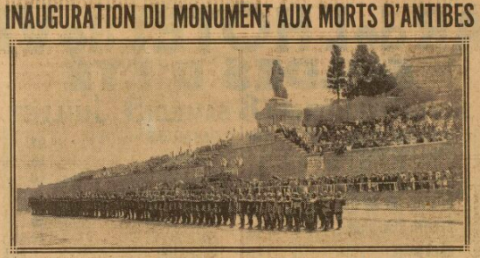
L’Excelsior 5 July 1927. Site internet BNF/Gallica
In attendance were a former undersecretary of state for war, who presided over the ceremony, a senator, a member of Parliament and a general representing the minister of defense, but no president of the republic… who was certainly represented by proxy, as is often the case for this type of event.
The presence of such a valuable Cerny vase as a gift from the state on the occasion of a relatively insignificant competition may seem surprising. But it should be seen in the context of the long (and sometimes unusual) history of generosity granted by the authorities on the occasion of cultural, scientific or sporting events. It should be remembered that the State, the sole shareholder of the “Manufacture de Sèvres”, used it primarily to provide valuable diplomatic gifts, but also a large number of art objects presented on behalf of the authorities at cultural and sporting events. World, international, and regional exhibitions were thus an opportunity to present numerous vases, statuettes, and other decorative dishes—most often with the famous blue background of Sèvres—whose size and decoration were more or less correlated with the importance of the prizes awarded to the winners, rewards that were variously appreciated by the artistic community…[6].
As for our Cerny vase, presented more than 15 years after the last one was made in Sèvres, this was probably one of the many occasions on which the State drew on the reserves of official manufacturers to award first prizes, when it was not the institutions or ministries themselves that disposed of certain acquisitions. In 1927, at a time when Art Nouveau was already well out of fashion, the authorities probably did not realize that they were offering an object that, a century later, would acquire such significant artistic and financial value.
Why did our vase become the property of Numa Andoire rather than another player? As the family story is not sufficiently clear on this point, we can only speculate. Was it to reward the short but promising career of the young prodigy player from Olympique d’Antibes, or rather to offer him a farewell gift as he completed his seventh and final season with the Antibes team before joining the Nice team? Probably a little of both… In any case, it is touching to note that this vase was kept for a long time as a family heirloom before the heirs finally decided to part with it.
This unique Cerny vase now features prominently in our museum layout project for the Mezzara hotel.
Olivier Pons
Notes
[1] https://www.lecercleguimard.fr/fr/une-verrine-en-verre-du-metro-de-guimard-pour-notre-projet-museal/
[2] Sale on March 23, 2025, Metayer-Mermoz auction house in Antibes, expert E. Eyraud.
[3] The other two forms are the Chalmont plant pot and the Binelles planter.
[4] For more information on the history of this collaboration, readers are referred to the book published in 2022 by Éditions du Cercle Guimard: F. Descouturelle, O. Pons, La Céramique et la Lave émaillée d’Hector Guimard.
[5] Henri Bouchard (1875-1960) had a studio built in 1924 at 25 rue de l’Yvette in Paris (75016), opposite the property of the painter Jacques-Emile Blanche, for whom Guimard carried out decorative work. The sculptor’s studio, which became the Bouchard Museum, closed its doors in 2007 before being transferred to La Piscine in Roubaix.
[6] One of the most famous cases is probably that of François-Rupert Carabin (1862-1932), a rebellious sculptor who, in 1912, received a blue-bottomed Sèvres vase as the “Prix du Président de la République” (President of the Republic Award), which he considered “very ugly and second-rate.” He then created a pedestal consisting of three female figures turning away in horror and exhibited it shortly afterwards at the Salon de la Société nationale des Beaux Arts in order to display it during the presidential visit. The pedestal and the vase now belong to the Perrier-Jouët collection in Épernay.
[7] In 1905, for example, the Ministry of the Navy acquired a Cerny vase that had left the Sèvres workshops a year earlier, and was therefore dated 1904, like our vase…Translation: Alan Bryden
The Epidemic of Fake Bronze Subway Surrounds in the United States – Part Three: Past and Future
A good understanding of this article requires prior reading of the two previous articles. The first one deals with the fake subway surround sold by Bonhams in New York and the second with the other fake bronze surrounds known in the United States.
Let us recall that Guimard worked for the CMP[1] from 1900 to 1902. Starting in 1903, the company used his models to equip accesses of different widths with orthogonal bottomed uncovered surrounds as well as secondary accesses, the last of which were installed in 1922. In all, 167 Guimard structures were created[2]. In 1908 the first removal of an access was recorded. Episodic in the twenties, the dismantling of Guimard accesses then multiplied and their number recorded a first peak in the thirties. After the end of the Second World War and the taking over of the CMP by RATP in 1945, removals slowly resumed in the 1950s and soared in the 1960s. A first protection order at the ISMH (historic monuments directory) in 1965 only concerned a small number of accesses and it was not until 1978 that full protection was finally granted to them. By that time, 79 Guimard accesses had been dismantled. Many of the remaining uncovered areas had their fragile portals replaced by a Dervaux candelabra. In the absence of parts in stock from the Guimard structures that had been dismantled decades ago, the maintenance of the remaining accesses necessitated, as early as 1976, the ordering of new parts made by overmoulding at the GHM foundry. This process induces a slight shrinkage of the copies due to the shrinkage of the metal during the cooling that follows casting. From 1983 onwards, a new generation of cast iron is produced with exact dimensions by creating new models in cast aluminum. It was finally in 2000 that RATP carried out a complete restoration campaign of the Guimard accesses, restoring them to the appearance they have today.
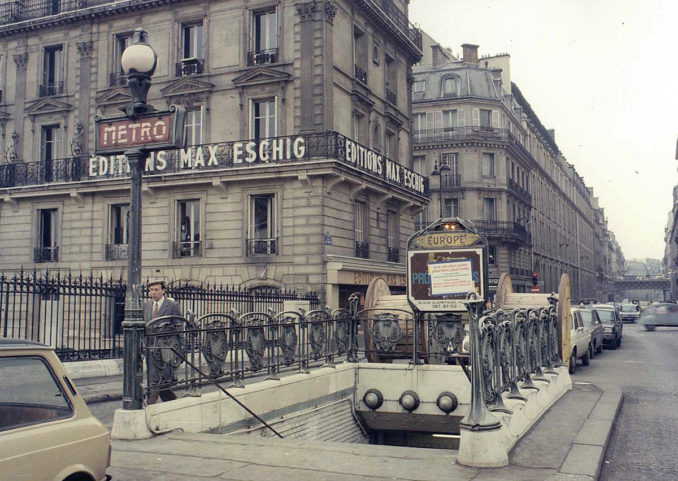
State of the surrounds of the Europe station before the restorations of the year 2000. The portal was knocked down and replaced by a Dervaux candelabrum on the left. Photo RATP.
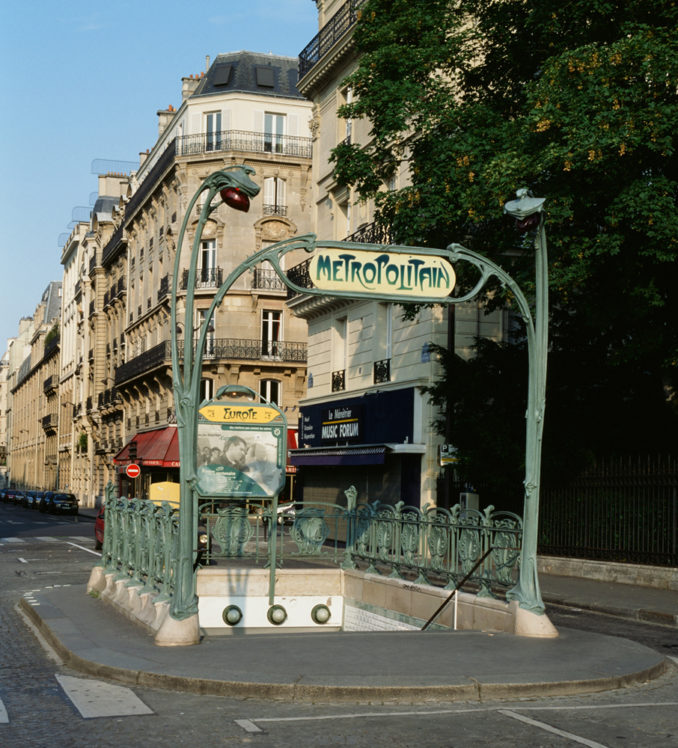
State of the surrounds of the Europe station after the restorations of the year 2000. The portal was restored using a copy provided by the GHM foundry and a new enameled lava sign provided by the Pyrolave company. Photo by the author.
Common characteristics of false bronze surrounds
All the copies of bronze surrounds discussed in our two previous articles (we exclude the one from the National Gallery of Art in Washington, D.C.) show strong similarities between them. These surrounds never include the original base stone. They are always found with an orthogonal base and never with a rounded base[3]. While the number of modules in length is variable and sometimes incomplete, the number of modules in width is always three — the most common configuration on the Parisian network— which corresponds to a hopper of about three meters and makes it possible to determine the width of a sign holder. The upper part of the sign holder of these surrounds has a slightly rounded shape, which we will come back to later but which determines an increase in the height of the sign. These surrounds never contain the original sign (whether it is made of enameled lava or red sheet metal with stencil letters), which would be expected when dismantling an old surround. In two cases, the sign is made of painted sheet metal with a discordant lettering (red sheet metal with white lettering such as the big M for Toledo; yellow sheet metal with green lettering such as the big M for the Phillips sale in New York). The Houston surround is made of two copper alloy plates, painted and riveted on an iron rim with a correct but approximate large M surround lettering. In the case of the Bonhams sale the sign is simply missing.
The detailed photos provided by the Bonhams auction house showed us the initial appearance of the painting of these false surrounds.
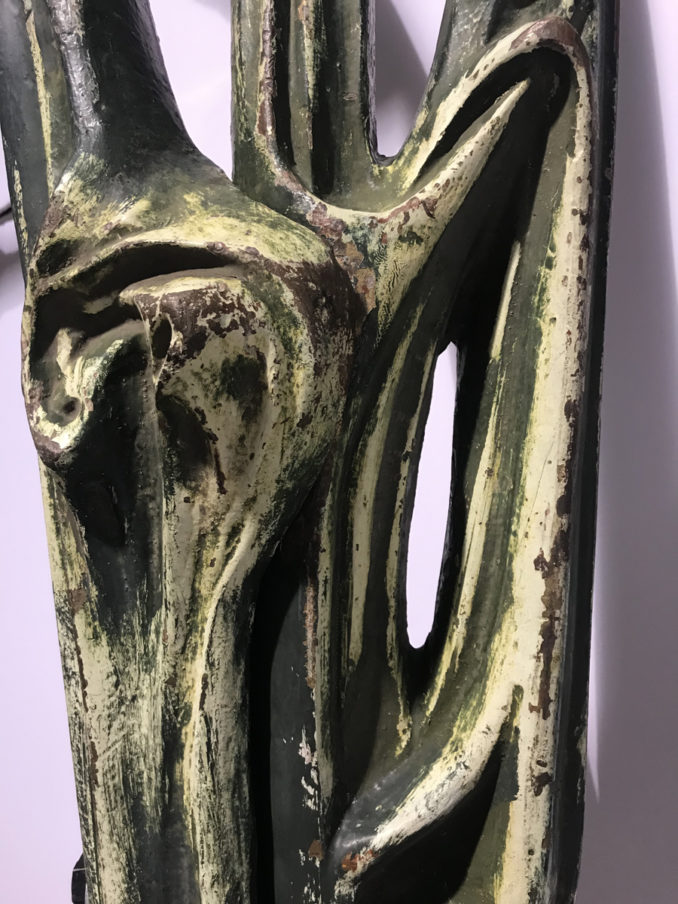
Detail of the right pillar and arch surround the Bonham sale in New York in 2019. Photo Bonhams.
But a more precise study is provided by the state report of the Houston surround written by Steven L. Pine in 2002. It mentions a first coat of burnt Sienna earth-colored paint on the bronze, then the concomitant use of a dark chrome green paint and a white paint for the reliefs. This first paint application is probably the one that prevailed for most of the false bronze surrounds since we find it almost on the corner post of the Chayette & Cheval sale in 2019. The forgers did not push the abnegation to the point of multiplying the repaints, whereas the old elements of the Paris subway have undergone over the years multiple painting before their restoration in 2000 when they were stripped and repainted[4]. For the surrounds of Toledo and Houston, exposed outside, a new, more recent painting was carried out. The one in Houston is covered with green epoxy paint enhanced with white on the reliefs.
Why bronze?