
Tag: no-auto-post
Our article on Castel Béranger appeared in the Barcelona-based magazine “coupDefouet”
10 July 2026
Published in Barcelona since 2003, the magazine coupDefouet is luxuriously produced in a large-format print edition (not available for sale) and as a PDF, which can be viewed and downloaded free of charge from the site www.artnouveau.eu . It brings together academic studies and news on Art Nouveau from around the world, with a focus on high-quality illustrations. The articles, written equally in Catalan and English, draw on the expertise of specialists in the subjects covered.
It was on the same date — 2003 — that the Cercle Guimard was founded in Paris. Unsurprisingly, the first article, ‘Hector Guimard: Logic, Harmony and Emotion’, written by Jean-Pierre Lyonnet (1952–2019), the association’s president, was published in issue no. 7 of the journal in 2006.
Shortly afterwards, a large delegation from the Cercle Guimard attended the second congress of the European Art Nouveau Route in Barcelona in February 2007. Apart from the delegates from Nancy, we were the only representatives of French Art Nouveau at the time.
Later, in June 2013, we took part in the coupDeFouet Symposium in Barcelona with a paper on ‘Guimard and ornamental cast iron’.
Finally, in 2018, we published an article entitled ‘History of the Cercle Guimard’ in issue no. 30 of the journal.
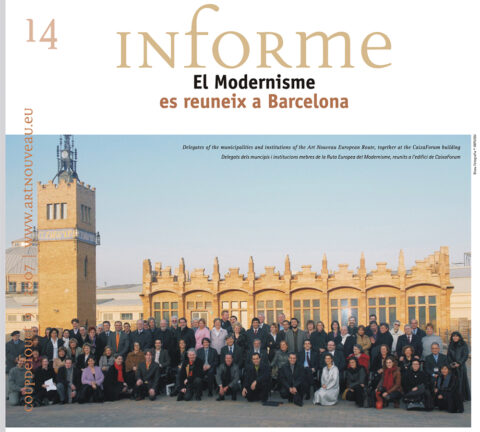
Participants at the second European Art Nouveau Route conference in Barcelona in February 2007, photographed at Josep Puig i Cadafalch’s Fábrica Casaramona (now the CaixaForum). Photo: coupDefouet No. 9, 2007.
Last year, our friend Inma Pascual, who is the editor-in-chief of coupDeFouet, asked us to write an article to mark the 130th anniversary of the start of construction of Castel Béranger – a request we were only too happy to fulfil, as it gave us the opportunity to share some new insights on the subject. The article appeared earlier this year in issue 44, spanning 12 pages with 26 illustrations.
For our readers who are not fluent in Catalan or English, we have reproduced below the text of the article, originally written in French, along with some of the illustrations.
Castel Béranger (1895–1898): a manifesto of Parisian Art Nouveau
Off the beaten track as it is situated in Paris’s 16th arrondissement, with its eclectic décor and colourful exterior and interior – seen by some as cheerful, by others as unsettling – the Castel Béranger, designed by the architect Hector Guimard (1867–1942), has been the subject of numerous articles from the time of its construction to the present day. This building — which we know well, as Le Cercle Guimard is based on the ground floor of Guimard’s former practice — continues to make us reflect on the stylistic shifts and communication strategy of an ambitious young architect with an explosive creative genius.
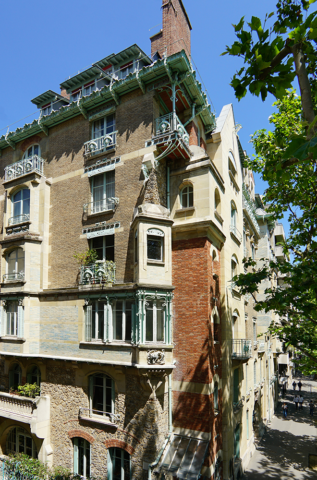
Facades overlooking Rue Jean-de-La-Fontaine and the Béranger hamlet of Castel Béranger. Photo: Frédéric Descouturelle.
Whilst he was still a student at the École nationale des Beaux-Arts in Paris from 1888 onwards, and having become a lecturer at the École nationale des Arts Décoratifs in Paris in 1891, Guimard designed small mansions in the 16th arrondissement and in the western suburbs of Paris. His style at that time was influenced by Viollet-le-Duc’s rationalism, whilst placing great emphasis on colourful, naturalistic decoration through the creation of new architectural ceramic designs produced by Muller & Cie. In 1894, Élisabeth Fournier, a widow wishing to invest her capital, commissioned him to design an investment property on a large plot of 700 m2 at 14 Rue La Fontaine. Following an initial, more modest design, the plans dated March 1895 show a building in which a medieval appearance (hence the name ‘castel’) was sought through the inclusion of gables facing the street. Furthermore, breaking with the Neo-Haussmannian style, the façades are punctuated by recesses and projections, as well as by variations in height. The planned decoration was rather restrained, both in terms of the ceramics drawn from his previous works and the ironwork. However, whilst the structural work was indeed carried out in accordance with these plans, Guimard changed the entire decoration following a trip to Belgium in the summer of 1895, where he met the architects Paul Hankar and Victor Horta.
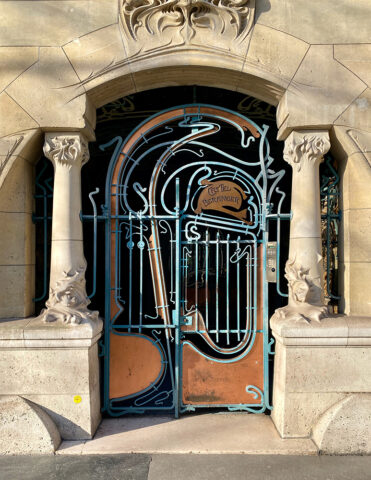
Gateway to the street-facing façade of Castel Béranger. Photo: Nicolas Buisson.
The Castel Béranger comprises two blocks of six to seven storeys, joined by a narrow wing housing the circulation corridors. The building contains 36 flats, mainly with three or four rooms, intended for the lower middle class. On the top floor are four studios featuring large bay windows and, in some cases, glass roofs, which attracted artists such as Paul Signac and Pierre Selmersheim from the very beginning. Each flat benefits from modern amenities: a functional layout, running water and a service staircase for domestic staff. However, there is no lift or car park, and probably no electric lighting as yet.
The street-facing façade features cut stone and glazed or beige brick; the façades facing the courtyard and the hamlet are clad in millstone and red brick. The view towards the inner courtyard transports the observer back to the time of its construction, as almost nothing has changed since then.
The communal areas have been meticulously finished. The entrance hall, a transitional space between the exterior and the interior, accessed via a latticework gate made of wrought iron and sinuously curved copper plates, is famous for its glazed stoneware ceramic decoration created by Alexandre Bigot’s workshop. Extending on from this, the architect – ever in search of innovation – proposed an ingenious composition of Falconnier glass bricks in a variety of shapes and colours to provide indirect lighting for the stairwell. In this total work of art, Guimard designed all the decorative elements in the communal areas and the various rooms of the flats: stair carpets, stained-glass windows, panelling, fireplaces, stucco features, fittings and even the wallpapers.
Although he had not included it in his initial plans, Guimard moved his practice from Boulevard Exelmans to the Castel Béranger by June 1897 at the latest. This space, situated on the ground floor of the building facing the street, allowed him both to remain in close contact with the building as it was being completed and to have premises befitting his new reputation. The office comprised a waiting room, a studio overlooking the Béranger hamlet—where he could accommodate several draughtsmen—and a large double room opening onto Rue La Fontaine, where he had set up his office. The practice was entirely decorated and furnished between 1897 and 1900 by the architect, who had turned it into a showcase for his early modern style, which would soon become more arborescent and elegant. Of this unique interior, which we know of from a photograph reproduced on a postcard, only a few traces remain on the walls, whilst most of the furnishings have disappeared. Around 1911, Guimard moved his practice to the ground floor of his new townhouse on Avenue Mozart.
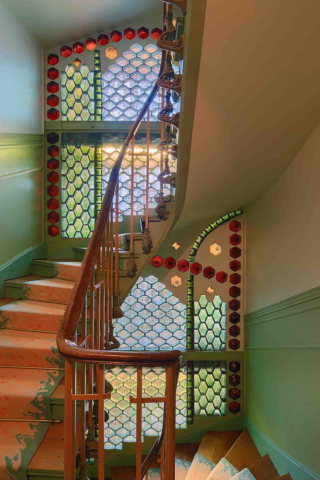
Stairwell featuring Falconnier glass blocks in the building on the streetside of Castel Béranger. Photo: Régis Colombo.
Owing to its ontogenetic significance in the development of Guimard’s works, as well as the relatively slow pace of its construction (nearly four years), the Castel Béranger features a heterogeneous décor combining two styles: the picturesque for the structural work, and Art Nouveau for the finishing touches. Many remnants of the décor originally conceived in the tradition of Viollet-le-Duc are concentrated on the structural work, but are also found on more economically produced joinery. Even the dressing table, the only piece of Guimard furniture supplied for each flat, reflects this transition. Here, it is all the fittings (tap plate, door and drawer handles, towel rail, soap dish and razor holder lids) that reflect the shift towards Art Nouveau.
The modern décor thus oscillates between a naturalistic repertoire reinterpreted with more or less imaginary underwater creatures, and a ‘satanic’ register (a cat arching its back, bats, Mephistophelean masks), semi-abstract motifs where the viewer can imagine connections with the real world, as well as completely abstract linear motifs, particularly on the ironwork and stained-glass windows. As for the three-dimensional abstract motifs, they have a fluid quality with two distinctive features that were not to last long: the visible imprints of fingers left in the modelling and affinities with the ‘auricular style’ that was in vogue in the 17th century.
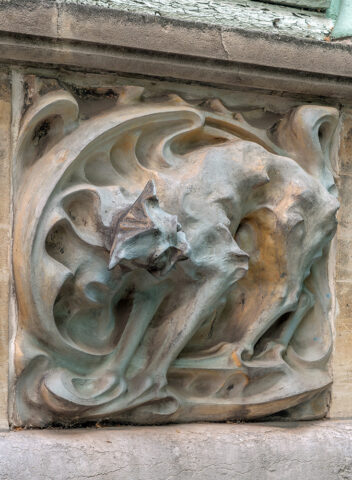
Glazed stoneware panel depicting a cat, by Gilardoni fils, A. Brault & Cie, on the oriel window at the corner of Rue Jean-de-La-Fontaine and the Béranger hamlet of Castel Béranger. Photo: Nicholas Christodoulidis.
Castel Béranger received extensive media coverage, commensurate with the decorative and architectural revolution it represented. However, whilst Guimard had planned to use all the promotional and advertising channels of the time to publicise his work, he had undoubtedly underestimated the interest it aroused from the very outset – including beyond France’s borders – and probably also the impact it had on his career, even though he could only have hoped for such an outcome. In addition to the numerous articles published by his colleagues as early as 1896 in specialist journals, and subsequently by his friends in literary and artistic magazines, there were reports in widely circulated newspapers on the results of the 1898 façade competition, in which the building was awarded first prize, followed by reports on the exhibition and lecture given by the architect in the salons of the Figaro in 1899, at a time when he was publishing a lavish portfolio of 65 colour plates to crown his endeavour.
This first major project immediately brought Guimard fame. Regarded as a seminal work that defines the ‘Guimard Style’, it embodies his principles of ‘logic, harmony and feeling’. It is also a major historical milestone, a groundbreaking work marking his decisive shift towards modernity.
Its completion in 1898 symbolised the advent of Parisian Art Nouveau, three years after the opening of Siegfried Bing’s L’Art Nouveau gallery (1895), at a time when this movement was still marginal in architecture. The Castel Béranger is now recognised as the first Art Nouveau building in Paris. Its iconic entrance has influenced generations of architects, some of whom have even gone so far as to produce veritable pastiches of it.
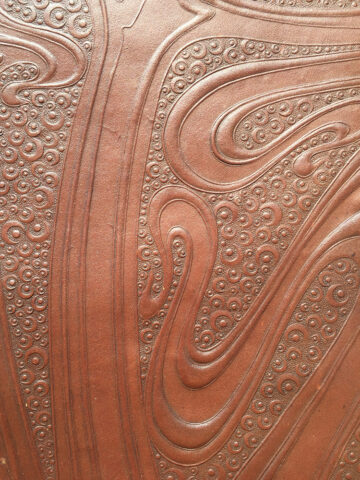
Lincrusta Walton panelling in the dining rooms of the flats at Castel Béranger (detail). Private collection. Photo: Frédéric Descouturelle.
To keep the costs of such an ambitious project under control, amongst other cost-saving measures, Guimard naturally turned to the mass production of his designs. This enabled him to recoup the expenditure incurred in creating original designs. As he had previously done with the ceramics firm Muller & Cie, he approached new manufacturers (foundries, ceramists, producers of ironmongery, wall coverings, etc.) who could mass-produce his designs so that they could be reused in other buildings. At the time of the Castel Béranger, Guimard agreed to have them featured in his suppliers’ catalogues, thereby ensuring mutual publicity. He also provided them with other designs that did not appear in the Castel Béranger. And it was with this approach in mind that he gradually set his sights on covering the entire spectrum of the decorative arts through catalogues dedicated to his personal style.
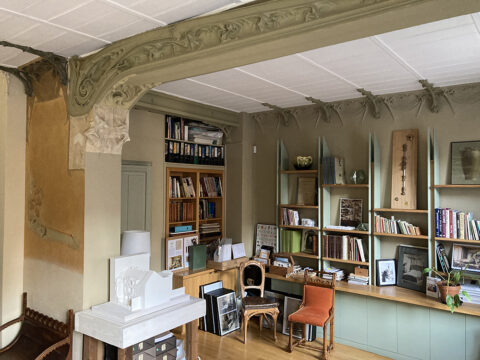
Guimard’s agency on the ground floor of Castel Béranger, as it stands today. Photo: Frédéric Descouturelle.
Once the post-war period of neglect had passed, from the 1960s onwards, the heritage value of Castel Béranger began to emerge. However, this did not prevent numerous acts of defacement, and above all resulted in the looting of a large proportion of the ironwork and many of the stained-glass windows by the occupants themselves. It was not listed until 1992, shortly before the building was sold off as flats and underwent its first restoration in 2000. For the communal areas, a predominantly green colour scheme was chosen, but this now appears to contradict stratigraphic studies which reveal grey and blue hues. Today, within a building that is still not open to the public, it would be appropriate to envisage presenting the beautifully restored flats to the public. A meticulous and well-documented study would be a prerequisite for any consideration of the use and scientific restoration of this major work by Hector Guimard.
The Cercle Guimard
Translation : Alan Bryden
Saint Mary the Virgin, Great Warley, Essex, England, “the aluminium church”
9 November 2025
Our friend Paul Smith, a well-known historian in the field of industrial archaeology, serves on the Board of Directors of the Cercle Guimard. We asked him to republish on our website his article, which appeared in 2023 in the Cahiers d’histoire de l’aluminium. This research highlights a material that was then rarely used in decorative art for one of the few examples of English Art Nouveau design.
The parish church dedicated to the Virgin Mary, located in the village of Great Warley in the county of Essex, is famous in England for its sumptuous interior decoration, a “total” work of art created in the early 20th century by the painter and sculptor William Reynolds-Stevens (1862–1943). Because of two of the materials used in this decoration, it is known locally as the pearl church or the aluminium church. But let’s clear up any confusion right away: in Great Warley, aluminium is used only for decorative purposes and plays no structural role.
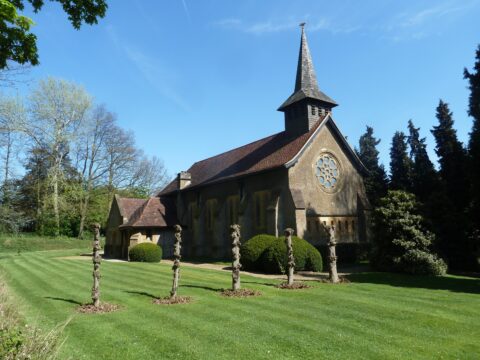
Saint Mary the Virgin, Great Warley, Essex, England. Photo Paul Smith.
Due to its original design and excellent state of preservation (apart from the theft of two brass candelabra in 1974), the church is now considered one of the most remarkable examples of Arts & Crafts churches in the United Kingdom[1]. Its decorative qualities were appreciated from the moment of its creation, notably in an article published under the title “A Notable Decorative Achievement” in February 1905 in The Studio[2],a highly influential international periodical.
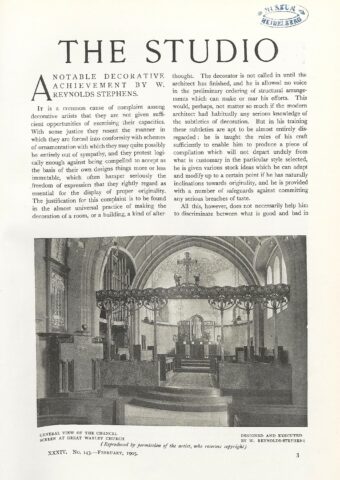
The Studio, February 1905.
In 1954, Nikolaus Pevsner, in the Essex volume of his Buildings of England series, described the church’s interior decoration as “an orgy of the Arts & Crafts variety of the international Art Nouveau movement.” As early as 1976, the church was listed at Grade I, the highest level of protection in the English system, reserved for buildings of exceptional interest[3]. The lych gate on the street, the entrance porch to the churchyard with its cemetery, was listed at Grade II* in 1993[4]. The building and its decoration are the subject of an excellent article by art historian Wendy Hitchmough in a collection of essays titled Architecture 1900, published in 1998[5], an art history dissertation for an MA at the Open University in 2009[6], and a well-illustrated analysis by historian Jacqueline Bannerjee on the website The Victorian Web. The church is active, and services are held there every Sunday[7]; during the week, tours are available accompanied by one of the churchwardens[8]. Two informational booklets and postcards are available for purchase on site[9].

H. R. Wilkins, church guide, 1976.
The Project Sponsor
Construction of the church began in 1902 at the initiative of Evelyn Heseltine (1850–1930). It was his wife, Emily Henrietta, née Hull, who laid the cornerstone of the building during a service held on Saturday, July 5, which, with games, tea, and fireworks, also celebrated the coronation of King Edward VII. Along with two of his brothers, Evelyn Heseltine was a principal partner in the brokerage firm Heseltine, Powell & Co., founded in 1848 and active on the London Stock Exchange. The firm specialized in brokering stocks and bonds issued by North American railroads.
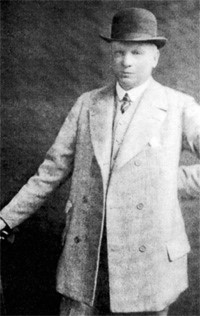
Evelyn Heseltine (1850-1930)
H. R. Wilkins, Guide, p. 44.
With a fortune in the making, and without giving up his London residence at 48 Upper Grosvenor Street in the Mayfair district, Heseltine moved in 1875, shortly after his marriage, to a modest farmhouse in Great Warley, a rural village located a few kilometres from the town of Brentwood[10]. At the time, Brentwood had a population of 5,000, and its train station, opened in 1843, was only about half an hour from Liverpool Street Station in London, near the City. Around 1880, Heseltine commissioned architect Ralph Nevill (1845–1917), a student of George Gilbert Scott (1839–1897), to transform the original house, renamed “The Goldings”, into an opulent manor in a historicist style variously described as “mock-Tudor,” “stockbroker Tudor ,” “Tudorbethan,” or “Old England.” An outbuilding, dated 1884, housed stables and outhouses. Heseltine led a life there as a gentleman-farmer, a squire with a passion for hunting and outdoor sports such as cricket, tennis, and golf, along with billiards and table tennis in the winter.
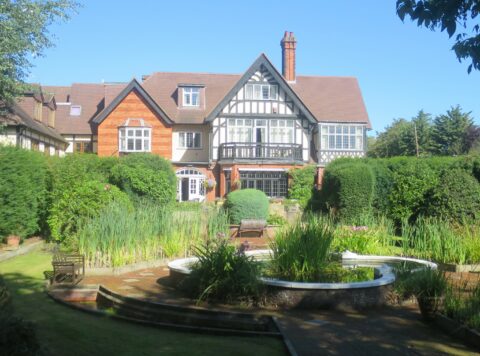
The Goldings, Great Warley, Ralph Nevill architect, 1884 (currently a hotel for travellers). Photo Paul Smith.
He was a devoted member of the Anglican Church and a benefactor to the community, building housing for his domestic staff and farmworkers.
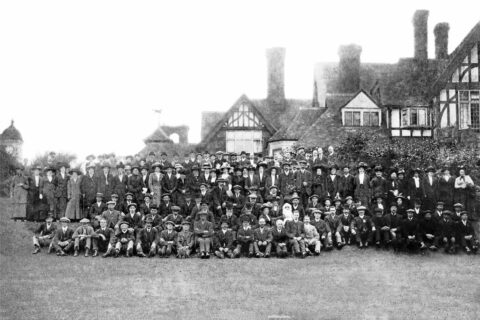
Staff at Evelyn Heseltine’s estate and farms, circa 1910 D.R.
From 1907 to 1928, he served as chairman of the board of governors at Brentwood School—Sir Antony Browne’s School for Boys—and provided the school with large sports fields, a sanatorium, and an outdoor swimming pool[11].
Toward the end of the 19th century, the old parish church in Great Warley, situated south of the village—whose growth was bringing it closer to Brentwood to the north—was in a state of neglect and disrepair. In 1901, Evelyn Heseltine donated a plot of land and a considerable sum of five thousand pounds for the construction of a new church, located about 300 metres south of his own estate. This church is dedicated to the memory of his brother Arnold, a lawyer in London who died in 1897; he was apparently very close to him: two years his junior, Arnold had married, in his first marriage, the sister of his own wife.
The architect
The architect of the church, as well as of the lych gate—built of oak on massive stone walls—is Charles Harrison Townsend (1851–1928).
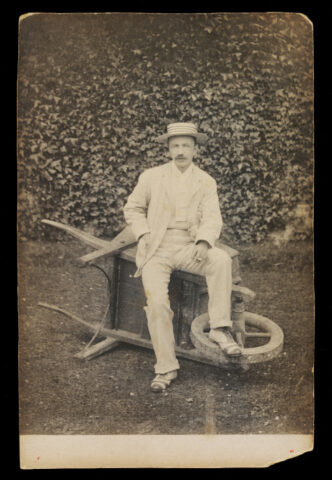
Charles Harrison Townsend (1851-1928), Victoria and Albert Museum.
At Heseltine’s request, for the building’s overall design, Townsend drew inspiration from St. Peter’s Church in Hascombe, Surrey, built between 1862 and 1864 by Henry Woodyer (1816–1896), a disciple of Augustus Pugin (1812–1852) and a “gentleman-architect” of numerous Neo-Gothic churches[12]. Heseltine had spent part of his youth in Godalming, very close to the village of Hascombe, whose church he is said to have attended around the time he met his future wife and her younger brother Arnold, who would later become his brother-in-law. At Great Warley, the church’s exterior architecture is “modestly pretty,” in Pevsner’s words, characterized by its roughcast finish and “Voysey-style” buttresses—that is, similar to a typical feature of the country houses designed by C.F. Annesley Voysey (1857–1941), a friend of Townsend’s and, like him, a member of the Art Workers’ Guild. In plan, the parts of the church projecting as transepts are a chapel to the south and, to the north, the organ loft and the sacristy. The small shingled belfry and the porch on the south façade, beneath its timber-framed roof, are of regional inspiration, “Essex style,” to quote the official listing description. The rounded apse to the east is considered less vernacular.
According to the 1902 plans preserved by the Royal Institute of British Architects[13], Townsend adopted from the Hascombe church model a “squint” or hagioscope, an oblique opening giving the congregation seated in the south chapel—namely Evelyn Heseltine and his family—a direct view of the altar and the elevation of the host. But in the end, this feature was not included in the church at Great Warley as it was built. In the aftermath of World War I, the chapel was converted into a memorial.
The architect, Townsend, is fairly well known in England, duly classified as one of the “pioneers of the modern movement” for his “carefree rejection of tradition[14].” He is sometimes considered the only English architect to have practiced Art Nouveau[15], or what is sometimes called the British Modern Style, a sort of English Charles Rennie Mackintosh (1868–1928). This reputation is based primarily on three projects in London, the last two of which had only very recently been completed when Townsend, then aged 50, set about designing St. Mary’s Church in 1901. The first is the Bishopgate’s Institute, an independent cultural center founded in 1895 in the City, built between Liverpool Street Station and Spitalfields Market.
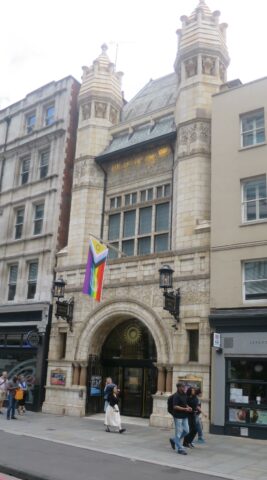
Bishopsgate Institute, Londres, architect Charles Harrison Townsend, 1895. Photo Paul Smith.
Next came the building designed for the Horniman Free Museum, located in Forest Hill in south London, which opened on June 30, 1901. This museum consists of a cheerfully eclectic collection of stuffed animals, ethnological objects, and musical instruments assembled by Frederick John Horniman (1835–1906), a businessman whose family had made its fortune in the tea trade. In 1901, he donated the museum, its collections, and its six-hectare gardens to the City of London for the “entertainment, education, and enjoyment” of the public.
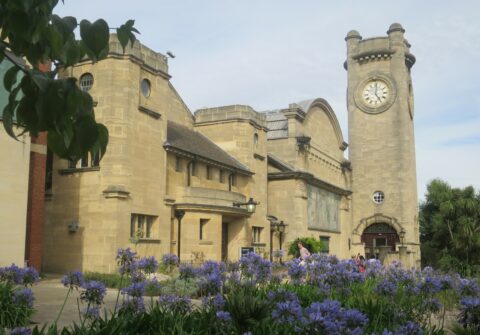
Horniman Museum, Forest Hill, London, architect Charles Harrison Townsend, 1901. Photo Paul Smith.
The third famous building designed by Townsend, also opened in 1901, on March 12, is the Whitechapel Art Gallery, located in London’s East End, in a deprived neighbourhood known at the time for its Irish and Jewish immigrant populations, and later for its Bangladeshi residents. The gallery’s façade is characterized by a large semicircular entrance arch, positioned asymmetrically and topped by a blind wall resembling a screen, flanked by two turrets decorated with terracotta panels featuring foliage motifs. A mosaic frieze by Walter Crane (1845–1915), similar to that by Robert Anning Bell (1863–1933) on the facade of the Horniman, was intended to be installed there but was never completed.
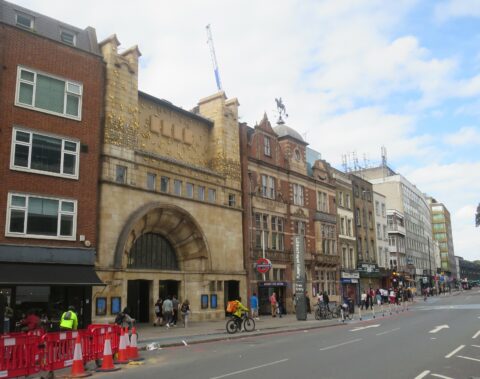
Whitechapel Art Gallery, London, architect Charles Harrison Townsend, 1901. Photo Paul Smith.
It is striking that these three projects are located in disadvantaged neighbourhoods of the capital and all have philanthropic programs designed to provide Londoners with resources for learning about and appreciating art. The Whitechapel Gallery turns its back on the traditional model that treated museums and art galleries as temples. The entrance, located on the neighbourhood’s main shopping street, provides direct access to the exhibition halls. The steel framework of the upper hall allows for ample overhead lighting, but from the outset, the exhibition halls were lit by electricity so they could remain open in the evening, after the workday[16].
Far less idiosyncratic than the three buildings in London that established his reputation, Townsend’s architecture at Great Warley is deliberately understated and simple, an “exercise in humility[17]” in service of the interior design.
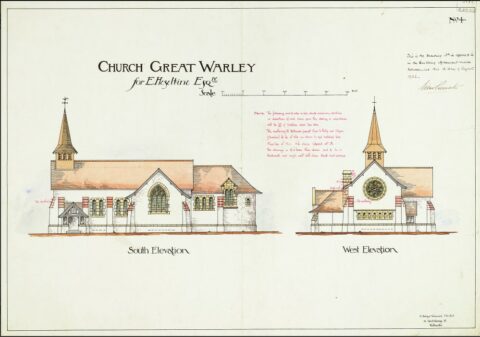
Church, Great Warley, contract drawing, elevations, Charles Harrison Townsend, 1902, Royal Institute of British Architects, PA 901/3.
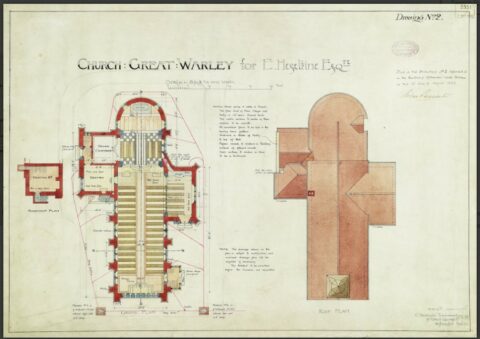
Church, Great Warley, contract drawing, plan, Charles Harrison Townsend, 1902, Royal Institute of British Architects, PA 901/3.
As if seeking to pre-empt accusations of a lack of originality in the church’s design, he gave a lecture on February 8, 1902, at the bimonthly meeting of the Architectural Association, in which, offering advice to young architects, he told them not to strive to be original at all costs, for they would not succeed:
“If your work bears your mark, what other originality must it have, can it have? But this quality must come of its own accord. It must not result from an attempt to do what other men have never done before; it must come from your desire to do your work this way, because it seems to you to be the best solution to the problem you face. And, having arrived at this solution—your own—you accept it or, on the contrary, you reject it, but not for the simple reason that others arrived at the same solution before you[18].”
Thus, with a few minor details aside, as you pass through the lych gate to discover the church among the trees, you might almost believe you are standing before a small traditional country church or chapel. But the details in question—the golden dove at the top of the spire, holding an olive branch in its beak, or the cast-iron basins at the tops of the rainwater downspouts, with their very Art Nouveau-style plant motifs—leave no doubt as to the church’s construction era, and turn out, in fact, to be not the architect’s creations but those of the decorator.
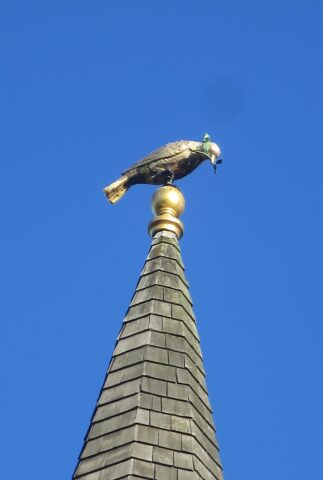
A golden dove atop the church spire, designed by William Reynolds-Stevens. Photo Paul Smith.
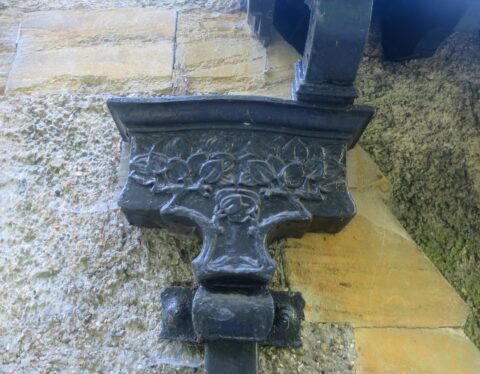
Cast-iron drain at the top of rainwater downspouts, designed by William Reynolds-Stevens. Photo Paul Smith.
The Decorator
The church’s decoration was designed and executed by the painter, sculptor, and decorator William Reynolds-Stevens (1862–1943), a highly versatile artist but one who is less well known than the architect. The interior of Saint Mary’s represents his only decorative ensemble that has been preserved intact. He was born to British parents in Detroit, Michigan, in 1862 but returned to England, where he was first trained as an engineer before turning to the fine arts and taking classes from 1885 to 1887 at the Royal Academy Schools. But his initial training may help explain the skills he demonstrated in working with a wide variety of materials, especially metals. A member, like Townsend, of the Art Workers’ Guild, he gave lectures there in 1890 on “the pickling, coloring, and lacquering of metals” and, in 1910, on “bronze casting”[19]. His well-known paintings, such as Interlude, published in The Studio in 1899[20], are Post-Pre-Raphaelite in style, quite similar to the epic compositions of Lawrence Alma-Tadema (1836–1912), for whom he worked[21]. However, beginning in 1894, Reynolds-Stevens gave up painting to devote himself to sculpture and decoration.
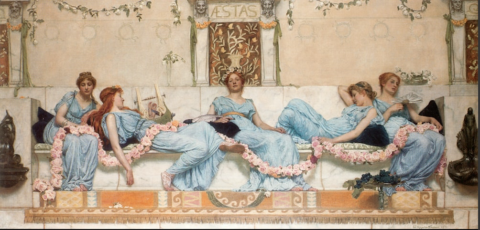
Interlude, painting by William Reynolds-Stevens, 1891, published in The Studio in March 1899/
Between 1897 and 1903, he received several commissions from a London stockbroker, William Vivian, notably to redesign the drawing room of his home at 185 Queen’s Gate, South Kensington, built in 1891 by the architect Norman Shaw (1831–1912)[22]. The new drawing room was designed by Reynolds-Stevens to showcase the owner’s collection of paintings[23]. On the same street, at 196 Queen’s Gate, another house designed by Norman Shaw in 1875[24] was at that time the residence of Evelyn Heseltine’s older brother, John Postle Heseltine (1843–1929), a member of the same stockbroking firm, a friend of William Vivian, and, moreover, an engraver, art collector, and one of the trustees of the National Gallery. It was probably through an introduction by this older brother that Evelyn Heseltine discovered the decorative work of William Reynolds-Stevens just as he was considering the design of a church dedicated to the memory of his younger brother. As early as June 1901, Evelyn and his wife visited Reynolds-Stevens at his home in the Saint John’s Wood neighbourhood of west London, a house with a studio designed by Voysey.
Titled “A Notable Decorative Achievement by W. Reynolds-Stevens,” the article published in The Studio in February 1905 by Alfred Lys Baldry emphasizes that, contrary to the customary practice of calling upon the decorator after the fact, once the architect had completed his work, at Great Warley this order was reversed; the design proceeded, so to speak, from the inside out.
“The donor placed the responsibility for the project in the hands of Mr. Reynolds-Stevens, making him the general consultant with extensive powers of oversight. Mr. Harrison Townsend was then entrusted with the task of designing the building […] It provides an absolutely appropriate setting for the complex ornamentation it houses.”
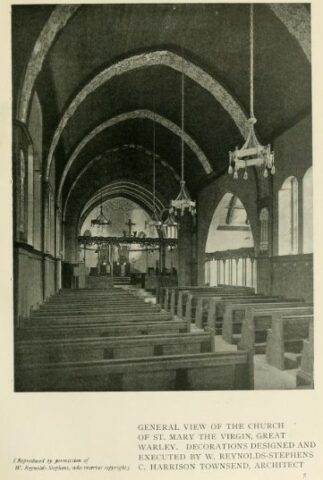
The Studio,February 1905, general view of the church.
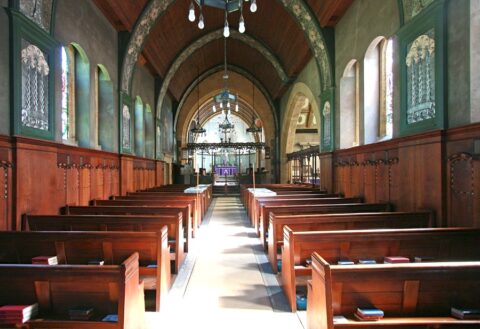
Interior of the church, looking east, showing the choir and the apse. Photo by John Salmon, The Victorian Web.
The article commends the interior designer and the architect for the respect each shows for the other’s role. It is generously illustrated but features only Reynolds-Stevens’s contributions, with no floor plans of the church or images of its exterior.
The decorative design of the church’s interior, as noted, is a total work of art, a coherent creation liberated from the confines of the canvas or the single sculpted object. Initially giving an impression of “calm and restful elegance[25],” it is rich in symbolic details linked to the hope of the resurrection: poppies, associated with sleep and death, yet framing a butterfly, a symbol, precisely, of resurrection; tree trunks or branches intertwined in threes, the Trinity; fleurs-de-lis, associated with the Virgin Mary but also expressing the hope that is reborn at Easter with the blossoming of flowers; vines and red grapes symbolizing the Eucharist; and six angels on the rood screen displaying the fruits of the Spirit[26]: joy, peace, patience, kindness, goodness, faithfulness… The lych gate may also have a symbolic meaning: the word “lych” derives from the Old English word for corpse, and the small building, intended to house the body while awaiting the priest, is sometimes called a “resurrection gate.”
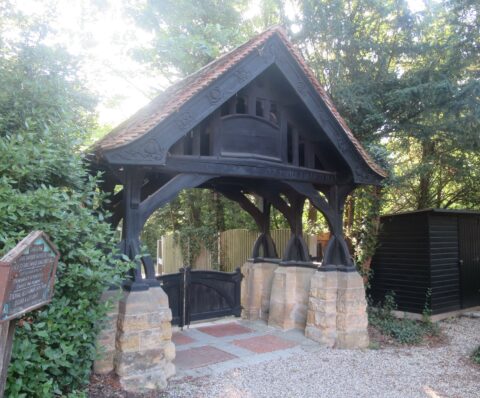
Great Warley, Saint Mary the Virgin, the Lych Gate. Photo Paul Smith.
Today, the symbolic message conveyed by these details is undoubtedly less immediately understandable, but even at the time, it was deemed necessary to provide some guidance for interpretation. At the church’s consecration in June 1904, each parishioner was given a “memorandum[27]” explaining the intentions of Evelyn Heseltine and his decorator: “The main purpose is to guide the thoughts of the faithful through the decorations toward the glorified and risen Christ, whose figure, at the centre of the altarpiece, will be the keystone of the whole. ” The Christ in question, with long hair and a Dürer-style beard, is made of silver oxidized over copper and wears a breastplate decorated with mother-of-pearl. He tramples the serpent of Evil underfoot and raises his right hand in blessing, as if greeting a friend.
In keeping with Arts & Crafts practices, yet far removed from any notion of simplicity that the movement might otherwise embody, the church’s decoration boldly juxtaposes textures and colours drawn from a wide range of materials: the light limestone surrounding the windows and the arches separating the nave from the chapel to the south and the choir to the east; on the floor, terrazzo or, in the chapel, black-and-white mosaic; the white marble of the baptismal font, and elsewhere, black, dark green, and grey marble. The church pews (designed “less excessively[28]” by Townsend) are made of American walnut, as is the panelling on the nave walls, accented with beech and ebony marquetry featuring small mother-of-pearl inlays. And, scattered throughout the decor, the organ case, and the furnishings, are metals: cast iron, galvanized iron, hammered steel, hammered copper, oxidized copper, brass, bronze, gilded bronze, tin, rhodium-plated silver… and aluminium.
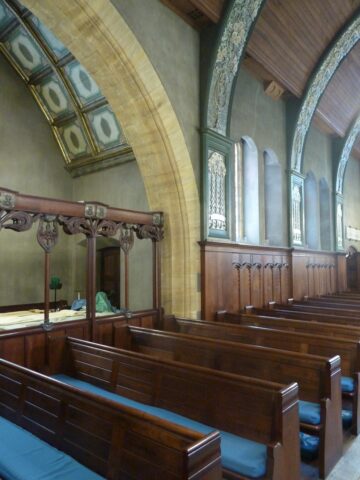
View toward the nave, with the Heseltine family chapel on the right and the south side on the left, showing the arched ribs of the vault. Photo Paul Smith.
And what about aluminium in all this?
The Arts and Crafts movement, in its rejection of industrial products, accepted wrought iron but rejected cast iron and steel straight from the factory. As for aluminium, it is hard to imagine manufacturing processes less artisanal than the Hall-Héroult process by electrolysis, implemented in the United Kingdom by the British Aluminium Company as early as 1896[29]. But Reynolds-Stevens does not seem to have harboured any prejudices regarding the industrial origins of the materials he used. Cast iron served him, as we have seen, for the basins at the tops of the downspouts that adorn the exterior walls of the church on the north and south sides. As for aluminium, which had only become a relatively accessible material about ten years earlier—and was now cheaper than gold or silver—Reynolds-Stevens was already using it in his decoration of the drawing room at 185 Queen’s Gate in London, which Heseltine visited in 1901. Above the paintings, a plaster frieze modelled as vines and fruit trees frames the ceiling, which is covered in aluminium sheets[30].
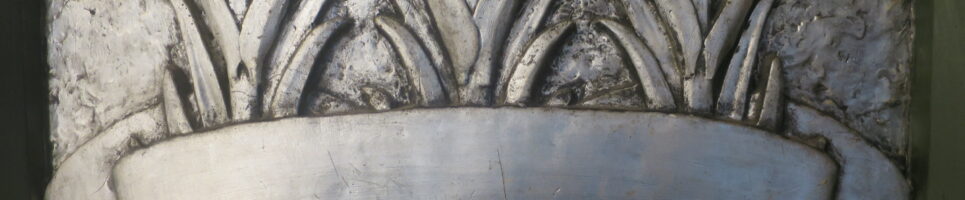
At Great Warley, aluminium is used in two places: on six ribs or arched bands that punctuate the barrel vault of the nave, and on the semi-dome ceiling of the apse. The ribs are carved in bas-relief with flowering rosebushes (wild roses) emerging from rectangular panels, from which three blooming lilies rise from their bulbs.
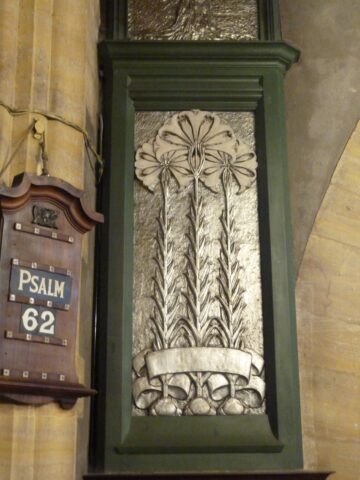
Panel featuring three blooming lilies at the base of an arched band. Photo Paul Smith.
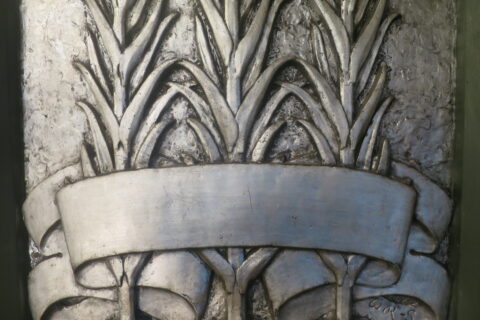
Detail of a panel, treated with aluminium foil or paint. Photo Paul Smith.
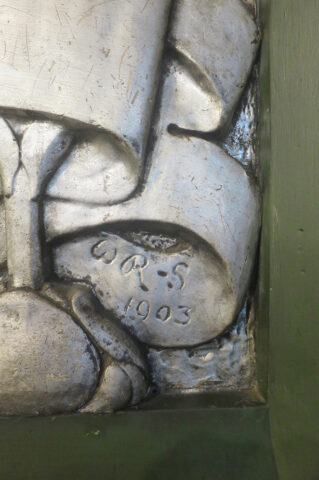
Detail of a panel, treated with aluminium foil or paint. Photo Paul Smith.

The ceiling of the apse, behind Christ, also features a bas-relief decoration of geometrically stylized vines and bunches of grapes painted in bright red.
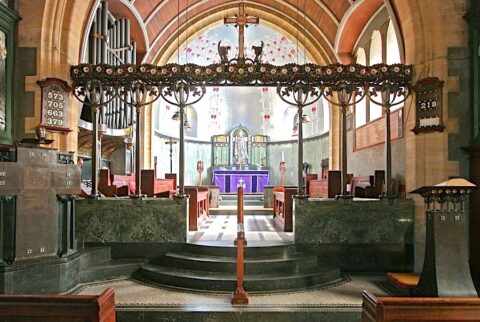
Interior of the church, the choir with the rood screen. Photo John Salmon, The Victorian Web.
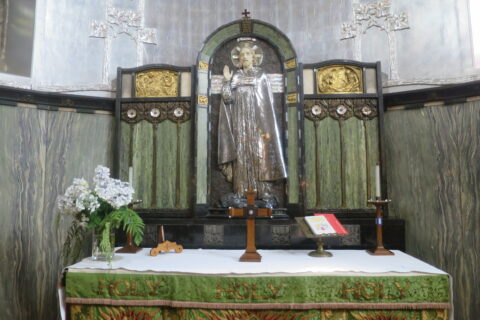
The altar. Photo Paul Smith.
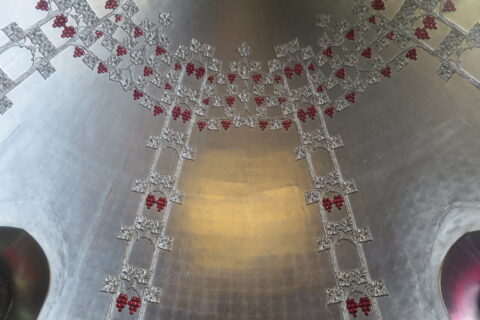
Cover of th abse treated in aluminium. Photo Paul Smith
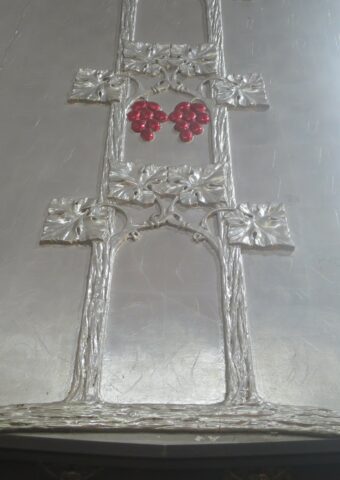
Detail of the relief decoration on the apse ceiling. Photo Paul Smith.
The 1905 article in The Studio specifies that these elements are “overlaid with silvery aluminium” and suggests that the material’s durability—the assurance that neither time nor wear would cause it to lose its luster or become invisible—was a key factor in choosing this metal. The information in this article did not prevent subsequent confusion between silver and aluminium: Pevsner, in the 1954 edition of his guide, believed that the bands and the apse of the church were decorated in silver[31].
There is also some confusion regarding the nature of the aluminium applied to the relief surfaces. Set within their green-painted wooden frames, the panels depicting lilies, which bear the signature “W R-S 1903,” are said to have been prefabricated, so to speak, in the sculptor’s London studio, where, at that time, he was assisted by two assistants and an apprentice [32]. But was the metallization achieved there by applying aluminium powder dissolved in a solvent—that is, aluminium paint—or in very thin sheets, through what is sometimes called aluminium gilding? Both techniques are documented[33] and may even have been combined. The treatment of the apse appears more clearly to consist of aluminium sheets. Blackened by soot from the candles, this ceiling was restored in 1980 by Harold Lansdell.
Recent research, funded by the International Aluminium Institute and seeking to quantify the benefits of using the metal in architecture, highlights Great Warley Church at the top of an international selection of fifty architectural projects, spanning 1895 to 1986[34]. The pioneering sites, according to this selection, are, in chronological order, St. Edmund’s Church in Fenny Bentley, Derbyshire, where panels painted in 1895 on the ceiling of a family chapel turned out to be made of aluminium[35]; then the Church of San Gioaccino in Rome, where the steel structure of the dome is clad in aluminium sheets approximately 1.3 millimetres thick; and, in third place, our Church of St. Mary in Great Warley, where aluminium is the “key material” in the decoration. Next, in fourth place, is the famous Vienna Post Office Savings Bank, completed in 1906. This building, designed by the master of Art Nouveau, Otto Wagner (1841–1918), is far more of a harbinger of modern architecture than Reynolds-Stevens’s decorative work. The building’s former cashier’s hall has now been converted into an exhibition space and café, but it is still in use, as are the vast majority of the fifty buildings selected for this project. The durability of aluminium, the first of its many qualities, seems to be confirmed. And indeed, at Great Warley, the aluminium continues to shine in the sanctuary, still expressing, 120 years later, the expensive tribute paid by Evelyn Heseltine to his brother.
Paul Smith, historian
[1] Alec Hamilton, Arts & Crafts Churches, London, Lund Humphries, 2021, pp. 202–204.
[2] Alfred Lys Baldry, “A notable decorative achievement by W. Reynolds-Stevens”, The Studio, February 1905, pp. 3–15.
[3] The lists for England include approximately 9,000 Grade I listed buildings, representing 2.5% of all listed buildings.
[4] This porch, featuring inscriptions carved by Eric Gill (1882–1940), dates from the church’s construction and forms a unified whole with it. However, in accordance with the English system, it is listed separately.
[5] Wendy Hitchmough, “Great Warley Church: architecture and sculpture, body and soul,” Peter Burman (ed.), Architecture 1900, Dorset, Donhead, 1998, pp. 99–108.
[6] Margaret Mary Donovan, St. Mary the Virgin at Great Warley in Essex, the making of an Arts and Crafts church, thesis submitted to the Open University, 2009.
[7] https://stmarygreatwarley.weebly.com
[8] My thanks here to Stephen Brabner.
[9] H.R. Wilkins, Great Warley, A Digest of Church and Village History from 1247, Illustrated Guide by A. W. Wellings, Great Warley, Church Council, 1976, revised 2005; Lawrence Miller, Great Warley Church Guide, Great Warley, Church Council, 1999.
[10] The name comes from “burnt wood.” Its current population is 55,000.
[11] Where the author of this text learned to swim.
[12] James Bettley, Nikolaus Pevsner, The Buildings of England: Essex, London, Yale University Press, 2007, pp. 429–431; on Woodyer, see Edmund Harris’s blog, Dandified Gothic: the architecture of Henry Woodyer (1816–1896) – Less Eminent Victorians
[13] PA 901/3 (1–8).
[14] Nikolaus Pevsner, Pioneers of Modern Design, from William Morris to Walter Gropius, Bath, Palazzo Editions, 2011, p. 133 (expanded and illustrated edition of the 1936 work, Pioneers of the Modern Movement).
[15] Stephan Tschudi Madsen, The Art Nouveau Style, A Comprehensive Guide with 246 Illustrations, New York, Dover Publications Inc., 2002, p. 280.
[16] Stephen Escritt, “Charles Harrison Townsend, the Whitechapel Gallery and the Enigma of English Art Nouveau,” Katrina Schwarz, Hannah Vaughan (eds.), Rises in the East, A Gallery in Whitechapel, London, Whitechapel Gallery Venture, 2009, pp. 20–32.
[17] Wendy Hitchmough, op. cit.
[18] Charles Harrison Townsend, “’Originality’ in Architectural Design,” The Builder, Vol. LXXXII, February 8, 1902, pp. 133–134.
[19] “Sir William Ernest Reynolds-Stevens VPRBS,” Mapping the Practice and Profession of Sculpture in Britain and Ireland 1851–1951, University of Glasgow History of Art and HATII, online data base, 2011, accessed September 2023.
[20] Alfred Lys Baldry, “The work of W. Reynolds-Stevens,” The Studio, Vol. 17, 1899, pp. 74–84.
[21] In 1889, he created a bas-relief for Alma Tadema based on his painting The Women of Amphissa. Ibid.
[22] The four townhouses built by Norman Shaw on Queen’s Gate are analyzed by Andrew Saint in Richard Norman Shaw (Revised Edition), New Haven and London, Yale University Press, 2010.
[23] This house was destroyed during the Blitz.
[24] Listed as a Grade II building in 1958.
[25] Alfred Lys Baldry, “A notable decorative achievement by W. Reynolds-Stevens,” op. cit.
[26] Galatians 5:22.
[27] Rev. J. F. Tarleton, The Church of St. Mary the Virgin, Great Warley, Essex, Explanatory memorandum, 1904.
[28] James Bettley, Nikolaus Pevsner, op. cit.
[29] Andrew Perchard, Aluminiumville, Government and Global Business in the Scottish Highlands, Lancaster, 2012.
[30] Wendy Hitchmough, op. cit.
[31] Nikolaus Pevsner, The Buildings of England, Essex, London, Penguin Books, 1954, p. 196.
[32] “Sir William Ernest Reynolds-Stevens VPRBS,” Mapping the Practice and Profession of Sculpture in Britain and Ireland 1851–1951, cited database.
[33] See J. Bally, “Aluminium as a Decorative Metal” and “Aluminium in Architecture and Decoration,” Revue de l’aluminium, no. 7, April 1925, and no. 22, December 1927.
[34] Michael Stacey (ed.), Aluminium and Durability, Towards Sustainable Cities, Nottingham, Cwningen Press, 2014 (online).
[35] In Bordeaux, in Saint-André Cathedral, an earlier application of aluminium sheet, executed between 1860 and 1874, was recently discovered: see the articles by Marie-Pierre Etcheverry and Thierry Renaux in the Cahiers de l’histoire de l’aluminium, 2021/1/No. 66 (online).
Translation : Alan Bryden
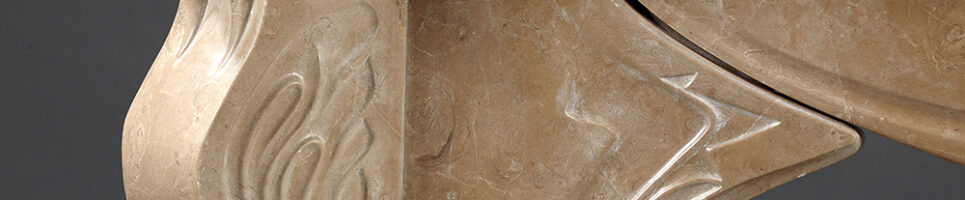
Guimard’s Marble Fireplaces – 1
11 April 2026
All photos owned by the authors or by the Cercle Guimard Archives and Documentation Center must, without exception, be approved by the Cercle Guimard for any publication project, regardless of the medium.
A comprehensive study of Guimard’s work in the field of marblework has yet to be undertaken. It is nevertheless clear that this field held his interest just as much as other areas of decorative art. Guimard worked with marble craftsmen from very early on, at least since the construction of Victor Rose’s tomb in 1892, and we know that he designed funerary monuments until 1929 (the project for the commemorative monument to the Victory of the Marne). This article provides an overview of his creations in the more limited field of marble fireplaces. A second article will discuss the recent restoration of the engraved decoration on a fireplace in the Trémois building (1909–1910).
We are not aware of any marble fireplaces in any of Guimard’s early architectural works, but it is quite possible that some existed. The first designs specifically created by Guimard may date back to the interior work on Castel Béranger (1895–1898). Guimard’s use of fireplaces there was in no way innovative: it followed well-established conventions for apartments and private residences, where the combination of the fireplace and the mantelpiece above it persisted from the 18th to the 19th century[1]. But as we saw previously, the presence of heat vent grilles indicates that the apartments at Castel Béranger had a mixed heating system, with radiators in the basement and fireplaces in the main rooms. These elements of the fixed decor, though not very efficient, were long considered indispensable to a private interior and were therefore used occasionally or during the shoulder seasons. The list of contractors recorded in the Castel Béranger portfolio mentions “Hénault. – Marblework,” followed by this note: “Following the death of Mr. Hénault, the marble fireplaces were executed by Mr. Maybon[2].” This latter firm, whose workshops and showroom were located on Rue Saint-Sabin in the 11th arrondissement, specialized in “artistic and commercial fireplaces.”
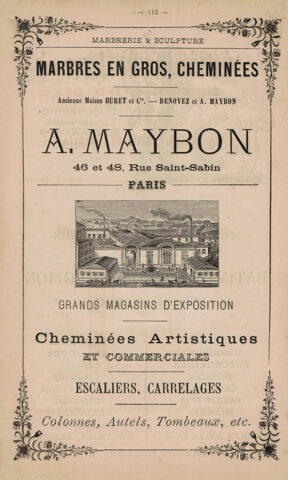
Sales brochure from Albert Maybon Marble Works, 46–48 Rue Saint-Sabin, undated. Private collection.
For the 1900 Paris World fair, an advertising brochure published by the same company listed the various categories in which it exhibited its products.
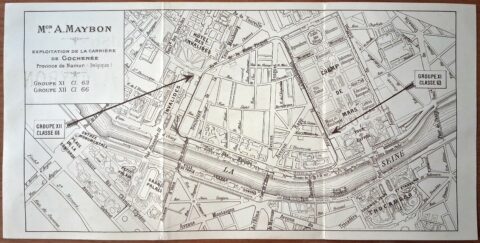
Advertising brochure for Maison A. Maybon, published for the 1900 World’s Fair in Paris. Private collection.
Within Group XII, Class 66—dedicated to the permanent decoration of public buildings and residences—featured, among other exhibits, Guimard’s display, which included several interior fragments, including a bedroom and its marble fireplace. A particularly well-crafted label, now preserved at the Forney Library, confirms that the fireplace was on display at Guimard’s exhibition booth.
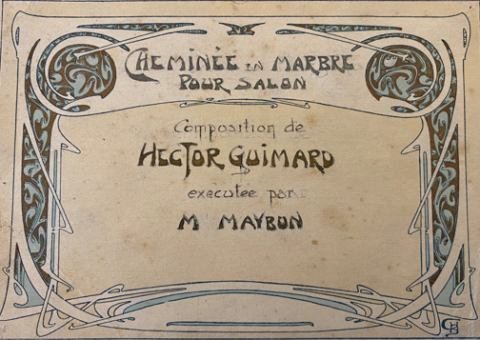
Poster for Hector Guimard’s pavilion at the 1900 World Fair. Geo Dorival Collection. Forney Library.
At Castel Béranger, the fireplaces with marble mantels from the A. Maybon company were found in the bedrooms and living rooms of the apartments. The other rooms were fitted with mantels made of glazed stoneware (produced by Alexandre Bigot) or cast iron (produced by the Durenne foundry in Sommevoire). The mantels in the bedrooms, which are fairly simple, feature classic inserts made of flat white earthenware tiles.
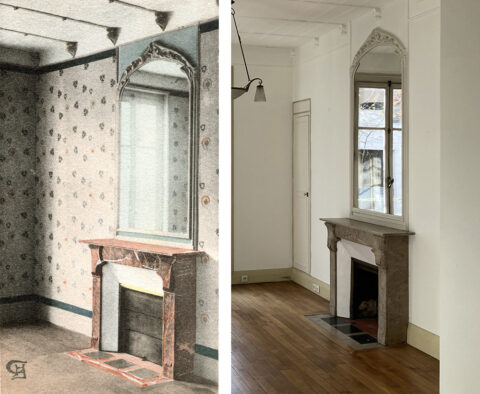
Left: View of a bedroom in the apartment at the corner of Rue La Fontaine and the Béranger hamlet, on the second floor of the Castel Béranger, Hector Guimard, *L’Art dans l’Habitation moderne/Le Castel Béranger* (Castel Béranger portfolio), pl. 35 (detail), Librairie Rouam, 1898. Private collection.
Right: view of a bedroom in an apartment on the first floor of Castel Béranger featuring a marble fireplace with a narrower section clad in earthenware tiles. Photo by F. D.
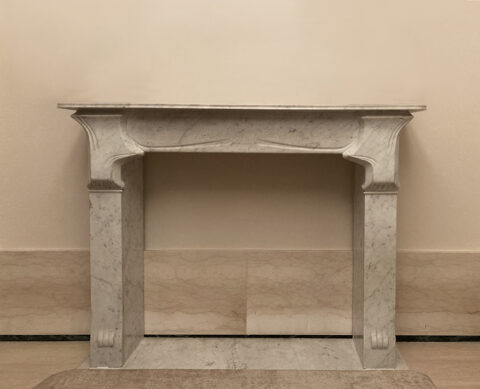
A marble mantelpiece modeled after those in the bedrooms of Castel Béranger, acquired by Hector Guimard Diffusion. Photo and computer graphics by F. D.
This design is also featured in the rooms of Castel Val, with a unique twist: the color of the marble varies from room to room. To the best of our knowledge, this 1904 building by Guimard is the last to feature this fireplace design from the Castel Béranger period.
Apart from this building, perhaps for an exhibition, Guimard experimented with creating a narrowing effect using three flat plates of glazed lava.
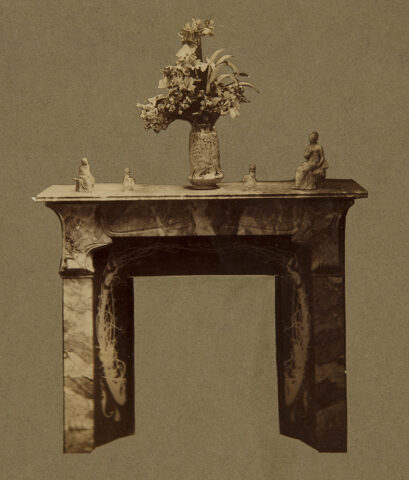
Marble fireplace modeled after those in the bedrooms of Castel Béranger, with a narrower section featuring glazed lava stone panels. Bibliothèque des Arts Décoratifs, donated by Adeline Oppenheim-Guimard, 1948. Photo by Laurent Sully Jaulmes (detail).
Significant fragments of this glazed lava vessel have been recovered and are now in a private collection.
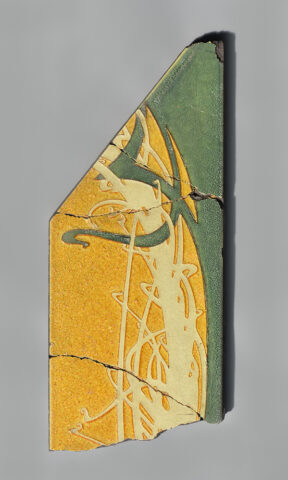
A fragment of the glazed lava trim from a fireplace typical of the bedrooms at Castel Béranger. Private collection. Photo by F.D.
The fireplaces in the living rooms, which are more elaborate, feature a cast-iron or glazed terracotta insert crafted by Gilardoni & Brault.
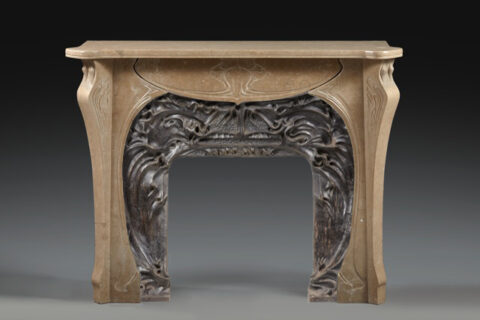
A marble fireplace model from Castel Béranger with a bronze-finished cast-iron insert by Durenne. Collection of the Saint-Dizier Museum. Photomontage created using photographs from the Auction France sale of the former Plantin collection, September 2015.
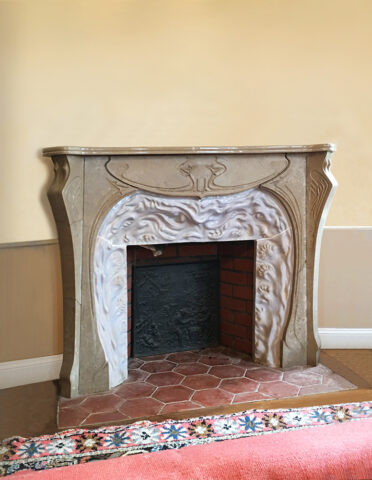
Castel Béranger-style marble fireplace with a glazed terracotta insert in the living room of Castel Val (1903). Photo and computer-generated image by F. D.
Presumably to save money, the decorative elements on these two marble mantelpiece designs from Castel Béranger are primarily engraved in grooves. Guimard reused them for several years in other buildings. At the same time, however, he also used wood for a mantelpiece (at Castel Val) and, most notably, from around 1900 to 1908, glazed lava, which allowed him to add color to these mantelpieces in a subtle way.
However, the appeal of carved and engraved marble remained strong, and around 1904, new designs emerged in line with the evolution of his style. Those at Castel d’Orgeval are very simple and feature flat earthenware panels for the insert.
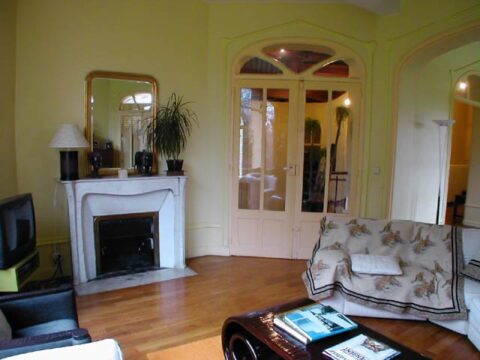
Living room at Castel d’Orgeval. Photo from a real estate agent. All rights reserved
Depending on the budget allocated and the room in which they are located, the mantelpieces in other homes vary in opulence.
Fireplace on the ground floor of the villa on Rue Jean Doyen in Eaubonne (c. 1907–1908). The mantelpiece is made of simple flat ceramic tiles. Photo by F. D.
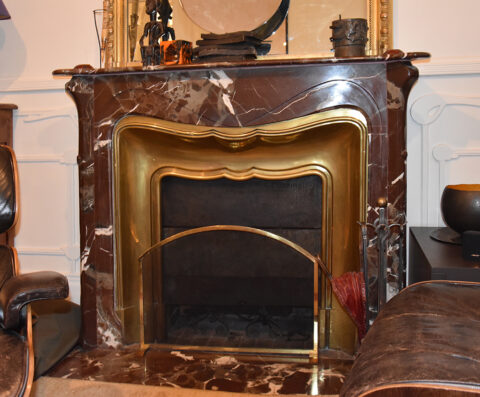
Marble mantelpiece with a brass insert at the Deron-Levent Hotel (1907–1908), 8 Villa de La Réunion, Paris’s 16th arrondissement. Photo by F. D.
These marble mantelpieces foreshadow the designs that appeared in the drawings featuring the standard sizes listed in the *Fontes artistiques de Guimard* catalog, published by the Saint-Dizier foundry in 1908. These standard sizes, designed to fit the most common mantelpiece models on the market, are presented across three plates, two of which bear the following note: “The marble can be obtained from: Société Anonyme des Usines et Carrières — Devillers et Cie — Marpent (Nord)[3].” On these plates, Guimard shows four different mantelpiece models adapted to three groups of inserts. The tallest and widest are the GA and GC, which are the same size (96 cm high and 110 cm wide). The GB model is of intermediate height and width (93 cm high by 100 cm wide).
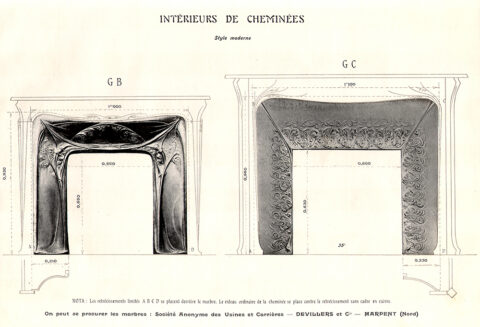
GB and GC chimney flue inserts, from the catalog of Guimard’s Artistic Cast Iron Works, Saint-Dizier Foundry, plate 61. Private collection.
As for the GI, GH, GG, and GE series, they are all the same height (90 cm), and their width increases by 5 cm with each model (from 75 to 90 cm).
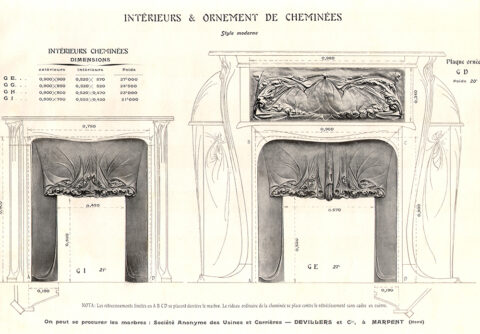
GI and GE chimney inserts, from the catalog of Guimard’s Artistic Cast Iron Works, Saint-Dizier Foundry, plate 62. Private collection.
For this final series, Guimard also designed a more monumental mantelpiece model featuring an ornate cast-iron panel at the top. The *Fontes Artistiques* catalog presents it in the widest GE model (above), but we also know of a narrower version with the GI insert (below).
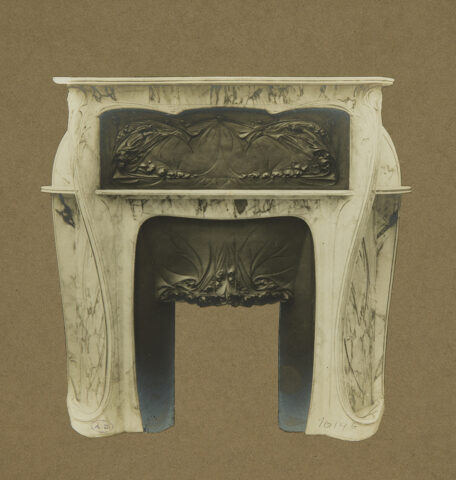
Marble fireplace with a GI-style insert and a GD-style decorative panel. Bibliothèque des Arts Décoratifs, donated by Adeline Oppenheim-Guimard, 1948. Photo by Laurent Sully Jaulmes (detail).
But it soon becomes clear that the fireplace mantel designs shown in the plates of the artistic cast iron catalog are merely illustrative, as Guimard created a wide variety of different models. For example, within the GI, GH, GG, and GE series of narrower designs, we know of another mantel model that was actually produced (though its location is unknown) and is, in contrast, extremely simple.
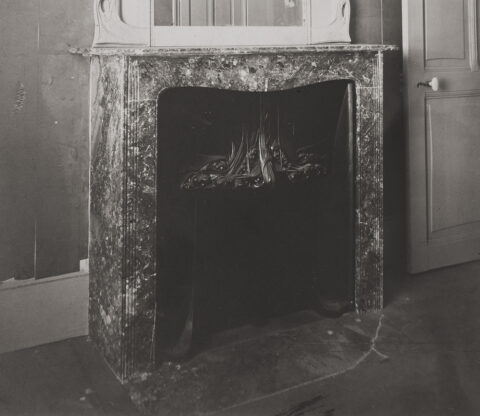
Marble fireplace with a GH-style insert, photograph taken in Guimard’s workshops at 12 Avenue Perrichont-prolongée. Bibliothèque des Arts Décoratifs, donated by Adeline Oppenheim-Guimard, 1948. Photo by Laurent Sully Jaulmes (detail).
For a GC insert, Guimard also designed a model for a mantel featuring bronze brackets at the corners.
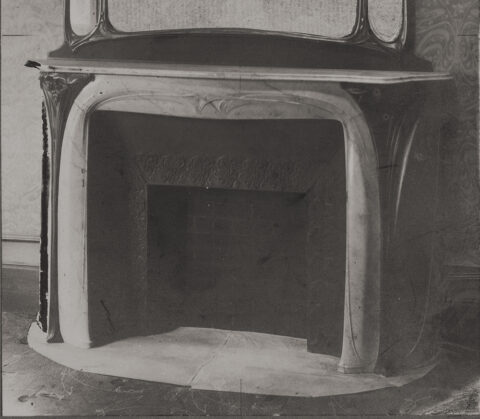
Marble fireplace 1017 with a GC insertt and bronze brackets, photograph taken in Guimard’s workshops at 12 Avenue Perrichont-prolongée. Bibliothèque des Arts Décoratifs, donated by Adeline Oppenheim-Guimard, 1948. Photo by Laurent Sully Jaulmes (detail).
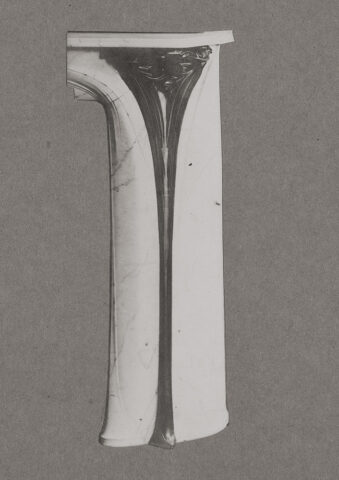
Detail of the bronze brackets on the marble mantelpiece 1017. Bibliothèque des Arts Décoratifs, donated by Adeline Oppenheim-Guimard, 1948. Photo by Laurent Sully Jaulmes (detail).
This fireplace, numbered 1017, was installed in the living room of the Hôtel Guimard on Avenue Mozart. It is, in fact, the only fireplace in the hotel, as Guimard opted for central heating to save space in the modestly sized rooms of this very small property.
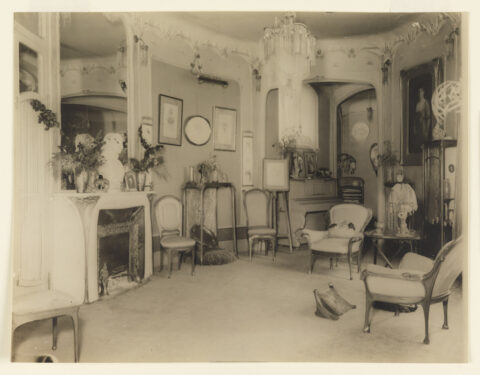
Old photograph of the living room at the Hôtel Guimard, 122 Avenue Mozart, featuring the 1017 fireplace. Cooper-Hewitt Museum, New York, donated by Adeline Oppenheim-Guimard. All rights reserved.
Another document is likely a photo montage featuring a cutout from a retouched photo of a marble coat model, superimposed on a photo (itself cut out) of a GC insert.
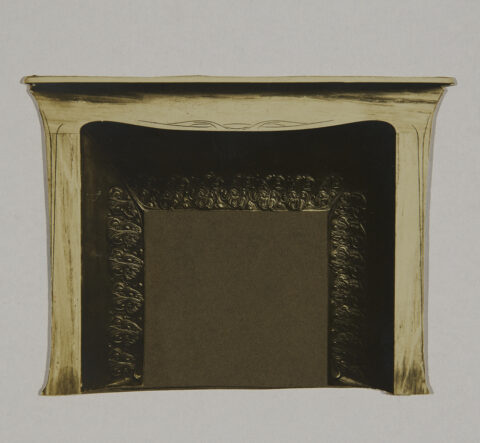
Probable photo montage of a mantelpiece on a GC insert. Bibliothèque des Arts Décoratifs, donated by Adeline Oppenheim-Guimard, 1948. Photo by Laurent Sully Jaulmes (detail).
For GB inserts, the marble mantels have also presented with variations.
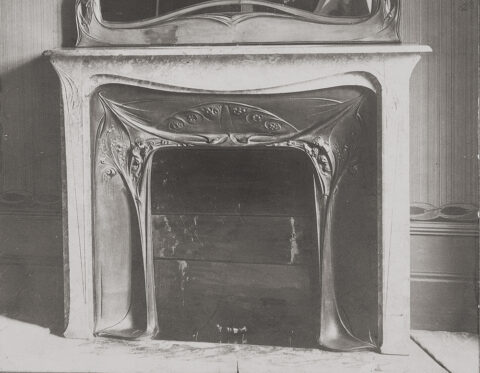
Marble fireplace 1013. Bibliothèque des Arts Décoratifs, photograph taken in Guimard’s studios at 12 Avenue Perrichont-prolongée, donated by Adeline Oppenheim-Guimard, 1948. Photo by Laurent Sully Jaulmes (detail).
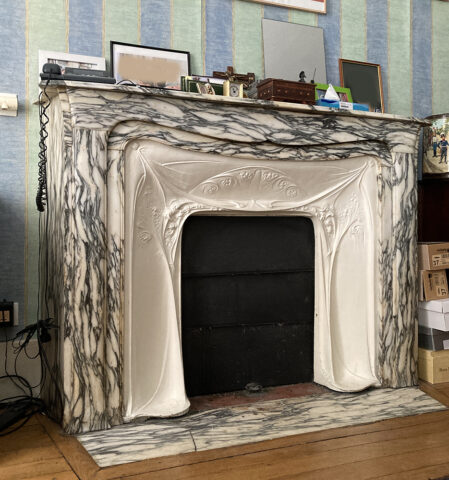
Fireplace with a GB insert in an apartment in the Trémois building (1909–1910). Photo by F.D.
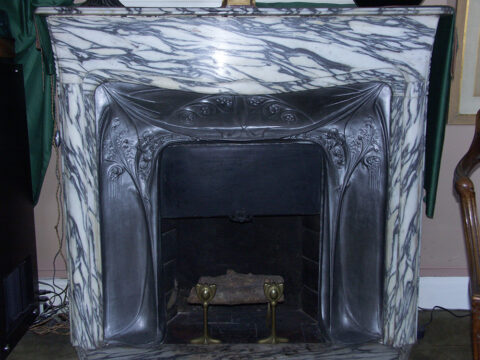
Fireplace with a GB-style insert, in an apartment at 17 Rue La Fontaine (1909–1911). Photo by F. D.
Among the photographs donated by Adeline Oppenheim to the Bibliothèque des Arts Décoratifs in 1948 is another mantel design with a refined silhouette that may have been photographed as a plaster model during the design phase.
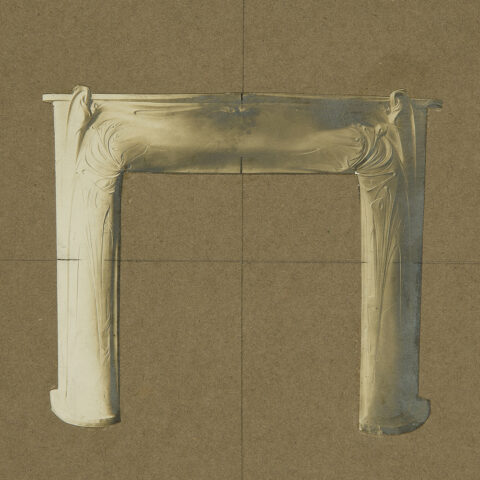
Probably a plaster model for a marble mantelpiece. Bibliothèque des Arts Décoratifs, donated by Adeline Oppenheim-Guimard, 1948. Photo by Laurent Sully Jaulmes (detail).
These photographs, donated by Adeline Oppenheim-Guimard, are mounted on a sheet of heavy paper on which Guimard handwrote the model’s name and assigned it a number. This presentation suggests that he was planning to produce a catalog of fireplaces, just as he was considering others: chandeliers, hardware, mirror frames, vases, furniture, cutlery, and even tombs, for which the stonework would necessarily have to be commissioned from stonemasons. Most of these catalog projects never came to fruition, but they stand as an important testament, on the one hand, to Guimard’s desire to expand the scope of his creations almost infinitely, and on the other, to his wish to make them accessible to as many people as possible through mass production. On the eve of World War I, he was thus at the helm of a vast array of designs suitable for furnishing rental properties—whether modest or luxurious—as well as private mansions, all while maintaining tight control over the costs of their furnishings.
It is also worth noting that for his marble fireplaces, Guimard once again called upon contractors from northern France, as he did for the mosaics in the vestibules and halls of the Castel Béranger (De Smet in Lille), the earthenware versions of the Chalmont planters (De Bruyn in Lille), and the rugs and carpets (Honoré Frères and later Parlant & Biron in Tourcoing).
One cannot help but suspect the existence of a network of connections of which Louis Coilliot, the Lille-based ceramics dealer and client of Guimard, was likely a part.
Another telling sign that Guimard was closely connected to the marble industry is that in early 1908, just as the catalog of artistic castings published by the Fonderie de Saint-Dizier was about to be released, an unsigned article appeared, purportedly covering the 1907 Salon des Artistes Décorateurs but in fact devoted almost entirely to commenting on Guimard’s exhibition at that salon. No doubt due to a lack of access to the major decorative art journals of the time, which typically excluded the architect, it ended up in an obscure trade journal for the marble industry. This text offers a eulogy of the “Guimard Style” with an enthusiasm its creator had never enjoyed, not even when it was in vogue. The praise is so effusive that if Guimard was not the author himself, he must have firmly guided the writer’s pen and provided all the necessary arguments.
After the war, there is no evidence that Guimard created any new fireplace designs. In all areas of his work, he continued to reuse his older designs while occasionally—though rarely—creating new ones. The list of businesses at the Village Français town hall, built for the 1925 Exposition of Modern Decorative Arts, includes a fireplace manufacturer, the Société Industrielle des Pyrénées, but it is unlikely that Guimard designed a model specifically for this occasion. He continued, however, to use this heating method, as fireplaces are still present in a prestigious building such as the one at 18 Rue Henri Heine (1926), where the Guimards lived from 1930 to
Frédéric Descouturelle
with the participation of Olivier Pons
Notes
[1] Its origins can even be traced back to Jules Hardouin-Mansart’s renovation of Louis XIV’s apartment at the Grand Trianon in the late 17th century. [2] Originally from Belgium, Albert Maybon’s marble company operated a quarry in Flaumont-Waudrechies, in the Nord department, in 1900. (source: Burgundy-Franche-Comté Regional Inventory). At the Paris World’s Fair, the company, representing Belgium, exhibited two marble columns from the Gochenée quarry near Namur (source: official exhibition catalog, Group XII, Class 66, fixed decoration of public buildings and dwellings). [3] The Société anonyme des usines et carrières Devillers et compagnie was a Belgian company founded in 1893 and operating in Marpent (Nord). This company is cited by Guimard in a letter published by La Construction Moderne in 1913 as one of the companies that made the greatest sacrifices to market the models designed by Guimard. It was dissolved in 1910 (National Archives of the World of Work). However, it likely continued under a new name, as the Société des carrières et marbreries de Marpent took it over in 1927 (Hauts-de-France Inventory, Presentation of the Municipality of Marpent).Translation: Alan Bryden
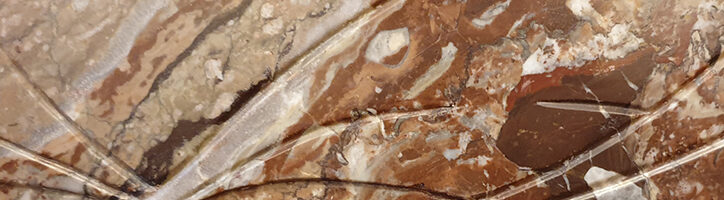
Guimard’s Marble Fireplaces — 2 — Restoration of the Sculpted Decor on a Fireplace in the Trémois Building
19 April 2026
All photos owned by the authors or by the Cercle Guimard Archives and Documentation Center must, without exception, be approved by the Cercle Guimard for any publication project, regardless of the medium.
In the apartment of one of our members, located in the Trémois building designed by Guimard in 1909–1910 on Rue François Millet, the living room and dining room feature different Guimard marble fireplaces fitted with cast-iron inserts (GA and GB). We had noticed that the engraved decoration on the lintel of one of the mantels had been obscured. We therefore suggested the assistance of our friend Émilie Dominey, who, after leading guided tours for the Cercle Guimard for several years while pursuing training in sculpture conservation and restoration, is now working independently. We are reproducing the report of her work below.
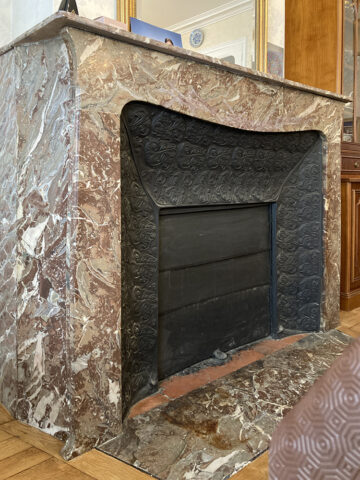
The fireplace in the dining room of an apartment in the Trémois building on Rue François Millet, Paris’s 16th arrondissement, before renovation. Photo by F. D.
Condition Report
Hector Guimard’s fireplace is framed by a mantelpiece decoration made of red, veined marble veneer. The top of the mantelpiece consists of a wooden panel covered with a painted faux-marble design.
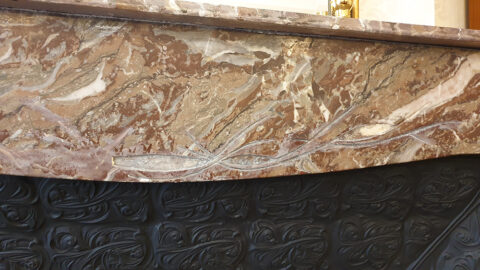
This fireplace once featured a delicate, chiseled marble decoration on the upper lintel. It has been covered with a layer of plaster and retouched with paint—likely acrylic—in an attempt to recreate the marble’s veining.
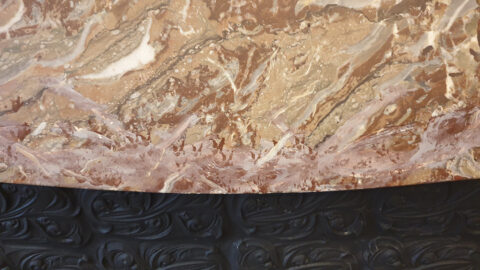
Carved decoration covered with plaster and retouched. Photo by E. D.
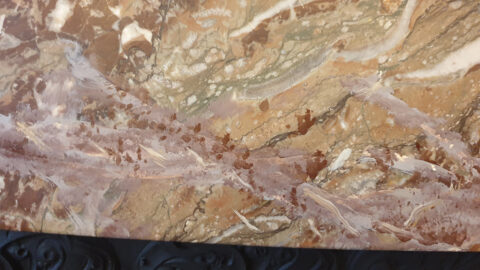
Detail of the decoration and color retouching. Photo by E. D.
Conservation and Restoration Work
Removal of Plaster
The plaster coating that covered the carved decorative details was removed using stonemason’s tools (chisel and mallet) and a scalpel.
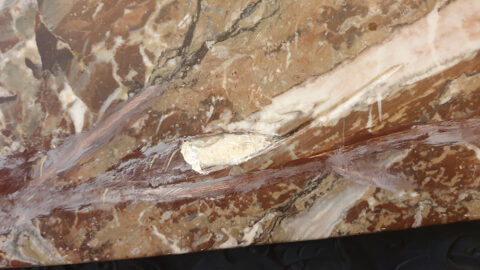
Detail of the decoration; plaster removal in progress. Photo by E. D.
Détail du décor, retrait du plâtre en cours. Photo E. D
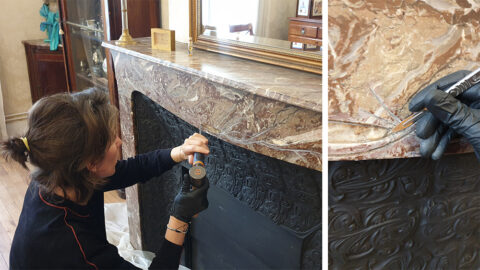
Detail of the decoration; plaster removal in progress. Photo by E. D.
Removal of the old color retouching
The old color retouching was easily removed using a solvent and cotton (acetone).
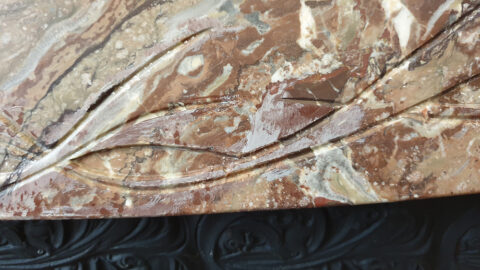
Detail of the decoration after removal of the plaster Photo E. D.
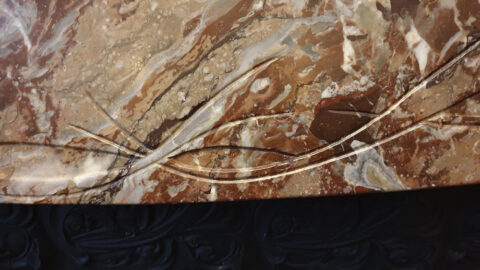
Close-up of the decoration after cleaning and removal of the colored retouching. Photo by E. D.
Cleaning
After removing the old layers that had obscured the decoration, the entire surface of the marble mantelpiece was cleaned with water and a sponge.
Touch-up and Wax Application
Certain areas showing tool marks were lightly touched up with watercolor. The entire surface of the marble was coated with a thin layer of microcrystalline wax to restore the marble’s full luster.
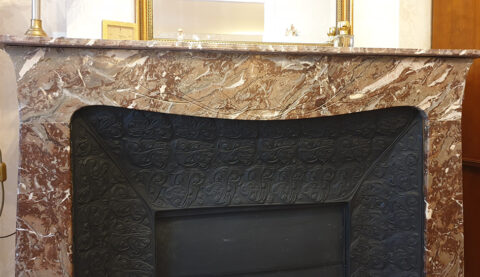
View of the upper lintel after treatment. Photo by E. D.
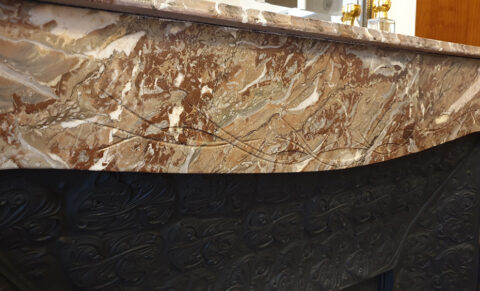
Detail of the sculpted decorztion after treatment Photo E. D.
It is worth noting that this same decorative motif can be found on other similar fireplace designs by Hector Guimard, notably at the Hôtel Mezzara, in a servant’s room on the second floor.
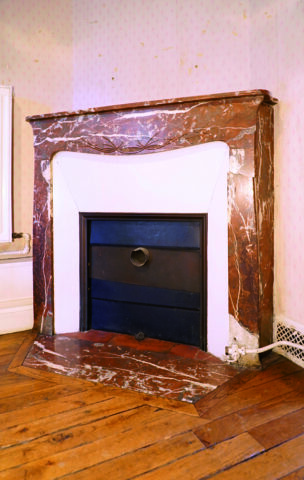
Fireplace on the second floor of the Mezzara Hotel, featuring a marble mantelpiece similar to the one restored in the Trémois building. The insert consists of simple flat ceramic tiles. Photo by F. D.
Émilie Dominey – Sculpture Conservation and Restoration
Translation : Alan Bryden
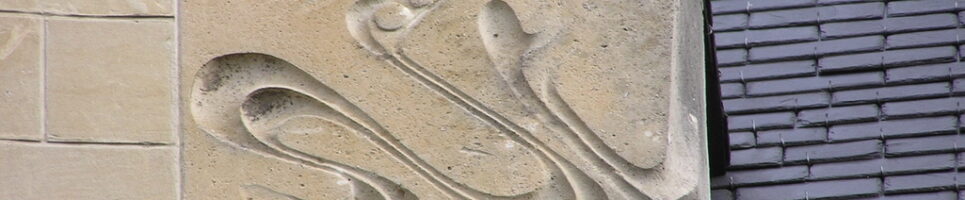
Opening this summer of the Villa Berthe- La Hublotière
As they do every year, the owners of Villa Berthe – La Hublotière, located in Le Vésinet (78) (one hour from Paris by Metro and RER), will open the garden to the public. This presents a perfect opportunity for visitors to get a closer look at this remarkable structure, built by Hector Guimard in 1896.
La villa Berthe – La Hublotière, 72 route de Montesson, 78110 Le Vésinet
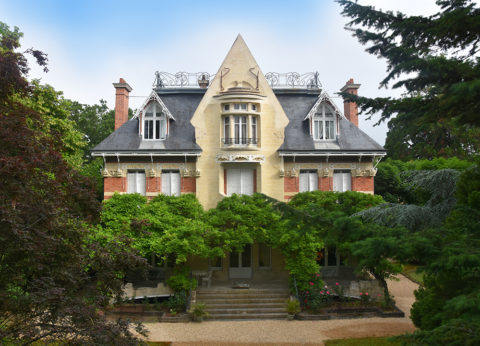
Villa Berthe – La Hublotière, façade sur rue. Photo F. D.
2026 Opening Hours:
8:30 AM to 2:30 PM (last admission at 1:45 PM):
– every day from July 1 to July 24 (including weekends and holidays),
– every day from August 31 to September 13 (including weekends),
– September 19 and 20.
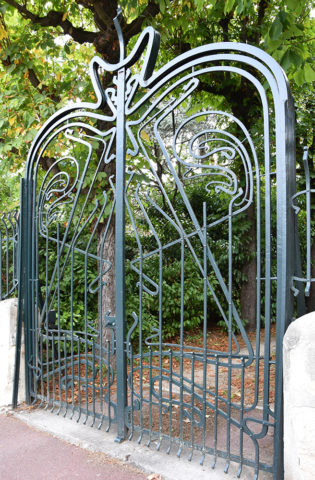
Villa Berthe – La Hublotière, gate at the street entrance to the driveway. Photo F. D.
Price list:
– €5/adult,
– €1/child aged 3 to 12, free for children under 3.
– Family rate: free admission for children (under 18) when accompanied by at least 2 adults.
– Group rate: 10% off for groups of more than 10 people. For groups, please contact us at lavillaberthe@gmail.com so we can best organize your visit.
More information on the web site: https://lahublotiere.com
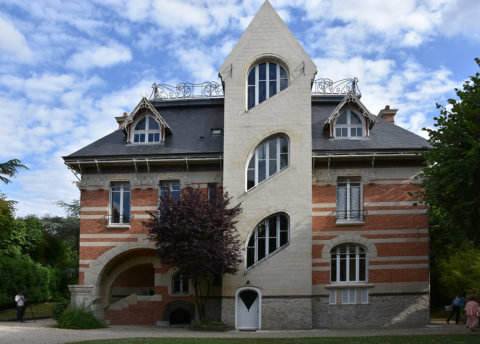
Villa Berthe – La Hublotière, rear side. Photo F. D.
Built around the same time as Castel Béranger, from which it borrows certain features, Villa Berthe is considered Guimard’s first Art Nouveau work. Its striking rear façade—invisible from the street—clearly reveals the location of the staircase in the central bay and highlights the flights of stairs with rampant arches above each of the half-level windows.
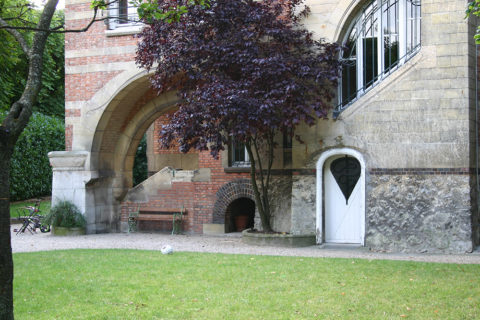
Villa Berthe – La Hublotière, rear side Photo F. D.
It likely served as a partial inspiration for Henri Sauvage when designing the front facade of the Villa Majorelle in Nancy.
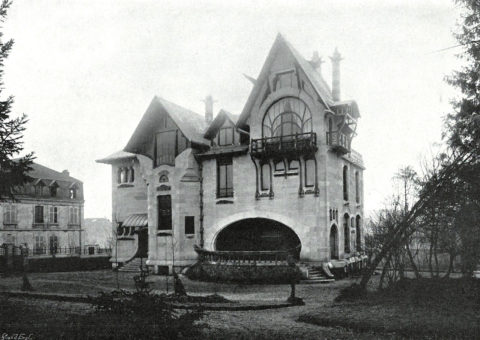
Villa Majorelle in Nancy, L’Art Décoratif, August 1902. Bibliothèque numérique Limédia, site of the musée de l’École de Nancy/Villa Majorelle.
The tour will give visitors a chance to admire the glazed sandstone lintel decorations, likely the work of Bigot or Gilardoni & Brault. They are framed by cut iron sheets.
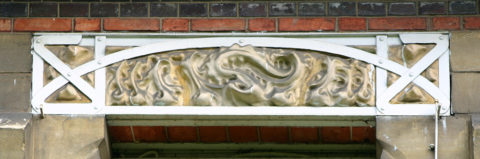
Villa Berthe – La Hublotière, Lintel decoration of the street facing facade
Photo Nicolas Horiot
The carved stone sculptures are in relief,
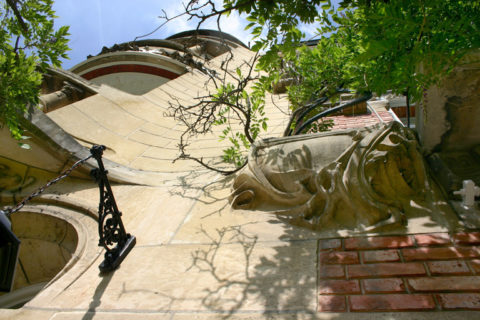
Villa Berthe – La Hublotière, facade street side. Photo Nicolas Horiot.
or recessed—as at Castel Béranger—which allowed for cost savings but may also be a sign of work carried out after the structural framework had already been completed.
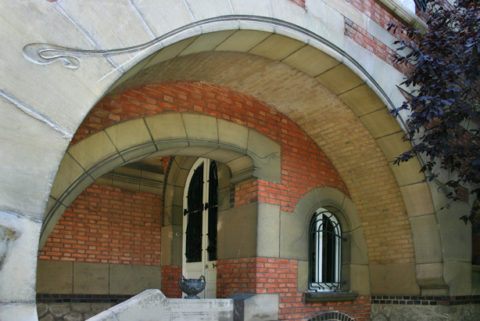
Villa Berthe – La Hublotière, rear facade Photo Nicolas Horiot.
The ironwork, which is also similar to that of Castel Béranger, consists of rolled iron bars that are bent and assembled using screws in overlapping layers or separated on the same plane by small cylindrical spacers through which screws pass.
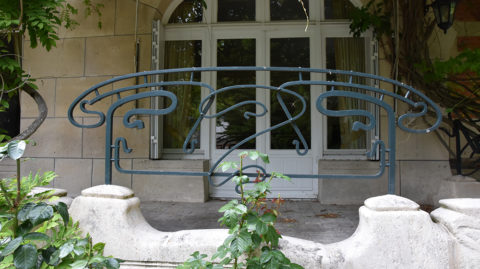
Villa Berthe – La Hublotière, wrought-iron railing on the terrace facing the street. Photo by F. D.
Other ironwork pieces created using the same technique line the rooftop terrace.
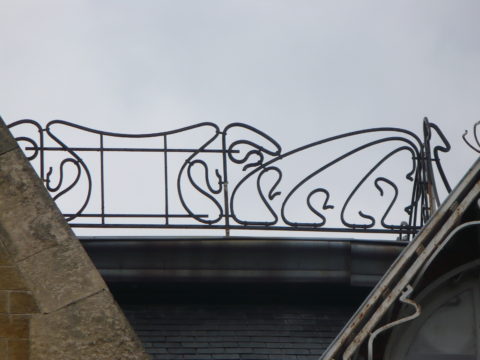
Villa Berthe – La Hublotière, wrought iron railing on the rooftop terrace. Photo by O. P.
As we do every year, we commend this generous initiative by the owners, who recognize the artistic value of their property and wish to share it with others.
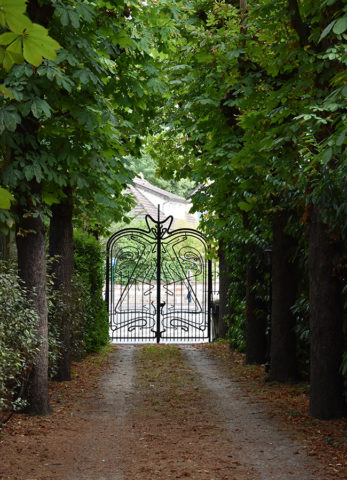
Villa Berthe – La Hublotière, driveway and gate facing the street. Photo by F. D.
The “Dreyfus Affair of the Fine Arts”: Guimard and the Legion of Honor
22 May 2026
It is always a pleasure to publish articles by Léna Lefranc-Cervo, who now holds a Ph.D. in the history of architecture and teaches at the École nationale supérieure d’architecture de Nancy. This article serves as a perfect follow-up to her piece “Protecting Parisian Art Nouveau Heritage: Initiatives and Networks in the Interwar Period,” as well as to her presentation “Hector Guimard and the Group of Modern Architects: Networks and Mobilization Strategies of a Modern Architect” during the Hector Guimard study day at Paris City Hall on December 3, 2024, and finally our article on Guimard’s use of different varieties of brick. This investigation into a setback suffered by our architect shows that a simple slanderous accusation—which could have been dismissed by a brief inquiry—required the persistent mobilization of his network of friends and professionals to secure the coveted decoration. This administrative inertia could also be indicative of the lingering effects of past hostility toward this innovator, as well as a certain inability to recognize him as one of the founding fathers of modern architecture and decorative arts in France.
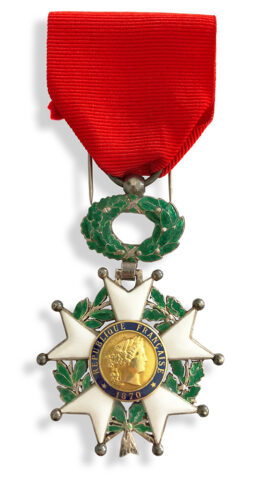
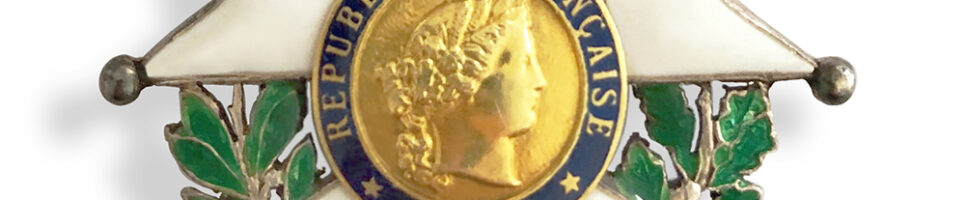
Knight’s Cross of the National Order of the Legion of Honor, Third Republic model.
Source: commons.wikimedia.org
The 1925 International Exhibition of Modern Decorative and Industrial Arts marked a triumph for modern architects. Having formed the Group of Modern Architects (GAM) in 1922, they had secured the major commissions for the International Exhibition. At the conclusion of the event, Frantz Jourdain, the Group’s president, described the exhibition as “a complete victory of modern art over all forces of incomprehension and routine[1].”
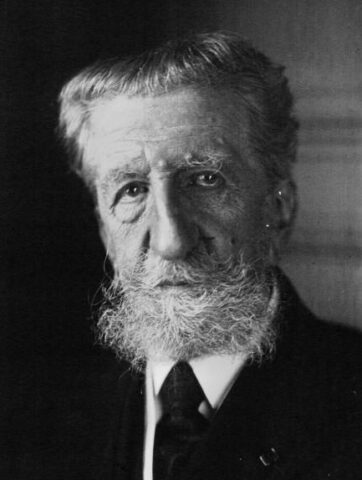
Portrait of Frantz Jourdain from 1923. National Library of France.
Shortly thereafter, Henri Sauvage, vice-president of the GAM, wrote to Paul Léon, director of the Beaux-Arts, stating: “You led us so well into the fray that here we are, all at once, and almost [unconsciously?], having achieved success[2].” Success was thus assured, and the Exhibition’s organizing committee then requested that the architects be promoted to the Legion of Honor, a process that would have finally established the Group’s members as the leading figures of the French architectural scene.
As early as 1926, several architects who had participated in the event were promoted to various ranks of the Legion of Honor. Henri Pacon, Michel Roux-Spitz, Pierre Chareau, Albert Laprade, Alfred Levard, Bernard Haubold, Edmond Malo, Robert Mallet-Stevens, Joseph Marrast, Paul Montagnac, Fernand Nathan, Auguste Perret, Henri Sauvage, and Pierre Selmersheim were made Knights. A few others were also promoted to the higher rank of officers, including Adolphe Dervaux, Ernest Herscher, and Charles Letrosne, as well as Pierre Paquet, Louis-Pierre Sézille, Louis Sorel, and Pierre Sardou. While the promotion of Dervaux, Sorel, Selmersheim, and Sauvage was seen at the time as a victory for the Group of Modern Architects, the group also suffered a bitter setback with the omission of Henri Favier, Gabriel Guillemonat, Pierre Patout, and, above all, its vice president and founder, Hector Guimard. Gathered to discuss the new promotions, the committee members expressed their outrage at “not finding in *L’Officiel* the names of certain members who rendered exceptional service[3].” The committee then sent a letter to the Minister of Commerce, and two protest letters were published in *Comœdia* on June 6, 1926. Yvanhoé Rambosson, the Group’s secretary-general, intended to publicly highlight the fundamental role of Guimard, who “played too dominant a role in the history of the modern movement to be forgotten[4]”:
“Let today’s innovators ask themselves if they would be doing what they do without having benefited from the experience of two generations. They will recognize Guimard’s splendidly revolutionary role and defend it alongside me. (…) It would be unjust to see many of those who entered the new forest through the breach he had made receive honors, without the first woodsman being rewarded[5].”

Portrait of Yvanhoé Rambosson, *Le Carnet de la semaine*, July 12, 1925, p. 12.
Following this appeal, Patout was finally awarded the rank of Chevalier. Guimard, however, continued to be sidelined in the recognition process. At the February 1927 committee meeting, the “Guimard affair” dominated much of the discussion among the members. New efforts were then made by the GAM to approach Bokanowski[6] and by Rambosson to approach Édouard Herriot. But the committee reported on the difficulties encountered:
“Our various expressions of indignation were met with total indifference. We have come up against high-ranking officials who have refused to inform themselves about such a delicate matter, or who have taken no action[7].” The committee, however, remained resolute: “We cannot leave matters as they are indefinitely. We have a duty to succeed in lifting the cruel injustice afflicting our comrade GUIMARD, and the Group will have to make his case its own personal concern[8].”
The Chancellery of the Order of the Legion of Honor had received a letter from an industrialist named Taté, owner of a factory and a plaster quarry in Thorigny-sur-Marne, who, without specifying the exact reasons[9], deemed Guimard unworthy of receiving this distinction[10]. The exact nature of this dispute is unknown. It is possible that it arose in the context of their collaboration on the construction of the town hall for the Village Français.
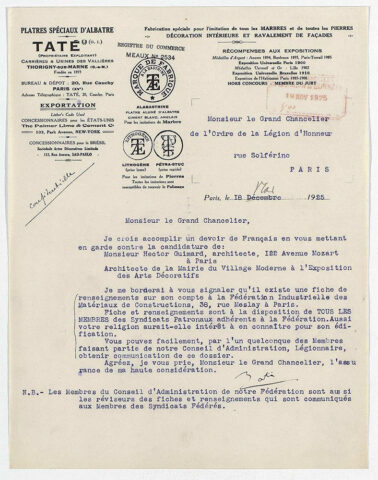
Letter from Taté to the Grand Chancellor of the Order of the Legion of Honor, dated May 18, 1925. National Archives, Léonore database, Guimard’s Legion of Honor file.
“Mr. Grand Chancellor,
I believe I am fulfilling my duty as a French citizen by warning you against the candidacy of:
Mr. Hector Guimard, architect, 122 Avenue Mozart, Paris
Architect of the Village Moderne Town Hall at the Exposition des Arts Décoratifs.
I will limit myself to pointing out that there is an information file on him at the Industrial Federation of Building Materials, 38 Rue Meslay in Paris.
The file and information are available to ALL MEMBERS of the employers’ unions affiliated with the Federation. Therefore, it would be in your best interest to review it for your own edification.
You may easily obtain a copy of this file through any member of our Board of Directors who is a Legionnaire.
Please accept, Mr. Grand Chancellor, the assurance of my highest regard.
N.B. — The members of our Federation’s Board of Directors are also the reviewers of the files and information that are communicated to the members of affiliated unions.”
In any case, Taté’s complaint triggered an investigation by the Ministry of Commerce, which brought all proceedings undertaken by the Exhibition Commission to a halt. The injustice was, it seems, sufficiently evident that the aggrieved vice-president of the GAM decided not to attend the banquet organized by the Group of Modern Architects in March 1927 in honor of the new members[11]. On this occasion, Guimard wrote a letter in which, while congratulating his colleagues on their success, he expressed his dismay at the injustice he was facing.
In Rambosson’s writings, these events came to be known as the “Dreyfus Affair of the Fine Arts.” The case was raised again at the GAM committee meeting on June 7, where Frantz Jourdain, lamenting the administrative delays, indicated that he would resume the efforts. But by November, nothing had yet been achieved. The GAM’s secretary-general then recalled the promises made by Paul Léon as well as those of Herriot and expressed surprise that the Group had not obtained satisfaction. It would, however, be another two years before the GAM architects’ efforts became more aggressive. On February 2, 1929, Rambosson sent the Minister of Commerce a letter countersigned by Jourdain[13] on behalf of the Group of Modern Architects.
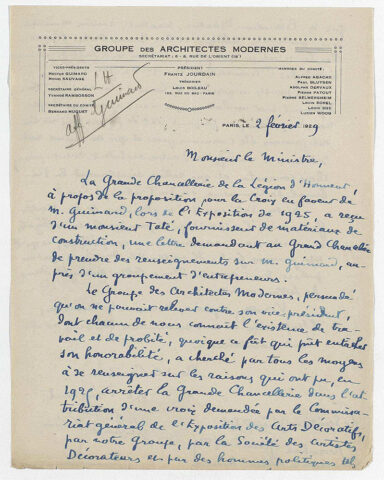
First page of the letter from Yvanhoé Rambosson, countersigned by Jourdain, addressed to the Grand Chancellor of the Order of the Legion of Honor on February 2, 1929. National Archives, Léonore database, Guimard’s Legion of Honor file.
For his part, Frantz Jourdain wrote to the Grand Chancellor himself the very next day, and a few days later, Jean-Baptiste Bienvenu-Martin, a senator from the radical left and former minister, also sent a letter exonerating the architect, using the same arguments as those put forward by Rambosson and Jourdain[14].
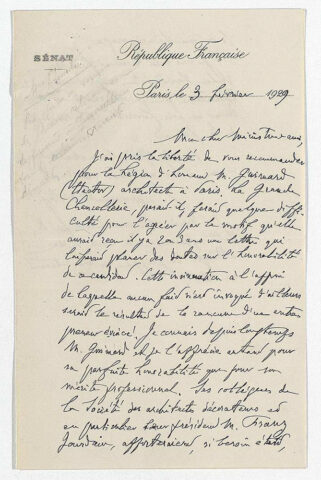
Letter from Senator Jean-Baptiste Bienvenu-Martin to the Minister of Commerce, dated February 12, 1929. Guimard’s Legion of Honor file. National Archives, Léonore Database.
Emphasizing the irreproachable conduct of the GAM’s vice president, Rambosson, the Group’s secretary general points out that the promotion was requested by no fewer than three different organizations: the General Commission of the Decorative Arts Exhibition, the Group of Modern Architects, and the Society of Decorative Artists. He dismisses Taté’s complaint as a mere “dispute between architect and contractor, a common occurrence that falls solely within the jurisdiction of the Commercial Court or the Civil Court[15].” He notes that Taté has not brought the matter before either of these courts “and that it therefore does not appear that a letter sent under such circumstances can be taken into account[16].”
As for Jourdain, he points out to the Grand Chancellor that the charges against Guimard remain unknown: “The Ministers whom I had the honor of meeting on this subject, [illegible], have always assured me that no grievance remains against our candidate, and I find myself facing an inextricable situation for which you alone, General, can find a solution[17].” He continues: “If Mr. Guimard is innocent and worthy of the esteem in which all artists hold him, let us finally accept a 62-year-old artist who has demonstrated throughout his long career as much originality as talent, and who must finally be cleared of hypocritical, base, and cowardly attacks that could greatly tarnish his reputation[18].”
To support their cause, Rambosson had a short article published in Comœdia on February 22, emphasizing the role played by the vice president of the GAM in the emergence of modern architecture in France[19].
The interventions of the two men appear to have been decisive, and thanks to the energetic efforts of André Dezarrois, chief of staff to the undersecretary of state for the Fine Arts, André François-Poncet, the matter was finally resolved. Dezarrois inquired with the Industrial Federation of Building Materials, whose president replied that he had never been informed of any issue concerning Guimard and had never been asked to give an opinion on the architect[20].
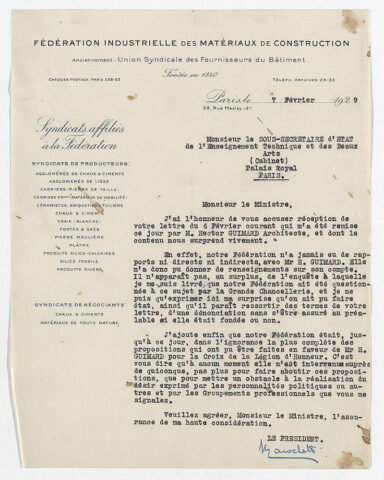
Letter from the president of the Industrial Federation of Building Materials to the Under-Secretary of State for Fine Arts, dated February 7, 1929. National Archives, Léonore database, Guimard’s Legion of Honor file.
This response brought the matter to a definitive close, and on February 28, 1929, Guimard was finally promoted to the rank of Chevalier. The news was immediately reported in *Comœdia*, and Frantz Jourdain, himself a Grand Officer, welcomed Guimard into the Legion of Honor. The resolution of the case thus demonstrated the solidarity and ability of modern architects close to Guimard to rally together.
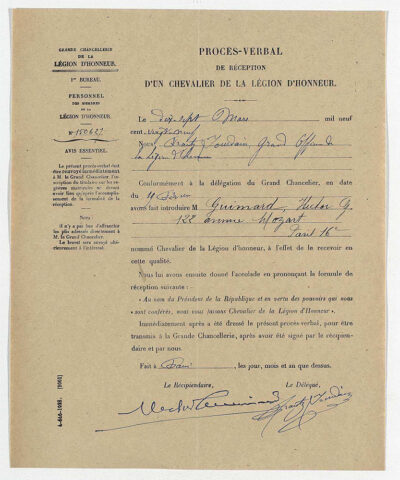
Minutes of Guimard’s induction into the Order of the Legion of Honor, dated March 27, 1929. Guimard’s Legion of Honor file. National Archives, Léonore Database.
This approach is characteristic of the positioning strategies of GAM members, who were convinced that the recognition of modern architects—and, through them, of modern architecture—could only be achieved through validation by official bodies. In 1895, Jourdain published *Les décorés, ceux qui ne le sont pas*[21] as a tribute to artists who had not received institutional recognition. Although the book surprisingly includes no architects’ names, it remains fundamental to understanding Jourdain’s approach, as he maintained throughout his life the ambition of securing official recognition for modern architects. For the president of the GAM, receiving an honor such as the Legion of Honor constituted an essential step in the fight for their recognition. Jourdain’s interest in this matter may seem surprising given his systematic—and often vehement—opposition to these very same official bodies. Jourdain is, in fact, primarily a progressive reformer who seeks to improve the situation of modern artists, yet he remains committed to the republican values of merit. It is not the institutions themselves that Jourdain questions, but rather the selection process they employ and, by extension, the judgment of those who constitute them. Jourdain believes that recognition for modern architects—and, through it, the triumph of modern architecture—will be achieved through democratic pressure exerted primarily through associations. His main objective is to secure official recognition for the modernists by replacing the established standards. For Jourdain, innovative architects must ultimately replace the Beaux-Arts architects—whom he considers mediocre—as France’s artistic glories. In his view, the innovators’ victory can only be achieved if there is a reversal of values within the democratic sphere itself.
Following this long-awaited victory, the GAM decided to hold a banquet in honor of the architect, which was organized in June 1929 at the Hôtel Lutetia.
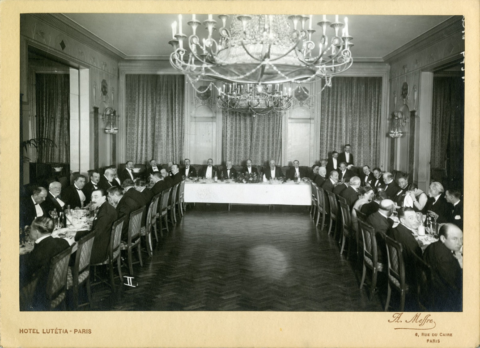
A. Meffre, photographer. Banquet hosted by the Group of Modern Architects in June 1929 in honor of Hector Guimard at the Hôtel Lutetia. Perret Collection, Center for Contemporary Architecture Archives (Cité de l’architecture). All rights reserved.
This banquet is indeed presented as a festive occasion marking the recognition of Vice President Hector Guimard. The aim is to celebrate what the GAM will present as the architect’s official recognition and as a new victory for the Modernists, achieved thanks to the Group’s mobilization. Through Guimard, the entire founding network of the Group of Modern Architects is also being recognized. For the Group, the event apparently signified the State’s rallying to the cause of the Modernists. As such, the list of political representatives from the State and the City of Paris that the GAM planned to invite was impressive. No fewer than eleven representatives of national and Parisian administrations are invited, including André François-Poncet, Under-Secretary of State for Fine Arts, and his chief of staff André Dezarrois, as well as the Prefect of the Seine, the Police Prefect, the President of the Municipal Council and the General Council, the budget rapporteurs for Fine Arts in the Senate and the Chamber of Deputies, the President of the Civil Court of the Seine, and finally Paul Léon and Fernand David. Aside from the confirmed attendance of André François-Poncet at this banquet, the presence of other representatives from these administrations cannot be confirmed. The speech delivered by the Under-Secretary of State was, in fact, in line with the GAM’s views, and the senior official confirmed the recognition of the Group’s architects, noting that the Exposition had demonstrated that France had regained “its rightful place—as a creator, a guide, and a trendsetter[22].” This result “is the work of the bold pioneers, the leaders gathered here: Frantz Jourdain, Louis Bonnier, Henri Sauvage, Georges [sic] Sorel, Auguste Perret, Paul [sic] Bluysen, Louis Boileau, Adolphe Dervaux, and Lucien Woog[23].” The banquet, however, could not have played this role without the media coverage of the event provided by Rambosson in Comœdia. The Group’s former secretary-general presented the banquet as “a splendid celebration of modern architecture[24]” that brought together “the best of our innovators[25],” among whom he named: Auguste Perret, Sauvage, Bonnier, Dervaux, Boileau, Sézille, Sardou, Selmersheim, Patout, Tournon, Abraham, Favier, Gouverneur, Woog, and Bluysen[26].
Nevertheless, François-Poncet’s speech also constitutes a mixed tribute to Hector Guimard, despite the fact that he was the guest of honor at this dinner. Recalling his childhood memories in Cabourg, the senior civil servant then spoke of the interchangeable houses built at the turn of the century, followed by the arrival of modern architectural prototypes:
“And then, one day, Hector Guimard’s work appeared on this coast (…) For me, it was a source of perplexity and the starting point for some reflection. I did not consider the result to be entirely successful, and, to tell the truth, I did not have the overwhelming impression of any decisive beauty. But I was unsettled; for me, it was the revelation of an attempt, of a desire for innovation, whose underlying principle I felt deep down was sound and commendable; so I was particularly pleased to be able, some twenty-five years later, to pay tribute—and do justice—to the man who had given it to me[27].”
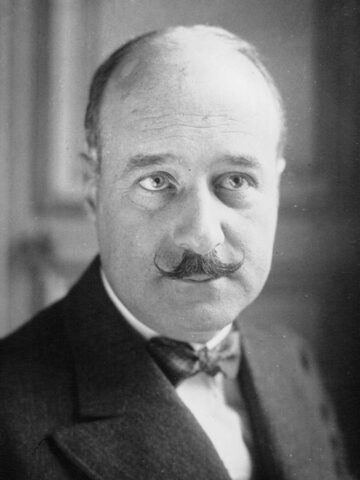
Portrait of André François-Poncet (1887–1978) from 1931. Source: Wikipedia, Meurisse Press Agency, National Library of France.
François-Poncet’s speech is indicative of the relative indifference and poor reception of Guimard’s work on the eve of the 1930s, as well as the difficulty in accepting the architect as a leading figure in modern architecture. In many ways, it foreshadows the obscurity and neglect into which the architect and his work would sink in the following decade. While Guimard could indeed count on the support of his friends and his network—who would always remain committed to defending his work, as Auguste Bluysen’s efforts in the 1940s would demonstrate—the relative lack of understanding surrounding Art Nouveau would overshadow the quality and significance of his work for at least thirty years.
Léna Lefranc-Cervo
Ph D. in history of architecture
Notes
[1] Yvanhoé Rambosson, “The Consequences of the Exposition,” Paris-Soir, July 8, 1925, p. 1
[2] Handwritten letter from Henri Sauvage to Paul Léon, May 3, 1926, Pierrefitte-sur-Seine, National Archives, Collection of the Ministry of Public Instruction and Fine Arts, 20140260/2. [3] Le Rapin, “Fine Arts. New Charcoal Drawings,” Comœdia, June 6, 1926, p. 2. [4] Ibid. [5] Yvanhoé Rambosson, “Another Forgotten Guimard,” Comœdia, June 6, 1926, p. 1. [6] Maurice Bokanowski was Minister of Commerce at the time. [7] Minutes of the meeting of the committee of the Group of Modern Architects on February 19, 1927, Paris, Center for Contemporary Architecture Archives, Perret Collection, 535 AP 561/1. [8] Ibid. [9] I would like to thank the Cercle Guimard and Frédéric Descouturelle for this information. [10] Typewritten letter from Taté to the Grand Chancellor of the Legion of Honor, May 18, 1925, Pierrefitte-sur-Seine, National Archives, Hector Guimard’s Legion of Honor file, available online at https://www.leonore.archives-nationales.culture.gouv.fr/ui/#show [11] Yvanhoé Rambosson, “The Banquet of Modern Architects,” Comœdia, March 28, 1927, p. 2.[12] Yvanhoé Rambosson, “A Grand Celebration of Modern Architecture,” Comoedia, June 22, 1929, p. 3. Since no anti-Semitic undertones could be found in this case of the delayed awarding of the Legion of Honor, the term “Dreyfus affair of the fine arts” must certainly be understood as equivalent to “grave injustice,” even though the two cases are obviously not comparable.
[13] Handwritten letter from Yvanhoé Rambosson, countersigned by Frantz Jourdain, to the Minister of Commerce, February 2, 1929, Pierrefitte-sur-Seine, National Archives, File on the appointment of Hector Guimard to the rank of Knight of the Legion of Honor, available online at https://www.leonore.archives-nationales.culture.gouv.fr/ui/#show. Rambosson follows his signature with his title of Knight of the Legion of Honor, and Jourdain with that of Grand Officer of the Legion of Honor. [14] Handwritten letter from Jean-Baptiste Bienvenu-Martin, February 3, 1929, Pierrefitte-sur-Seine, National Archives, File on the appointment of Hector Guimard to the rank of Knight of the Legion of Honor, available online at https://www.leonore.archives-nationales.culture.gouv.fr/ui/#show [15] Handwritten letter from Yvanhoé Rambosson, countersigned by Frantz Jourdain, to the Minister of Commerce, February 2, 1929. Op. cit. [16] Ibid. [17] Handwritten letter from Frantz Jourdain to General Dubail, Grand Officer of the Legion of Honor, February 3, 1929, Pierrefitte-sur-Seine, National Archives, File on the appointment of Hector Guimard to the rank of Knight of the Legion of Honor, available online at https://www.leonore.archives-nationales.culture.gouv.fr/ui/#show [18] Ibid. [19] “Les artistes. Hector Guimard,” Comœdia, February 22, 1929, p. 2. [20] Typewritten letter from the president of the Industrial Federation of Building Materials to the undersecretary of state for Fine Arts, February 7, 1929, Pierrefitte-sur-Seine, National Archives, File on the appointment of Hector Guimard to the rank of Knight of the Legion of Honor, available online at https://www.leonore.archives-nationales.culture.gouv.fr/ui/#show [21] Frantz Jourdain, Les décorés, ceux qui ne le sont pas, Paris, H. Simonis Empis, 1895. [22] “Mr. François-Poncet Praises New French Architecture,” Comœdia, June 22, 1929, p. 1. [23] Ibid., p. 2. [24] Yvanhoé Rambosson, “The Beaux-Arts. A Grand Celebration of Modern Architecture,” Comœdia, June 22, 1929, p. 3. [25] Ibid. [26] The banquet also brought together Brunet, Montagnac, Lambla de Sarria, Guillemonat, Guët, and Houdaille. [27] “Mr. François-Poncet Praises New French Architecture,” Comœdia, June 22, 1929, p. 1.
Translation : Alan Bryden
Victor Horta. The Solvay hotel, 224 Avenue Louise in Brussels. About a recent book published by Éditions Racine in Brussels.
Françoise Aubry, former curator of the Horta Museum in Brussels, had been a friend of the Cercle Guimard even before its founding in 2003. We met her on numerous occasions—in Paris, Brussels, and Barcelona—and corresponded with her frequently. Her expertise and experience guided us through the difficult journey toward establishing a Guimard Museum in Paris, and she graciously agreed to write the foreword for our first book dedicated to the Hôtel Mezzara in 2018, at a time when its future was highly uncertain.
Françoise was kind enough to respond to our request and send us a summary of the remarkable book she has just published on the Solvay hotel, one of Victor Horta’s masterpieces and undoubtedly his most luxurious work. On the occasion of the building’s repurposing—it has become a museum open two days a week following extensive restoration—she revisits the meticulous work of Yolande Oostens-Wittamer, published nearly thirty years ago.
In 1894, Armand, son of the great inventor and industrialist Ernest Solvay, married Fanny Hunter. The young couple chose to settle on Avenue Louise, at the time Brussels’ most prestigious boulevard, and to have a mansion built on a 950-square-meter lot. He chose Horta as the architect. His name was suggested by engineer Émile Tassel, for whom he was building a house nearby at 6 Rue Paul-Émile Janson, and by Tassel’s friend, Charles Lefébure, Ernest Solvay’s personal secretary. Horta was not yet very well known, but the novelty of the Tassel mansion caused a sensation. He would undoubtedly be able to build a residence equipped with all modern comforts (central heating, a bathroom, electricity) that would highlight the young couple’s boldness in the eyes of Brussels’ “high society”—a conventional crowd enamored with eclecticism. The Solvays’ fortune was recent and owed to the entrepreneurial skills of Alfred and Ernest Solvay. They were not heirs to a family tradition that might have constrained their choices and forced them into conformity.
Horta won the family’s trust and was commissioned for various projects, ranging from the family tomb at the Ixelles cemetery to the company’s laboratories on Rue des Champs-Elysées in Ixelles, including a château in Chambley, Lorraine, for Alice, who was married to Baron Henri de Wangen.
On September 3, 1894, Horta presented his initial plans to Armand Solvay. The project promised to be monumental. In his Memoirs, he speaks of a “giant’s work,” as the architect was also responsible for the interior decoration, including all the furniture, each piece of which was unique and custom-designed.
The building permit was granted by the City of Brussels on August 20, 1895. The construction project would be lengthy and could be considered complete in 1902 when the large canvas by the painter Théo Van Rysselberghe, *Reading in the Park*, was hung in the stairwell, blending beautifully into the colorful world created by Horta.
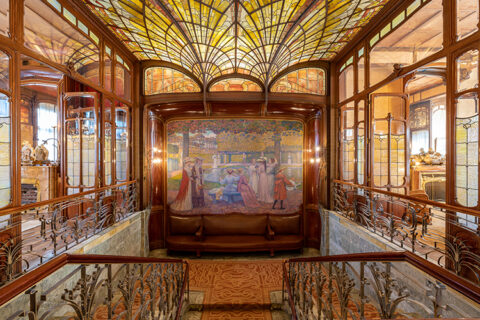
Solvay hotel at 224 Avenue Louise in Brussels, 1895–1902, landing of the staircase leading from the ground floor to the bel étage, painting *Reading in the Park* by Théo Van Rysselberghe. Photo by Gilles van den Abeele.
The Solvay hotel remained largely unchanged throughout much of the 20th century. During World War II, the glass roof covering the grand staircase was blown off when a bomb fell nearby. In the early 1950s, the Solvay family decided to sell the building, preferring to live in the green suburbs of Brussels. They offered to sell the mansion to the Belgian government at a reduced price. This generous offer was rejected, and it was not until late 1957 that the hotel was acquired by Mr. and Mrs. Wittamer-De Camps, who intended to establish their haute couture ateliers there. Various renovations were then carried out to adapt the mansion to its new purpose, and the skylight above the grand staircase was covered with a floor (today, the double-fan-shaped glass roof has been restored but is artificially lit, as the floor remains at the second-floor level). This alteration also deprived the winter garden of natural light (in the bedrooms on the first floor). The rooms on the second floor now form a single large space spanning the entire depth of the building.
Thanks are due to Mr. and Mrs. Wittamer, for it is likely that without them the Solvay hotel would have suffered the same fate as Horta’s other buildings on Avenue Louise: his second private home, at No. 136; the Aubecq hotel, at No. 520 (demolished in 1950); the Roger hotel, at No. 459 (completely renovated). After World War II, Avenue Louise was cut through by tunnels, and many of its mansions were replaced by apartment buildings.
The Solvay hotel was not designated a historic landmark until 1977, too late to prevent the construction of the two buildings that flank it today. After the death of Mr. and Mrs. Wittamer, their son Michel took over the management of the historic building. As for their daughter, Yolande Oostens-Wittamer, she devoted herself to research on Horta, culminating in a doctoral dissertation on the Solvay Mansion presented at the University of Louvain-la-Neuve (published in 1980). The current owner is Michel Wittamer’s son, Alexandre, who commissioned me in 2024 to write a book on the Hôtel Solvay, nearly thirty years after the one published by his aunt with Diane de Selliers in 1996. This book was published by Racine in 2025 and has been translated into Dutch and English, featuring photographs by Gilles van den Abeele and a series of plans by the firm Van der Wee Architects, which conducted a new survey of the mansion in preparation for its restoration.
The layout of the Solvay Mansion breaks with the tradition of Brussels mansions. The carriage entrance is still present and opens onto a driveway leading to the stables built at the rear of the lot. These were not commissioned from Horta by Armand Solvay but from architects who regularly worked for the Solvay firm (Constant Bosmans and Henry Vandeveld, 1898). The façade features two large bow windows, topped by balconies, which frame a curved central section. On the main floor, the living room balcony offered a view of the carriages heading to the Hippodrome or the Bois de la Cambre. The metal structures, painted in light ochre, are ubiquitous and radically new in the context of a luxurious mansion. Euville stone lends itself to subtle molding, while the more durable blue stone is used for the base, the frames of the balcony’s French doors, and a few horizontal bands.
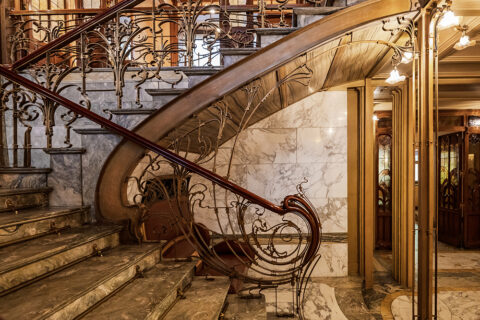
Victor Horta, Solvay hotel, 224 avenue Louise à Bruxelles, 1895-1902, the beginning of the railing of the stair case on the ground floor Photo Gilles van den Abeele
The interior layout is unique: the floor plan is organized around two stairwells, topped by a glass roof, situated against the shared walls. The grand staircase, preceded by a vast hall opening onto the carriage entrance, leads to a landing from which it splits into two branches leading to the main floor. One must then cross a large landing providing access to the row of salons on the street side and the dining room on the garden side, before taking a more discreet staircase to reach the private floors.
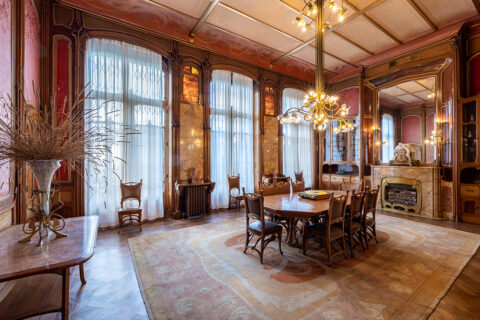
Victor Horta, Solvay hotel, 224 avenue Louise à Bruxelles, 1895-1902, dining room on the « bel étage » garden side , Photo Gilles van den Abeele
Thanks to glass doors, the living rooms and dining room can open completely onto the stairwell, which is transformed into a grand entrance hall on days when guests are hosted. The entire space of the main floor can be taken in at a glance. These doors also allow natural light from the street- and garden-facing facades to flood into the heart of the house. Horta masterfully controls the flow of light and maximizes natural light because it lends a shifting vitality to the colors of the stained-glass windows and creates multiple electric light fixtures in gilded brass, whose stems are oriented to highlight the colors of the stained-glass windows once night falls, the intricate carving of the woodwork, the gold accents of the ironwork and decorative paintings, and the brilliance of the beveled glass. He also adheres to the tradition of placing enormous mirrors above the fireplaces to enlarge the space and multiply the brilliance of the lamps.
Victor Horta, Solvay hotel, 120 avenue Louise à Bruxelles, 1895-1902, mosaic ceiling of the “bel étage”. Photo Gilles van den Abeele
Horta was, of course, an confirmed architect, but he was also an accomplished artist when he combined colors in the manner of the painters of his time, applying Chevreul’s laws of complementary colors. In the wall decoration of the stairwell between the main floor and the first floor, orange gradually blends into green.
The first-floor landing separates the rooms reserved for the parents (the husband’s study, the wife’s boudoir, the bedroom) from those intended for family life (the study, the small, intimate dining room). The landing benefits from two sources of light thanks to the glass roof covering the second skylight and a second rounded glass roof that closes off an opening in the first skylight above the grand staircase. The landing is designed as a gathering place, an intimate space with its low sofas, metal floor lamps that evoke trees, and a garden represented by the floral stems frozen in the stained-glass window. This space invites timeless daydreams, as the real world seems so far away.
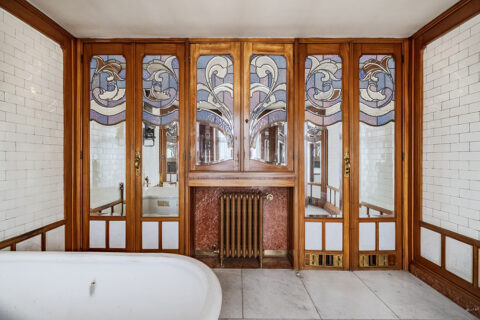
Victor Horta, Solvay hotel, 224 avenue Louise à Bruxelles, 1895-1902, bath room on the mezzanine Photo Gilles van den Abeele.
Between the first and second floors, Horta placed the bathroom on the mezzanine level. There, he boldly combines industrial materials such as white glazed brick with Carrara marble, set within American ash woodwork mounted on a red marble baseboard. Opposite the window, the door and cabinet panels are clad in beveled mirrors and frosted glass, used here for their texture and colors rather than to let in light, except in the door leading to the access corridor. The six panels form a splendid ornamental pattern. This bathroom exudes great refinement without being ostentatious. This is not the Hôtel de la Païva.
The walls of the final section of the stairwell are painted in an orange gradient fading to white as one approaches the glass roof. Bright orange arabesques outline a metal pergola, complemented by the glass roof and its foliage rendered in very soft yellow frosted glass. This arrangement highlights the fact that, in Horta’s work, the entire decorative system derives from the curve he imprinted on the metal. Rationally adapted to convey the material’s flexibility (in accordance with one of Viollet-le-Duc’s principles), the arabesque forms the basis of the wall decoration, which, in this case, represents architecture within the interior. The actual steel beams that frame the walls of the stairwell visually “support” painted arches, extended by the metal structure of the glass roof.
The service staircase, lit by a series of windows of various shapes on the garden side, provides access to a third floor, intended for the servants. The attic is spacious but cannot be fully utilized because its floor is pierced by the two skylights corresponding to the glass roofs set into the roof slope. This is a layout found in other buildings designed by Horta at the time: the stained-glass windows of the skylights crowning the stairwells must be protected from the elements by corresponding glazing in the roof.
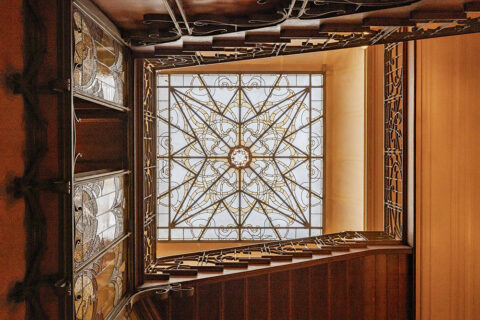
Victor Horta, Solvay hotel, 224 Avenue Louise in Brussels, 1895–1902, private staircase covered by the glass roof of the north skylight. Photo by Gilles van den Abeele.
When examining the rear facade, the division of functions is rational. The most prominent part is the kitchen, which protrudes from the main structure (here, Horta departs from the principle of the basement kitchen); its roof forms a large balcony for the dining room, which is flanked by two stories. The narrow, solid structure of the service staircase is attached to it. Above the driveway, the utility room with toilet, the master bathroom, and the guest bathroom are stacked one above the other.
Another element of “modern” comfort, the ventilation was carefully designed by Horta, and a constant flow of air circulates through the hotel without the need to open the windows. The steam heating system originally fed radiators that have now been converted to gas by plumber and heating engineer Pascal Desmee, a delicate modification that required months of work. Recently (2021–2025), Alexandre Wittamer commissioned architect Barbara Van der Wee (who, among other Horta buildings, oversaw the restoration of the Horta Museum and the Van Eetvelde Hotel) to restore the façade and roof of the Solvay hotel. The metal structures had deteriorated and required complex repairs carried out by metalworker Luc Reuse. Many other skilled craftsmen (roofers J.M. Tong and his son, painter Chr. Feuillaux, carpenter D. Lutjeharms, master glassmaker Cl. Van Veerdegem-Vosch, etc.) participated in this exemplary project, which was awarded an Europa Nostra Prize in 2025.
We must be aware today of the fragility of these Art Nouveau buildings, to which access must be strictly limited. The staircase at the Horta Museum had to be reinforced because it was sagging under the weight of visitors, and it lacks the precious wool carpets that Horta had designed for the Solvay hotel. The maintenance and restoration of these exceptional architectural works depend on the availability of well-trained craftsmen. One might wonder whether public authorities will continue in the future to fund “heritage schools” and the conservation of historic buildings. Will future generations be drawn to these often arduous and demanding trades, rooted in a long tradition of craftsmanship where manual skill and intellectual ability go hand in hand?
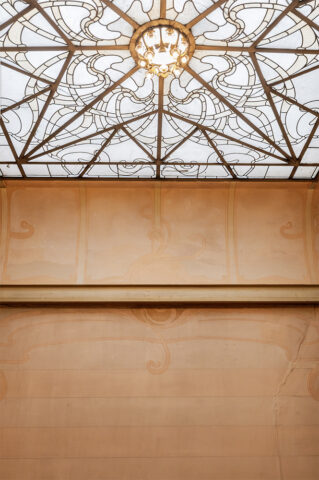
Victor Horta, Solvay hotel, 224 Avenue Louise in Brussels, 1895–1902, wall and glass roof of the private stairwell. Photo by Gilles van den Abeele.
The Solvay hotel, along with three other buildings designed by Horta (the Tassel hotel, the Van Eetvelde hotel, and Horta’s own home), were designated UNESCO World Heritage Sites in 2000—an international recognition of Horta’s work that unfortunately came too late to save the Maison du Peuple, which was demolished in 1965.
Françoise Aubry
Further Reading:
David DERNIE and Alastair CAREW-COX, Victor Horta. The Architect of Art Nouveau. Brussels, Fonds Mercator, 2018.
Michèle GOSLAR, Victor Horta 1861–1947. The Man – The Architect – Art Nouveau. Brussels, Fonds Mercator and the Pierre Lahaut Foundation, 2012.
Yolande OOSTENS-WITTAMER, Victor Horta. The Solvay Hotel. Louvain-la-Neuve, Higher Institute of Archaeology and Art History, Erasme College, 1980.
Yolande OOSTENS-WITTAMER, Horta. The Solvay Hotel. Paris, Diane de Selliers Editeur, 1996.
Victor Horta. Memoirs, edited by Cécile DULIERE. Brussels, Ministry of the French Community of Belgium, 1985.
Translation : Alan Bryden
Guimard’s rugs and carpets
27 Novembre 2025
Since his projects were aimed at creating a comprehensive interior design, Guimard took an interest in floor coverings, whether rugs or carpets. As early as the Castel Béranger period (1895–1898), he commissioned several large rugs from a manufacturer whose name is not yet known with certainty. The only bibliographic reference to these rugs that we are aware of is the frontispiece plate in the Castel Béranger portfolio published at the end of [1] 1898 and its caption (in the table of plates): “TITLE—composition for rugs.”
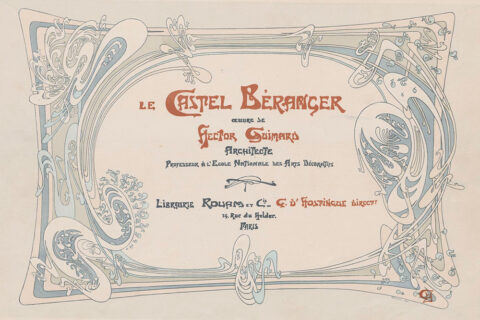
Frontispiece plate from the Castel Béranger portfolio, ETH Library, Zurich.
In fact, their design incorporates only part of the frontispiece’s design: the lower left corner, mirrored in the other three corners, as well as the central motif of the lower border, mirrored in the upper border. It is, of course, possible that Guimard instead expanded upon and refined an initial carpet design to create the frontispiece’s design.
These wool carpets, which are very likely the first Art Nouveau-style models to have appeared in France, are extremely rare. They were obviously not intended for the tenants of Castel Béranger, who had neither the means nor the space in their rather modestly sized rooms, but rather for a clientele of wealthy collectors. Two of them have been sold on the art market over the past decade. One is larger in size: 4 m x 6 m.
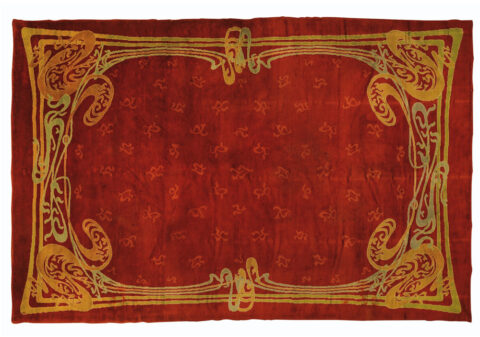
Rug by Guimard, maker unknown, 4 m wide, 6 m long. Sotheby’s Paris auction, November 24, 2015; knotted wool.
The other one, which is smaller, measuring 3.45 m by 4.93 m, is a scaled-down version of the first.
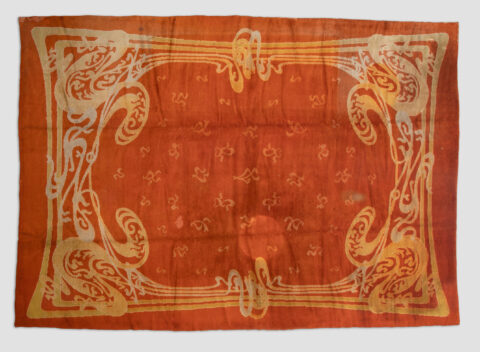
Carpet by Guimard, manufacturer unknown, width 3.45 m, length 4.93 m. Bonhams New York auction, December 19, 2024, lot 3w, knotted wool. Hector Guimard Diffusion Collection.
This last piece recently arrived from the United States, where it was acquired by our partner, Hector Guimard Diffusion. It is in good condition, but restoration work is needed in several areas.
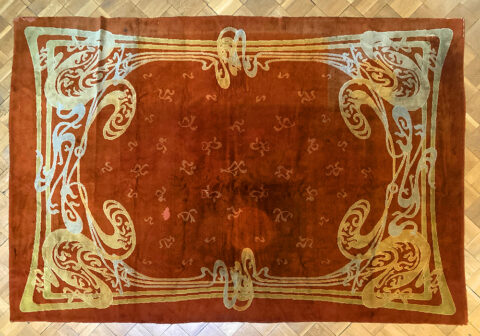
Carpet by Guimard, manufacturer unknown, width 3.45 m, length 4.93 m. Bonhams New York auction, December 19, 2024, lot 3w, knotted wool. Hector Guimard Diffusion Collection. Photo: F. D.
Rug by Guimard, manufacturer unknown, width 3.45 m, length 4.93 m. Bonhams New York auction, December 19, 2024, lot 3w, knotted wool. Hector Guimard Diffusion Collection. Photo: Bonhams NY.
Both carpets are made of knotted wool with a short pile. Their orange-red background is framed by yellow, light orange, and pale blue borders.
Carpet by Guimard, manufacturer unknown, width 3.45 m, length 4.93 m. Bonhams New York auction, December 19, 2024, lot 3w, knotted wool. Hector Guimard Diffusion Collection. Photo: Bonhams NY.
The reverse side of these carpets clearly reveals the technique used. The “pixelated” effect, caused by the thickness of the stitches, does not lend itself well to Guimard’s curves, but it is mitigated by the large size of these carpets.
Carpet by Guimard, maker unknown, width 4 m, length 6 m. Sold at Sotheby’s Paris on November 24, 2015; knotted wool; restored by Rugs & Tapestries, Padua.
Neither of these two units bears a manufacturer’s mark, but they may have been produced by Honoré Frères in Tourcoing, the firm commissioned in 1897 to create the carpets for the three staircases of the Castel Béranger[2]. Their appearance is known from their reproduction in the Castel Béranger portfolio, where Guimard provided two color versions: one for the staircase facing the street (pl. 29) and the other for the staircase facing the courtyard (pl. 28). In these colorized reproductions, the surface texture is also consistent with that of knotted wool carpets. Given their narrow width and the delicacy of the patterns, their knots were necessarily small.
On the left, the carpet on the staircase facing the street; on the right, the carpet on the staircase facing the courtyard. Photomontage based on plates 28 and 29 from the Castel Béranger portfolio. Private collection.
On a single sheet of paper preserved in the Guimard collection at the Musée d’Orsay, there are two drawings for these rugs, which are symmetrical to one another, bearing the note “Delivered to the manufacturer on March 29, 1897, P. Honoré frères” as well as a simplified signature by Guimard.
Drawings for the stair carpets at Castel Béranger, graphite pencil on heavy paper, height 0.342 m, width 0.244 m, handwritten pencil note: “Submitted to the Manufacturer/March 29, 1897/P. Honoré frères,” signed by Guimard. Gift of the Association for the Study and Preservation of 20th-Century Architecture and Decorative Arts, 1995, GP 240, Musée d’Orsay. © RMN-Grand Palais (Musée d’Orsay)/Jean-Gilles Berizzi.
But these are not exactly the same designs as those reproduced in the Castel Béranger portfolio. If we isolate one of the two designs—for example, the one on the right—and examine one of the two borders, we see that to create the opposite border, Guimard rotated it by 180 degrees.
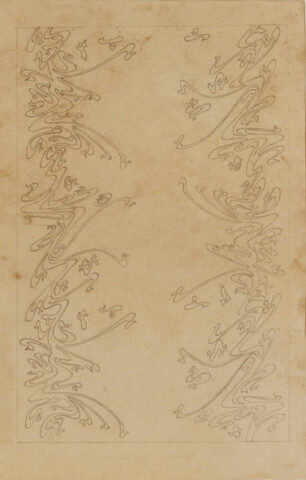
Right half of the design for the stair carpets at Castel Béranger, GP 240, Musée d’Orsay. The central motifs have been erased.
Whereas to obtain the design of the carpets as they were actually executed, he duplicated one of the two borders by reflecting it across a vertical axis.
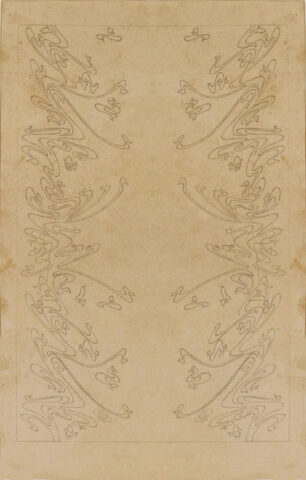
A photomontage on the right half of the drawing depicting the stair carpets of Castel Béranger, GP 240, Musée d’Orsay. The central motifs have been erased.
For these stair carpets at Castel Béranger, Guimard took his attention to detail to the point of designing a unique model of studs to secure the rails, of which we have several units.
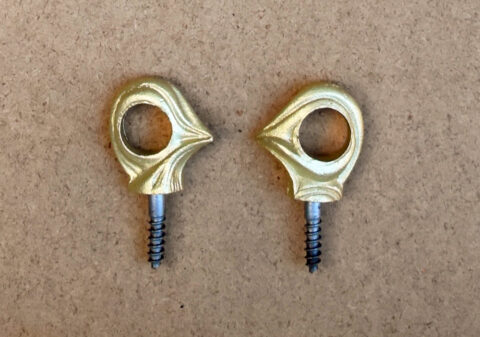
The studs on the stair runners at Castel Béranger. Private collection. Photo by F. D.
During the restoration work carried out in 2000, the stair carpets were roughly restored, and the wrong color was used for the staircase in the building’s street-facing lobby.
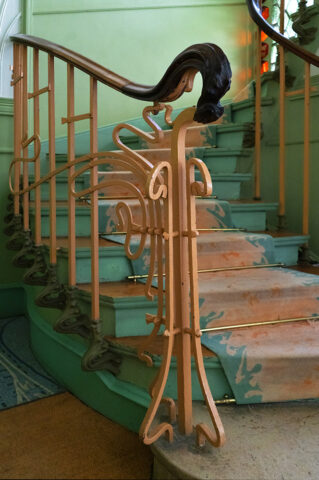
Current state of the staircase in the street facing lobby of Castel Béranger following restoration work. Photo by F. D.
Just as he had done in other fields, with the aim of making his designs more widely available and lowering their cost, Guimard wanted to have his carpet designs produced. He therefore approached the firm Parlant & Biron, which had its Paris office at 13 Rue Poissonnière. We had long noted that this company was also originally from Tourcoing, but it was only very recently that we were able to establish with certainty that Parlant & Biron was indeed the successor to the Honoré Frère firm, thanks to the acquisition of a promissory note from the Gaston Honoré company, dated March 31, 1911, and bearing the overprint “PARLANT & BIRON, Sucrs.” The fact that this succession is indicated by a stamped overprint suggests that, in March 1911, it was recent enough that updated documents had not yet been printed. This document also reveals that Gaston Honoré himself succeeded “Maison V. Straub, Ch. Gérardin, Honoré Frères, réunies”[3].
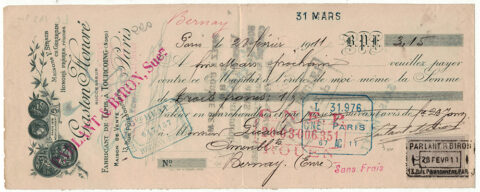
Promissory note from the firm Gaston Honoré, Parlant & Biron, successors, dated March 31, 1911. Private collection.
Guimard thus secured the publication of his designs in a catalog. The copy held at the Bibliothèque des Arts Décoratifs contains only four unnumbered plates, all of which feature Guimard’s designs. Since this copy was donated by his widow, it is likely that the other plates were removed from the catalog in order to document simply the architect’s work.
Cover of an undated Parlant & Biron catalog. Bibliothèque des Arts Décoratifs. Gift of Adeline Oppenheim-Guimard, 1948. Photo by Laurent Sully Jaulmes.
Six designs for Parlant & Biron are available as rugs with a fixed width of 70 cm and sold by the linear meter in three grades, priced at 7, 8, and 9 F-or. The material used and the type of weave are not specified.
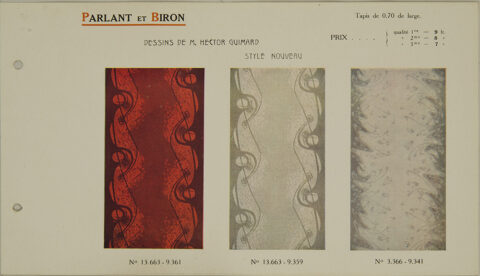
Plate from a Parlant & Biron catalog, undated. Bibliothèque des Arts décoratifs, models 13.663–9.359; 13.663–9.361; 3.366–9.341. Gift of Adeline Oppenheim-Guimard, 1948. Photo by Laurent Sully Jaulmes. The model of the Castel Béranger is on the right.
It is noticeable that the model shown on the right side of this plate appears to be that of the staircase at Castel Béranger, reproduced in shades of gray with greater clarity than in the two plates of the portfolio. In fact, however, this is the original drawing (GP 240), with its asymmetrical borders.
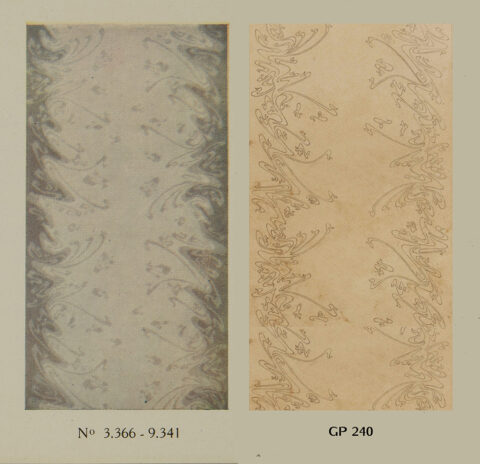
Composite image of model 3.366–9.341, created from a page in a Parlant & Biron catalog and part of drawing GP 240.
For the other model on this sheet, which is shown in two color variations, there are two watercolor studies by Guimard in the collection of documents donated by Adeline Oppenheim Guimard to the Bibliothèque des Arts décoratifs in 1948.
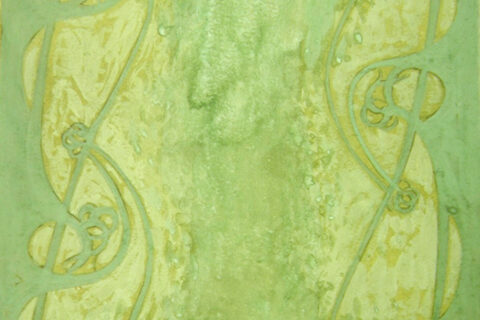
Design for a rug, unsigned, undated, watercolor on paper, Bibliothèque des Arts décoratifs, Gift of Adeline Oppenheim-Guimard, 1948. Photo by Laurent Sully Jaulmes.
On a second plate of the Parlant & Biron catalog, a third design is shown in three colors. As with the two designs presented above, its clearly defined borders indicate that it is intended as a stair carpet or a hallway rug.
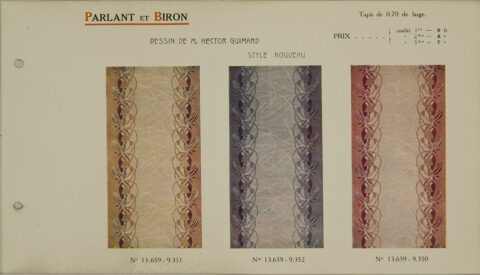
Plate from a Parlant & Biron catalog, undated. Bibliothèque des Arts décoratifs, models 13.659–9.350; 13.659–9.351; 13.659–9.352. Gift of Adeline Oppenheim-Guimard, 1948. Photo by Laurent Sully Jaulmes.
On the contrary, the three other patterns featured on the other two plates have no borders and are designed to be joined together (like wallpaper) so they can cover large areas and serve as a carpet. Once placed side by side, the strips are sewn together and then stretched out.
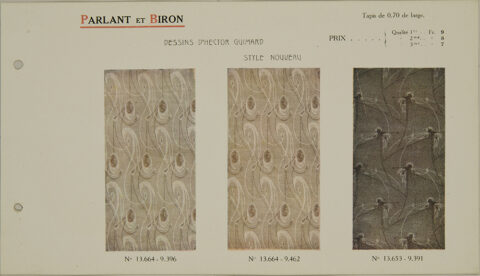
Plate from a Parlant & Biron catalog, undated. Bibliothèque des Arts décoratifs, models 13.664–9.396; 13.664–9.462; 13.653–9.391. Gift of Adeline Oppenheim-Guimard, 1948. Photo by Laurent Sully Jaulmes.
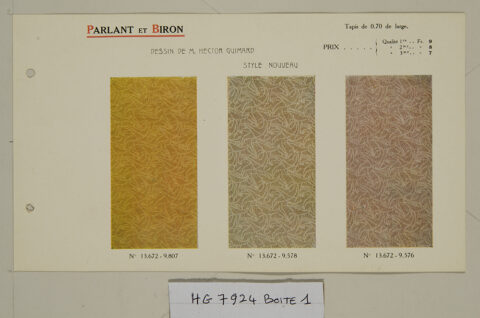
Plate from a Parlant & Biron catalog, undated. Bibliothèque des Arts Décoratifs, items 13.672–9.576; 13.672–9.578; 13.672–9.807. Gift of Adeline Oppenheim-Guimard, 1948. Photo by Laurent Sully Jaulmes.
We think it is worth taking a closer look at the reference numbers for these six models and their variants:
3.366 – 9.341 for the Castel Béranger model.
13.663 – 9.359 and 13.663 – 9.361 for the bordered model shown on the same plate.
13.659 – 9.350; 13.659 – 9.351; 13.659 – 9.352 for a bordered model on a second sheet.
13.664 – 9.396 and 13.664 – 9.462 for a pattern with a seam on a third sheet.
13.653 – 9.391 for a pattern with a seam on this third sheet.
13.672 – 9.576; 13.672 – 9.578 and 13.672 – 9.807 for a pattern with a seam on a fourth panel.
The last four digits after the hyphen distinguish the color variations of identical patterns. We do not know the meaning of the number 9. As for the groups of numbers before the hyphen, they designate the models. Furthermore, we propose the following hypothesis: the number(s) before the period could indicate the year the model was added to the manufacturer’s catalog (Honoré Frères, then Gaston Honoré, then Parlant & Biron). Thus, the Castel Béranger model (3.366) would have been added in 1903, and all other models would have been added in 1913—that is, at the time Guimard was designing his mansion. This would give us a sixteen-year timeframe (from 1897 to 1913) of collaboration between Guimard and the manufacturer. Keep in mind that the date of 1913 does not necessarily correspond to the creation of these five models and that Guimard may have had access to them before they were published in a catalog.
Several photographs show Guimard using these rugs. One of them, undated, is likely a view taken inside Guimard’s workshops. It clearly shows the bordered rug 13.659 and, less clearly, beneath the desk and chair, the pattern-matched rug 13.653.
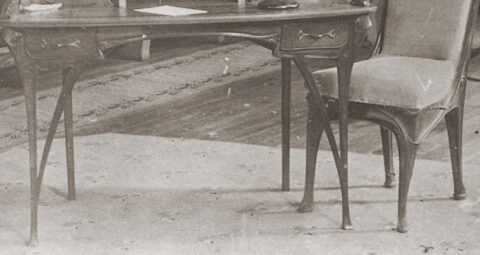
Probable interior arrangement in Guimard’s studios (detail) featuring rugs 13.659 and 13.653; early print on paper, undated. Donated by Adeline Guimard-Oppenheim, 1948. Bibliothèque des Arts décoratifs. Photo by Laurent Sully Jaulmes.
Pieces of the same pattern-matching rug (13.653) also appear in other photographs taken under similar conditions.
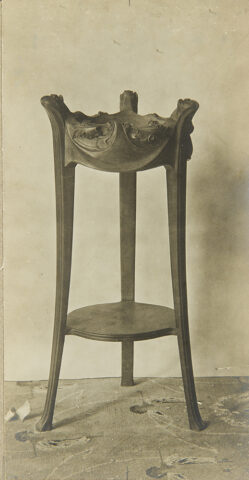
Probable set up in Guimard’s studio, featuring rug no. 13.653; an early print on paper, undated. Donated by Adeline Oppenheim-Guimard, 1948. Bibliothèque des Arts décoratifs. Photo by Laurent Sully Jaulmes.
Finally, two of these seamless carpet designs appear in photographs taken inside the Guimard Hotel: once again, the 13.653, used as wall-to-wall carpeting in the bedroom.
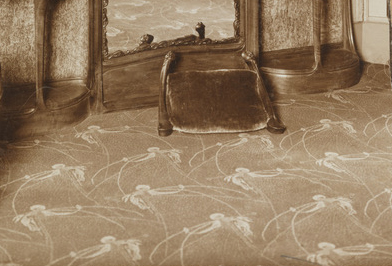
Detail from a photograph of the bedroom at the Hôtel Guimard, showing rug no. 13.653; vintage print on paper, ca. 1913. Private collection.
And 13.672, used for the dining room carpet.
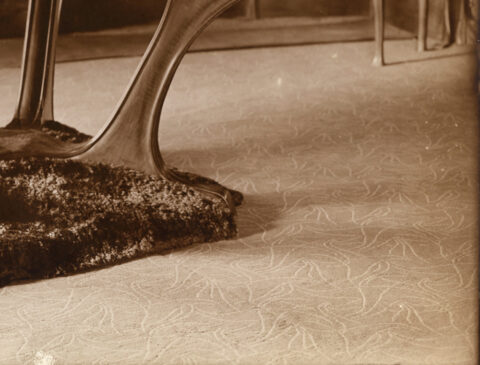
Detail from a photograph of the dining room at the Hôtel Guimard, showing rug no. 13.672; vintage print on paper, ca. 1913. Gift of Adeline Oppenheim-Guimard, 1948. Archives de Paris 3115W 10.
Alongside this production for commercial purposes, Guimard continued to design large rugs. We have evidence of this in the form of a watercolor sketch with a particularly rich, even evocative, design. Although undated, it can be dated to 1903 or later and is housed at the Bibliothèque des Arts décoratifs.
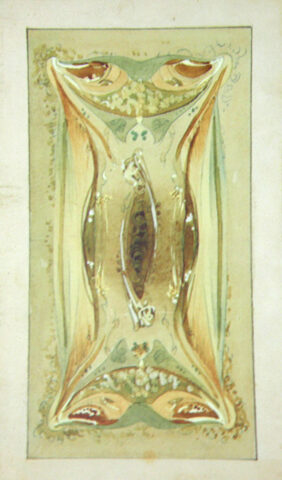
Design for a rug, unsigned, undated, watercolor on paper, Bibliothèque des Arts décoratifs, Gift of Adeline Oppenheim-Guimard, 1948. Photo by Laurent Sully Jaulmes.
We can see, then, that Guimard’s rugs and carpets reflected his stylistic evolution, with designs that, in some cases, could be seamlessly integrated into modern interiors.
Frédéric Descouturelle
in collaboration with Olivier Pons
Notes
[1] Guimard, Hector, Art in the Modern Home/Le Castel Béranger, Paris, Librairie Rouam, 1898.
[2] Their name appears in the list of suppliers at the beginning of the portfolio: “HONORÉ FRÈRES — Carpets.”
[3] The Honoré Frères company had borne this name since Gaston and Lodois Honoré took over the business in April 1893. Gaston continued on his own after his brother sold him all his shares in September 1904.
Translation: Alan Bryden