
The “Dreyfus Affair of the Fine Arts”: Guimard and the Legion of Honor
22 May 2026
It is always a pleasure to publish articles by Léna Lefranc-Cervo, who now holds a Ph.D. in the history of architecture and teaches at the École nationale supérieure d’architecture de Nancy. This article serves as a perfect follow-up to her piece “Protecting Parisian Art Nouveau Heritage: Initiatives and Networks in the Interwar Period,” as well as to her presentation “Hector Guimard and the Group of Modern Architects: Networks and Mobilization Strategies of a Modern Architect” during the Hector Guimard study day at Paris City Hall on December 3, 2024, and finally our article on Guimard’s use of different varieties of brick. This investigation into a setback suffered by our architect shows that a simple slanderous accusation—which could have been dismissed by a brief inquiry—required the persistent mobilization of his network of friends and professionals to secure the coveted decoration. This administrative inertia could also be indicative of the lingering effects of past hostility toward this innovator, as well as a certain inability to recognize him as one of the founding fathers of modern architecture and decorative arts in France.
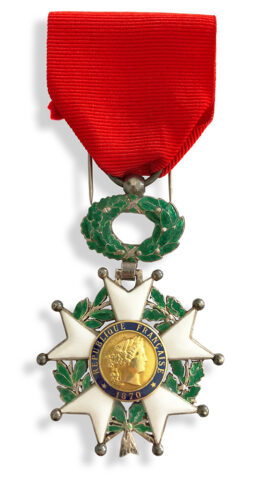
Knight’s Cross of the National Order of the Legion of Honor, Third Republic model.
Source: commons.wikimedia.org
The 1925 International Exhibition of Modern Decorative and Industrial Arts marked a triumph for modern architects. Having formed the Group of Modern Architects (GAM) in 1922, they had secured the major commissions for the International Exhibition. At the conclusion of the event, Frantz Jourdain, the Group’s president, described the exhibition as “a complete victory of modern art over all forces of incomprehension and routine[1].”
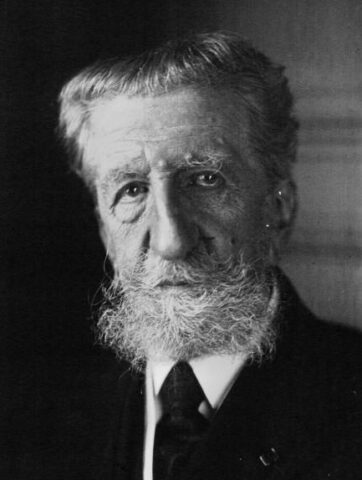
Portrait of Frantz Jourdain from 1923. National Library of France.
Shortly thereafter, Henri Sauvage, vice-president of the GAM, wrote to Paul Léon, director of the Beaux-Arts, stating: “You led us so well into the fray that here we are, all at once, and almost [unconsciously?], having achieved success[2].” Success was thus assured, and the Exhibition’s organizing committee then requested that the architects be promoted to the Legion of Honor, a process that would have finally established the Group’s members as the leading figures of the French architectural scene.
As early as 1926, several architects who had participated in the event were promoted to various ranks of the Legion of Honor. Henri Pacon, Michel Roux-Spitz, Pierre Chareau, Albert Laprade, Alfred Levard, Bernard Haubold, Edmond Malo, Robert Mallet-Stevens, Joseph Marrast, Paul Montagnac, Fernand Nathan, Auguste Perret, Henri Sauvage, and Pierre Selmersheim were made Knights. A few others were also promoted to the higher rank of officers, including Adolphe Dervaux, Ernest Herscher, and Charles Letrosne, as well as Pierre Paquet, Louis-Pierre Sézille, Louis Sorel, and Pierre Sardou. While the promotion of Dervaux, Sorel, Selmersheim, and Sauvage was seen at the time as a victory for the Group of Modern Architects, the group also suffered a bitter setback with the omission of Henri Favier, Gabriel Guillemonat, Pierre Patout, and, above all, its vice president and founder, Hector Guimard. Gathered to discuss the new promotions, the committee members expressed their outrage at “not finding in *L’Officiel* the names of certain members who rendered exceptional service[3].” The committee then sent a letter to the Minister of Commerce, and two protest letters were published in *Comœdia* on June 6, 1926. Yvanhoé Rambosson, the Group’s secretary-general, intended to publicly highlight the fundamental role of Guimard, who “played too dominant a role in the history of the modern movement to be forgotten[4]”:
“Let today’s innovators ask themselves if they would be doing what they do without having benefited from the experience of two generations. They will recognize Guimard’s splendidly revolutionary role and defend it alongside me. (…) It would be unjust to see many of those who entered the new forest through the breach he had made receive honors, without the first woodsman being rewarded[5].”
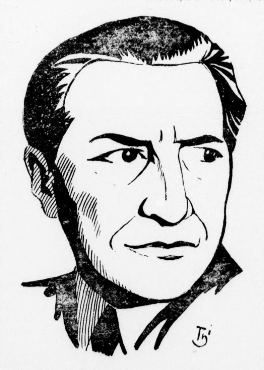
Portrait of Yvanhoé Rambosson, *Le Carnet de la semaine*, July 12, 1925, p. 12.
Following this appeal, Patout was finally awarded the rank of Chevalier. Guimard, however, continued to be sidelined in the recognition process. At the February 1927 committee meeting, the “Guimard affair” dominated much of the discussion among the members. New efforts were then made by the GAM to approach Bokanowski[6] and by Rambosson to approach Édouard Herriot. But the committee reported on the difficulties encountered:
“Our various expressions of indignation were met with total indifference. We have come up against high-ranking officials who have refused to inform themselves about such a delicate matter, or who have taken no action[7].” The committee, however, remained resolute: “We cannot leave matters as they are indefinitely. We have a duty to succeed in lifting the cruel injustice afflicting our comrade GUIMARD, and the Group will have to make his case its own personal concern[8].”
The Chancellery of the Order of the Legion of Honor had received a letter from an industrialist named Taté, owner of a factory and a plaster quarry in Thorigny-sur-Marne, who, without specifying the exact reasons[9], deemed Guimard unworthy of receiving this distinction[10]. The exact nature of this dispute is unknown. It is possible that it arose in the context of their collaboration on the construction of the town hall for the Village Français.
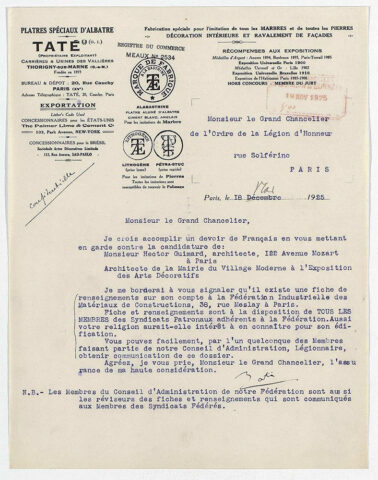
Letter from Taté to the Grand Chancellor of the Order of the Legion of Honor, dated May 18, 1925. National Archives, Léonore database, Guimard’s Legion of Honor file.
“Mr. Grand Chancellor,
I believe I am fulfilling my duty as a French citizen by warning you against the candidacy of:
Mr. Hector Guimard, architect, 122 Avenue Mozart, Paris
Architect of the Village Moderne Town Hall at the Exposition des Arts Décoratifs.
I will limit myself to pointing out that there is an information file on him at the Industrial Federation of Building Materials, 38 Rue Meslay in Paris.
The file and information are available to ALL MEMBERS of the employers’ unions affiliated with the Federation. Therefore, it would be in your best interest to review it for your own edification.
You may easily obtain a copy of this file through any member of our Board of Directors who is a Legionnaire.
Please accept, Mr. Grand Chancellor, the assurance of my highest regard.
N.B. — The members of our Federation’s Board of Directors are also the reviewers of the files and information that are communicated to the members of affiliated unions.”
In any case, Taté’s complaint triggered an investigation by the Ministry of Commerce, which brought all proceedings undertaken by the Exhibition Commission to a halt. The injustice was, it seems, sufficiently evident that the aggrieved vice-president of the GAM decided not to attend the banquet organized by the Group of Modern Architects in March 1927 in honor of the new members[11]. On this occasion, Guimard wrote a letter in which, while congratulating his colleagues on their success, he expressed his dismay at the injustice he was facing.
In Rambosson’s writings, these events came to be known as the “Dreyfus Affair of the Fine Arts.” The case was raised again at the GAM committee meeting on June 7, where Frantz Jourdain, lamenting the administrative delays, indicated that he would resume the efforts. But by November, nothing had yet been achieved. The GAM’s secretary-general then recalled the promises made by Paul Léon as well as those of Herriot and expressed surprise that the Group had not obtained satisfaction. It would, however, be another two years before the GAM architects’ efforts became more aggressive. On February 2, 1929, Rambosson sent the Minister of Commerce a letter countersigned by Jourdain[13] on behalf of the Group of Modern Architects.
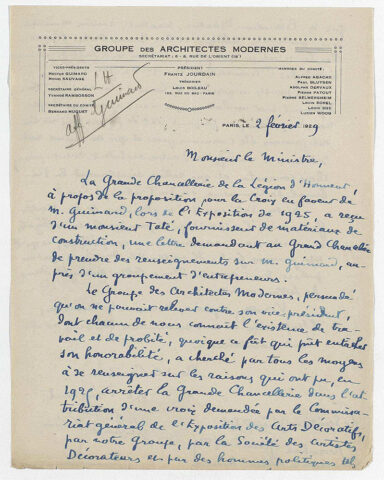
First page of the letter from Yvanhoé Rambosson, countersigned by Jourdain, addressed to the Grand Chancellor of the Order of the Legion of Honor on February 2, 1929. National Archives, Léonore database, Guimard’s Legion of Honor file.
For his part, Frantz Jourdain wrote to the Grand Chancellor himself the very next day, and a few days later, Jean-Baptiste Bienvenu-Martin, a senator from the radical left and former minister, also sent a letter exonerating the architect, using the same arguments as those put forward by Rambosson and Jourdain[14].
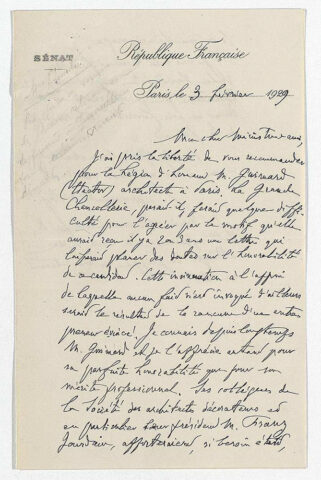
Letter from Senator Jean-Baptiste Bienvenu-Martin to the Minister of Commerce, dated February 12, 1929. Guimard’s Legion of Honor file. National Archives, Léonore Database.
Emphasizing the irreproachable conduct of the GAM’s vice president, Rambosson, the Group’s secretary general points out that the promotion was requested by no fewer than three different organizations: the General Commission of the Decorative Arts Exhibition, the Group of Modern Architects, and the Society of Decorative Artists. He dismisses Taté’s complaint as a mere “dispute between architect and contractor, a common occurrence that falls solely within the jurisdiction of the Commercial Court or the Civil Court[15].” He notes that Taté has not brought the matter before either of these courts “and that it therefore does not appear that a letter sent under such circumstances can be taken into account[16].”
As for Jourdain, he points out to the Grand Chancellor that the charges against Guimard remain unknown: “The Ministers whom I had the honor of meeting on this subject, [illegible], have always assured me that no grievance remains against our candidate, and I find myself facing an inextricable situation for which you alone, General, can find a solution[17].” He continues: “If Mr. Guimard is innocent and worthy of the esteem in which all artists hold him, let us finally accept a 62-year-old artist who has demonstrated throughout his long career as much originality as talent, and who must finally be cleared of hypocritical, base, and cowardly attacks that could greatly tarnish his reputation[18].”
To support their cause, Rambosson had a short article published in Comœdia on February 22, emphasizing the role played by the vice president of the GAM in the emergence of modern architecture in France[19].
The interventions of the two men appear to have been decisive, and thanks to the energetic efforts of André Dezarrois, chief of staff to the undersecretary of state for the Fine Arts, André François-Poncet, the matter was finally resolved. Dezarrois inquired with the Industrial Federation of Building Materials, whose president replied that he had never been informed of any issue concerning Guimard and had never been asked to give an opinion on the architect[20].
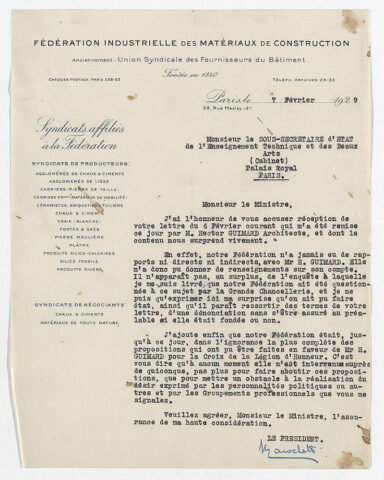
Letter from the president of the Industrial Federation of Building Materials to the Under-Secretary of State for Fine Arts, dated February 7, 1929. National Archives, Léonore database, Guimard’s Legion of Honor file.
This response brought the matter to a definitive close, and on February 28, 1929, Guimard was finally promoted to the rank of Chevalier. The news was immediately reported in *Comœdia*, and Frantz Jourdain, himself a Grand Officer, welcomed Guimard into the Legion of Honor. The resolution of the case thus demonstrated the solidarity and ability of modern architects close to Guimard to rally together.
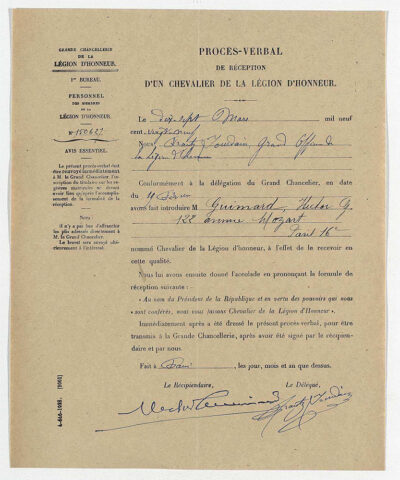
Minutes of Guimard’s induction into the Order of the Legion of Honor, dated March 27, 1929. Guimard’s Legion of Honor file. National Archives, Léonore Database.
This approach is characteristic of the positioning strategies of GAM members, who were convinced that the recognition of modern architects—and, through them, of modern architecture—could only be achieved through validation by official bodies. In 1895, Jourdain published *Les décorés, ceux qui ne le sont pas*[21] as a tribute to artists who had not received institutional recognition. Although the book surprisingly includes no architects’ names, it remains fundamental to understanding Jourdain’s approach, as he maintained throughout his life the ambition of securing official recognition for modern architects. For the president of the GAM, receiving an honor such as the Legion of Honor constituted an essential step in the fight for their recognition. Jourdain’s interest in this matter may seem surprising given his systematic—and often vehement—opposition to these very same official bodies. Jourdain is, in fact, primarily a progressive reformer who seeks to improve the situation of modern artists, yet he remains committed to the republican values of merit. It is not the institutions themselves that Jourdain questions, but rather the selection process they employ and, by extension, the judgment of those who constitute them. Jourdain believes that recognition for modern architects—and, through it, the triumph of modern architecture—will be achieved through democratic pressure exerted primarily through associations. His main objective is to secure official recognition for the modernists by replacing the established standards. For Jourdain, innovative architects must ultimately replace the Beaux-Arts architects—whom he considers mediocre—as France’s artistic glories. In his view, the innovators’ victory can only be achieved if there is a reversal of values within the democratic sphere itself.
Following this long-awaited victory, the GAM decided to hold a banquet in honor of the architect, which was organized in June 1929 at the Hôtel Lutetia.
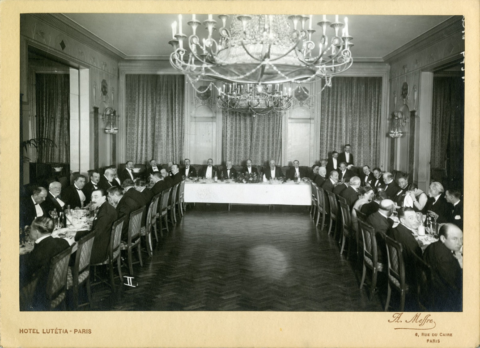
A. Meffre, photographer. Banquet hosted by the Group of Modern Architects in June 1929 in honor of Hector Guimard at the Hôtel Lutetia. Perret Collection, Center for Contemporary Architecture Archives (Cité de l’architecture). All rights reserved.
This banquet is indeed presented as a festive occasion marking the recognition of Vice President Hector Guimard. The aim is to celebrate what the GAM will present as the architect’s official recognition and as a new victory for the Modernists, achieved thanks to the Group’s mobilization. Through Guimard, the entire founding network of the Group of Modern Architects is also being recognized. For the Group, the event apparently signified the State’s rallying to the cause of the Modernists. As such, the list of political representatives from the State and the City of Paris that the GAM planned to invite was impressive. No fewer than eleven representatives of national and Parisian administrations are invited, including André François-Poncet, Under-Secretary of State for Fine Arts, and his chief of staff André Dezarrois, as well as the Prefect of the Seine, the Police Prefect, the President of the Municipal Council and the General Council, the budget rapporteurs for Fine Arts in the Senate and the Chamber of Deputies, the President of the Civil Court of the Seine, and finally Paul Léon and Fernand David. Aside from the confirmed attendance of André François-Poncet at this banquet, the presence of other representatives from these administrations cannot be confirmed. The speech delivered by the Under-Secretary of State was, in fact, in line with the GAM’s views, and the senior official confirmed the recognition of the Group’s architects, noting that the Exposition had demonstrated that France had regained “its rightful place—as a creator, a guide, and a trendsetter[22].” This result “is the work of the bold pioneers, the leaders gathered here: Frantz Jourdain, Louis Bonnier, Henri Sauvage, Georges [sic] Sorel, Auguste Perret, Paul [sic] Bluysen, Louis Boileau, Adolphe Dervaux, and Lucien Woog[23].” The banquet, however, could not have played this role without the media coverage of the event provided by Rambosson in Comœdia. The Group’s former secretary-general presented the banquet as “a splendid celebration of modern architecture[24]” that brought together “the best of our innovators[25],” among whom he named: Auguste Perret, Sauvage, Bonnier, Dervaux, Boileau, Sézille, Sardou, Selmersheim, Patout, Tournon, Abraham, Favier, Gouverneur, Woog, and Bluysen[26].
Nevertheless, François-Poncet’s speech also constitutes a mixed tribute to Hector Guimard, despite the fact that he was the guest of honor at this dinner. Recalling his childhood memories in Cabourg, the senior civil servant then spoke of the interchangeable houses built at the turn of the century, followed by the arrival of modern architectural prototypes:
“And then, one day, Hector Guimard’s work appeared on this coast (…) For me, it was a source of perplexity and the starting point for some reflection. I did not consider the result to be entirely successful, and, to tell the truth, I did not have the overwhelming impression of any decisive beauty. But I was unsettled; for me, it was the revelation of an attempt, of a desire for innovation, whose underlying principle I felt deep down was sound and commendable; so I was particularly pleased to be able, some twenty-five years later, to pay tribute—and do justice—to the man who had given it to me[27].”
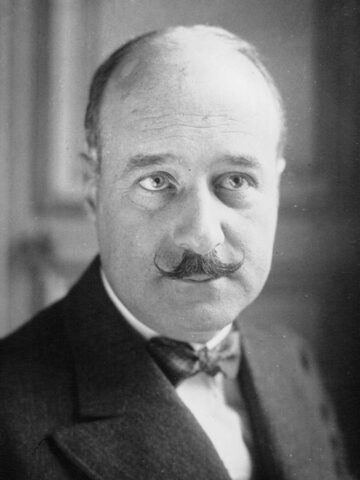
Portrait of André François-Poncet (1887–1978) from 1931. Source: Wikipedia, Meurisse Press Agency, National Library of France.
François-Poncet’s speech is indicative of the relative indifference and poor reception of Guimard’s work on the eve of the 1930s, as well as the difficulty in accepting the architect as a leading figure in modern architecture. In many ways, it foreshadows the obscurity and neglect into which the architect and his work would sink in the following decade. While Guimard could indeed count on the support of his friends and his network—who would always remain committed to defending his work, as Auguste Bluysen’s efforts in the 1940s would demonstrate—the relative lack of understanding surrounding Art Nouveau would overshadow the quality and significance of his work for at least thirty years.
Léna Lefranc-Cervo
Ph D. in history of architecture
Notes
[1] Yvanhoé Rambosson, “The Consequences of the Exposition,” Paris-Soir, July 8, 1925, p. 1
[2] Handwritten letter from Henri Sauvage to Paul Léon, May 3, 1926, Pierrefitte-sur-Seine, National Archives, Collection of the Ministry of Public Instruction and Fine Arts, 20140260/2. [3] Le Rapin, “Fine Arts. New Charcoal Drawings,” Comœdia, June 6, 1926, p. 2. [4] Ibid. [5] Yvanhoé Rambosson, “Another Forgotten Guimard,” Comœdia, June 6, 1926, p. 1. [6] Maurice Bokanowski was Minister of Commerce at the time. [7] Minutes of the meeting of the committee of the Group of Modern Architects on February 19, 1927, Paris, Center for Contemporary Architecture Archives, Perret Collection, 535 AP 561/1. [8] Ibid. [9] I would like to thank the Cercle Guimard and Frédéric Descouturelle for this information. [10] Typewritten letter from Taté to the Grand Chancellor of the Legion of Honor, May 18, 1925, Pierrefitte-sur-Seine, National Archives, Hector Guimard’s Legion of Honor file, available online at https://www.leonore.archives-nationales.culture.gouv.fr/ui/#show [11] Yvanhoé Rambosson, “The Banquet of Modern Architects,” Comœdia, March 28, 1927, p. 2.[12] Yvanhoé Rambosson, “A Grand Celebration of Modern Architecture,” Comoedia, June 22, 1929, p. 3. Since no anti-Semitic undertones could be found in this case of the delayed awarding of the Legion of Honor, the term “Dreyfus affair of the fine arts” must certainly be understood as equivalent to “grave injustice,” even though the two cases are obviously not comparable.
[13] Handwritten letter from Yvanhoé Rambosson, countersigned by Frantz Jourdain, to the Minister of Commerce, February 2, 1929, Pierrefitte-sur-Seine, National Archives, File on the appointment of Hector Guimard to the rank of Knight of the Legion of Honor, available online at https://www.leonore.archives-nationales.culture.gouv.fr/ui/#show. Rambosson follows his signature with his title of Knight of the Legion of Honor, and Jourdain with that of Grand Officer of the Legion of Honor. [14] Handwritten letter from Jean-Baptiste Bienvenu-Martin, February 3, 1929, Pierrefitte-sur-Seine, National Archives, File on the appointment of Hector Guimard to the rank of Knight of the Legion of Honor, available online at https://www.leonore.archives-nationales.culture.gouv.fr/ui/#show [15] Handwritten letter from Yvanhoé Rambosson, countersigned by Frantz Jourdain, to the Minister of Commerce, February 2, 1929. Op. cit. [16] Ibid. [17] Handwritten letter from Frantz Jourdain to General Dubail, Grand Officer of the Legion of Honor, February 3, 1929, Pierrefitte-sur-Seine, National Archives, File on the appointment of Hector Guimard to the rank of Knight of the Legion of Honor, available online at https://www.leonore.archives-nationales.culture.gouv.fr/ui/#show [18] Ibid. [19] “Les artistes. Hector Guimard,” Comœdia, February 22, 1929, p. 2. [20] Typewritten letter from the president of the Industrial Federation of Building Materials to the undersecretary of state for Fine Arts, February 7, 1929, Pierrefitte-sur-Seine, National Archives, File on the appointment of Hector Guimard to the rank of Knight of the Legion of Honor, available online at https://www.leonore.archives-nationales.culture.gouv.fr/ui/#show [21] Frantz Jourdain, Les décorés, ceux qui ne le sont pas, Paris, H. Simonis Empis, 1895. [22] “Mr. François-Poncet Praises New French Architecture,” Comœdia, June 22, 1929, p. 1. [23] Ibid., p. 2. [24] Yvanhoé Rambosson, “The Beaux-Arts. A Grand Celebration of Modern Architecture,” Comœdia, June 22, 1929, p. 3. [25] Ibid. [26] The banquet also brought together Brunet, Montagnac, Lambla de Sarria, Guillemonat, Guët, and Houdaille. [27] “Mr. François-Poncet Praises New French Architecture,” Comœdia, June 22, 1929, p. 1.
Translation : Alan Bryden