
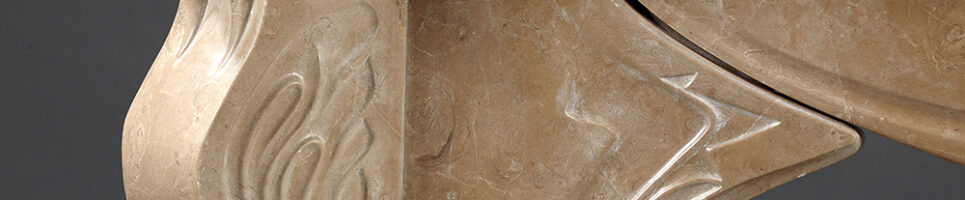
Guimard’s Marble Fireplaces – 1
11 April 2026
All photos owned by the authors or by the Cercle Guimard Archives and Documentation Center must, without exception, be approved by the Cercle Guimard for any publication project, regardless of the medium.
A comprehensive study of Guimard’s work in the field of marblework has yet to be undertaken. It is nevertheless clear that this field held his interest just as much as other areas of decorative art. Guimard worked with marble craftsmen from very early on, at least since the construction of Victor Rose’s tomb in 1892, and we know that he designed funerary monuments until 1929 (the project for the commemorative monument to the Victory of the Marne). This article provides an overview of his creations in the more limited field of marble fireplaces. A second article will discuss the recent restoration of the engraved decoration on a fireplace in the Trémois building (1909–1910).
We are not aware of any marble fireplaces in any of Guimard’s early architectural works, but it is quite possible that some existed. The first designs specifically created by Guimard may date back to the interior work on Castel Béranger (1895–1898). Guimard’s use of fireplaces there was in no way innovative: it followed well-established conventions for apartments and private residences, where the combination of the fireplace and the mantelpiece above it persisted from the 18th to the 19th century[1]. But as we saw previously, the presence of heat vent grilles indicates that the apartments at Castel Béranger had a mixed heating system, with radiators in the basement and fireplaces in the main rooms. These elements of the fixed decor, though not very efficient, were long considered indispensable to a private interior and were therefore used occasionally or during the shoulder seasons. The list of contractors recorded in the Castel Béranger portfolio mentions “Hénault. – Marblework,” followed by this note: “Following the death of Mr. Hénault, the marble fireplaces were executed by Mr. Maybon[2].” This latter firm, whose workshops and showroom were located on Rue Saint-Sabin in the 11th arrondissement, specialized in “artistic and commercial fireplaces.”
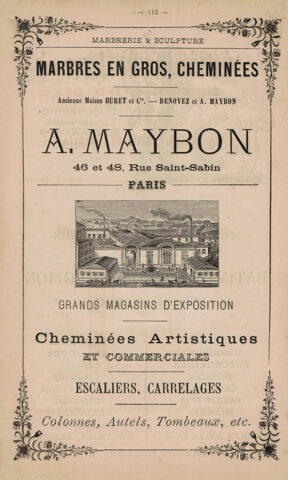
Sales brochure from Albert Maybon Marble Works, 46–48 Rue Saint-Sabin, undated. Private collection.
For the 1900 Paris World fair, an advertising brochure published by the same company listed the various categories in which it exhibited its products.
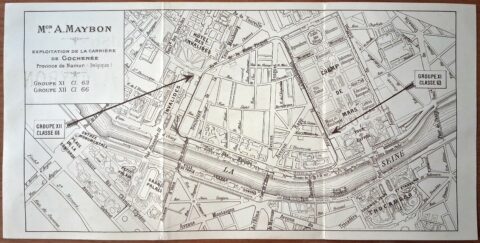
Advertising brochure for Maison A. Maybon, published for the 1900 World’s Fair in Paris. Private collection.
Within Group XII, Class 66—dedicated to the permanent decoration of public buildings and residences—featured, among other exhibits, Guimard’s display, which included several interior fragments, including a bedroom and its marble fireplace. A particularly well-crafted label, now preserved at the Forney Library, confirms that the fireplace was on display at Guimard’s exhibition booth.
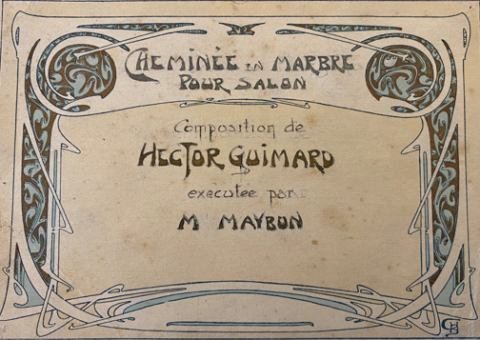
Poster for Hector Guimard’s pavilion at the 1900 World Fair. Geo Dorival Collection. Forney Library.
At Castel Béranger, the fireplaces with marble mantels from the A. Maybon company were found in the bedrooms and living rooms of the apartments. The other rooms were fitted with mantels made of glazed stoneware (produced by Alexandre Bigot) or cast iron (produced by the Durenne foundry in Sommevoire). The mantels in the bedrooms, which are fairly simple, feature classic inserts made of flat white earthenware tiles.
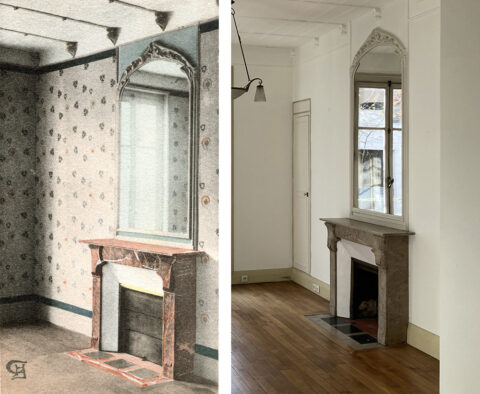
Left: View of a bedroom in the apartment at the corner of Rue La Fontaine and the Béranger hamlet, on the second floor of the Castel Béranger, Hector Guimard, *L’Art dans l’Habitation moderne/Le Castel Béranger* (Castel Béranger portfolio), pl. 35 (detail), Librairie Rouam, 1898. Private collection.
Right: view of a bedroom in an apartment on the first floor of Castel Béranger featuring a marble fireplace with a narrower section clad in earthenware tiles. Photo by F. D.
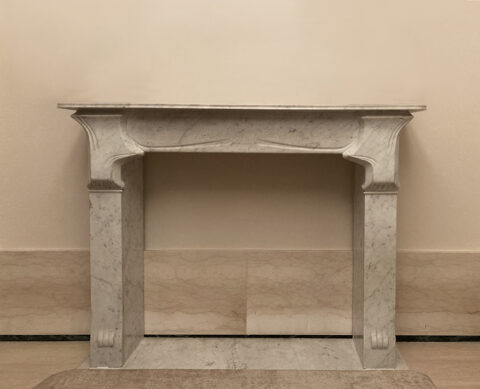
A marble mantelpiece modeled after those in the bedrooms of Castel Béranger, acquired by Hector Guimard Diffusion. Photo and computer graphics by F. D.
This design is also featured in the rooms of Castel Val, with a unique twist: the color of the marble varies from room to room. To the best of our knowledge, this 1904 building by Guimard is the last to feature this fireplace design from the Castel Béranger period.
Apart from this building, perhaps for an exhibition, Guimard experimented with creating a narrowing effect using three flat plates of glazed lava.
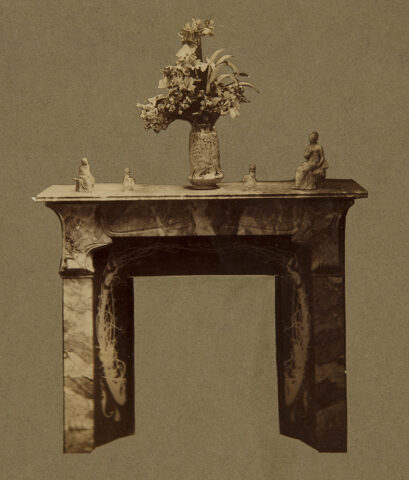
Marble fireplace modeled after those in the bedrooms of Castel Béranger, with a narrower section featuring glazed lava stone panels. Bibliothèque des Arts Décoratifs, donated by Adeline Oppenheim-Guimard, 1948. Photo by Laurent Sully Jaulmes (detail).
Significant fragments of this glazed lava vessel have been recovered and are now in a private collection.
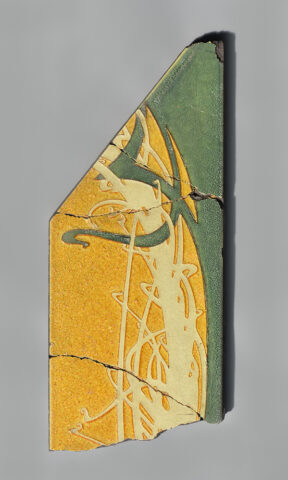
A fragment of the glazed lava trim from a fireplace typical of the bedrooms at Castel Béranger. Private collection. Photo by F.D.
The fireplaces in the living rooms, which are more elaborate, feature a cast-iron or glazed terracotta insert crafted by Gilardoni & Brault.
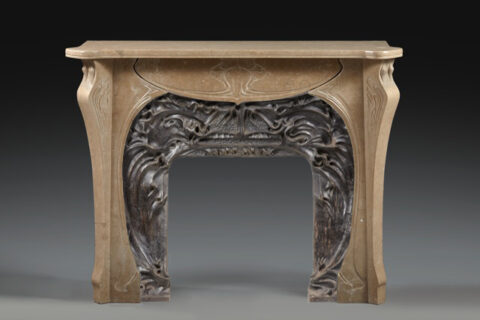
A marble fireplace model from Castel Béranger with a bronze-finished cast-iron insert by Durenne. Collection of the Saint-Dizier Museum. Photomontage created using photographs from the Auction France sale of the former Plantin collection, September 2015.
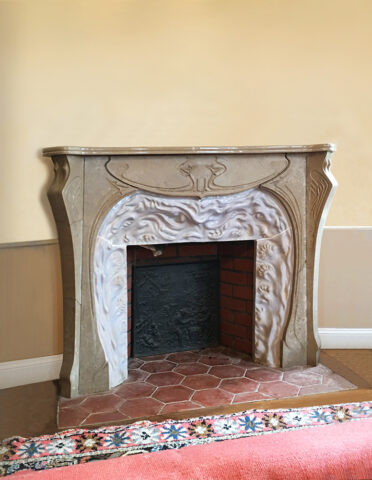
Castel Béranger-style marble fireplace with a glazed terracotta insert in the living room of Castel Val (1903). Photo and computer-generated image by F. D.
Presumably to save money, the decorative elements on these two marble mantelpiece designs from Castel Béranger are primarily engraved in grooves. Guimard reused them for several years in other buildings. At the same time, however, he also used wood for a mantelpiece (at Castel Val) and, most notably, from around 1900 to 1908, glazed lava, which allowed him to add color to these mantelpieces in a subtle way.
However, the appeal of carved and engraved marble remained strong, and around 1904, new designs emerged in line with the evolution of his style. Those at Castel d’Orgeval are very simple and feature flat earthenware panels for the insert.
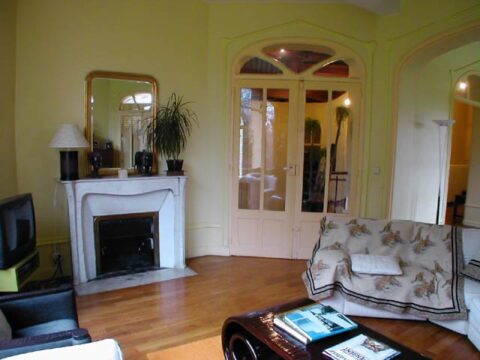
Living room at Castel d’Orgeval. Photo from a real estate agent. All rights reserved
Depending on the budget allocated and the room in which they are located, the mantelpieces in other homes vary in opulence.
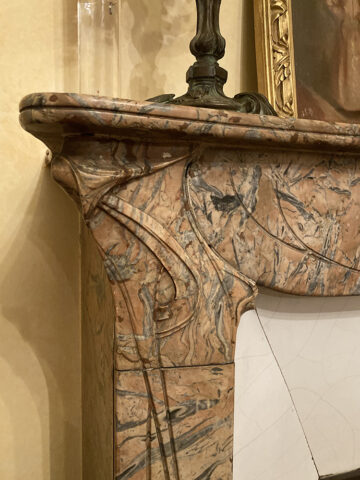
Fireplace on the ground floor of the villa on Rue Jean Doyen in Eaubonne (c. 1907–1908). The mantelpiece is made of simple flat ceramic tiles. Photo by F. D.
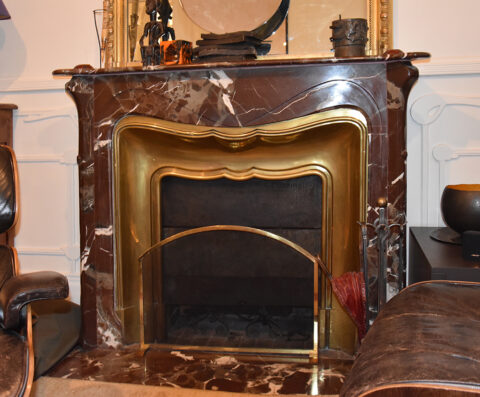
Marble mantelpiece with a brass insert at the Deron-Levent Hotel (1907–1908), 8 Villa de La Réunion, Paris’s 16th arrondissement. Photo by F. D.
These marble mantelpieces foreshadow the designs that appeared in the drawings featuring the standard sizes listed in the *Fontes artistiques de Guimard* catalog, published by the Saint-Dizier foundry in 1908. These standard sizes, designed to fit the most common mantelpiece models on the market, are presented across three plates, two of which bear the following note: “The marble can be obtained from: Société Anonyme des Usines et Carrières — Devillers et Cie — Marpent (Nord)[3].” On these plates, Guimard shows four different mantelpiece models adapted to three groups of inserts. The tallest and widest are the GA and GC, which are the same size (96 cm high and 110 cm wide). The GB model is of intermediate height and width (93 cm high by 100 cm wide).
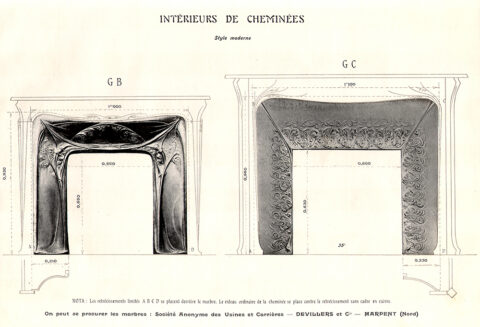
GB and GC chimney flue inserts, from the catalog of Guimard’s Artistic Cast Iron Works, Saint-Dizier Foundry, plate 61. Private collection.
As for the GI, GH, GG, and GE series, they are all the same height (90 cm), and their width increases by 5 cm with each model (from 75 to 90 cm).
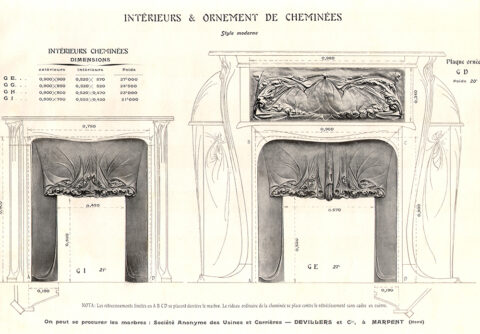
GI and GE chimney inserts, from the catalog of Guimard’s Artistic Cast Iron Works, Saint-Dizier Foundry, plate 62. Private collection.
For this final series, Guimard also designed a more monumental mantelpiece model featuring an ornate cast-iron panel at the top. The *Fontes Artistiques* catalog presents it in the widest GE model (above), but we also know of a narrower version with the GI insert (below).
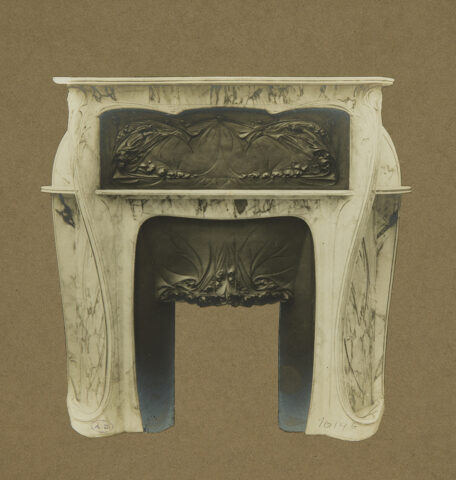
Marble fireplace with a GI-style insert and a GD-style decorative panel. Bibliothèque des Arts Décoratifs, donated by Adeline Oppenheim-Guimard, 1948. Photo by Laurent Sully Jaulmes (detail).
But it soon becomes clear that the fireplace mantel designs shown in the plates of the artistic cast iron catalog are merely illustrative, as Guimard created a wide variety of different models. For example, within the GI, GH, GG, and GE series of narrower designs, we know of another mantel model that was actually produced (though its location is unknown) and is, in contrast, extremely simple.
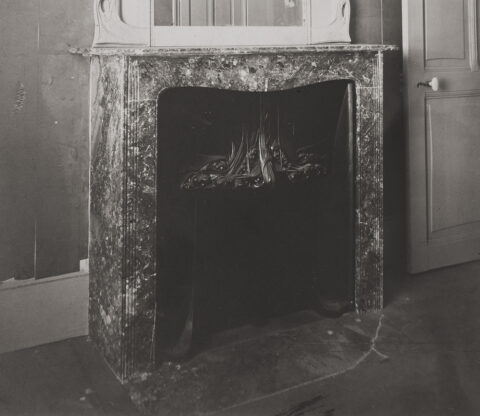
Marble fireplace with a GH-style insert, photograph taken in Guimard’s workshops at 12 Avenue Perrichont-prolongée. Bibliothèque des Arts Décoratifs, donated by Adeline Oppenheim-Guimard, 1948. Photo by Laurent Sully Jaulmes (detail).
For a GC insert, Guimard also designed a model for a mantel featuring bronze brackets at the corners.
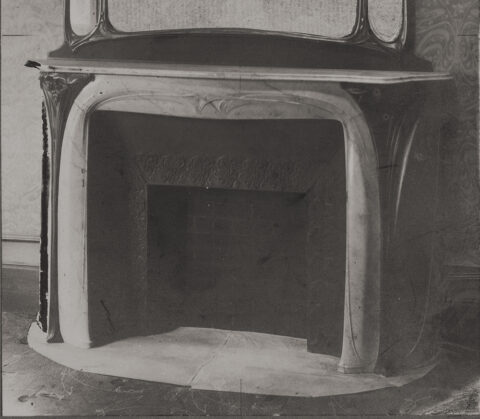
Marble fireplace 1017 with a GC insertt and bronze brackets, photograph taken in Guimard’s workshops at 12 Avenue Perrichont-prolongée. Bibliothèque des Arts Décoratifs, donated by Adeline Oppenheim-Guimard, 1948. Photo by Laurent Sully Jaulmes (detail).
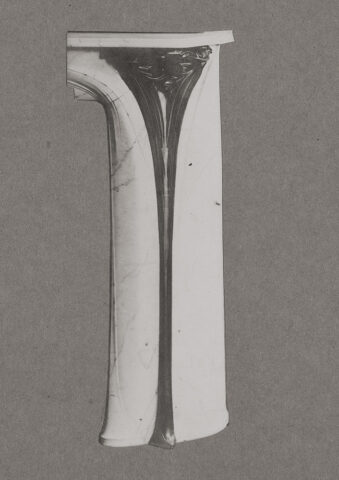
Detail of the bronze brackets on the marble mantelpiece 1017. Bibliothèque des Arts Décoratifs, donated by Adeline Oppenheim-Guimard, 1948. Photo by Laurent Sully Jaulmes (detail).
This fireplace, numbered 1017, was installed in the living room of the Hôtel Guimard on Avenue Mozart. It is, in fact, the only fireplace in the hotel, as Guimard opted for central heating to save space in the modestly sized rooms of this very small property.
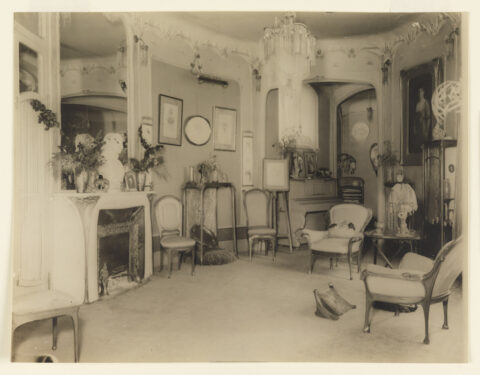
Old photograph of the living room at the Hôtel Guimard, 122 Avenue Mozart, featuring the 1017 fireplace. Cooper-Hewitt Museum, New York, donated by Adeline Oppenheim-Guimard. All rights reserved.
Another document is likely a photo montage featuring a cutout from a retouched photo of a marble coat model, superimposed on a photo (itself cut out) of a GC insert.
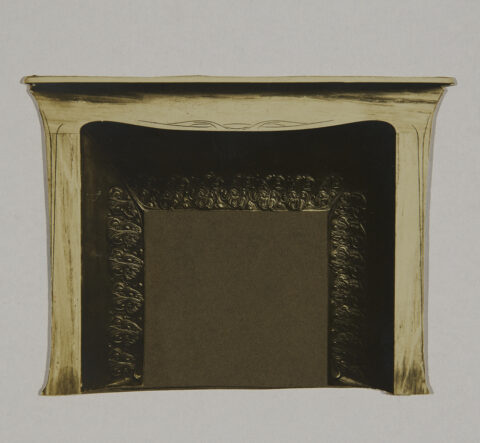
Probable photo montage of a mantelpiece on a GC insert. Bibliothèque des Arts Décoratifs, donated by Adeline Oppenheim-Guimard, 1948. Photo by Laurent Sully Jaulmes (detail).
For GB inserts, the marble mantels have also presented with variations.
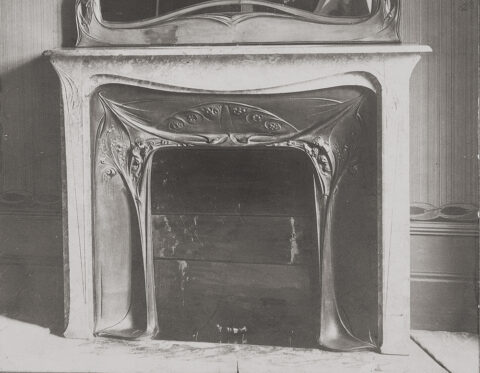
Marble fireplace 1013. Bibliothèque des Arts Décoratifs, photograph taken in Guimard’s studios at 12 Avenue Perrichont-prolongée, donated by Adeline Oppenheim-Guimard, 1948. Photo by Laurent Sully Jaulmes (detail).
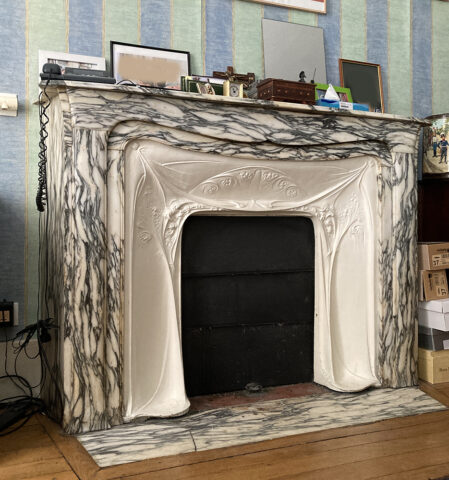
Fireplace with a GB insert in an apartment in the Trémois building (1909–1910). Photo by F.D.
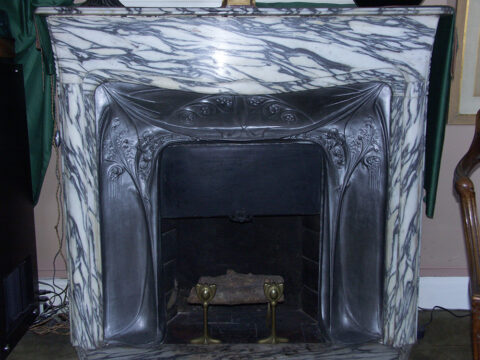
Fireplace with a GB-style insert, in an apartment at 17 Rue La Fontaine (1909–1911). Photo by F. D.
Among the photographs donated by Adeline Oppenheim to the Bibliothèque des Arts Décoratifs in 1948 is another mantel design with a refined silhouette that may have been photographed as a plaster model during the design phase.
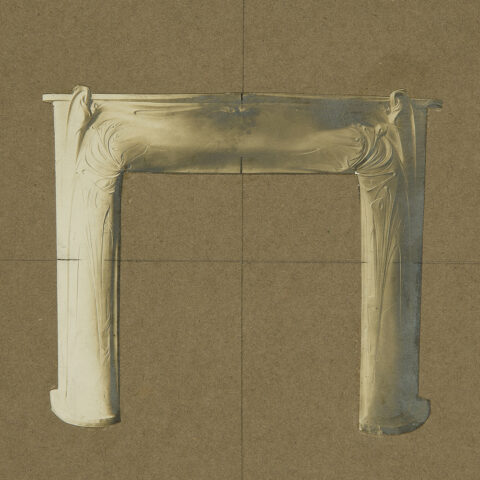
Probably a plaster model for a marble mantelpiece. Bibliothèque des Arts Décoratifs, donated by Adeline Oppenheim-Guimard, 1948. Photo by Laurent Sully Jaulmes (detail).
These photographs, donated by Adeline Oppenheim-Guimard, are mounted on a sheet of heavy paper on which Guimard handwrote the model’s name and assigned it a number. This presentation suggests that he was planning to produce a catalog of fireplaces, just as he was considering others: chandeliers, hardware, mirror frames, vases, furniture, cutlery, and even tombs, for which the stonework would necessarily have to be commissioned from stonemasons. Most of these catalog projects never came to fruition, but they stand as an important testament, on the one hand, to Guimard’s desire to expand the scope of his creations almost infinitely, and on the other, to his wish to make them accessible to as many people as possible through mass production. On the eve of World War I, he was thus at the helm of a vast array of designs suitable for furnishing rental properties—whether modest or luxurious—as well as private mansions, all while maintaining tight control over the costs of their furnishings.
It is also worth noting that for his marble fireplaces, Guimard once again called upon contractors from northern France, as he did for the mosaics in the vestibules and halls of the Castel Béranger (De Smet in Lille), the earthenware versions of the Chalmont planters (De Bruyn in Lille), and the rugs and carpets (Honoré Frères and later Parlant & Biron in Tourcoing).
One cannot help but suspect the existence of a network of connections of which Louis Coilliot, the Lille-based ceramics dealer and client of Guimard, was likely a part.
Another telling sign that Guimard was closely connected to the marble industry is that in early 1908, just as the catalog of artistic castings published by the Fonderie de Saint-Dizier was about to be released, an unsigned article appeared, purportedly covering the 1907 Salon des Artistes Décorateurs but in fact devoted almost entirely to commenting on Guimard’s exhibition at that salon. No doubt due to a lack of access to the major decorative art journals of the time, which typically excluded the architect, it ended up in an obscure trade journal for the marble industry. This text offers a eulogy of the “Guimard Style” with an enthusiasm its creator had never enjoyed, not even when it was in vogue. The praise is so effusive that if Guimard was not the author himself, he must have firmly guided the writer’s pen and provided all the necessary arguments.
After the war, there is no evidence that Guimard created any new fireplace designs. In all areas of his work, he continued to reuse his older designs while occasionally—though rarely—creating new ones. The list of businesses at the Village Français town hall, built for the 1925 Exposition of Modern Decorative Arts, includes a fireplace manufacturer, the Société Industrielle des Pyrénées, but it is unlikely that Guimard designed a model specifically for this occasion. He continued, however, to use this heating method, as fireplaces are still present in a prestigious building such as the one at 18 Rue Henri Heine (1926), where the Guimards lived from 1930 to
Frédéric Descouturelle
with the participation of Olivier Pons
Notes
[1] Its origins can even be traced back to Jules Hardouin-Mansart’s renovation of Louis XIV’s apartment at the Grand Trianon in the late 17th century. [2] Originally from Belgium, Albert Maybon’s marble company operated a quarry in Flaumont-Waudrechies, in the Nord department, in 1900. (source: Burgundy-Franche-Comté Regional Inventory). At the Paris World’s Fair, the company, representing Belgium, exhibited two marble columns from the Gochenée quarry near Namur (source: official exhibition catalog, Group XII, Class 66, fixed decoration of public buildings and dwellings). [3] The Société anonyme des usines et carrières Devillers et compagnie was a Belgian company founded in 1893 and operating in Marpent (Nord). This company is cited by Guimard in a letter published by La Construction Moderne in 1913 as one of the companies that made the greatest sacrifices to market the models designed by Guimard. It was dissolved in 1910 (National Archives of the World of Work). However, it likely continued under a new name, as the Société des carrières et marbreries de Marpent took it over in 1927 (Hauts-de-France Inventory, Presentation of the Municipality of Marpent).Translation: Alan Bryden