
Tag: no-auto-post
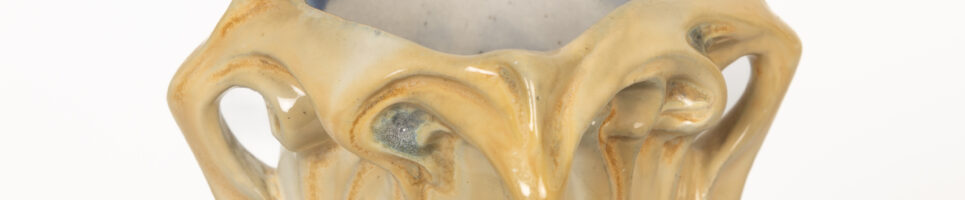
Acquisition of a previously unseen copy of a Hector Guimard’s Cerny vase
2 April, 2025
As the deadline for submitting bids for a long-term lease on the Hotel Mezzara was rapidly approaching we continued our efforts, with regard to enriching our collections. Following the purchase of a section of a candelabra and its glass cover from the metro by Le Cercle Guimard[1], it is now the turn of our partner Fabien Choné to acquire, this time at auction[2], a new work by Guimard: a period copy of the Cerny vase.
Cerny is one of three designs created by Guimard for the Manufacture de Sèvres around 1900[3]. Production spanned a decade, and our research in the institution’s archives has enabled us to estimate that no more than fifteen copies of the vase were manufactured by Sèvres during this period[4].
The appearance of an original copy of Cerny’s vase is therefore a minor event in itself, allowing us to identify and document the tenth copy to have survived to the present day. Made of glazed stoneware, it is characterized by a mustard yellow glaze enhanced by discreet blue crystallizations nestled in the hollows of the neck and highlighting its base, a color scheme that brings it closer to the examples preserved by the museums of Sèvres and Limoges.
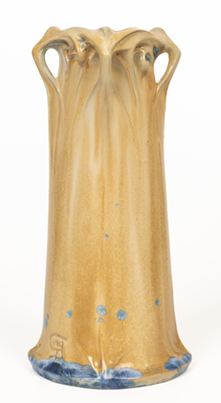
Cerny vase auctioned on 13 March 2025. Photo étude Metayer-Mermoz.
At its base is the traditional HG monogram—which adorns all of Guimard’s Sèvres productions—as well as the Manufacture’s own marks on the bottom: the triangular S 1904 stamp, which allows it to be dated, and the rectangular SÈVRES stamp.
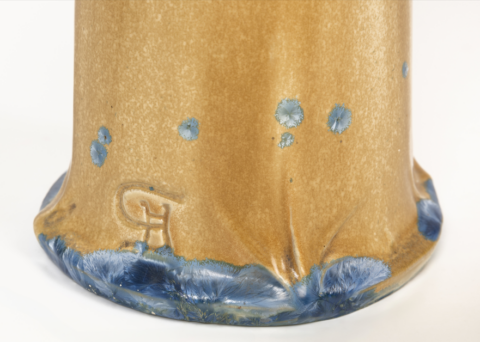
HG monogram engraved at the base of the vase. Photo étude Metayer-Mermoz.
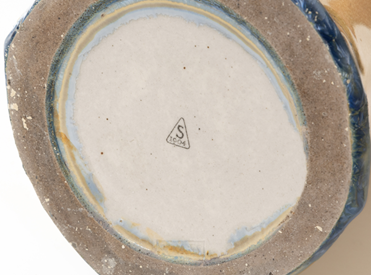
Base of the vase bearing the two marks of the Manufacture de Sèvres. Photo étude Metayer-Mermoz.
An accident in the past necessitated restoration work last year—which we will return to shortly—involving the partial reconstruction of one of the four handles forming the neck.
The originality of this vase lies in its history and provenance, which, unusually for this type of object, are known thanks to family accounts.
Through direct descent, this vase comes from the former collection of Mr. Numa Andoire (Coursegoules 1908 – Antibes 1994), a soccer player and professional coach, famous for winning the French Championship in 1951 and 1952 while coaching the Nice team, OGC Nice, as well as the French Cup in 1952.
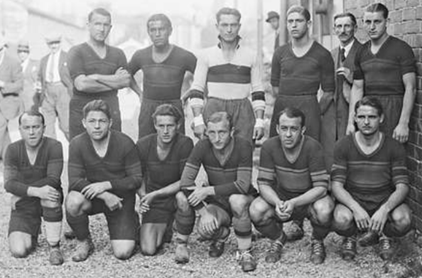
The Nice team in 1931. On the right, Numa is standing leaning on the wall. Photo all rights reserved.
The family story has it that the vase was given to Numa Andoire in 1927 by French President Gaston Doumergue (1863-1937) during a soccer tournament held to mark the unveiling of Antibes’ World War I memorial. The monument, whose centerpiece is a statue of a soldier sculpted by Bouchard[5], was built at the foot of Fort Carré and still overlooks the football field of the same name.
The regional and local press reported on the event, which took place on Sunday, July 3, 1927, with the usual patriotic speeches, troop parades, and medal ceremonies to the sound of the Marseillaise.
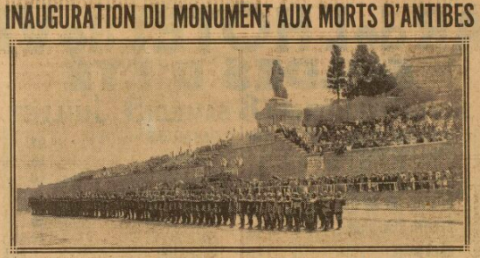
L’Excelsior 5 July 1927. Site internet BNF/Gallica
In attendance were a former undersecretary of state for war, who presided over the ceremony, a senator, a member of Parliament and a general representing the minister of defense, but no president of the republic… who was certainly represented by proxy, as is often the case for this type of event.
The presence of such a valuable Cerny vase as a gift from the state on the occasion of a relatively insignificant competition may seem surprising. But it should be seen in the context of the long (and sometimes unusual) history of generosity granted by the authorities on the occasion of cultural, scientific or sporting events. It should be remembered that the State, the sole shareholder of the “Manufacture de Sèvres”, used it primarily to provide valuable diplomatic gifts, but also a large number of art objects presented on behalf of the authorities at cultural and sporting events. World, international, and regional exhibitions were thus an opportunity to present numerous vases, statuettes, and other decorative dishes—most often with the famous blue background of Sèvres—whose size and decoration were more or less correlated with the importance of the prizes awarded to the winners, rewards that were variously appreciated by the artistic community…[6].
As for our Cerny vase, presented more than 15 years after the last one was made in Sèvres, this was probably one of the many occasions on which the State drew on the reserves of official manufacturers to award first prizes, when it was not the institutions or ministries themselves that disposed of certain acquisitions. In 1927, at a time when Art Nouveau was already well out of fashion, the authorities probably did not realize that they were offering an object that, a century later, would acquire such significant artistic and financial value.
Why did our vase become the property of Numa Andoire rather than another player? As the family story is not sufficiently clear on this point, we can only speculate. Was it to reward the short but promising career of the young prodigy player from Olympique d’Antibes, or rather to offer him a farewell gift as he completed his seventh and final season with the Antibes team before joining the Nice team? Probably a little of both… In any case, it is touching to note that this vase was kept for a long time as a family heirloom before the heirs finally decided to part with it.
This unique Cerny vase now features prominently in our museum layout project for the Mezzara hotel.
Olivier Pons
Notes
[1] https://www.lecercleguimard.fr/fr/une-verrine-en-verre-du-metro-de-guimard-pour-notre-projet-museal/
[2] Sale on March 23, 2025, Metayer-Mermoz auction house in Antibes, expert E. Eyraud.
[3] The other two forms are the Chalmont plant pot and the Binelles planter.
[4] For more information on the history of this collaboration, readers are referred to the book published in 2022 by Éditions du Cercle Guimard: F. Descouturelle, O. Pons, La Céramique et la Lave émaillée d’Hector Guimard.
[5] Henri Bouchard (1875-1960) had a studio built in 1924 at 25 rue de l’Yvette in Paris (75016), opposite the property of the painter Jacques-Emile Blanche, for whom Guimard carried out decorative work. The sculptor’s studio, which became the Bouchard Museum, closed its doors in 2007 before being transferred to La Piscine in Roubaix.
[6] One of the most famous cases is probably that of François-Rupert Carabin (1862-1932), a rebellious sculptor who, in 1912, received a blue-bottomed Sèvres vase as the “Prix du Président de la République” (President of the Republic Award), which he considered “very ugly and second-rate.” He then created a pedestal consisting of three female figures turning away in horror and exhibited it shortly afterwards at the Salon de la Société nationale des Beaux Arts in order to display it during the presidential visit. The pedestal and the vase now belong to the Perrier-Jouët collection in Épernay.
[7] In 1905, for example, the Ministry of the Navy acquired a Cerny vase that had left the Sèvres workshops a year earlier, and was therefore dated 1904, like our vase…Translation: Alan Bryden
The fantastic and colorful bestiary of Castel Béranger
12 January, 2025
The Cercle Guimard has already devoted several articles to the Castel Béranger, the apartment building commissioned by Élisabeth Fournier[1] from Hector Guimard in 1894 and completed in 1898. Our last article [2] showed that the complete stylistic overhaul carried out by Guimard during its construction from 1895 to 1898 coincided with a change in suppliers for the ceramic decorations. This time, we focus on the fantastical and colorful bestiary that adorns its facades, first presenting the unique features of this project, then the fantastical dimension of its decor inspired by nature and the neo-Gothic repertoire. Finally, the materiality and polychromy of this bestiary will be explained.
“This building, […], is set to revolutionize the art of construction. Its appearance is truly extraordinary”[3].
As reflected in these comments made by a journalist in an article dedicated to Castel Béranger, yesterday as today, the facade of this building does not go unnoticed in the public space. The fact that it was one of the winners of the facade competition organized by the Paris City Council in 1898 testifies to the desire of the public authorities at the time to encourage architecture that broke with the monotony of the facades of traditional Haussmann-style apartment buildings, “which made the streets of Paris boring enough to put you to sleep”[4]. Its construction coincided with the work of the commission set up to draw up new road regulations allowing greater freedom in the silhouettes of buildings and their projections.
The Castel Béranger project: modifications and unique features
A design far removed from the initial project
However, this rich decoration, which brought international fame to Castel Béranger and Hector Guimard, was not what the architect had originally planned. A look at the facade elevations in the building permit application submitted by Guimard in March 1895 reveals an initial design that was never realized. After his stay in Brussels in the summer of 1895, during which he met architects Victor Horta (1861-1947) and Paul Hankar (1859-1901), Guimard redesigned the entire interior of Castel Béranger. This is how a fantastic and colorful bestiary appeared on the facades, but also inside the building.
A bestiary on the facade: the only example in Guimard’s work
The term “bestiary” is used here in the same way as it is defined in the Larousse dictionary, namely as “the whole of animal iconography, or group of animal representations”[6]. Looking at the facades of Castel Béranger, it is easy to identify elements of the decor that are rather figurative in nature, inspired by wildlife. The shape of a cat is easily recognizable.
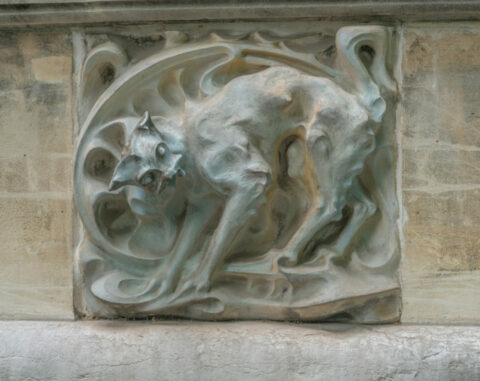
Panel depicting a cat arching its back, made of glazed sandstone from Castel Béranger, created by Gilardoni & Brault in 1897. Photo by Nicholas Christodoulidis.
The central motifs of the cast iron balconies are half human, half feline. Their large noses may even evoke the muzzle of a lion, a recurring motif in 19th-century ornamental cast ironwork.
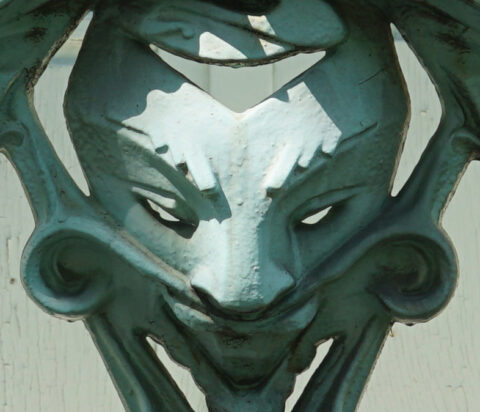
Central motif of the cast iron balconies of Castel Béranger, produced by the Durenne foundry in Sommevoire between 1895 and 1898. Photo by F. Descouturelle.
However, the bestiary of Castel Béranger also includes several motifs that are more specifically related to underwater fauna and contribute to a broader aquatic repertoire[7] in this apartment building.
The most convincing example is undoubtedly the decorative cast iron chain anchors, whose formal appearance resembles that of a seahorse. These structural elements, which appear numerous times on the facades, are the ends of tie rods that contribute to the chaining of the construction, allowing the distribution of tensile forces in the masonry and the solidarity of the walls (and possibly the floors) between them. It is for this reason that Guimard added what could be described as two legs to these sea horses.
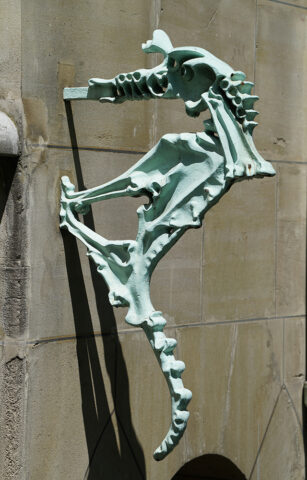
Cast iron anchor from Castel Béranger, made by the Durenne foundry in Sommevoire between 1895 and 1898. Photo by F. Descouturelle.
Inside, the starting point of the staircase handrail may also evoke the silhouette of a horse’s head and neck[8].
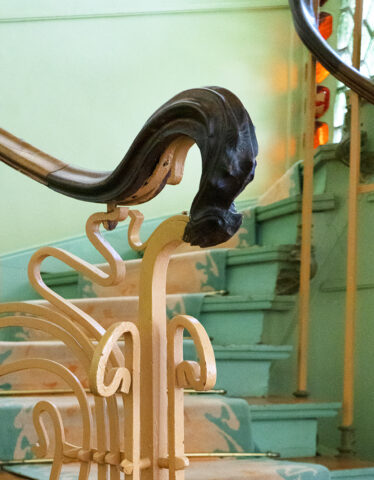
Start of the handrail on the staircase of the building on Rue du Castel Béranger, carved wood. Photo by F. Descouturelle.
Once again outside, on a tympanum of the building overlooking the courtyard facing the hamlet of Béranger, there is a fish between two shrimps.
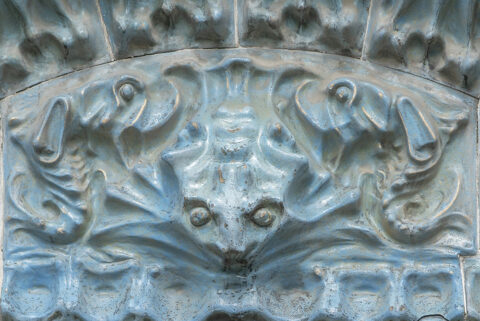
Glazed ceramic tympanum on the courtyard façade overlooking the hamlet of Béranger, created by Gilardoni & Brault between 1895 and 1898. Photo by Nicholas Christodoulidis.
This decorative animal register is an exception in Guimard’s work. Although some cast iron elements from Castel Béranger were later reused by the architect in some of his other projects[9], no other decoration of such magnitude featuring fauna preceded or followed it in his built work.
The fantastical decoration of Castel Béranger
A fantastical dimension…
Castel Béranger was not only unique in the diversity of polychrome materials used in its masonry. It was also unique in the profusion of chimeras adorning its facades, a veritable fantastical bestiary. According to the Larousse dictionary, the fantastic “refers to an artistic work […] that transgresses reality by referring to dreams, the supernatural, magic, and horror[10].”
This “transgression of reality” is a key concept in understanding the decoration of this apartment building. Unlike his initial project, in which he had planned a stylized botanical decoration, the architect ultimately designed a decoration that no longer sought to reproduce nature as it appears to us. Instead, it oscillates between a “modified” realism, as in the cast iron seahorses or the cat panel, where the modeling of the animal’s body is extended by three-dimensional curves…
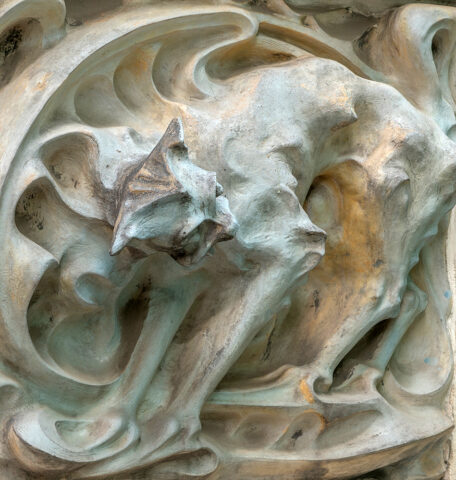
Nicholas Christodoulidis (photographer), Panel depicting a cat arching its back, made of glazed sandstone at Castel Béranger, created by Gilardoni & Brault in 1897. Photo Nicholas Christodoulidis.
… and a more or less advanced abstraction, such as, for example, on the panel decorating the corbel of the bow window in the courtyard, where the modeling appears so abstract, so shapeless, that at first glance it seems futile to look for any similarities with an element of fauna or flora.
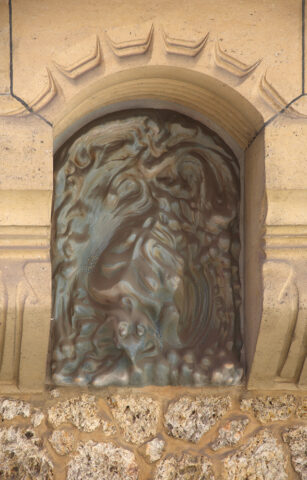
Corbeling of the bow window in the courtyard of Castel Béranger. Photo by F. Descouturelle.
Even if a few imaginative minds will surely cling to a detail in the lower part to see a beak and two eyes.
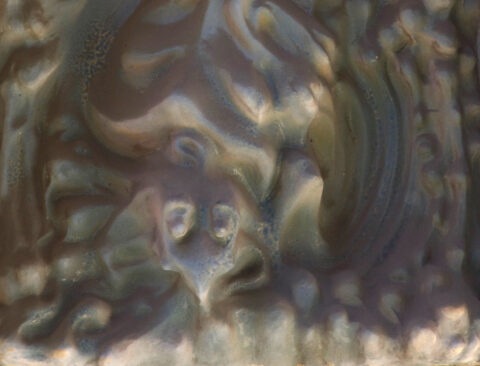
Detail of the glazed ceramic panel on the corbel of the bow window in the courtyard of Castel Béranger, created by Gilardoni & Brault between 1895 and 1898. Photo by F. Descouturelle.
In Études sur le Castel Béranger, written in 1899 by Georges Soulier and a certain “P.N.”—probably Paul Nozal—the authors explain that “the designs of the ornamentation [must] accompany the living decor […], in a harmony of more fluid forms”[11], without competing with it. We can therefore assume that for Guimard, the essential thing was not to reproduce nature but rather to evoke it through more or less precisely shaped contours[12].
Georges Soulier and Paul Nozal also point out that over the centuries, art has very rarely sought to imitate nature scrupulously and that transgressing reality is therefore nothing new. The foliage, the stylization of acanthus leaves on Corinthian capitals, and the chimeras adorning cathedrals are perfect examples of this.
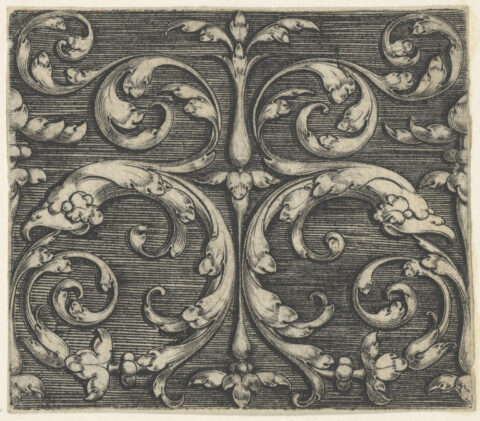
Symmetrical ornamental scrollwork, 1527, engraving. Louvre Museum, Department of Graphic Arts, 8324 LR
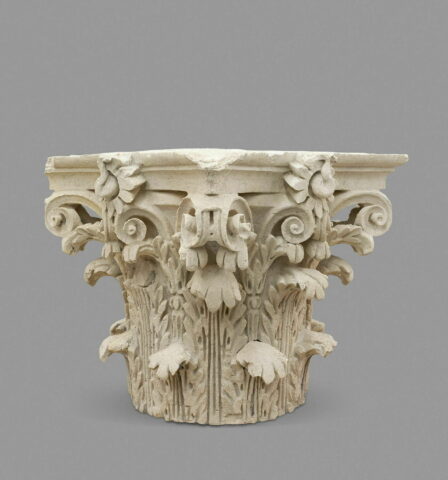
Corinthian capital, 1650-1700, Cour Carrée, sculpture. Louvre Museum, Department of Medieval, Renaissance, and Modern Sculpture, RF 4149.
…inspired by nature…
Some of these decorations, which transcend reality, can be spontaneously likened to natural organisms, but this time without it being possible to identify them with certainty as an animal species. Each viewer forms their own idea of what they see, based on their own culture. This is the case with the mass-produced ceramic metopes that adorn the metal lintels found numerous times on the façade. Their shape may, for example, vaguely resemble that of a frog’s head or an insect, such as a praying mantis.
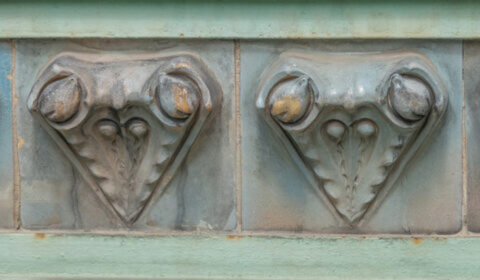
Metopes of the metal lintels of certain bays, made by Gilardoni & Brault in glazed ceramic (or by Bigot in glazed stoneware) between 1895 and 1898. Photo Nicholas Christodoulidis.
The air intakes on the facades are decorated with cast iron grids whose shape could be likened to that of a crab, or even a mouth and two nostrils[13].
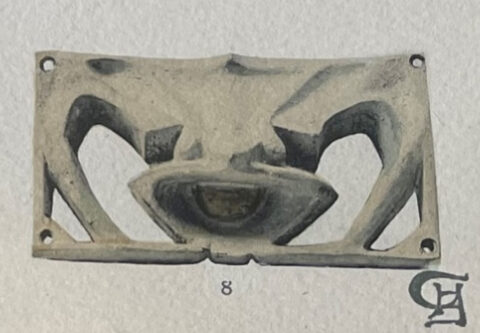
Air vent, portfolio Le Castel Béranger, work by architect Hector Guimard, Paris, Librairie Rouam, 1898, pl. 22. Library of the Museum of Decorative Arts, Reserve P95.
In the apartments, the wallpaper specifically designed for the antechambers also features a pattern highlighted by its coloring, with whimsical lines reminiscent of those of a feline.
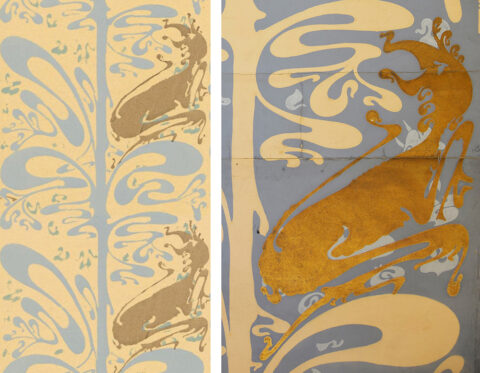
Left: detail of wallpaper in the antechambers, portfolio Le Castel Béranger, work by architect Hector Guimard, Paris, Librairie Rouam, 1898, pl. 30. Private collection. Right: detail of a fragment of wallpaper produced by Le Mardelé, kept at the Bibliothèque Forney, ref. 998, three tones including gold, circa 1895–1896. Photo: F. Descouturelle.
Unique among the other wallpapers designed for other rooms in Castel Béranger, its overall composition evokes a tree of Jesse, while the style of this particular motif is reminiscent of a medieval illumination, which brings us to the most intriguing aspect of this bestiary.
… and a medieval phantasmagoria
Another interpretation of the animal repertoire present at Castel Béranger is the one that earned it the nickname “house of devils” in Auteuil, as reported by Jean Rameau in Le Gaulois in 1899.
“The artist may have wanted to represent chimeras, but the common people see demons, causing all the old women in the district to cross themselves from twenty paces away. There are devils at the doors, devils at the windows, devils at the cellar windows, devils on the balconies and stained glass windows, and I am assured that inside, the stair railings, stove knobs, cupboard keys, everything from the large living room to the pantry, is the same devilry. If God no longer protects France, at least the devil seems to protect Auteuil. Parisians, sleep in peace[14].
Even if Jean Rameau exaggerates, his use of vocabulary associated with horror and hell clearly indicates that there is a “satanic” dimension to Castel Béranger. He even seems to have had a fairly detailed knowledge of the building, since he mentions the presence of devils on the stove knobs. However, as evidenced by a detail in the illustration of the kitchen stove facades published in the Castel Béranger portfolio, the motif between the two air intake panels on the cast iron facades perfectly evokes a diabolical figure with an oversized, toothy mouth and furious eyes above it.
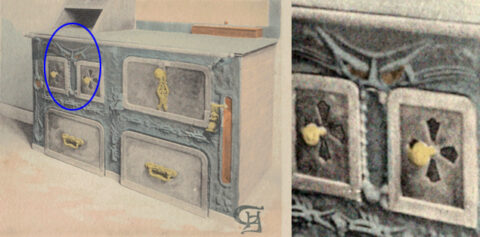
Stove in the kitchens of Castel Béranger, portfolio Le Castel Béranger, œuvre de Hector Guimard architecte, Paris, Librairie Rouam, 1898, pl. 51, no. 4 (detail). Private collection.
The facades of Castel Béranger feature several elements—particularly the gables and the relative asymmetry of the street-facing facade—that link the building to medieval architecture and justify its name, “castel.” This is hardly surprising given the renewed interest in Gothic architecture in the 19th century, but also the connection between Eugène Viollet-le-Duc and Hector Guimard. However, his “satanic” decorative repertoire, while certainly present, is not as prominent as Jean Rameau would have us believe. In reality, Guimard does not simply take the Middle Ages as his source, but refers to the phantasmagorical image of the witch, which, as Maryse Simon[15] explains, is wrongly linked to the medieval period, since in reality the witch hunt was at its peak in the 16th and 17th centuries. This phantasmagorical image of the medieval witch stems from a construct that began in the modern era and was modified in the 19th century, notably by authors of fairy tales such as the Brothers Grimm[16].
This pastel by Lévy-Dhurmer, created in 1897—during the construction of Castel Béranger (1895-1898)—depicts a witch surrounded by all her attributes: a cat, a snake, a lizard, a bat, and an owl. With the exception of the owl, all of these creatures can be found on the facades of Castel Béranger.
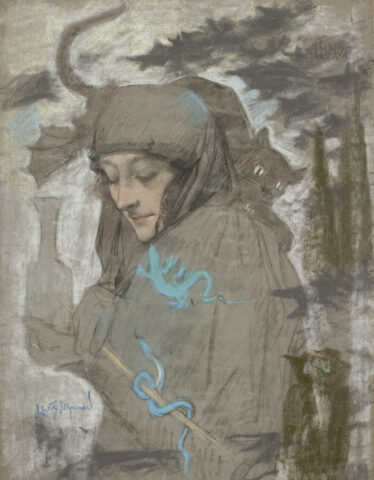
Lucien Lévy-Dhurmer, The Witch, 1897, pastel on paper. Musée d’Orsay, RF 35503.
The panel depicting the cat arching its back was made of glazed stoneware before May 1897 by Gilardoni & Brault, based on the work of modeler Xavier Raphanel.
Panel depicting a cat arching its back (detail) in glazed sandstone from the Castel Béranger, created by Gilardoni & Brault in 1897. Photo by Nicholas Christodoulidis.
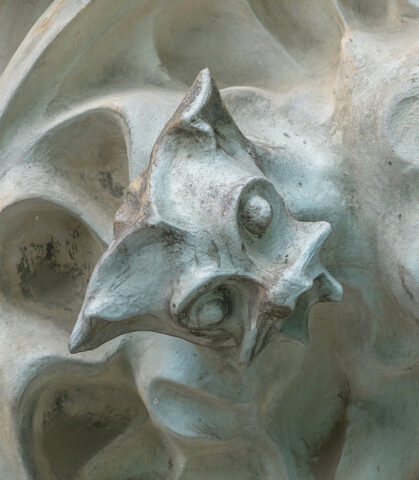
The scan carried out by Nicholas Christodoulidis identified the figure located at the intersection of the pediments of the dormers on the top floor overlooking Rue Jean-La-Fontaine. This chimera carved in stone, despite its bulging eyes, resembles a bat with its pair of membranous wings.
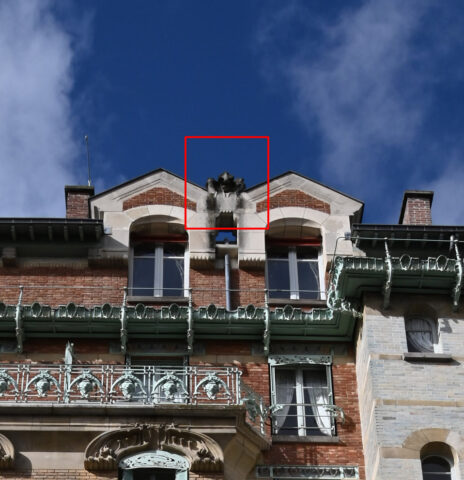
Castel Béranger seen from Rue La Fontaine, 1895–1898. The bat is framed in red.
Photo by Arnaud Rodriguez.
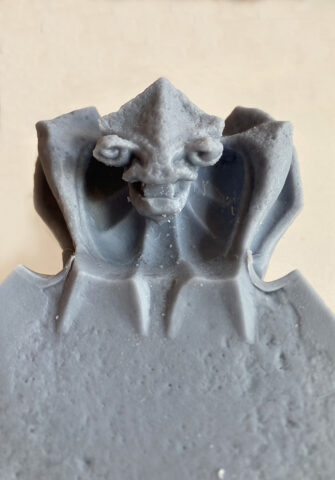
3D printing of the chimera located at the intersection of the pediments of the dormers on the top floor of the façade of Castel Béranger on Rue Jean-de-La Fontaine. Photogrammetry and 3D modeling by Nicholas Christodoulidis.
The use of these types of creatures was common during the Gothic and Neo-Gothic periods, as evidenced by the gargoyles on Bourges Cathedral (12th-13th centuries) and Viollet-le-Duc’s gallery of chimeras on Notre-Dame Cathedral in Paris (mid-19th century).
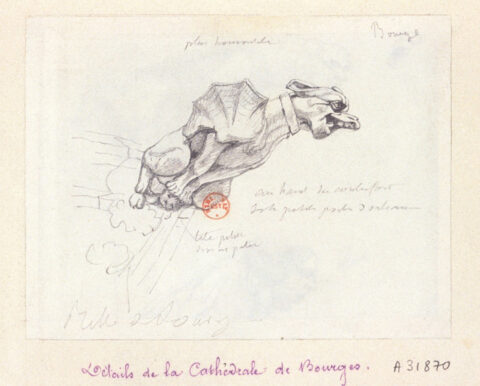
“Details of Bourges Cathedral,” pencil drawing. Bibliothèque nationale de France, Prints and Photography Department, EST RESERVE VE-26 (M).
The pattern of the air vents, presented above, can also evoke the shape of a spider. In addition to the fact that this insect is also linked to the image of the medieval witch, in the Middle Ages the symbol of the spider was associated with the plague because it was believed that they wove numerous webs in the homes of the deceased[17].
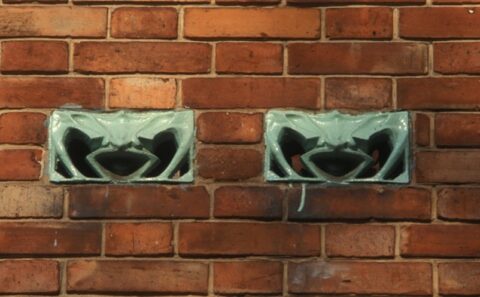
Cast iron air vent from Castel Béranger, made by the Durenne foundry in Sommevoire between 1895 and 1898. Photo by F. Descouturelle.
With their sinuous shape, the cast iron grab bar supports can resemble snakes.
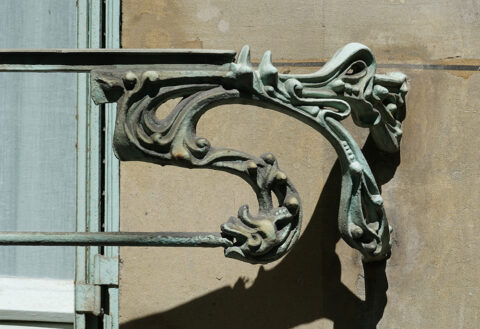
Cast iron crossbar from Castel Béranger, made by the Durenne foundry in Sommevoire between 1895 and 1898. Photo by F. Descouturelle.
As for the fantastical figures wrapped around the stone columns of the entrance gate, they resemble lizards or small dragons.
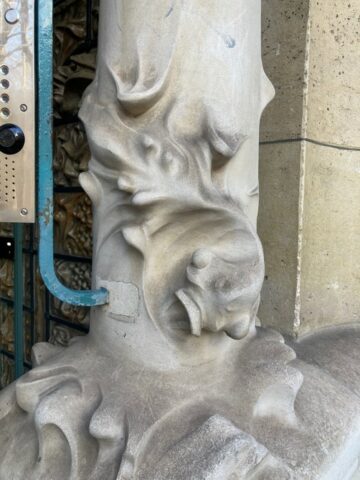
Sculpted column from the entrance gate of Castel Béranger, 1895–1898. Photo by F. Descouturelle.
The depiction of these reptiles can also be explained by artists’ keen interest in the Orient in the 19th century. Victor Hugo even wrote in the preface to the collection Les Orientales that “people are much more interested in the Orient than they ever have been. […] In the age of Louis XIV, people were Hellenists; now they are Orientalists[18].” The snake is therefore a recurring motif in the works of this period, as evidenced by this drawing by Eugène Grasset (1845-1917).
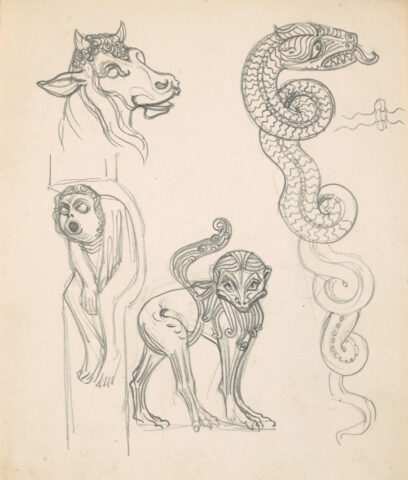
Eugène Grasset (illustrator), Heads of a monkey, bovine animal, and snake, pencil, created between 1890 and 1903. Musée d’Orsay, ARO 1993 9 2 354.
As well as this draft of a decorative panel by architect Louis Boitte (1830–1906), kept at the Musée d’Orsay.
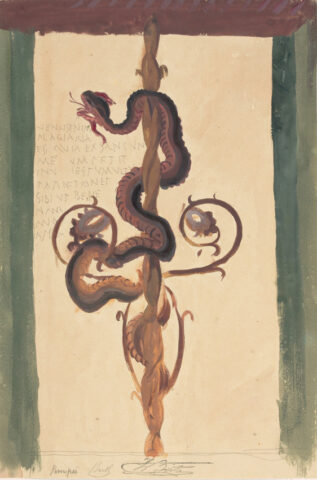
Louis Boitte, Panel decorated with a snake coiled around a braid, pencil and gouache on paper mounted on paper, created between 1890 and 1903. Musée d’Orsay, F 3457 C 673.
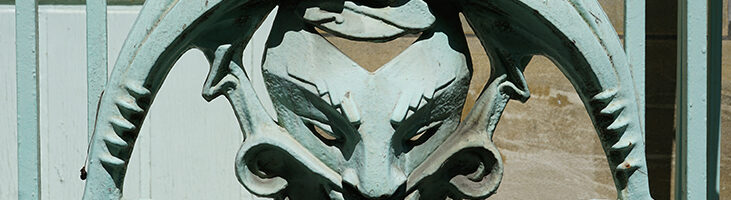
Finally, when you look at the street facade of Castel Béranger, you can’t miss the cast iron masks that adorn the railings. These are undoubtedly what earned this apartment building the nickname “house of devils,” as they feature the attributes of the demon Mephistopheles—a character from the legend of Faust—namely a moustache, a goatee, and almond-shaped eyes. The presence of these figures on the façade is not surprising in light of what we have just seen, since witches are associated with the figure of Satan[19].
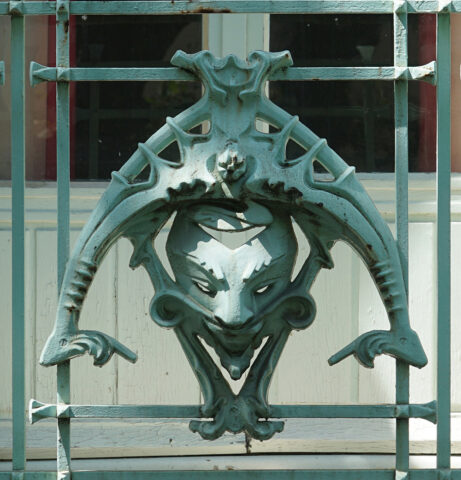
Central motif of the cast iron balconies at Castel Béranger, produced by the Durenne foundry in Sommevoire between 1895 and 1898. Photo: F. Descouturelle.
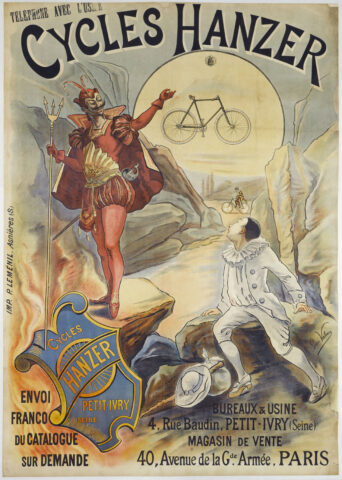
Léon Valentin (illustrator), J. Proust (illustrator-lithographer), Paul Lemenil Printing House. Cycles Hanzer, 40, avenue de la Grande Armée, Paris, poster, color lithograph, circa 1895. Paris, Musée Carnavalet.
The combination of this human figure with two legs above its head also echoes the grylles, grotesque creatures from antiquity, which were reused at the end of the Gothic period and during the Renaissance. The king’s staircase at the Château de Villers-Cotterêts features several examples of this.
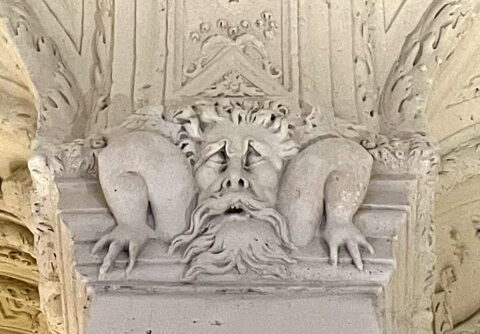
Grylle on the cornice of the King’s staircase at Villers-Cotterêts Castle. Photo Eliselfg, Wikimedia Commons (detail).
These masks adorning the railings of Castel Béranger clearly influenced German architect Felix Reinhold Voretzsch. He designed a very similar model—albeit in a burlesque style, as the masks here stick out their tongues—to decorate the railings on the third floor of the loggia of the Art Nouveau building at Bürgerwiese 20, built in Dresden in 1900.
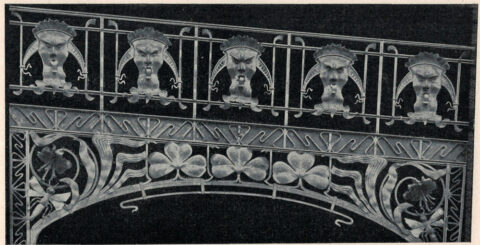
Balustrade of the loggia at Bürgerwiese 20 in Dresden, architect Reinhold Voretzsch, portfolio Modern Artistic Ironwork, 1902, pl. 98. Private collection.
Colorful chimeras
Colors and materiality
The variety of materials used on the facades of Castel Béranger, and the resulting polychromy, is very striking. As mentioned in the introduction, it clearly distinguishes the building from the neighboring apartment buildings. The photograph on plate thirteen of the Portfolio du Castel Béranger, colored using the “watercolor facsimile” process, shows the inner courtyard opening onto the Hameau Béranger. The variety of materials used by Guimard and the resulting polychromy are clearly visible. If we count only the materials used for the masonry, we arrive at a total of seven: millstone, terracotta or glazed brick, sand-lime brick, cut stone, cast iron, and sheet metal. This polychromy is not a whim of the architect but the result of rational thinking that illustrates the connection between Viollet-le-Duc and Guimard.
During the symposium dedicated to Hector Guimard, organized by the Musée d’Orsay as part of the 1992 exhibition devoted to the architect, Lanier Graham emphasized the considerable influence that the rationalist school initiated by Viollet-le-Duc had on architects at the end of the 19th century, particularly Hector Guimard[20]. For Viollet-le-Duc, form had to derive from function and structure, and materials had to be used and combined according to their specific qualities[21]. The most compelling example of the connection between the two architects is undoubtedly the main building of the École du Sacré Cœur, where Guimard used the sloping cast iron columns designed by Viollet-le-Duc for the “XIIe Entretien”, dedicated to masonry, published in the book Entretiens sur l’architecture[22]. This influence is particularly due to Guimard’s training, as his teachers, Charles Génuys and then Gustave Raulin, were part of the rationalist school and were both disciples of Viollet-le-Duc. Marie-Laure Crosnier Leconte points out in the 1992 exhibition catalog[23] that during Guimard’s lecture at the Figaro offices on May 12, 1899, he repeatedly stated that the author of the Entretiens was his mentor[24].
Like Viollet-Le-Duc, Guimard therefore strove to use the right materials in the right places in order to make the most of their qualities while keeping the budget under control. He applied this principle both to the construction of the Castel Béranger and to its ornamentation. Guimard chose to use cast iron and ceramics to create the fantastical bestiary we have just described. Both materials have the advantage of being highly malleable, making it easy to create zoomorphic shapes, with the cast iron being poured and the ceramics stamped into molds. These techniques are also perfectly suited to the low-cost mass production of pieces.
Ceramics is a material that is designed to be glazed. In addition to protecting the pieces, the glaze has the advantage of coloring them according to the designer’s wishes. At Castel Béranger, Guimard chose to coat most of the ceramic chimeras with a glaze in a more or less dark bluish-green hue[25]. The cast iron bestiary (seahorses, spiders, snakes) was covered with paint, also in a bluish-green shade, to create harmony between the elements of the finishing work that make up this fantastical bestiary. It is likely that the balcony masks were gilded, as suggested by the portfolio plates.
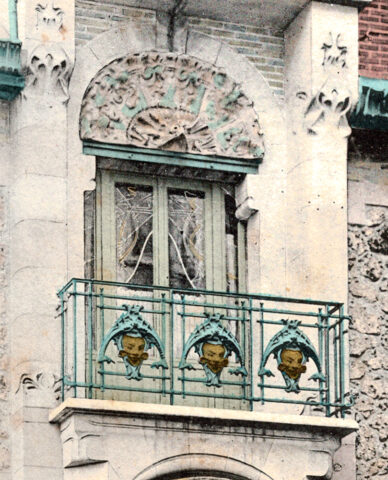
Balcony on the fourth floor of the courtyard façade of the Castel Béranger building, portfolio Le Castel Béranger, œuvre de Hector Guimard architecte, Paris, Librairie Rouam, 1898, pl. 16. Private collection.
The perishable nature of this coating and the maintenance it requires may explain its disappearance. However, it should be borne in mind that the photographs in the portfolio were taken in black and white and then colored with watercolors. We know that Guimard took certain liberties with reality in this portfolio and that he may have chosen to depict these masks as gilded, even though they may have originally been covered with a bluish-green paint.
A collaboration between Guimard and renowned art manufacturers
The preparatory drawings produced by Guimard for all these decorations were brought to life by two sculptors, Raphanel and Ringel d’Illzach, who are mentioned by Guimard in the list of suppliers who participated in the construction of the Castel Béranger, a list that appears at the beginning of the portfolio published in 1898[26].
We know that the casting was entrusted to the Sommevoire factory of the Durenne foundry, the main site of the establishment, as indicated in an advertisement published in the Bulletin municipal officiel de la Ville de Paris on November 21, 1900. The quality of its products was recognized worldwide, thanks in particular to the numerous prizes it won at various national and international exhibitions. The journal of the 1896 National and Colonial Exhibition in Rouen even mentions that “the Durenne company has no more awards to expect. After appearing in countless exhibitions, each time adding a new medal or diploma to its already impressive collection, it has been out of competition since the 1889 Paris World’s Fair[27].”
The exterior architectural ceramics that enliven the facades were attributed to the Gilardoni & Brault tile factory[28]. In parallel with the Castel Béranger project, this company collaborated with Guimard on the design of his stand at the 1897 National Ceramics Exhibition, as illustrated by postcard no. 7, Le Style Guimard. Of particular note is the presence of the future decorative panel of Castel Béranger featuring a cat arching its back, at the top right of the façade. Like Durenne, Gilardoni & Brault was an extremely well-known establishment, even described as “first-rate”[29], whose trademark mechanical tiles “[were] recognized by builders as indisputable “[30]. The Gilardoni & Brault factory, for example, received gold medals at the Universal Expositions of 1889 and 1900[31].
Thus, this decorative project, very different from the one initially planned by the architect before his trip to Belgium, brings into play more or less figurative elements unified by their materiality. Mainly made of glazed ceramic or painted cast iron, their colors range from green to blue and ochre, adding to the polychromy of the various materials used for the masonry.
The plurality of sources that Guimard drew on to compose this fantastical bestiary (Neo-Gothic, Neo-Renaissance, Orientalism, fauna and flora) produced a heterogeneous decor that sets it apart from the work of the two other main initiators of European Art Nouveau: Horta, whose style was much more homogeneous from the outset but who neglected certain aspects of fixed decoration such as wallpaper, and Antoni Gaudí (1852-1926), whose work was cluttered with Christian symbolism. In this first complete work of modern art in France, the bestiary of Castel Béranger, as well as the abstract motifs that accompany it, transcends a building inspired by Viollet-le-Duc’s rationalism with its disturbing strangeness.
Maréva Briaud, Doctoral School of History at Paris 1 Panthéon-Sorbonne University (ED113), IHMC (CNRS, ENS, Paris 1).
Notes
[1] Élisabeth Fournier was a bourgeois woman from the Auteuil neighborhood, a widow, eager to invest her capital in real estate.
[2] M. Briaud, “Hector Guimard and Muller & Cie at Castel Béranger: the end of a collaboration,” Le Cercle Guimard [online], November 8, 2024.
[3] Le Monde illustré, April 8, 1899.
[4] L. Morel, “L’Art nouveau,” Les Veillées des chaumières, May 17, 1899, p. 453.
[5] Established in June 1896 by the Prefect of the Seine, Justin de Selves, this commission, chaired by architect Paul Sédille, had as its rapporteur the architect Louis Bonnier, who was very favorable to Guimard. Its work resulted in new road regulations, published in the form of a decree in 1902.
[6] “Bestiary,” Larousse Dictionary [online], accessed 11/19/24. URL: https://www.larousse.fr/dictionnaires/francais/bestiaire/8916
[7] The whip-like lines of the mosaics on the floors of the vestibule and halls evoke seaweed, and the vestibule with its glazed sandstone walls has sometimes been compared to an underwater cave.
[8] Shortly afterwards, the ends of the cast iron arches of the uncovered metro surrounds would also take on this stylized shape of a seahorse’s head.
[9] This is the case with the balcony railings reused at the Roy Hotel (1897-1898), as well as the crossbar supports also reused at the Roy Hotel and the Guimard Hotel (1909-1912).
[10] “Fantastic,” Larousse Dictionary [online], accessed on 19.11.24. URL: https://www.larousse.fr/dictionnaires/francais/fantastique/32848
[11] G. Soulier and P. N., Études sur le Castel Béranger, œuvre de Hector Guimard, 1899, p. 13.
[12] Here we recall the similarity between Guimard’s early style and the 17th-century auricular style mentioned in Michèle Mariez’s article published on our website.
[13] Which could illustrate their ventilation function.
[14] J. Rameau, “Maisons Modernes,” Le Gaulois, no. 6323, April 3, 1899, p. 1.
[15] M. Simon, “La sorcière moyenâgeuse faussement médiévale ? Construction d’une image fantasmagorique” in É. Burle-Errecade, V. Naudet (eds.), Fantasmagories du Moyen Âge, Presses universitaires de Provence, 2010, pp. 201-208. URL: https://doi.org/10.4000/books.pup.2135.
[16] M. Simon, op. cit., pp. 201-208.
[17] G. Tempest, “L’araignée,” Historia [Online], February 14, 2019, https://www.historia.fr/societe-religions/vie-quotidienne/laraignee-2064996.
[18] V. Hugo, Les Orientales, Paris, J. Hetzel, 1829, p. 7.
[19] M. Simon, op. cit.
[20] L. Graham, “Guimard, Viollet-le-Duc et le modernisme,” in Guimard. Colloque international, musée d’Orsay, 12 et 13 juin 1992, Paris, Réunion des musées nationaux, 1994, p. 20.
[21] Ibid., p. 21.
[22] E. Viollet-le-Duc, Entretiens sur l’architecture. Atlas, Paris, A. Morel et Cie, 1863, pl. XXI.
[23] M.-L. Crosnier Leconte, P. Thiébaut, Guimard, Paris, Réunion des musées nationaux, 1992, p. 78
[24] Le Moniteur des arts, July 7, 1899, pp. 1465-1471.
[25] The ceramic tympanum on the fourth floor of the building’s facade overlooking the courtyard is covered with ochre enamel.
[26] H. Guimard, Le Castel Béranger, œuvre d’Hector Guimard, Paris, Librairie Rouam, 1898.
[27] “Les jardins,” Journal de l’Exposition nationale et coloniale de Rouen et moniteur des exposants, 1896, no. 7, p. 3.
[28] However, it is possible that the manufacture of the ceramic metopes decorating the metal lintels was entrusted to Alexandre Bigot.
[29] “Les Grandes industries. La tuilerie de Choisy-le-Roi,” Journal de l’Exposition nationale et coloniale de Rouen et moniteur des exposants, 1896, no. 14, p. 4.
[30] Ibid, p. 4.
[31] Exposition Universelle de 1900 à Paris. Liste des récompenses, classe 72, céramique, p. 852, Paris, Imprimerie nationale, 1901.
Translation : Alan Bryden
Eriksson espagnolettes, handles, and lock
In September 2013, a pair of espagnolette boxes and handles (without top or bottom strikes or rod guides) was sold on eBay under the title “Pair of Art Nouveau handles in silver-plated bronze attributed to Hector Guimard (Van de Velde) .” As the reference to Henry Van de Velde was simply included to attract the attention of a more international audience, the question of attribution to Hector Guimard immediately arose. No examples of these espagnolette locks were known to exist in any of his buildings, but the discovery of a new model is always possible.

Pair of espagnolette locks. eBay sale on September 22, 2013. Photo provided by the seller.
Most Guimard connoisseurs had noted a certain similarity between these objects and his style but had been put off by the somewhat overly naturalistic appearance of the casing, whose ends evoke leaves or flames. Nevertheless, attribution to Guimard was not impossible, as on rare occasions he did incorporate details taken directly from nature into his compositions. And in the case of these espagnolette locks, it was interesting to note the emphasis on the handcrafted appearance of the material, reminiscent of the porcelain doorknobs created for the Castel Béranger and widely used by Guimard thereafter. Indeed, on closer inspection, the espagnolette handle appears to have been roughly kneaded, as if strips of clay had been pressed and twisted by the modeler’s hand.

Pair of espagnolette locks. eBay sale on September 22, 2013. Photo provided by the seller.^
The ends of the casing show the same type of workmanship: thVee material appears to have been stretched and turned.

Pair of espagnolette locks. eBay sale on September 22, 2013. Photo provided by the seller.
As for the case, its central mass, smooth and rounded like a core, appears to have been discovered under a thick layer of clay that had been rolled back at its four corners.

Pair of espagnolette locks. eBay sale on September 22, 2013. Photo provided by the seller.
But this visual aspect alone would not have been sufficient to attribute them to Guimard, had it not been for the image of a lot sold by Sotheby’s New York in 2005. This lot included two door handles and four espagnolette handles identical to those in the eBay listing, two reddish in color (probably copper) and two bronze or brass in color. It was immediately clear that the door handles were the “long” version of the espagnolette handles.

Sotheby’s New York sale, March 10, 2005, lot 224, attributed to Guimard, sold for $2,400.
These six objects were then attributed to Guimard by the auction expert, which did not offer much guarantee. But a few years later, this attribution was confirmed when a pair of identical lever handles from the Josette Rispal-Lejeune donation in 2008 entered the Musée d’Orsay’s collections. The Musée d’Orsay posted photographs of them online, and their description clearly identified them as being by Guimard, although no bibliographical data was provided. Given this information, there seemed to be little doubt that the window handles sold on eBay were indeed by Guimard.

Pair of “lever-shaped door handles,” attributed to Guimard. Dimensions: width 13 cm, height 6 cm. Musée d’Orsay. Inventory numbers AOA 1742 1 and AOA 1742 2.
In addition, the eBay seller specified that his espagnolette locks bear the “FT” mark, which he claimed to be that of the Thiébault (or rather Thiébaut) foundry, a Parisian art foundry that was mainly active in the second half of the 19th century. As a matter of fact, the “FT” mark belongs to the Maison Fontaine, located at 181 rue Saint-Honoré in Paris, which specialized in artistic metalwork. This mark was acquired from Maison Fromentin when its business was bought out.

Pair of espagnolette locks. eBay sale on September 22, 2013. Photo provided by the seller.
And the album Le Castel Béranger clearly establishes that Guimard entrusted Maison Fontaine with the production of all the hardware for Castel Béranger, including the lock decorations, landing doorknobs, and door handles. It is therefore reasonable to assume that Guimard remained loyal to Fontaine for this model of espagnolette lock.

Hector Guimard. Landing doorknob, model from the Castel Béranger series produced by Maison Fontaine. Pictured here in the Jassedé building, 142 avenue de Versailles, Paris. Photo private collection
And yet, after consulting several old documents and visiting the charming Fontaine museum in Paris, one quickly becomes convinced of the contrary.
The first of these documents is a catalog from Maison Fontaine, published in August 1900 (no doubt on the occasion of the Paris World Fair) entitled Decorative Locks/Antique Styles/Modern Designs. It presents a large selection of photographic plates where the names of some of Maison Fontaine’s collaborators are mentioned.
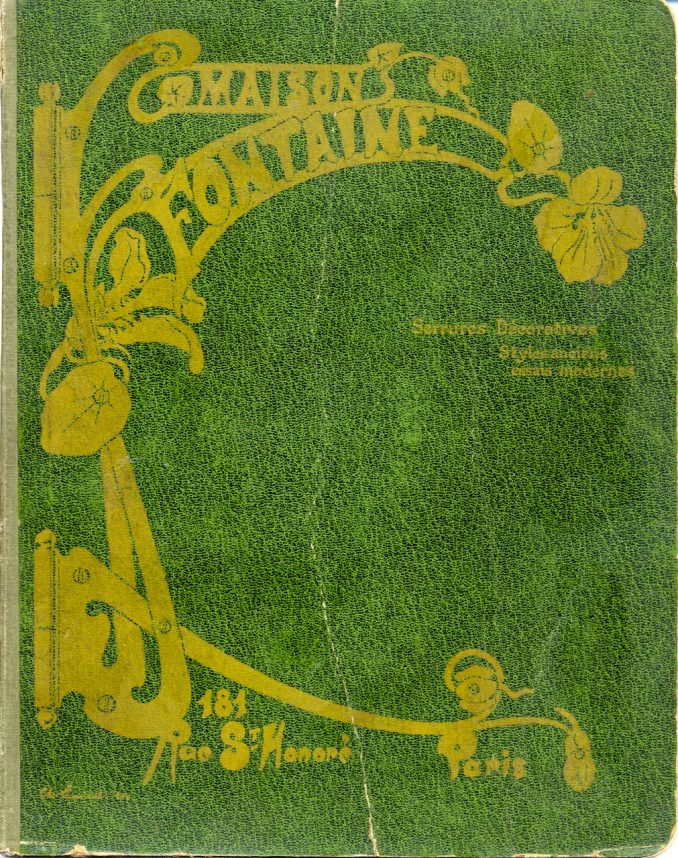
Cover of the Maison Fontaine catalog. Decorative locks/Antique styles/Modern designs, August 1900.
Private collection.
The second document is a portfolio, published by Maison Fontaine at an unknown date (probably around 1900). Rather than a commercial document, it is a prestigious publication showcasing some of the company’s most beautiful creations.
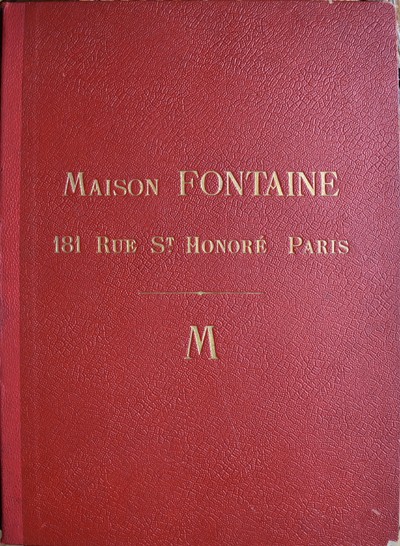 Fontaine Portfolio, date of publication unknown. Fontaine Museum.
Finally, the albums kept at the Fontaine Museum have a more clearly commercial purpose. They present the items, classified by product type, with their number and dimensions but without the name of their creator or their date of creation.
Indeed, from the first illustrated page (pl. 100) of the August 1900 catalog, the attribution of the espagnolette locks and door handles to Guimard is replaced by Eriksson, who is credited with an espagnolette lock (no. 187, pl. 100), a knob (no. 616, pl. 100), and a lock (no. 214, pl. 100). However, several other items in the catalog that do not bear his name can easily be attributed to him.
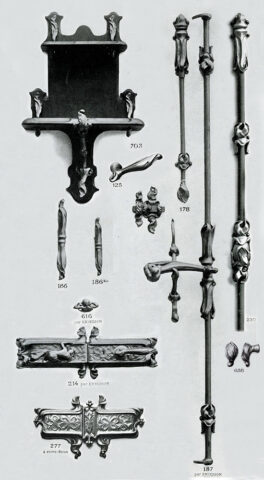
Eriksson, appliances produced by Maison Fontaine. Computer graphics montage based on various plates from the Fontaine catalog, August 1900. Private collection.
On plate 317, we find the famous espagnolette lock (no. 230) shown with its upper strike plate, its upper rod guide similar to the ends of the espagnolette casing, and its intermediate rod guide, which echoes the pattern of the ends of the casing and is identical to the espagnolette rod guide. Plate 169 also shows the espagnolette knob, numbered 658.
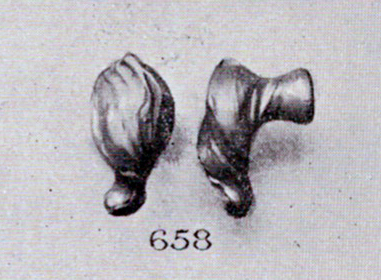 Eriksson, espagnolette lock no. 658. Fontaine catalog, August 1900, plate 169. Private collection.
Still by analogy of motifs, we can also attribute to Eriksson: a bolt (no. 178, pl. 100); a latch (no. 131, pl. 100);
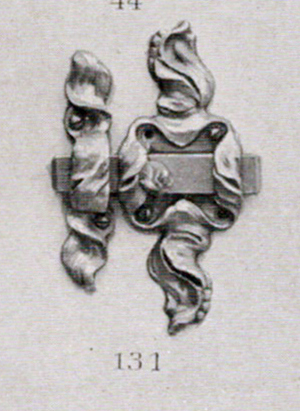 Eriksson, bolt n° 131. Catalogue Fontaine, août 1900, pl. 604. Private collection
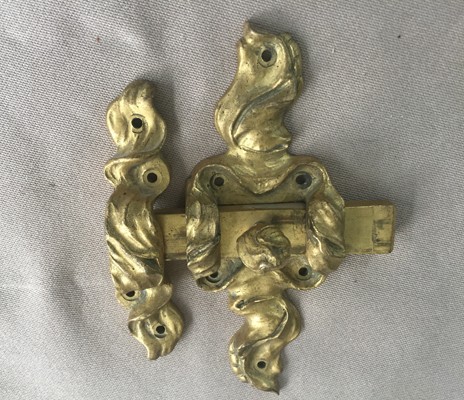 Eriksson, bolt n° 131. Catalogue Fontaine, août 1900, pl. 604. Private collection
hinges (Nos. 186 and 186 bis, pl. 100 and 427);
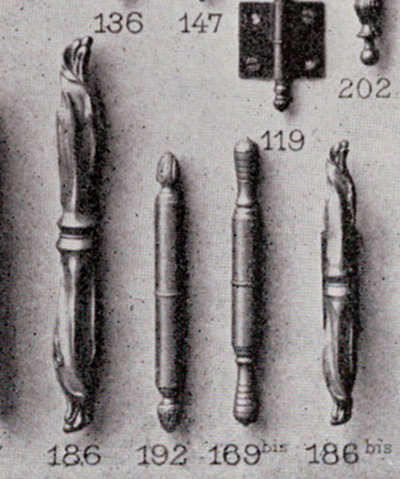 Eriksson hinges n° 186 et 186 bis. Catalogue Fontaine, août 1900, pl. 427. Private collection
metal decorations on a shelf (no. 704, pl. 100); a lock with a latch (no. 277, pl. 585);
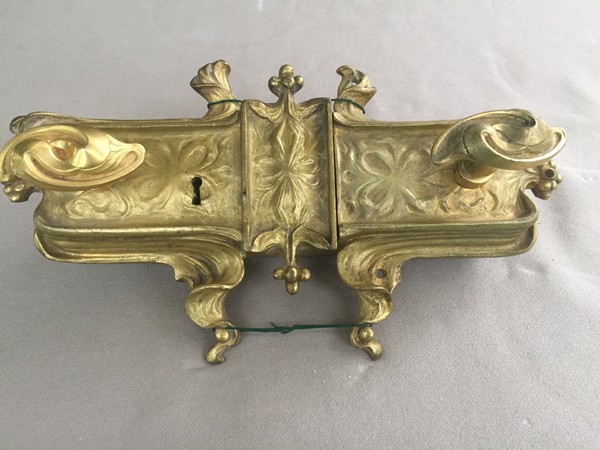
Lock n° 277 from catalogue Fontaine 1900 by Eriksson here with unknown bolts). Priv. Coll.
as well as the handle mentioned above. This crutch is available in three widths: 120 mm (No. 125), 130 mm (No. ?), which is the one in the Musée d’Orsay, and 142 mm (No. 314).
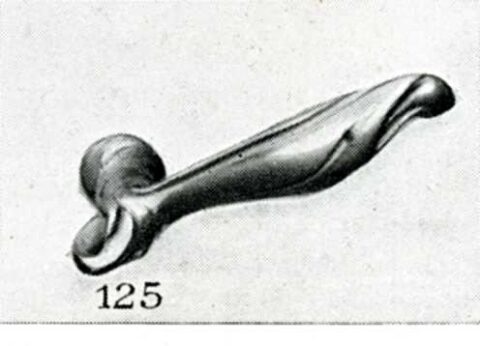
Eriksson, handle n° 125. Catalogue Fontaine, August 1900, pl. 134. Private collection
 Eriksson, handle n° 125, width 120 mm. Auction Delorme – Collin du Bocage, 20 March 2014, lot 188, brand « F.T ».

Eriksson, handle no. 314, width 142 mm. Private collection
The Fontaine catalog from August 1900 also features Tony Selmersheim for items that were still relatively unmodern, and Alexandre Charpentier, who incorporated figurative bas-reliefs (similar to those he created in his original profession as a medalist) onto strictly rectangular or octagonal surfaces. Finally, there is mention of “M. Guimard Architecte,” who is credited in this catalog only with a lock decoration (no. 276, pl. 585), that of the Castel Béranger. On the same plate 585, another set of lock decorations (no. 244) is reproduced without mentioning the author but is easily identifiable thanks to the similarity of its lugs to the motifs on Eriksson’s bolt. Its construction is identical to that of Guimard’s no. 276, with a simple parallelepiped box and strike plate featuring no decoration other than the entry cover and the lugs that hold the strike plate and box together at the four corners.
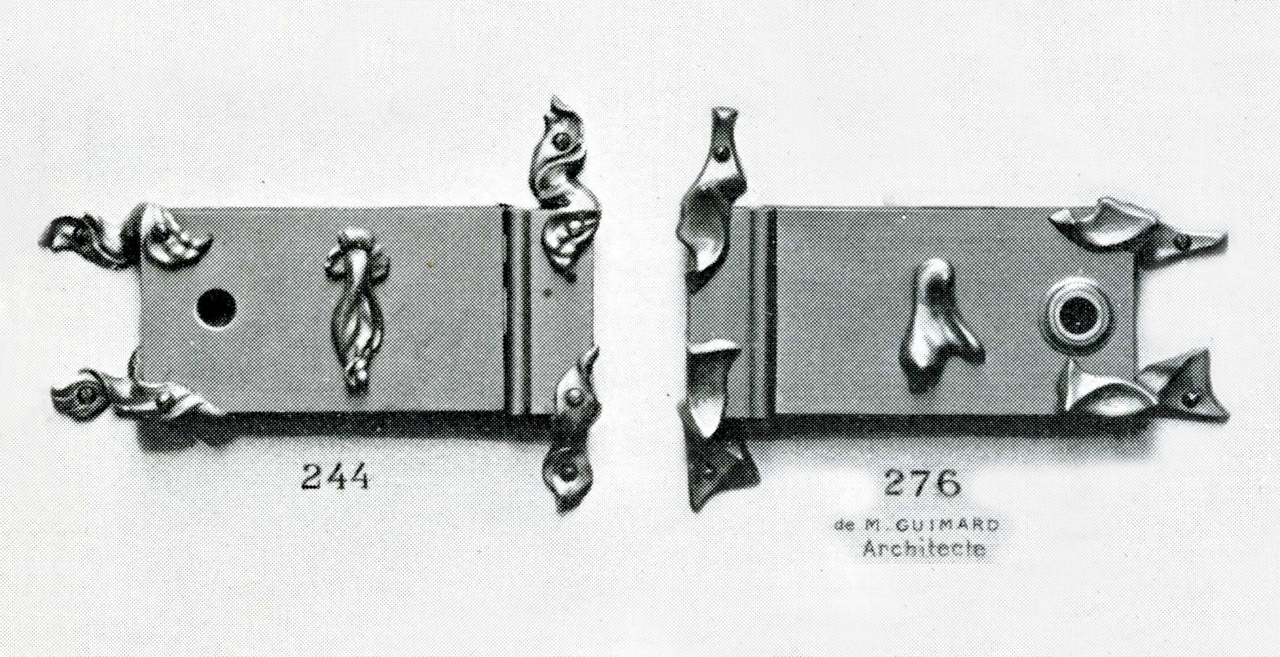 Eriksson for No. 244 and Hector Guimard for No. 276, lock models published by Maison Fontaine. Computer-generated image based on plate 585 of the Fontaine catalog, August 1900. Private collection.
Guimard opted for a fairly simple and straightforward modeling of the elements, where you can see the modeler’s thumbprint, while Eriksson remained faithful to a more detailed decorative style.
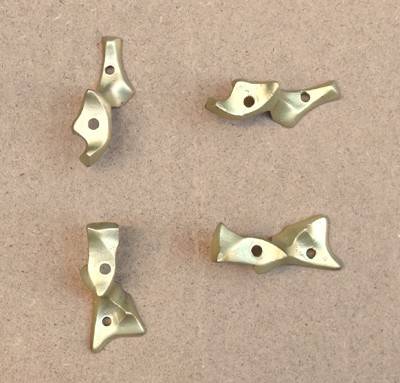 Guimard, lock brackets, no. 276 in the Fontaine catalog, August 1900. Private collection.
Although an entire page in the Fontaine portfolio (a prestigious document, not a commercial one) is devoted to Guimard’s designs for the Castel Béranger, his models do not appear in the Fontaine museum’s albums and are not kept in the Fontaine house collections. It is therefore likely that, apart from the lock, Guimard, who had already published them in 1898 in the Album of Castel Béranger, wished to retain exclusivity over them.
But who is this Eriksson who seems to have left so few traces in French decorative art? He is the Swedish sculptor Christian Eriksson (Taresud, 1858—Stockholm, 1935), famous in his own country and internationally trained. Nine years older than Guimard, he attended the same Parisian art schools as him during the same years. Our Swiss correspondent Michel Langenstein provided us with a biographical note from the catalog published in 2008 by The Dansk Museum of Art & Design in Copenhagen. It significantly enriches the one from the Isabella Stewart Gardner Museum in Boston. We also drew information from his Wikipedia entry published in Swedish.
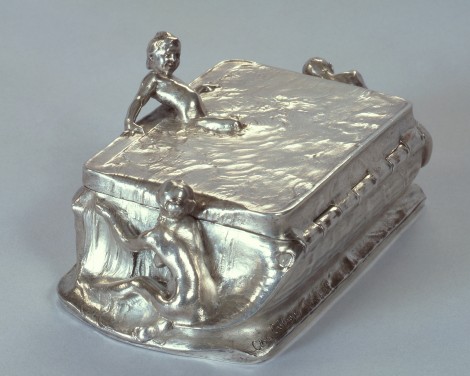 Christian Eriksson. Silver jewelry box depicting a little girl immersing herself in a basin that she causes to overflow, framed by a male figure and a female figure. 1897. Dimensions: width 6.5 inches, depth 2.8 inches, height 3.7 inches. Isabella Stewart Gardner Museum, Boston., Boston.
Christian Eriksson was born in Taresud in the county of Värmland, Sweden, in an environment devoted to agriculture and woodworking. As a child, he worked with his father, cabinetmaker Erik Olson, and his brother Elis Eriksson, who would also become a cabinetmaker. As a young man, he apprenticed with an ornamentalist in Stockholm while attending technical school. From 1877 to 1883, he worked as a furniture designer and model maker in a factory in Hamburg, where he also attended a school of crafts and design. In 1883, he traveled, working in various workshops in the Rhineland before ending up in Paris, where he enrolled at the École des Arts Décoratifs, then at the École des Beaux-Arts in 1884, in the studio of sculptor Alexandre Falguière. In 1886, he made his debut at the Salon and became known in 1888 with the sculpture Le Martyr, which earned him a medal and a scholarship. He also received commissions for furniture, built a house in Taresud, the town of his childhood, while traveling frequently between Paris and Värmland from 1894 (the date of his marriage to the Frenchwoman Jeanne Tramcourt) to 1898, finally settling in Stockholm. In 1902, he tackled the theme of Sami culture for the first time with the sculpture The Lapp.
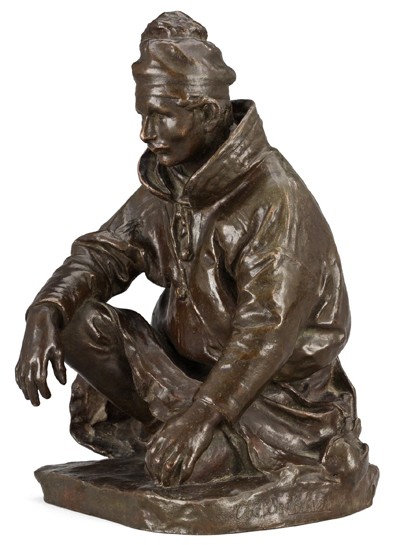 Christian Eriksson. Seated Lapp, 1909. Bukowskis auction, Stockholm.
From 1903 to 1908, he was responsible for the decoration of the façade of the Royal Dramatic Theater in Stockholm.
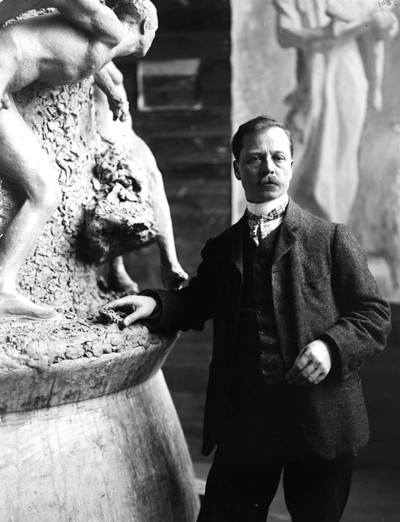 Christian Eriksson, photographic portrait, from 1904. Illustration taken from the Wikipedia entry on Eriksson.
Having thus experienced the early years of French Art Nouveau, practicing monumental sculpture as well as decorative art with small bronze and silver vases and bowls, he did not disdain offering his assistance to industrial artists, notably through his important collaboration with Maison Fontaine’s “modern experiments.” His more familiar figurative style appears on several pieces of hardware, such as lock no. 214.
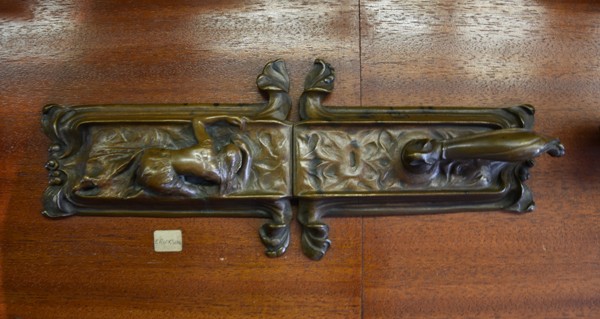 Christian Eriksson, lock no. 214, La Curiosité, with handle no. 125. Fontaine Museum.
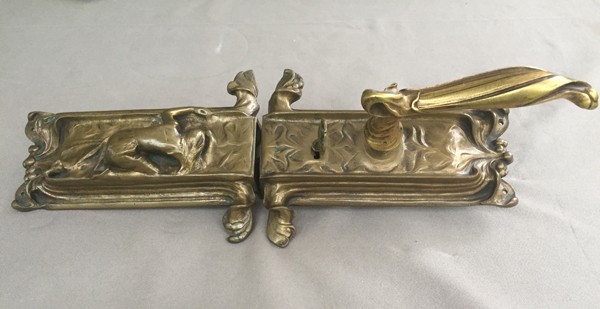 Christian Eriksson, lock no. 214, La Curiosité, with handle no. 314. Private collection.
The female figure who appears to be peering through the keyhole earned her the name La Curiosité (Curiosity) and links her to the late Symbolist movement, much like the door handle/mailbox La Renommée (Fame) designed by Victor Prouvé for the door of the Nancy carpenter Eugène Vallin’s house in 1895.
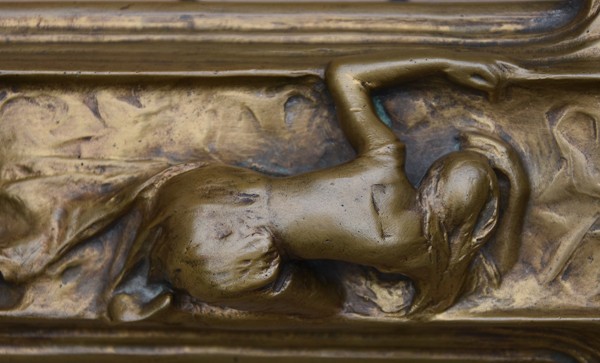 Eriksson, lock no. 214, La Curiosité (detail). Private collection.
As a sign of its importance, it occupies a page in the Fontaine portfolio.
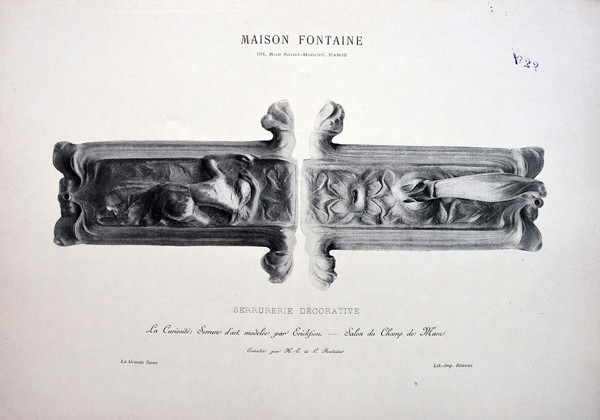 Christian Eriksson, lock no. 214 with handle no. 125. Labeled “La Curiosité” (Curiosity); Artistic lock designed by Eriksson — Salon du Champ de Mars. Plate from the Fontaine portfolio, date unknown. Fontaine Museum.
The right side of the lock, with the handle, can be found on the doors of two of the three salons created by Nancy-born Louis Majorelle for the Café de Paris (41 avenue de l’Opéra) in 1898, which helps to pinpoint its date of creation. The following year, when Henri Sauvage was commissioned to design two additional salons, he used more commonplace locks that were less well integrated into the woodwork.
 Door to one of the three salons furnished and decorated by Louis Majorelle at the Café de Paris, Avenue de l’Opéra in Paris, in 1898. The door is secured by Eriksson’s Fontaine lock no. 214. German portfolio Modern Bautishler-Arbeiten, pl. 53, August 1902.
At the 1900 World’s Exhibition, this lock, No. 214, La Curiosité, was presented with knob No. 616 (Woman Combing Her Hair) by Maison Fontaine, alongside figurative works by Gustave Michel and Louis Bigaux. The Museum of Art and Design in Copenhagen has a silver version of this knob.
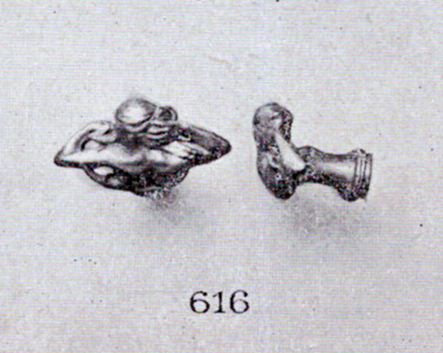 Eriksson, door knob n° 616. Catalogue Fontaine, August 1900, pl. 169. Private collection
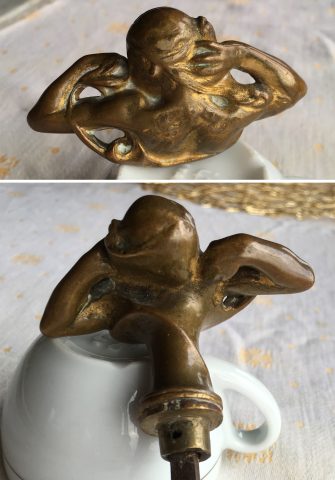
C
Christian Eriksson, doorknob n°° 616, Femme se coiffant, bronze with traces of gold. Private collection
The handle of espagnolette No. 187 is quite astonishing. Seen from a distance, it is reminiscent of the end of a bone and, by extension, the sarcasm of art critic Arsène Alexandre in Le Figaro on September 1, 1900, who claimed that “the noodle [had] compromised itself with a sheep bone to compose what has been given the generic and bizarre name of “Art Nouveau””
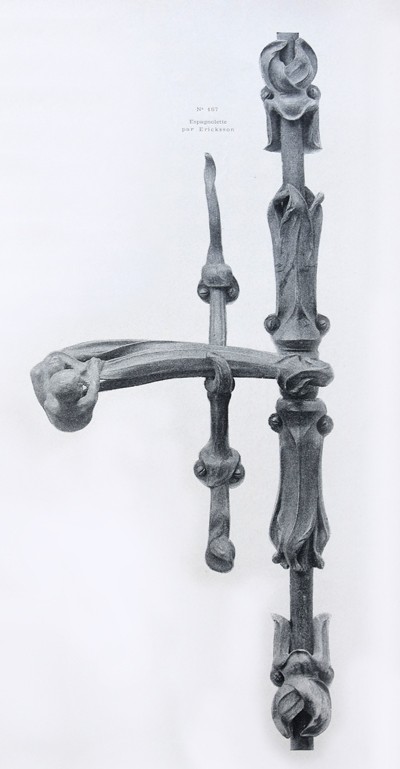 Eriksson, espagnolette n° 187. Portfolio Fontaine, unknown date. Musée Fontaine.
But upon closer inspection of its end, we see that it is a small figure that seems to be using all its weight to keep it closed.
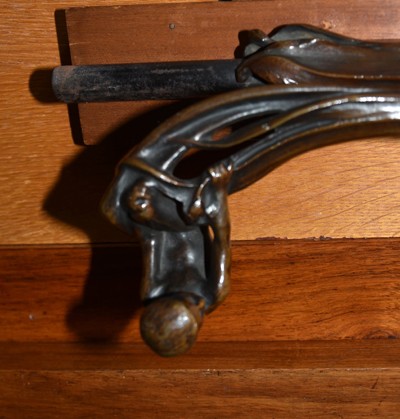 Eriksson, espagnolette no. 187 (detail of the handle). Fontaine Museum.
On the other hand, the hinges, bolt, espagnolette lock and rod guides are closer to the naturalistic style of Art Nouveau, evoking curled leaves.
 Christian Eriksson, strike plate and guide for espagnolette bolt no. 230. Fontaine catalog, August 1900, plate 317.
But as we mentioned above, the details of the espagnolette bolt and of the handle introduce a whole new approach that emphasizes the modeler’s technique, deliberately displaying an unfinished look. There is a real parallel here with the work of Guimard’s early years, whose modeling had a “crumpled” and somewhat wild appearance before he quickly moved on to emphasize the harmony of lines and the elegance of composition.
Finally, thanks to our German correspondent Michael Schrader, who kindly reminded us, we should mention the presence of Eriksson espagnolettes on the windows of the beautiful reception hall of the town hall in Euville in Meuse, decorated (or rather clad internally) in 1907 by Eugène Vallin. The designer of several models of hardware for his joinery and furniture, Vallin did not have his own model of espagnolette. In this case, he therefore resorted to the catalogs of Parisian manufacturers.
 Espagnolette by Christian Eriksson on a window in the village hall of Euville Town Hall. Installed in 1907 by Nancy carpenter Eugène Vallin. Photo by Cédric Amey. Nancy-guide.net.
Frédéric Descouturelle
with the collaboration of Dominique Magdelaine and Olivier Pons.
Many thanks to the collectors who allowed us to reproduce their objects and provided information, as well as to Ms Christine Soulier, Head of Decorative Locksmithing at Maison Fontaine.
P.S. At the same time as this article was published, the Musée d’Orsay amended its entry to restore Eriksson’s authorship of his two handles: http://www.musee-orsay.fr/fr/collections/catalogue-des-oeuvres/resultat-collection.html?no_cache=1 Click on ‘Collection’, then ‘Catalogue of works’, then type ‘Eriksson’.
Translation: Alan Bryden
Hector Guimard’s participation in the 1925 Exhibition of Decorative Arts– Part 2
23 September 2025
After discussing the interiors of the town hall through its fixed decor, we continue our presentation with a look at its furniture. We will then turn our attention to the French Village cemetery, for which Guimard designed two funerary monuments. This is an opportunity to highlight the small chapel, a unique work that has long escaped the attention of researchers. Finally, we will conclude this study by discussing the reuse of a remnant of the town hall, which itself served as inspiration for the construction of another town hall a few years later.
The town hall furniture
Fifteen years ago, the discovery of a pair of chairs identical to those that furnished the town hall was the starting point for our research into this furniture and its supplier, EAGLE, a furniture manufacturer based in the Faubourg Saint-Antoine district of Paris[1].
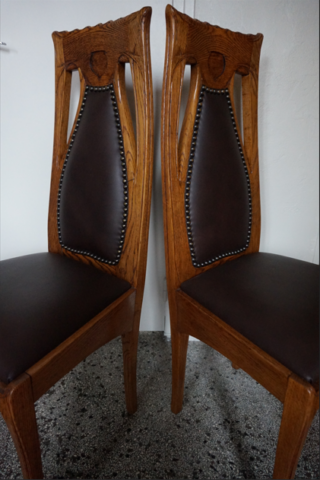
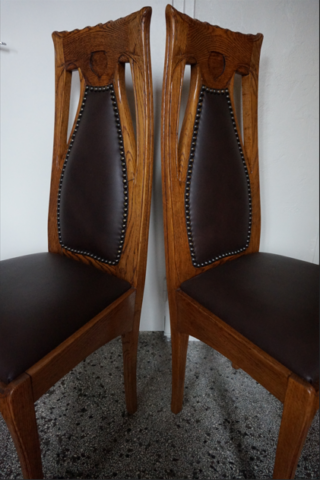
Chairs of the town hall of the French Village oak, leather cover and modern nails; Private collection.
The appearance of a new piece of furniture by Guimard is always a small event in itself. While a new piece naturally enriches the reasoned catalogue of the architect’s furniture (currently in progress), it is also the best way to train our eyes and broaden our minds to furniture that we would not necessarily have associated with Guimard a few years ago. These chairs are a good example.
With a fairly simple overall design, they feature two distinct parts: a simple, unadorned seat contrasts seamlessly with a curved backrest that showcases the bulk of the cabinetmaking work. The only sculptural elements on the lower part are fine grooves that highlight the front legs along their entire height. The more complex design of the backrest leaves no doubt as to its creator: the ribbing and stretching of the material, the pointed “ears,” and the notched upper crossbar all refer to Guimard’s style.
These chairs are similar to a model of armchair, a photo of which can be found in the collection donated by the architect’s widow to the library of the Musée des Arts Décoratifs. It was probably intended for the Nozal-Pezieux family, as a coat of arms clearly bearing the stylized initials NP adorns the upper crossbar of the backrest. This feature is also found on the chairs in the town hall, where there is an identical space for the initials.
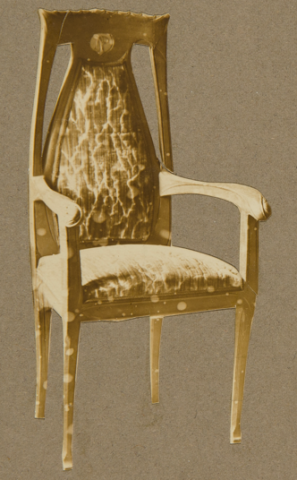
Armchair with the crest Nozal-Pézieux, Bibliothèque des Art décoratifs, donation by Adeline Oppenheim-Guimard, 1948. Photo Laurent Sully Jaulmes
For EAGLE, participating in an event such as the 1925 Exposition required a significant investment, but one that was ultimately quite reasonable given the foreseeable economic benefits and expected gains in terms of image. Clearly, the company had no shortage of resources, having taken over an entire building in the heart of Faubourg Saint-Antoine. This high local visibility was reinforced by major, regular advertising campaigns in several national daily newspapers and specialist magazines.
By partnering with Guimard and supplying furniture for one of the main buildings in the French Village, the brand may also have wanted to benefit from the architect’s reputation. Although we do not know how Guimard came into contact with this company, he was undoubtedly impressed by the quality arguments put forward and detailed in the brand’s catalogs. These catalogs explain that “the furniture was manufactured in large quantities in two factories in Vincennes, while preserving the artistic aspect of its manufacture,” then finished in Paris “by master craftsmen in workshops adjacent to the stores on the Faubourg Saint-Antoine.”[3]
Deprived of his workshops since World War I, Guimard had to find a low-cost supplier who was nevertheless capable of producing (or reproducing) high-quality furniture. The architect already had connections in the Faubourg Saint-Antoine, as a contract with one of its manufacturers had almost been signed before the war[4]. He therefore naturally turned to this neighborhood, where supply was still abundant.
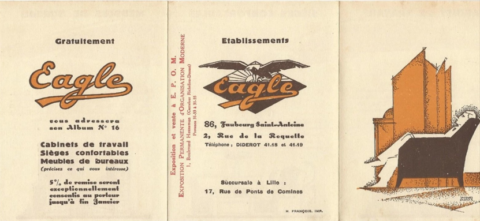
Commercial flyer of the EAGLE company.
The photo of the wedding hall shows the mayor’s desk surrounded by two chairs, probably intended for the deputy mayors, while a third seat, perhaps an armchair, raised and decorated with a medallion, seems perfectly suited to accommodate the mayor.
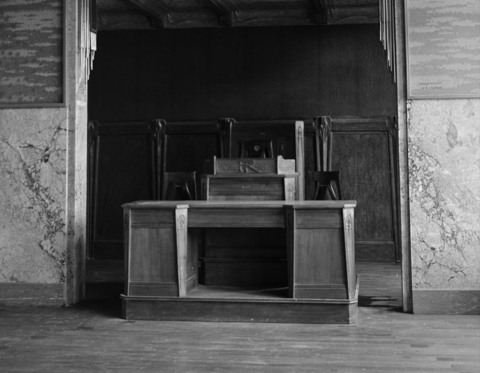
The Mayor’s desk. GrandPalaisRmnPhoto. All rights reserved.
The stylized letters “R” and “F” on the upper band recall the official function of the premises. They brighten up a structure with massive, geometric lines, softened only slightly by the slanted corner motifs, which echo the design of the ELO paneling and reinforce the unity of the decor according to a principle dear to Guimard. The architect did not usually employ such an angular, almost rustic style, even in the mid-1920s. The explanation certainly lies elsewhere, as the main feature of this office was its modularity.
A detailed examination of the photo reveals that the office was in fact a set of independent pieces of furniture placed on a platform. Apart from the three chairs, which were by definition movable, it consisted of a large rectangular desk that could be used by the mayor for day-to-day administrative tasks and a recessed lectern, itself placed on another small platform intended for the mayor’s chair. This second part could certainly be used independently of the rest, for example for a speech. The complete configuration as it appears in the photo would therefore correspond to a situation in which the mayor would preside over a city council meeting alongside his two deputies.
Unable to afford a more refined set, Guimard opted for simple, functional furniture that could be easily adapted to life in a city hall.
The lack of photos of the other areas of the town hall or drawings of its furniture means that we do not yet know the exact size and location of this furniture, although we assume it to be fairly modest. However, we have found some answers in the advertising campaign launched at the time by the EAGLE company and in its catalogs published at the same time.
The 1926 catalog reveals an artist’s impression of the town hall’s wedding hall. Although fanciful in some respects—the stained glass windows that occupied the entire left side wall, for example, have been replaced by separate windows—the illustration is precise enough that the chairs and the mayor’s desk are easily recognizable, as are the ELO paneling and speckled ceiling as they appear in photos of the time. The artist even took care to include the Lustre Lumière wall lights that adorned the four corners of the room.
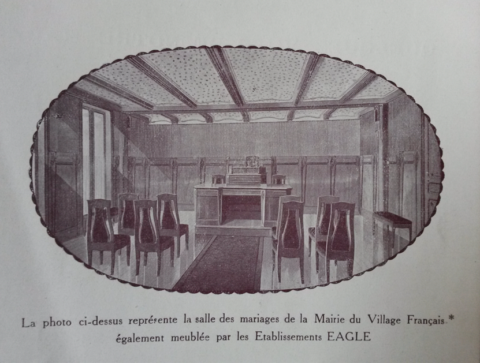
Extract of the ELO catalogue, 1926. Collection BnF.
The presence of a bench on the right suggests that additional or complementary furniture was probably scattered throughout certain areas or rooms of the town hall. Advertisements published in the summer of 1925 also provide some clues as to the location of the furniture. L’Intransigeant of August 22, 1925, for example, invited readers to visit “the Decorative Arts Exhibition featuring ensembles designed by EAGLE,” including “the mayor’s office and secretariat in the French Village town hall (architect Hector Guimard).”
Logically, the rest of the furniture was therefore located in the secretariat, the other administrative room in the town hall. The ensemble must therefore have comprised no more than a dozen pieces of furniture divided between the mayor’s office and the secretariat, which could be broken down as follows: six or eight chairs, two armchairs, two desks, and perhaps a few side benches.
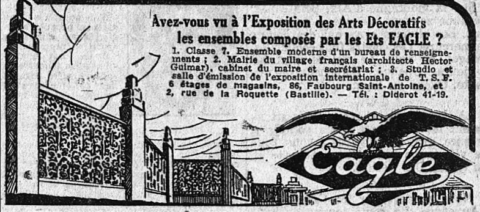
Advertisement for the EAGLE bran, L’Intransigeant, 22 August 1925. BnF/Gallica.
For both economic and stylistic reasons, Guimard drew on his earlier work, asking the EAGLE company to reproduce, in a simplified form, a chair model whose rather sober design, even for the 1900s, was compatible with the decor and architecture of the 1920s (at least that of his town hall). The mayor’s desk and lectern are therefore probably the only truly original creations in this set of furniture.
The French Village cemetery
For visitors to the French Village, the chances of bumping into a mayor in the corridors of the town hall were as slim as the risk of encountering a ghost or will-o’-the-wisp in its cemetery, since no one was buried there. However, it seems that the atmosphere of the place inspired a few vocations. An amusing anecdote published in the press recounts the arrival of a visitor at the general secretariat of the Exhibition, who, in all seriousness, requested a perpetual concession in the small cemetery…[4].
About ten days before the official inauguration of the French Village as a whole, the newspaper Excelsior reported on the inauguration of its cemetery on June 4, 1925, illustrating its article with a photo taken during the ceremony. Standing slightly behind the four officials, a fifth figure in profile, tall and thin, with a white beard, holds his hat in his left hand. Hector Guimard is easily recognizable, seemingly listening attentively to the comments of his companions for the day.
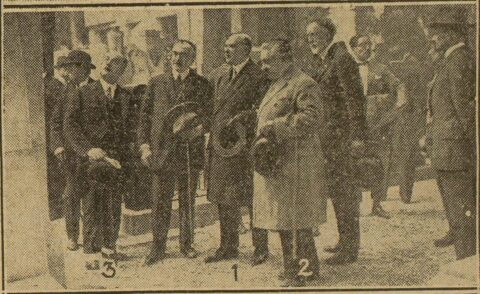
Inauguration of the cemetery of the French Village, Excelsior, 05 June 1925. BnF/Gallica.
Among the personalities present that day was the all-powerful president of the French granite producers’ union, Edmond Pachy, who had spared no effort to install a cemetery—a first for an installation of this scale at an international exhibition—which had inevitably sparked some comments in the press, at best amused, often skeptical of this commercial exercise, which was morbid and questionable to say the least… With considerable resources at his disposal, the source of which was easy to imagine in the aftermath of the First World War, Pachy had succeeded in mobilizing several major funeral companies around this project, as well as some big names in modern art.
The cemetery occupied a small space at the foot of the church apse and, as was fitting, close to the home of the stonemason of architect Louis Brachet (1877-1968).
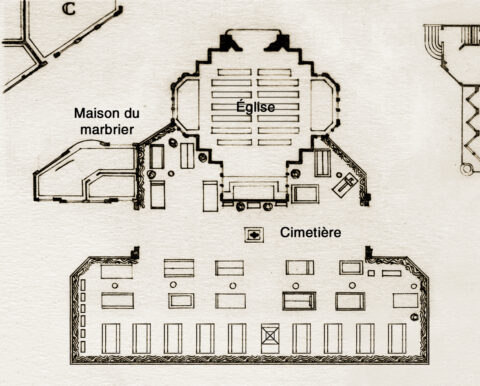
Partial plan of the French Village centered on the cemetery drawn according to the plans of the portfolio L’Architecture à l’Exposition des arts décoratifs modernes de 1925/Le Village moderne/Les Constructions régionalistes et quelques autres pavillons/Rassemblés par Pierre Selmersheim, éditions Charles Moreau, 1926 and of our own research. Photomontage and drawing F. D.
Louis (Félix) Bigaux (1858-1933), who designed the cemetery, also created several tombs and, most notably, the bush-hammered granite entrance to the cemetery, which was crafted by the French Granite Producers’ Union and built by its members.
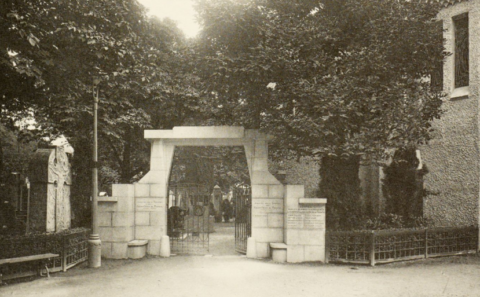
Entrance of the cemetery of the French Village by Bigaux. Portfolio L’Architecture à l’Exposition des arts décoratifs modernes de 1925/Le Village moderne/Les Constructions régionalistes et quelques autres pavillons/Rassemblés par Pierre Selmersheim, éditions Charles Moreau, 1926, pl. 9. Private collection.
The cemetery contained around thirty funerary monuments, including a calvary and a chapel[5], all designed in a modern style. These included works by Bigaux, Roux-Spitz, Lambert, Dervaux, Victor Prouvé, the Martel brothers, and of course Guimard.
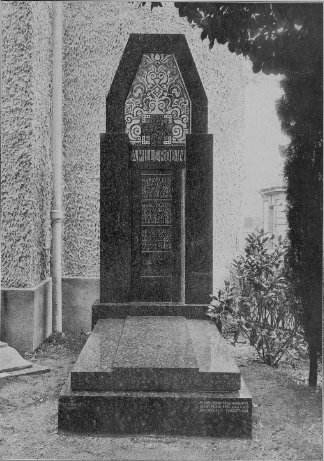
Funerary monument by the architect Roux-Spitz. La Construction moderne, 19 July 1925. Private collection.
The presence of two works by Guimard in the French Village cemetery could be perceived as post-war opportunism. This motivation is undoubtedly real, both for Guimard and for his colleagues involved in the cemetery, but it must also be put into context, bearing in mind that the construction of tombs was an integral part of the architect’s profession. When they had the means, after building their homes, families often entrusted their architects with the construction of their final resting places. However, this personalized activity tended to decline during the 20th century, as the bourgeoisie gradually turned to manufacturers offering standardized products. As far as Guimard is concerned, the fact that we have an increasingly comprehensive knowledge of his work means that we now have a fairly complete picture of his activity in the funerary field. He began very early on, and although his work seems significant to us, we do not yet know whether it was a particular interest of his or whether it was typical of his colleagues, among whom it is not so prominent. Nevertheless, we lean towards the former hypothesis, given the architect’s sustained and regular efforts in this field throughout his career. In any case, this activity reflects the evolution of his style, even if he sometimes had to compromise with the wishes of his clients.
His most famous (and undoubtedly most spectacular) tomb is that of the Caillat family at Père-Lachaise, but his work also included tombs, small chapels, and funerary or commemorative monuments.
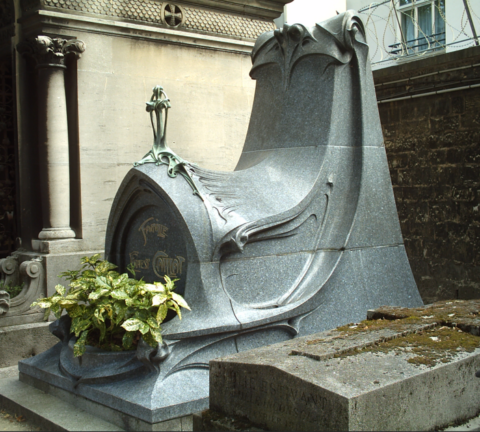
Caillat grave at the Père-Lachaise cemetery in Paris. Photo author.
The Decorative Arts Library collection also contains a number of photographs of funerary monuments, which were probably intended for inclusion in a catalog.
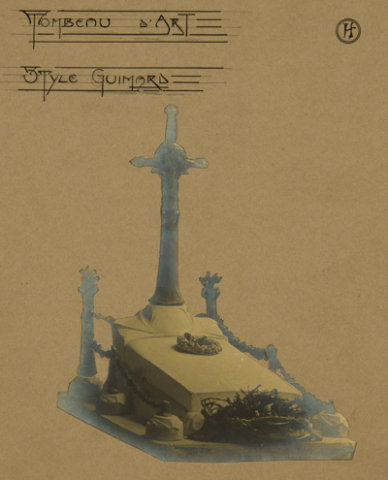
Fake tomb incorporating a GA cross, two GB bouquet-bearing pilasters, two GB posts, a GF planter, mesh and chain links, c. 1910. Bibliothèque des Arts Décoratifs. Donated by Adeline Oppenheim-Guimard, 1948. Photo by Laurent Sully Jaulmes.
Another series of later photographs shows simplified, fake monuments photographed outdoors. We can assume that they were part of an exhibition or presentation at a funeral company. These examples show that, more than ever, even in the funeral sector, Guimard intended to distribute his work in to reach a clientele who could not afford a unique creation but wanted the graves of their deceased to have a modern artistic touch.
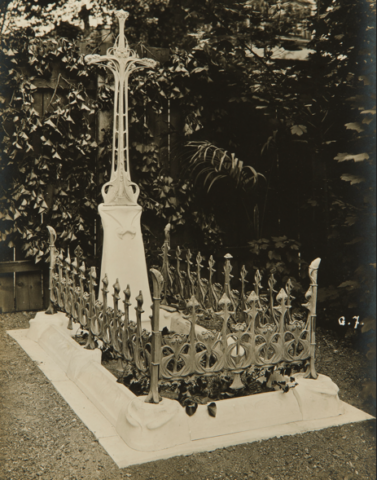
Fake tumb incorporating a GB cross and surround. Bibliothèque des Arts décoratifs. Donation by Adeline Oppenheim-Guimard, 1948. Photo Laurent Sully Jaulmes.
Guimard drew heavily on his catalog of cast iron designs published by the Saint-Dizier foundry from 1908 onwards. Several plates relate to funerary ornamentation: pilasters and grave surrounds, crosses of all sizes, wreath holders, coffin handles, and chain links. Curiously enough, none of these items were included in the French Village cemetery. No doubt their style was considered too dated.
Guimard’s two new creations for the French Village cemetery thus complete the long list of works he devoted to this field[6].
His involvement in the French Village cemetery is attested to by an early funerary monument that won a gold medal. An old postcard, published for promotional purposes by the tomb manufacturer Admant-Buissont, celebrated this award.
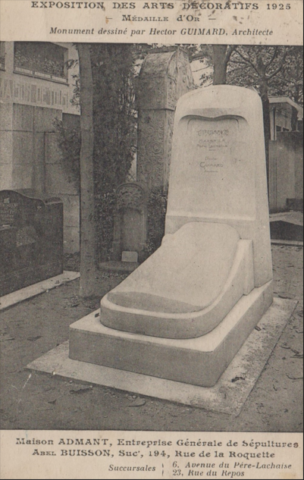
Funerary monument at the cemetery of the French Village. Ancient postcard. Private collection
Apart from perhaps the upper part of the stele, where a light sculpture frames the identification of the deceased (or a possible epitaph), almost nothing betrays the identity of its creator. The jury seems to have taken great pleasure in rewarding Guimard’s ability to simplify his style to the extreme, as this tomb is probably the simplest and most unadorned work of his entire career!
The background of the postcard illustration was a valuable source of information in locating the tomb within the cemetery and helping us to establish its layout. On the left, we can see the façade of the Maison de Tous, in the center behind Guimard’s tomb, the monument sculpted by Émile Derré (1867-1938), and even one of the three lava stone fountain terminals scattered throughout the French Village, which can be glimpsed behind the tree to the left of the tomb[7].
Guimard’s second creation for the French Village cemetery long escaped the attention of researchers, to the point that its existence was questioned. To our knowledge, no book or article entirely devoted to this section of the French Village has been published, so at first we had to make do with fragmentary and often imprecise information scattered throughout the press of the time.
The Official General Catalog does mention the presence of a chapel within the cemetery, but without providing any further information. The Hachette guide to the Exhibition is much more precise, detailing some of the works and their creators. We learn that “(…) Mr. Hector Guimard built a small chapel whose appearance highlights this architect’s very characteristic evolution towards less complicated forms, but always in perfect balance”[8].
In the literature devoted to Guimard, several hypotheses have been put forward, sometimes with supporting photographs, but without convincing readers[9].
Furthermore, none of the monuments related to the cemetery published in the press at the time or in public collections correspond to the definition of a funeral chapel[10].
This situation persisted until the discovery of new autochromes in the collections of the Albert Kahn Museum. In several photographs relating to the French Village cemetery and dated July 1, 1925, a tall, compact shape stands out against the light. Although the photo is dark, the overall composition of the building catches the trained eye and could correspond to the description of the Guimard chapel in the Hachette guide.
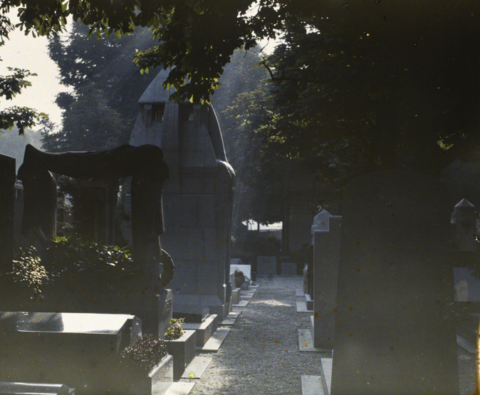
View of the cemetery of the French Village autochrome. Musée départemental Albert-Kahn, Département des Hauts-de-Seine.
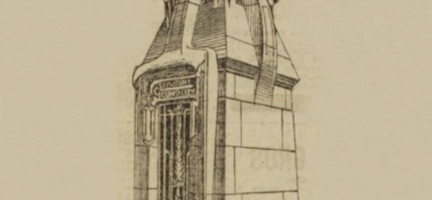
At the same time, Marbreries Générales Gourdon launched a major advertising campaign to promote a new model of funeral chapel on display at the “Modern Village Cemetery,” accompanied by an illustration[11]. Presented from a different angle, showing the main façade and its entrance closed by a wrought-iron door, the monument is easily recognizable with its uprights rising halfway up three of the four façades and enveloping an original double openwork roof system. The treatment of the entrance—whose masonry stands out clearly from the monument—is even more characteristic of Guimard’s work. From the upper lintel of its frame springs a fourth upright, which also joins the small capital crowning the chapel and supporting the cross at the top.
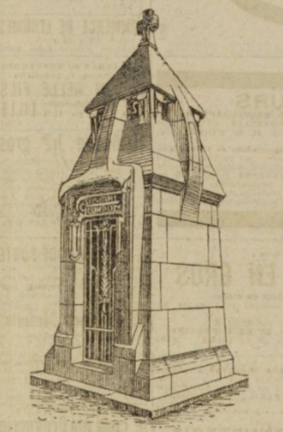
The chapel of the French Village. L’Écho du Nord de la France, 12 août 1925. BnF/Gallica.
Curiously enough, but perhaps as a result of an agreement (or a dispute…), the advertisements do not mention Guimard, even though the company was well acquainted with the architect. In the aftermath of World War I, Marbreries Générales Gourdon sent out advertising leaflets and catalogs accompanied by a facsimile of a letter on the architect’s letterhead and signed by him.
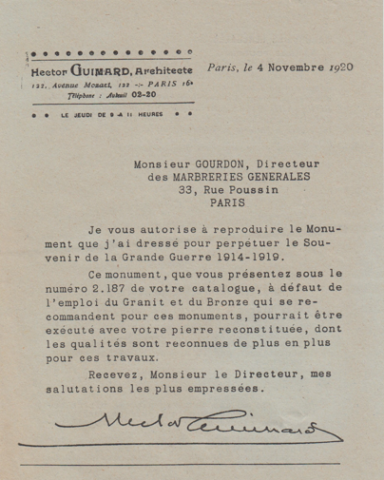
Fac-similé of a letter by Guimard attached to the catalogues of the Marbreries Générales Gourdon.
Private collection
Thanks to these new discoveries, we have been able to finalize the cemetery map with the location of Guimard’s two monuments. We take this opportunity to launch a search for these two works, which were certainly located in the alleys of a (real) cemetery.
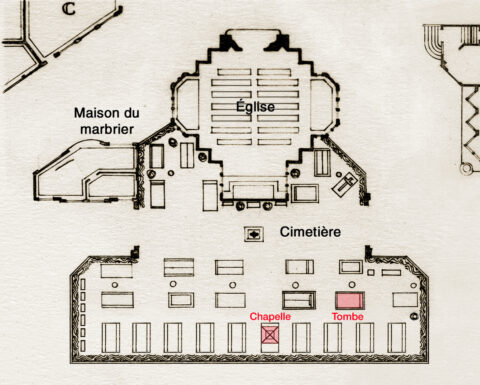
Map of the cemetery of the French Village drawn from the plans of the portfolio L’Architecture à l’Exposition des arts décoratifs modernes de 1925/Le Village moderne/Les Constructions régionalistes et quelques autres pavillons/Rassemblés par Pierre Selmersheim, éditions Charles Moreau, 1926 and from our research. Photomontage and drawing F. D.
Remains and legacy
Some parts of the Exposition were quickly demolished after it closed, while others remained standing for several months for financial reasons, as no one wanted to bear the cost of demolition. Fortunately, a few works have survived to this day, sometimes on display in public spaces or added to private or museum collections.
The demolition of the French Village also took several months. It seems that the town hall was still standing in January 1926, as noted by several journalists who came to report on the demolition work. Guimard probably tried to offer the building to local authorities, but without much success, as far as we know, since the town hall did not survive the Exposition. However, it is entirely possible that some of the decorations and materials were reused elsewhere. Guimard himself reused at least one element, adapting it to a new configuration.
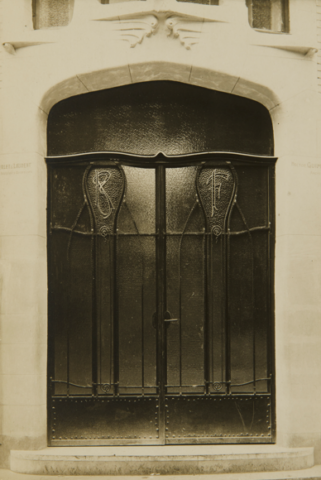
Main entrance door of the town hall of the French Village. Bibliothèque des Arts décoratifs. Donation Adeline Oppenheim-Guimard, 1948. Photo Laurent Sully Jaulmes.
The entrance door of the building on Rue Henri Heine, built by Guimard, bears a striking resemblance to that of the town hall…
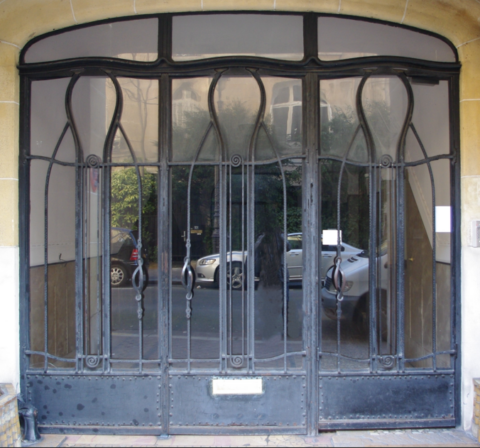
Entrance door to the building 18 rue Henri Heine, 75016 Paris. Photo author.
Although Guimard’s town hall did not enjoy a second life within a municipality, it nevertheless seems to have inspired the designers of the town hall in Pont-Sainte-Maxence (Oise), built in 1930. This hypothesis, put forward by Léna Lefranc-Cervo at the Hector Guimard study day organized last year at Paris City Hall, seems entirely convincing to us [12]. Triangular pediments on the facades, a spire set back from the pediment of the main facade, dormer windows on the roof… there are many similarities in the overall composition of the two buildings (and even in their interior layout). Furthermore, the fact that the three architects Marcel Jannin, Jean Pantinet, and Jean Szelechoivsk were members of the Society of Modern Architects (formerly the Group of Modern Architects founded by Guimard in 1923) also supports this assumption.
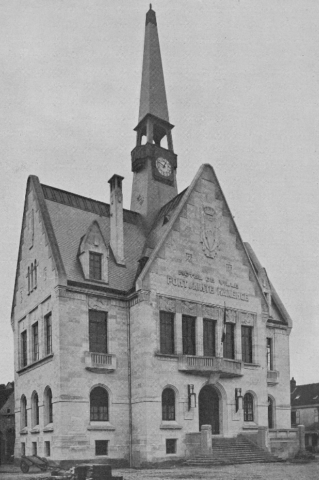
Town hall of Pont-Sainte-Maxence. La Construction Moderne, n°33, 18 mai 1930. Portail documentaire de la Cité de l’architecture et du patrimoine.
However, the resemblance ends there, as the architects opted for a massive, angular building with no ornamental references to the Art Nouveau style.
Conclusion
Although Hector Guimard’s work in the aftermath of World War I did not receive the same attention as the first part of his career, it is nonetheless of real interest. The architect continued his work, charting his course with the same ideas while discreetly but significantly adapting them to the social context of his time. Resolutely committed to modern architecture and applied art, he always advocated the renewal of the decorative arts, a principle he put into practice by simplifying his style but at his own pace, cultivating his difference and repeating to anyone who would listen that fashion should not dictate art.
On April 9, 1930, at around 6:30 p.m., Hector Guimard sat down at the Eiffel Tower radio station for a short lecture on architecture and fashion. Explaining to listeners that “[…] the nature of fashion is to change rapidly. Architecture being by definition the art of building, which implies lasting works, the word ‘fashion’ is therefore a contradiction in terms in architecture,“ he denounced the austerity that he believed was rampant in architecture and the applied arts: ”I think, moreover, that the current fashion for the nude responds to a whole state of mind. We no longer believe in mystery; we want to immediately understand things that we can simply touch.”[13].
The gradual evolution of Guimard’s style was often misunderstood, with some observers of the time judging a little too quickly (even though they did not have all the explanations) that Guimard was stubbornly sticking to the 1900 style. But while the stylistic gap between him and his colleagues was still acceptable in the mid-1920s, it became untenable at the beginning of the following decade.
Olivier Pons
Notes
[1] Originally from the US, the brand specialized in mid- to high-end office furniture. Its arrival in France seemed fairly recent, as the first mentions of its existence date back to the early 1920s. The main store occupied a large space on Rue du Faubourg-Saint-Antoine, but EAGLE also had another store nearby on Rue de la Roquette and a branch in Lille.
[2] In addition to its presence at the French Village town hall, the brand exhibited in the information office section (class 7), for which it won a silver medal, as well as in the studio and broadcasting room of the International TSF Exhibition.
[3] EAGLE catalog from 1926. BnF collection.
[3] A draft contract between Guimard and the manufacturer Olivier et Desbordes, preserved in the Adeline Oppenheim-Guimard papers at the New York Public Library, provided for the small-scale production of “Guimard-style” furniture.
[4] Le Merle blanc of May 30, 1925 reports the visitor’s request: “Sir, I have come to ask you to grant me a perpetual concession at the cemetery of the Exposition des Arts Décoratifs. Of all the cemeteries, yours is my favorite. At Père-Lachaise, there are too many great men. The Montmartre cemetery is too close to the dance halls on the hill. Pantin and Bagneux are too far away for my friends. At the Passy cemetery, I would fear suffering the same tribulations as Marie Matskirsef [sic]. With your permission, I want to be buried in the Cours-la-Reine cemetery.”
[5] Official General Catalog. Ministry of Commerce and Industry, Posts and Telegraphs, 1925. Private collection.
[6] We have counted sixteen funerary and commemorative works, not including the drawings from the École nationale des beaux-arts and the unrealized project for a commemorative monument to the Victory of the Marne.
[7] L’Auvergne littéraire et artistique et félibréenne, July 1925. The students of the Volvic Departmental School had provided three lava stone drinking fountains. Two were located in the cemetery, while a third had been installed in the courtyard of the French Village school.
[8] Paris, arts décoratifs, 1925, Guide de l’Exposition, Librairie Hachette. Private collection.
[9] Georges Vigne, Hector Guimard, Éditions d’art Charles Moreau, 2003, p. 357. A photograph illustrating the article on the French Village cemetery is supposed to show Guimard’s chapel behind a sculpture by Théodore Rivière. This photo was actually taken at the Château de Nice cemetery. The sculpture representing the two sorrows is still in place and the chapel in the background is the funerary monument of a prominent Nice family.
[10] A funeral chapel is a monument that partly resembles a religious chapel but is less imposing. It is usually closed by a door and has a commemorative altar used for eulogies for the deceased. Coffins are either placed inside if the chapel is large enough, or underneath it (in the case of the Guimard chapel).
[11] La Dépèche (Toulouse), August 10, 1925; Le Grand écho du Nord de la France, August 12, 1925; L’Est républicain, August 11, 1925. The advertisement that appeared in the European edition of The New York Herald on October 7, 1925 provides some additional information. The chapel is built of granite from the quarries of Becon (Maine-et-Loire) and can be ordered for the sum of 56,000 francs (door and windows included).
[12] Hector Guimard study day organized at Paris City Hall on December 10, 2024, to mark the end of the Hector Guimard year.
[13] L’Ouest-Éclair, April 9, 1930. BnF/RetroNews.
Translation : Alan Bryden
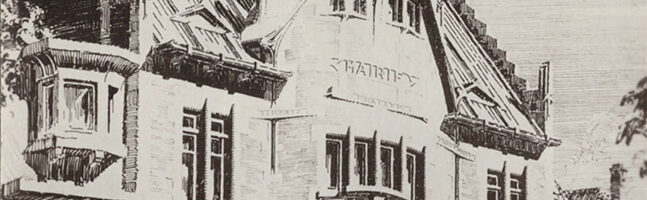
Hector Guimard’s participation in the 1925 Exhibition of Decorative Arts– Part 1
7 September 2025
We are taking advantage of the celebrations marking the centenary of the International Exhibition of Modern Decorative and Industrial Arts, held in Paris in 1925[1], to publish our research on Hector Guimard’s participation in this event. The architect’s relatively modest contribution is somewhat reflective of his career in the aftermath of the First World War. This period has ultimately been little studied, but the 1925 Exhibition was one of its highlights and undoubtedly one of its most interesting moments. Guimard’s participation took the form of three works in one of the exhibition’s sections called the French Village: the town hall and two funerary monuments. While we have a comprehensive study of the French Village currently underway, we have chosen to highlight some lesser-known aspects, such as the interiors of the town hall and the cemetery. We will begin by discussing the context that led to the organization of the exposition, Guimard’s role, and his participation in the debate of ideas on the eve of this major event for the decorative arts and architecture.
Driven by Art Nouveau in the 1890s, the revival of European architecture and decorative arts that began in the late 19th century reached maturity around 1910, then continued into the 1920s with what would retroactively be called the Art Deco style, reaching a spectacular climax in France with the 1925 Exhibition. The long gestation period of this event—which began twenty years earlier and was postponed several times, notably due to the First World War—was commensurate with its success (more than 16 million visitors) and its international impact, propelling France to the forefront of nations in this field.
The organizers’ stated ambition was to exhibit only new and modern works[2], so no space was given to older styles, which were confined to exhibitions outside the event, such as the one organized at the Galliera Museum[3]. Even though some observers recognized the contribution of the 1900 artists to modern art, the break with Art Nouveau was already largely complete. Among a few famous statements, that of the painter Charles Dufresne (1876-1938) summed up the general mood of the time quite well: “The art of 1900 was the art of fantasy, that of 1925 is the art of reason” … With a few exceptions, critics were therefore fierce towards Art Nouveau, often dwelling on its excesses and quickly forgetting that the architecture and decorative arts celebrated with pomp and circumstance in 1925 drew in part from the renewal that had begun thirty years earlier. It would take a decade before interest in Art Nouveau was rekindled and its rehabilitation and protection began to be considered[4].
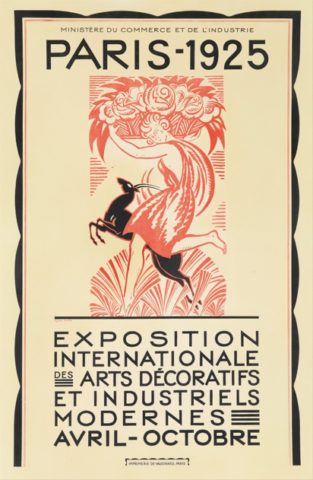
Official poster for the 1925 Exhibition Priv.coll.
In 1925, among the names of participants who took advantage of the event to launch or consolidate their careers, such as Mallet-Stevens, Le Corbusier, Roux-Spitz, and Patout, others were already active on the art scene in the 1900s. A sign of a certain recognition, the presence in 1925 of Plumet, Sauvage, Dufrène, Follot, and Jallot was also proof of their ability to adapt and renew themselves. Two of them, Maurice Dufrène (1876-1955) and Paul Follot (1877-1942), were even at the head of decoration workshops in Parisian department stores (La Maîtrise at Galeries Lafayette for the former, Pomone at Le Bon Marché for the latter). The success of the high-quality Art Nouveau productions of these two great names in decoration at the turn of the century did not prevent them from shifting towards a more stripped-down style in the mid-1900s and then, in the 1910s, towards compositions in which curves had almost disappeared.
Hector Guimard’s situation was somewhat different from that of his colleagues. Although he had evolved his style towards greater simplicity and sobriety, he always refused to give in to fashion. On the eve of the 1925 Exhibition, he told a newspaper: “Let’s just be ourselves, impose the discipline of harmony on ourselves, without believing that Fashion can and should dictate Art[5].” We will return to this principle a little later, as it was a guiding principle of the 1920s that largely explains the choices made by the architect during this period.
At the beginning of this new decade, Guimard continued to focus primarily on architectural work, as the loss of his studios in the aftermath of the world war had greatly reduced his work in the field of decorative arts. However, the activism he still displayed in the early 1920s allowed him to retain a certain influence within organizations known for promoting new ideas and heavily involved in the genesis of the 1925 Exhibition. Thus, even though he no longer held any responsibilities within the Société des Artistes Décorateurs (SAD)[6], he was still a member in the early 1920s and even exhibited there in 1923[7]. It should also be noted that during his trip to the United States in 1912, Guimard had been commissioned by the SAD. He introduced himself to the Americans as vice-president of the association and promoter of “The International Exhibition of Modern Architecture and Decoration,” which was to be held in Paris in 1915[8]…
It was therefore as an expert on the subject and spokesperson for modern ideas in the run-up to the exhibition that he became a founding member of the Groupe des Architectes Modernes (GAM)[9], holding the position of vice-president alongside Henri Sauvage (1873-1932), under the presidency of the indispensable Frantz Jourdain (1847-1935).
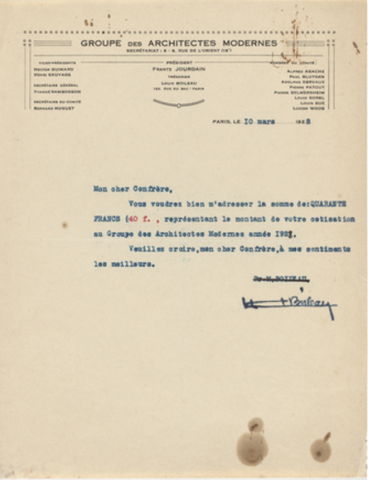
Letter from the Groupe des Architectes Modernes requesting the fee of 40 F from its members, dated 10 March 1928 and signed by Boileau. Coll. MOMA. All rights reserved
In the same interview in 1923, he justified its creation by the need to promote modern ideas that would undoubtedly be expressed during the upcoming event and, aware that the pavilions built would only have a short-lived existence, by the need to create an annex outside the 1925 Exhibition sponsored by the French State and the City of Paris “where modern architecture would be expressed, like jewelry, furniture, and fabrics, in definitive materials. These buildings would provide modern decorators with a living setting and industrialists with an initial outlet for their modern production, without which a reaction would be to be feared. Most of the pavilions built for the exhibition were indeed destroyed after the event, and this annex project never saw the light of day, nor did the ambitious project entitled “Travelers’ Hotel/American House/ Investment Buildings, permanent constructions for visitors to the 1925 Decorative Arts Exhibition,” which we know existed from three plans signed by several GAM architects, including Guimard, and which was to be located on Boulevard Gouvion-St-Cyr in Paris (75017).
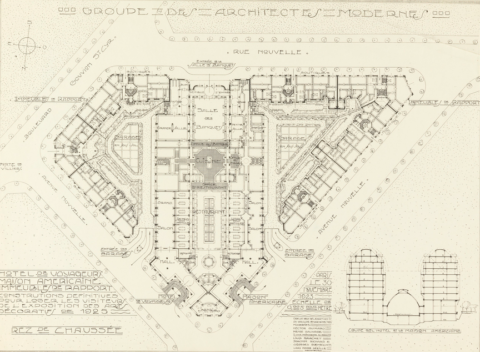
Plan of the ground floor of the final building design by the Groupe des Architectes Modernes for the 1925 Exhibition, dated November 30, 1923. Cooper Hewitt, Smithsonian Design Museum. All rights reserved..
The GAM was ultimately entrusted with the creation of a section called the French Village within the exhibition. This could be seen as compensation, or even a way of keeping it at arm’s length, but the fact that several of its members were tasked with constructing some of the most important buildings at the event nevertheless confirms the association’s influence on the exhibition.
The French Village Town Hall
The French Village occupied a relatively small area around Cours Albert 1er, slightly away from the Esplanade des Invalides, which was considered the epicenter of the exhibition. Comprising some twenty buildings designed by as many architects from the GAM[10], the complex was a kind of architectural proposal intended to represent a village from the early 20th century.
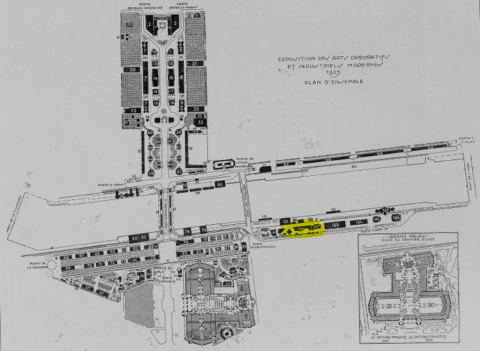
Plan d’ensemble de l’Exposition de 1925 implantée de part et d’autre de la Seine. L’emplacement du French Village est surligné en jaune. La Construction Moderne, 03 Mai 1925. Coll. part.
In addition to the essential town hall, church, and school, there was an inn, a “bourgeois” residence, a community center, a bazaar[11], various commercial buildings, and several so-called secondary structures such as electrical transformers, a sanitary unit, and a wash house. Without exception, all these structures shared the common feature of having been built in a modern style.
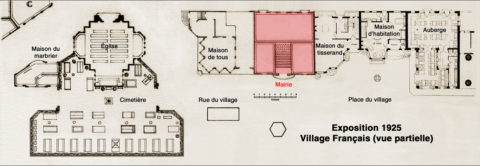
Partial plan of the French Village based on plans from the portfolio L’Architecture à l’Exposition des arts décoratifs modernes de 1925/Le Village moderne/Les Constructions régionalistes et quelques autres pavillons/Rassemblés par Pierre Selmersheim, published by Charles Moreau, 1926. Photomontage by F. D.
For economic reasons and due to constraints related to its environment, the ambition of the initial project had been scaled back. The architects had to work around existing plantings and connections to the sewer, water, gas, electricity, and telegraph systems. Furthermore, as the area ultimately allocated to the project did not allow for the construction of independent buildings, Dervaux had no choice but to make the buildings adjoined (with the notable exceptions of the church and the school). Most of them were therefore aligned lengthwise, parallel to the Seine. This revision of the initial project had the immediate effect of changing the name of the complex from “Modern Village” to “French Village,” as the GAM architects had been unable to demonstrate sufficient urban planning skills. It should be noted that this double name persisted, even during the exhibition, as some authors felt that the small village was modern enough to retain this description.
The Guimard town hall was one of the last buildings in the village to be completed (along with Pierre Patout’s (1879-1965) electrical transformer), even though the exhibition had been open for over a month[12]. Several old postcards show the building still under construction, despite the photographers’ efforts to hide it or relegate it to the background…
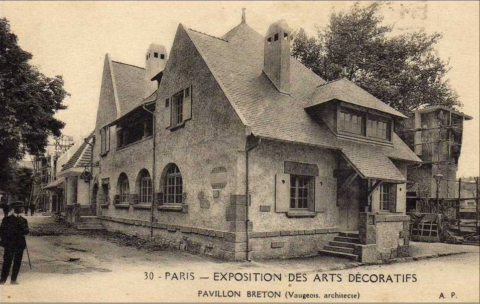
View of the French Village. In the background on the left, the town hall under scaffolding, as well as the Patout transformer on the right may be seen, ancient postcard. Private collection.
This delay in the construction of one of the main buildings in the small town probably explains its late inauguration. It was not until Monday, June 15, 1925, that the French Village was inaugurated, as shown in a photo in the Excelsior newspaper, in which the town hall appears to be free of scaffolding.
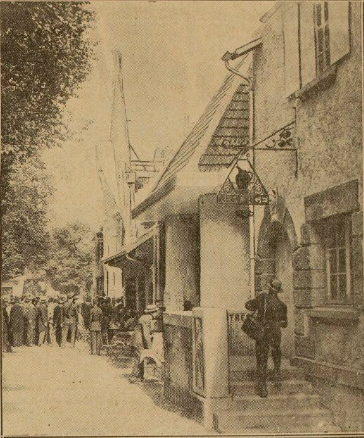
The inauguration of the French Village, Excelsior, 16 Juna, 1925 Bnf/ Gallica
With its back to the river, Guimard’s town hall stood at the edge of the village square, adjoining the” Maison de Tous” on its left, designed by the talented urban planner D. Alfred Agache (1875-1959), and the “Maison du Tisserand” by architect Émile Brunet (1872-1952) on its right. Agache perfectly summed up the spirit that guided the GAM in the construction of this complex: “(…) the “Village de France”, which we built in order to provide a snapshot of what a rural community should be, to meet the needs of modern life[13].”
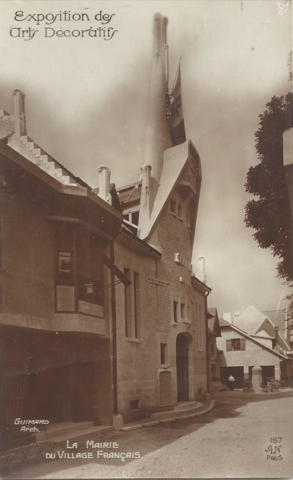
The townhall of the French Village, ancient postcard Private collection .
Recognizing that they had been unable to construct separate buildings, the two architects took advantage of this immediate proximity to create an opening allowing circulation between the two structures[14], no doubt believing that the functions and roles of the two buildings were compatible and complementary.
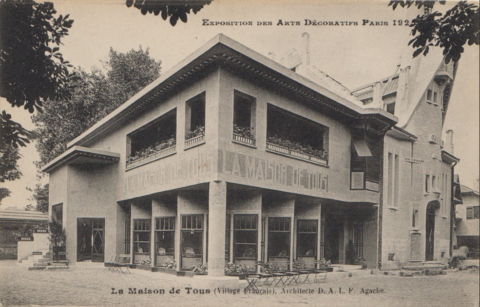
The “Maison de Tous” and the Town hall of the French Village, ancient postcard, private collection
The exterior appearance of the building is well known thanks to numerous old postcards on which it is either the main subject or a secondary subject, with the eleven pinnacles punctuating the roof often making it impossible to miss in photographs. The building appears to be a synthesis of Guimard’s last pre-war works and his research in the early 1920s to develop an economical construction method called “Standard-Construction”, which was used to build the small hotel on Square Jasmin in the 16th arrondissement of Paris.
Adding a touch of originality to the group of buildings, the highest of these pinnacles rose directly above the central bay of the slightly curved main facade, punctuated by numerous openings, but set back from a cement canopy covering the clock. Like a signal, both in terms of its height and its function as a carillon, it symbolically rivaled the bell tower of the neighboring church built by architect Jacques Droz (1882-1955) and reminded visitors of the importance of republican life in a modern village… We also have a fairly accurate idea of its colors, as the Archives de la Planète at the Albert-Kahn departmental museum hold numerous autochromes of the event, in which the town hall appears in light tones due to its asbestos brick and white and gray stone cladding[15].
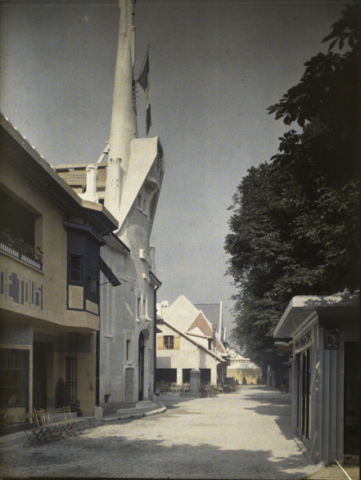
View of the French village. On the left, the Maison de Tous and the town hall, followed by the village square and then the inn; on the right, the fish market, autochrome. Albert Kahn Departmental Museum, Hauts-de-Seine Department
Two other sources are invaluable for learning about the town hall: the portfolio published by Pierre Selmersheim[16] and Anthony Goissaud’s article in La Construction Moderne[17]. A third unpublished article in Le Moniteur des Architectes communaux[18] still eludes us, but we hope that this publication will enable us to find it…
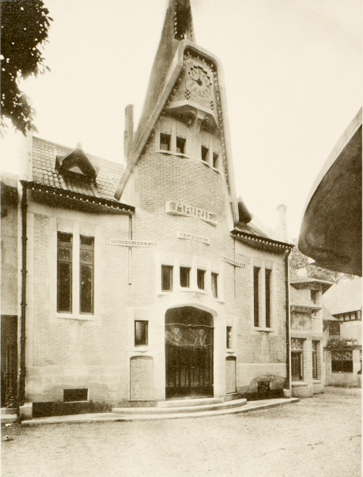
Main facade of the town hall, portfolio Architecture at the 1925 Exhibition of Modern Decorative Arts/The Modern Village/Regionalist Buildings and Several Other Pavilions/Compiled by Pierre Selmersheim, Charles Moreau Publishing, pl. 2, 1926. Private collection.
A postcard published for promotional purposes by Guimard (used to illustrate the header of this article) completed this editorial material. On the front is an illustration by artist A. C. Webb (1888-1975)[19]. The back comes in different versions depending on the intended use (advertising with a list of town hall employees, promotional material touting a construction technique, or blank for correspondence, etc.).
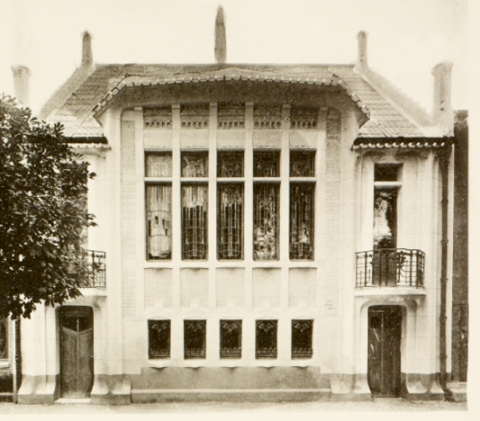
Rear facade of the town hall, portfolio Architecture at the 1925 Exhibition of Modern Decorative Arts/The Modern Village/Regionalist Buildings and Several Other Pavilions/Compiled by Pierre Selmersheim, Charles Moreau Publishing, pl. 3, 1926. Private collection
The panels framing the main entrance door, intended for municipal notices, were used here to showcase the companies and artists who collaborated on the town hall project. Among them were some more or less famous names, such as the Schenck family of ironworkers, who made the wrought iron staircase railing, the stained-glass artist Gaëtan Jeannin, who created the stained-glass windows in the wedding hall, and the painter René Ligeron, whom we will discuss later.
Finally, a collection of cast iron pieces from Guimard’s repertoire of models, produced since 1908 by the Saint-Dizier foundry, adorned the building, particularly on the rear facade, where there were balconies on the first floor and panels decorating the windows on the ground floor.
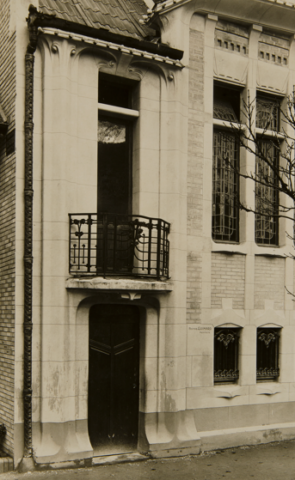
Details of the rear facade of the town hall decorated with cast iron. Library of Decorative Arts. Gift of Adeline Oppenheim-Guimard, 1948. Photo by Laurent Sully Jaulmes.
At the ends of the two facades, the downspouts from the Saint-Dizier foundry connected to gutters from the Bigot-Renaux foundry. These undecorated gutters were fitted with “outward-angled gutter ornaments” also from the Saint-Dizier foundry, which appear to have been used only here.
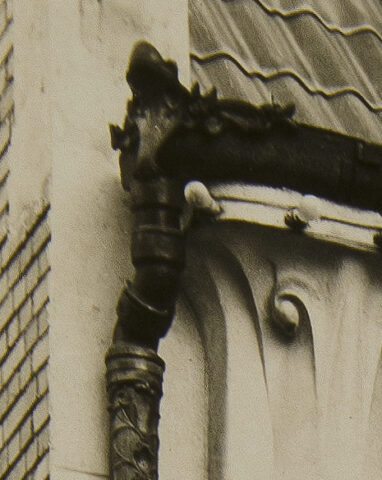
Details of the rear facade of the town hall decorated with cast iron. Decorative Arts Library, donated by Adeline Oppenheim-Guimard, 1948. Photo by Laurent Sully Jaulmes.
Fixed decoration
Among the companies that played an important role in the interior decoration of the building was ELO[20], whose fiber cement paneling covered part of the interior walls. This company experienced significant growth in the 1920s, when there was high demand for inexpensive decorative elements in all styles. As cost savings were a common denominator in most of Guimard’s buildings, it is not surprising that he called on this company for the town hall, given that the budget was particularly limited[21]. ELO paneling thus joined the long list of new materials (and sometimes new techniques) used by the architect throughout his career. The possibility of modeling them to his style was an additional advantage. Notable examples include the use of Lantillon fiberboard panels covering the ceilings of Castel Béranger, Castel Henriette, Villa Berthe, and the Lantillon pavilion in Sevran, as well as Garchey glass stone, also used at Castel Henriette, and ferrolithe, used on the rear façade of the Pavillon de l’Habitation in 1903 [22].
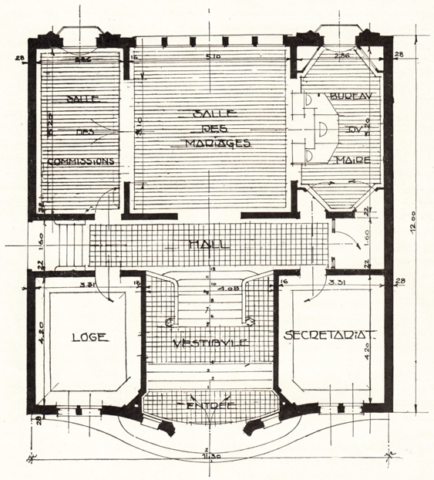
Plan of the town hall published in La Construction Moderne, November 8, 1925. Private collection.
An exhibition devoted to the new materials and techniques used in the construction of the town hall occupied the large room on the ground floor, accessible only through two doors at the rear. Among those featured were Taté for plaster, stone, and marble; Lambert Frères for asbestos bricks; and the Société de Traitement Industriel des Résidus Urbains (Industrial Urban Waste Treatment Company)[23].
In the photo from La Construction Moderne, we can see ELO paneling covering part of the wall behind the mayor’s desk.
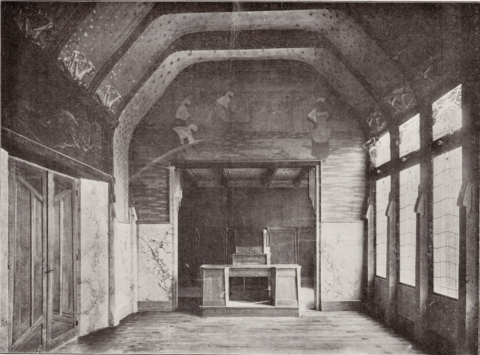
Wedding hall with the mayor’s desk in the background and Jeanneau stained glass windows on the right. La Construction moderne, November 8, 1925. Private collection.
Public collections, meanwhile, hold another photograph that allows us to appreciate the wood paneling sculpture in the foreground.
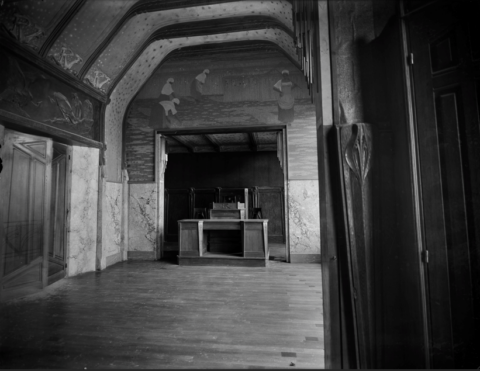
Wedding hall and the mayor’s desk. GrandPalaisRmnPhoto. All rights reserveds.
Finally, the Cooper Hewitt, Smithsonian Design Museum holds the original and almost definitive design for the paneling. A subtle and delicate blend of the organic and plant worlds, the main motif takes us back twenty years, bringing a touch of sentiment dear to Guimard and open to interpretation.
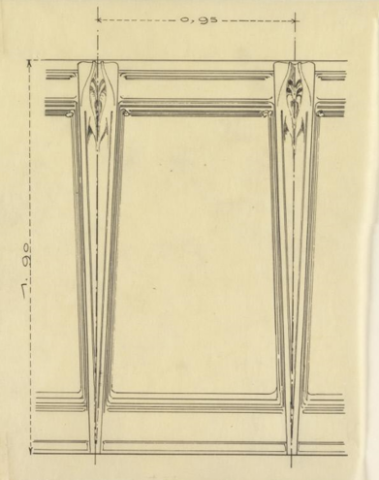
Drawing of the town hall paneling. Cooper Hewitt, Smithsonian Design Museum. All rights reserved.
This paneling would appear under the name “Lambris Guimard” in the following year’s ELO catalogs. This was probably the architect’s last attempt to market a model commercially.
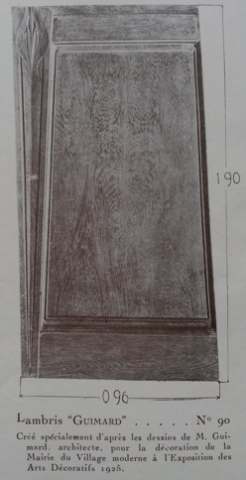
« Lambris Guimard », catalogue of the ELO company, 1926. Coll. part.
ELO is also likely the maker of the striking bas-relief featuring vultures above the doors to the wedding hall, signed by Raymond Andrieux. Although birds of prey—alongside wild animals—were among the favorite subjects of artists of the time, one might wonder why they were chosen to adorn the wedding hall.
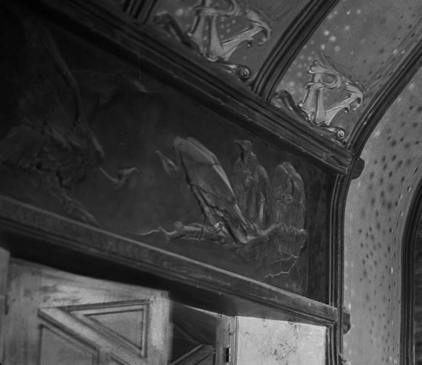
Detail of the frieze depicting vultures by R. Andrieux decorating the wedding hall. GrandPalaisRmnPhoto. All rights reserved.
Although Guimard undoubtedly met this virtually unknown artist through the ELO company—or perhaps it was the other way around—he may have wanted to seize the opportunity to promote a young artist while adapting an existing work at minimal cost. Information about Raymond Andrieux is very scarce[24], but we have found a trace of a work, now in a private collection, whose resemblance to the bas-relief at the Town Hall is particularly striking.
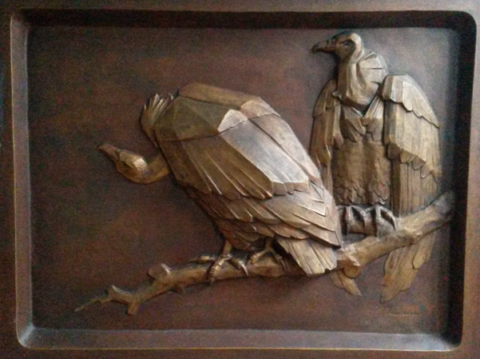
ELO panel with vultures signed R. Andrieux on the lower right and bearing the ELO company stamp on the reverse, width 1.37 m, height 1.15 m, depth 0.18 m. Private collection.
Our investigation led us to the 1924 Salon des Artistes Français, where Andrieux exhibited a panel in the Decorative Arts category under the caption: “Vultures, fiber cement panel”[25]. This work therefore certainly served as a model for the bas-relief in the wedding hall, with Guimard probably asking the young artist to draw inspiration from his 1924 work and adapt it into a frieze. It is even possible that this work appeared in the manufacturer’s catalog, but the copies we have do not mention it.
Among the other artists who collaborated on the interior decoration of the building was René Ligeron (1880-1939)[26], whose two paintings depicting scenes of the French countryside—a decorative theme found in many town halls—adorned the walls of the gables of the wedding hall. Thanks to the previous photos, we were familiar with the painting entitled Harvesters binding sheaves. A third, previously unseen view of the wedding hall being decorated gives a glimpse of the second work, entitled Woman guarding sheep, in the same rural style as the first.
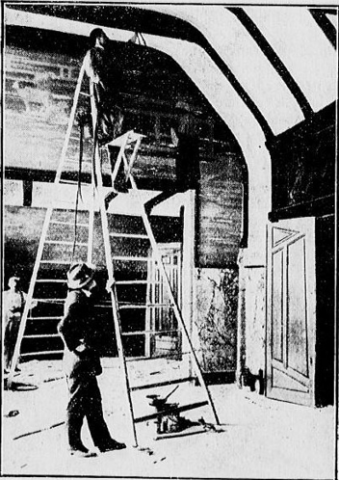
The wedding hall of the town hall of the French Village under decoration Recherches et Inventions n° 163, mars 1928. Private collection
It is not impossible that the figure in profile with a gray beard, wearing a hat and standing on a ladder, is Hector Guimard himself, who came to supervise the work…
(to be continued)
Olivier Pons
[1] The event took place from April 28 to November 8, 1925. For convenience, we will refer to it as the 1925 Exhibition or simply the Exhibition.
[2] The rules stipulated: “(…) works of new inspiration and genuine originality, executed and presented by artists, craftsmen, industrialists, designers, and publishers, and falling within the scope of industrial and modern decorative arts, are eligible for admission to the Exhibition. Copies, imitations, and counterfeits of ancient styles are strictly excluded.” Exhibition rules. Private collection.
[3] “Exhibition of the Renovators of Applied Art from 1890 to 1910,” Galliera Museum (Paris), June 6 to October 20, 1925.
[4] See the article by Léna Lefranc-Cervo: https://www.lecercleguimard.fr/fr/proteger-le-patrimoine-art-nouveau-parisien-initiatives-et-reseaux-dans-lentre-deux-guerres/
[5] Interview given to L’Information financière, économique et politique, February 19, 1923. BnF / Gallica.
[6] The Société des artistes décorateurs (Society of Decorative Artists) was founded in 1901 on the initiative of lawyer René Guilleré and several other leading figures in the decorative arts. Its aim was to “promote the development of the decorative arts,” as stated in Article 2 of the SAD’s statutes, “approved by order of the Prefect of Police on April 6, 1901.” Private collection.
[7] The catalog failed to mention his name, but his participation in the 1923 SAD is confirmed by several articles. For example, the January 1923 issue of L’amour de l’Art mentions the three tombs presented by Guimard, including “that of the Henri family,” a unique monument that undoubtedly still exists and which we are actively searching for…
[8] See the article: https://www.lecercleguimard.fr/fr/le-premier-voyage-dhector-guimard-aux-etats-unis-new-york-1912/
[9] See the article by Léna Lefran-Cervo: https://www.lecercleguimard.fr/fr/entre-norme-et-liberte-larchitecture-du-point-de-la-vue-de-la-societe-des-architectes-modernes/
[10] It was built under the direction of architects Charles Genuys (1852–1928) and Gouverneur, based on an overall plan designed by Adolphe Dervaux (1871–1945). See Lefranc-Cervo, Léna, Le Village français: une proposition rationaliste du Groupe des Architectes Modernes pour l’Exposition Internationale des arts décoratifs de 1925, research thesis (2nd year of 2nd cycle) supervised by Alice Thomine Berrada, École du Louvre, September 2016.
[11] The bazaar was built based on plans by architect Marcel Oudin (1882-1936) for the Magasins Réunis chain. A specialist in reinforced concrete construction, Oudin had become one of the architects of the Corbin family from Nancy, owners of the Magasins Réunis in eastern France, but also in Paris (Magasins Réunis République, À l’Économie Ménagère, Grand Bazar de la rue de Rennes).
[12] In an original photo dated June 1, 1925, the town hall still appears to be covered in scaffolding.
[13] La Cinématographie française, April 11, 1925. La Maison de Tous, which was initially to be called Maison du Peuple (House of the People) – a name considered too connotative – was undoubtedly one of the most attractive buildings in the Village, both in terms of its architectural design and the ideas behind its conception and deserves a full article.
[14] Le Journal des débats politiques et littéraires, June 17, 1925.
[15] An article devoted to Guimard’s use of bricks is in preparation and will provide a more complete overview of the materials used in the French Village town hall.
[16] Architecture at the 1925 Exhibition of Modern Decorative Arts/The Modern Village/Regionalist Buildings and a Few Other Pavilions/Compiled by Pierre Selmersheim. Charles Moreau Editions, 1926.
[17] “The Town Hall of the French Village,” A. Goissaud, La Construction Moderne, November 8, 1925.
[18] “La Mairie du Village français à l’Exposition,” Le Moniteur des Architectes communaux, 1925, no. 2.
[19] Alonzo C. Webb (1888-1975) was an American painter and engraver who spent his life between the United States and Europe. After studying architecture and fine arts first in Chicago and then in New York, he moved to Europe after World War I and settled in France in the 1920s, where he produced drawings of ancient monuments and landscapes for advertising and to illustrate articles in major national newspapers (including L’Illustration). Guimard may have met him through his wife Adeline, as Webb was part of the small American colony in Paris. After specializing in engraving, he moved to London in the late 1930s, where he died in 1975.
[20] Founded in 1902, ELO had its headquarters and factories in Poissy (Yvelines) and showrooms located at 9 rue Chaptal in Paris’s 10th arrondissement. It offered decorative paneling and fiber cement (a mixture of asbestos and cement) cladding for both interior and exterior use, thanks to its strength, rot resistance, and fire resistance. Manufactured in large quantities, the cladding was designed to imitate wood, bronze, stone, leather, and even ceramic at prices well below those of these materials (Journal Excelsior, May 6, 1925).
[21] The budget allocated to the town hall was 92,000 francs. La Construction Moderne, November 8, 1925.
[22] Ferrolithe was a type of coating that imitated stone. Highly resistant and moisture-proof, it was mainly used to renovate and cover exterior walls.
[23] L’Architecture no. 23, December 10, 1925.
[24] Raymond Andrieux was an artist from Lille who became a member of the Société nationale des Beaux-Arts in 1926 in the sculpture category. A trinket tray decorated with a vulture and signed by R. Andrieux was sold at auction in 2016.
[25] Le Grand Écho du Nord de la France, May 21, 1924. BnF/Gallica.
[26] (Jacques) René Ligeron was born in Paris on May 30, 1880, and probably died in Algiers on December 8, 1939. A traveling painter, he was best known for his engravings, with a preference for etchings. A student of Lepeltier, Lefebvre, and Robert-Fleury, he exhibited mainly landscapes and a few portraits at the Salon des Artistes Français from 1905 onwards. In 1936, the press reported on an exhibition in a Parisian gallery showcasing his latest works, notably blackened wooden panels intended to decorate a large dining room, one fragment of which, featuring Japanese-inspired decoration, has recently been rediscovered.
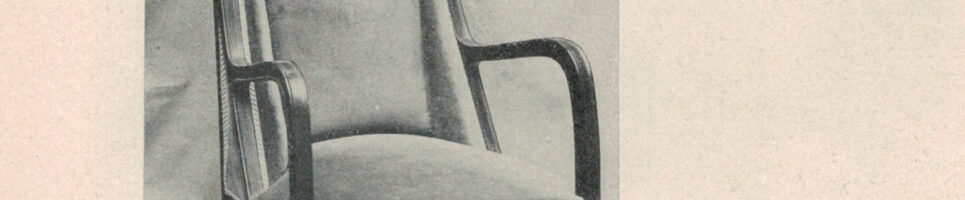
The « Maison Moderne » of Julius Meier-Graefe — Part 3
30 August 2025
The tenuous links between La Maison Moderne and Guimard
Following Bertrand Mothes’ two articles recounting the history and operations of La Maison Moderne, we would like to add some information about the indirect links that existed between this gallery and Hector Guimard, beginning with a few thoughts on how his creations were marketed.
Only a minority of the countless models created by Guimard would have been suitable for sale by an art gallery. Anything that could be considered industrial production, such as cast iron and architectural ceramics or hardware, had to be excluded. However, both furniture and decorative art objects such as vases, lamps, and frames could have been sold through this type of commercial channel. Yet it is easy to see that no art objects designed or modeled by Guimard and then entrusted to a craftsman to be produced as unique pieces or in small series were ever offered for sale at La Maison Moderne or the Bing Art Nouveau Gallery. As Bertrand Mothes showed us in his previous article, at La Maison Moderne, it was usually Julius Meier-Graefe who was responsible for choosing a model presented by an artist and then for its manufacture (and therefore its cost price). However, as at Bing’s, it was possible for certain prestigious brands or artists to deposit their creations in the gallery. The sale of these objects, whose manufacture had already been paid for, therefore generated only a smaller profit shared between the gallery and the designer. However, unlike many artists and decorators, Guimard refused to use the art gallery distribution channel, where his style, which he had wanted to be so distinctive that he gave it his name, would have been anonymized, diluted among multiple expressions of modern decorative art.
He may also have thought that the advantage of having his works permanently displayed in a gallery (which is more effective than occasional exhibitions) could be offset by well-executed media coverage. However, this type of publicity through the press and publications, which had worked very well at the time of Castel Béranger, subsequently became less common and was sometimes even unfavorable to him.
Having chosen to isolate his production from that of others, he could have used a dealer to represent him or even gone so far as to open a store[1]. The first option would again have represented a significant loss of income. As for the cost of running a store, it could have been a deterrent. But above all, Guimard, who was already indeed an entrepreneur, was keen not to appear as a merchant, because of the moral code that architects imposed on themselves, but also because of the business license that would have had to be paid. We know from a lawsuit brought against him, which he won on appeal, that his status as an architect prevailed over that of a merchant. In a dispute with a supplier who claimed that he “combined the practice of his profession with the operation of a veritable industry, that he had manufacturing workshops and stores where he sold various items made under his direction,”. Guimard defended himself by saying that he did not engage in such an activity, but only practiced ”the artistic application and implementation of his knowledge as an architect and his personal taste.”
So Guimard circumvented indirect sales in two ways. First, in a very traditional manner, through direct sales for small production volumes, either by order or at exhibitions. Then, when larger production volumes were expected, he redoubled his efforts not only to have his creations mass-produced but also to have them published. This was not always the case in his early years of artistic creation, and it was only gradually that this approach became widespread, along with the desire to have his designs featured in catalogs. His goal was twofold: to ensure a steady income while working with this wider distribution to promote the “modern style”, and his own style in particular. It should be noted that in most of these catalogs, Guimard’s designs were placed on the same level as the others, just as they would have been on the shelves of an art gallery. And, ultimately, it was the manufacturer who reaped the lion’s share of the profits from the sale. Only in rare cases was he able to obtain the creation of a specific catalog limited to his own designs.
In order to pursue successfully this policy to market his creations, Guimard needed a production unit capable of manufacturing products from start to finish (such as furniture or wooden and plaster frames), or of supplying usable models to a manufacturer, whether a craftsman or an industrialist. He was able to achieve this first Rue Wilhem and then, from 1904 to 1914, Avenue Perrichont prolongée.
Given his great sociability, Guimard did not sever all ties with the art dealers, especially when their commitment to the modern style was sincere and not seen as simply another card to add to an eclectic range of products.
In the article we devoted to the recently acquired Guimard glass vase, we showed that Guimard had collaborated closely with the Cristallerie de Pantin.
Guimard Vase from la Cristallerie de Pantin, height. 40,2 cm. Priv.coll. Photo F. D.
This crystal manufacturer presented a selection of “aquamarine” vases in the gallery of La Maison Moderne, presented in the catalog published in 1901.
« Crisallerie de Pantin/Aquamarine vases . Documents from L’Art Industriel au vingtième siècle (La Maison Moderne catalog), Paris, Éditions de La Maison Moderne, 1901, p. 12.
Aquamarine vase from the Cristallerie de Pantin, close to the vase of 2014 from the sélection of vases sold by La Maison moderne. Photo internet, all rights reserved
For the reasons mentioned above, it is unlikely that any of Guimard’s designs were included in this selection. However, the selection only featured designs with abstract, swirling patterns, far from the naturalistic designs copying the Nancy style that the crystal factory produced in abundance using the same type of slightly bluish glass.
But in the same catalog, the chapter on glassware was written by a friend of Guimard’s, the journalist Georges Bans. In 1895, Bans founded and edited a small bi-monthly literary and artistic magazine, La Critique. Although its circulation was limited, the magazine received contributions from many prominent authors such as Camille Mauclair, as well as excellent illustrators such as Gustave Jossot and Maurice Biais. The latter collaborated with La Maison Moderne, not only with the poster we have already reproduced, but also with drawings of furniture, including an armchair with particularly sober and modern lines.
Maurice Biais, imprimerie J. Minot, poster for La Maison Moderne, 1899-1900, color lithography on paper , ighut. 114 m, width. 0,785 m, Paris, Bibliothèque nationale de France.
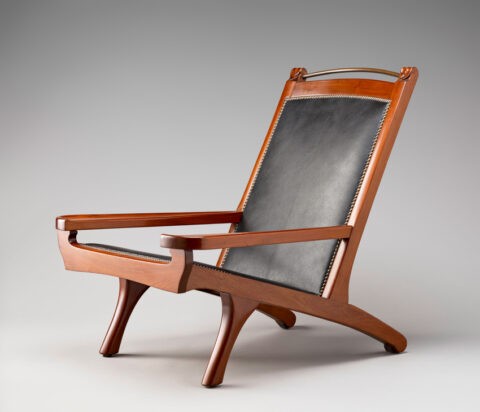
Armchair designed Maurice Biais, Musée d’Orsay, mahogany, leather and brasss, hight. 0,86 m, width. 0,70 m, depth. 0,95 m. Photo © RMN-Grand Palais (musée d’Orsay) / Mathieu Rabeau, rights reserved. This armchair is presented in L’Art Industriel au vingtième siècle (La Maison Moderne catalog), « Ameublement et décoration », fauteuil renversé n° 35, p. 16, 1901.
Also noteworthy is the beautiful frontispiece designed for the chronicle of the 1900 World’s Fair in La Critique by Maurice Dufrène, one of the main contributors to La Maison Moderne.
Frontispiece drawn by Maurice Dufrène for the chronicle of 1900 Exposition Universelle in La Critique. Source Gallica.
La Critique was mainly run by Émile Strauss and the poet and critic Alcanter de Brahm (pen name of Marcel Bernhardt). Hector Guimard quickly developed an intellectual rapport and undoubtedly a friendship with the latter, which led to him being frequently quoted in the magazine[3]. Georges Bans also followed Guimard’s career and presented several of his works in La Critique, notably the Paris metro entrances. In a brief note [4] published in August 1900 in La Critique, clearly informed by a disgruntled Guimard, he vigorously contested the battle waged by two city councilors, Charles Fortin and Maurice Quentin-Beauchard, who were fighting to have the kiosks replaced by open surrounds. To restore them, he was appealing to the Prefect of the Seine, Justin de Selves, who was careful not to intervene. A second article by Georges Bans, published two months later in October 1900, this time in L’Art Décoratif, commented very favorably on the installation of the first metro entrances, inventing the famous phrase “the dragonfly spreading its light wings” to describe the inverted roof of the B kiosks. On this occasion, we can guess that Guimard personally explained to him certain details and motivations behind his work that most critics of the time did not perceive.
We can also cite an article by Georges Bans in the German magazine L’Architecture du XXe siècle, which features two drawings of Guimard’s facade elevations and refers to the dinner at La Critique on December 31, 1900, which Guimard attended, as well as the joint participation of Guimard and Bans in the office of the company Le Nouveau Paris, founded in 1903 by Frantz Jourdain.
The catalog of La Maison Moderne also features a silver matchbox holder by the young architect Henry Bans[5], brother of Georges Bans.
Henry Bans, matchbox holder, « L’Orfèvrerie », L’Art Industriel au vingtième siècle (La Maison Moderne catalog), Paris, Éditions de La Maison Moderne, 1901, p. 11. Coll. part.
Henry Bans was a close friend of the family of sculptor Jean-Baptiste Carpeaux (1829-1875)[6]. Guimard expanded the Carpeaux studio in 1894-1895 on Boulevard Exelmans with the creation of an exhibition gallery dedicated to the sculptor’s work. It was probably on this occasion that he met the Bans brothers.
Finally, it is worth noting the presence in the La Maison Moderne catalog of an armchair by Géza Kiss, No. 45 in Jarah wood, which can be seen partially reproduced in Maurice Biais’ poster (see above).
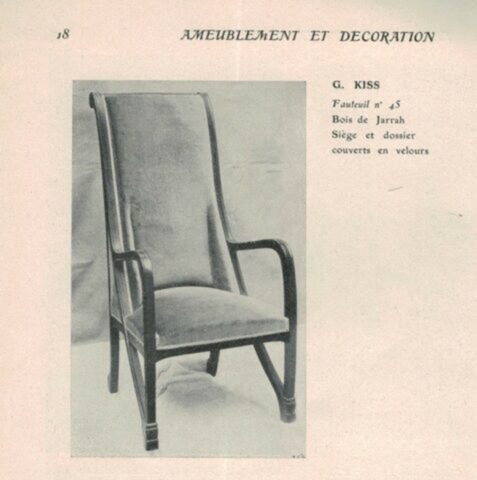
Géza Kiss, armchair n° 45, jarrah wood, seat and back covered in velvet, « Ameublement et décoration », L’Art Industriel au vingtième siècle (La Maison Moderne catalog), Paris, Éditions de La Maison Moderne, p. 18, 1901. Private collection
Without going any further (see note 3), we can assure that Kiss, Guimard, the editors of La Critique, and of course Julius Meier Graefe knew each other.
Frédéric Descouturelle
Notes
[1] One immediately thinks that the shop or shops planned for the ground floor of the Castel Béranger, which we do not yet know whether they actually operated, would have been an ideal showcase for Guimard. However, there is no evidence to suggest that he had this intention at any point.[2] Guimard v. Mutel case, ruling of the Seine Commercial Court of January 4, 1901, overturned by the Seine Court of Appeal on January 14, 1904, “Jurisprudence” La Construction Lyonnaise, January 1912.
[3] We will soon review these quotes from Guimard in La Critique.
[4] G. B. “Notule, Le monde à l’envers,” La Critique, August 5, 1900.
[5] François Gabriel Bans, known as Henry or Henri Bans (1877-1970).
[6] Henry Bans would much later design the stele for the Carpeaux monument in Square Carpeaux in Paris’s 18th arrondissement. The monument is adorned with a bust sculpted by Léon Fagel in 1929.
Translation: Alan Bryden
Signing of the long-term lease commitment for the Mezzara Hotel
28 July 2025
On the morning of July 25, the Mezzara Hotel briefly reopened its doors for the signing of the 50-year lease commitment, in the presence of the Minister for Culture Ms. Rachida Dati and numerous other dignitaries.
Welcome for Ms. Dati by Nicolas Horiot, president of the Cercle Guimard. Photo F. D.
After a brief visit and speeches by Fabien Choné, President of the Fabelsi Holding company, and Ms. Dati, who emphasized the importance of promoting heritage in a dynamic way rather than waiting until it is in danger, highlighting the unusual approach taken jointly by a private entrepreneur and an association of art historians, the official signing took place in the dining room.
Speech by Fabien Choné. Photo D. M.
Signing of the lease commitment Photo D. M.
This morning was an opportunity for the Cercle Guimard and Fabien Choné to reconnect with many of the people who support us and with whom we are developing our museum project. This ceremony was just one step in a process that should continue with a building permit, which will determine when restoration and renovation of the building can actually begin.
The signing of the lease commitment for the Hôtel Mezzara was widely reported in the media, from social networks to icibeyrouth.com and the local press in Saint-Dizier, demonstrating enthusiasm that extends far beyond specialized circles and national borders.
Le Cercle Guimard

The « Maison Moderne » of Julius Meier-Graefe — Part 2
7 July 2025
Organization, offerings, and operation of La Maison Moderne
Among all the artists selected, two Belgian compatriots were given the most important assignment: Georges Lemmen, first and foremost. Meier-Graefe entrusted him with the task of designing the most recognizable element of the brand: its logo. This symbol, intended to be the “brand” of La Maison Moderne, consisted simply of the initial letters of the gallery’s name superimposed on each other, drawn in curves in line with the style already used by Lemmen in the posters for Dekorative Kunst. Simple in design, this logo appeared on most of La Maison Moderne’s production and publications, in its original or a more elaborate form.
Georges Lemmen, logo of La Maison Moderne, 1899.
The design of La Maison Moderne was commissioned to the artist Meier-Graefe trusted most: Henry Van de Velde. He designed a storefront with display windows, allowing passersby to see a selection of the items sold inside.
Interior design of La Maison Moderne by Van de Velde, 82 rue des Petits-Champs in Paris, Deutsche Kunst und Dekoration, October 1900, online library of the University of Heidelberg. On the shelf of the display cabinet are two vases by Dufrène and Dalpayrat.
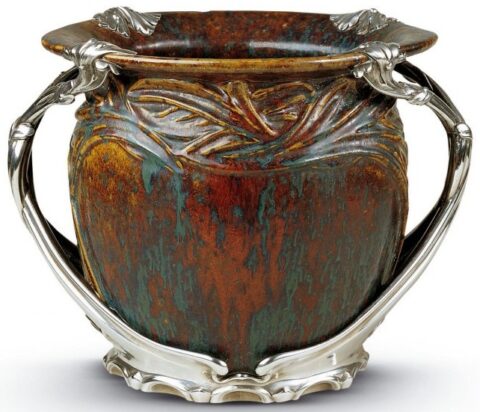
Maurice Dufrène, designer, Dalpayrat and Lesbros, ceramist, flamed stoneware, c. 1899, purchased by the Union Centrale des Arts Décoratifs at La Maison Moderne in 1899, silver mount by Cardeilhac added in 1900, exhibited at the UCAD pavilion at the Universal Exhibition in Paris in 1900, Musée des Arts Décoratifs. All rights reserved.
The typography for the letters was designed by Georges Lemmen[2]. This choice reflects Meier-Graefe’s confidence in the talent of the two Belgian artists, as the shop front played as important a role as a poster for shops at the end of the 19th century. In the gallery, Van de Velde proposed a complete decor, alternating display cases, shelves, and furnished rooms.
The other artists selected to appear in the gallery catalog were countless: more than sixty were listed. Despite Meier-Graefe’s stated desire to create a gallery that favored French works, foreign artists were very numerous within its walls.
Bernhard Hoetger (Hörde, Germany, 1874 – Beatenberg, Switzerland, 1949), The Storm, c. 1901, bronze, Musée d’Orsay, RF 4189, height 0.311 m, width 0.245 m, depth 0.25 m. All rights reserved. This sculpture is reproduced in Documents sur l’Art Industriel au vingtième siècle, bronze 3322-1, La Sculpture p. 5.
To provide an overview of the diversity of the offerings, it is worth mentioning all the nationalities represented among La Maison Moderne’s collaborators: French, Belgian, German, Italian, Austrian, Hungarian, Romanian, Serbian, Danish, Dutch, and Finnish. It is interesting to note the absence of British and Spanish artists among them. Meier-Graefe’s taste is the only real common denominator among all these artists, and they were selected with a concern for consistency that was dear to him (Bing had been criticized for a lack of consistency four years earlier).
Interior design of La Maison Moderne by Van de Velde, 82 rue des Petits-Champs in Paris, Deutsche Kunst und Dekoration, October 1900, online library of the University of Heidelberg.
The establishment also offered a wide range of products: the article announcing its opening in September 1899 stated that “The galleries of the ‘Maison Moderne’ will contain a little bit of everything: furniture, upholstery fabrics, carpets, ceramics, glassware, lighting fixtures, embroidery, lace, jewelry, fans, toiletries, and fancy items—from brushes to cane knobs—in short, everything for the home and the person[3].” This prediction was clearly confirmed: La Maison Moderne offered everything needed to furnish an interior and all the accessories—except clothing—that a wealthy person in the early 20th century might need. The same article also mentions a selection of master painters whose works were offered for sale: Édouard Manet, Claude Monet, Edgar Degas, Paul Cézanne, Auguste Renoir, Maurice Denis, Théo Van Rysselberghe, Édouard Vuillard, and Pierre Bonnard. However, this article remains the only mention of the painting exhibition at La Maison Moderne. We do not know which paintings were exhibited there, and no other artists can be identified.
In addition to offering individual items for sale, the gallery also designed and furnished rooms, apartments, and other types of interiors. Most of these complete designs were carried out under the direction of Abel Landry, Pierre Selmershein, or Maurice Dufrène. No examples have survived other than old photographs, such as those of this fashion store, also designed by Van de Velde for the Palast Hotel on Potsdamer Platz in Berlin, managed by P. H. C. Kons.
Henri Van de Velde, interior design of a fashion store “filiale de Madame Henriette” in the Palast Hotel in Berlin, realized by La Maison Moderne with furniture designed by Abel Landry, Deutsche Kunst und Dekoration, October 1900, online library of the University of Heidelberg.
The most important and best documented order was for the interior design of the German restaurant Konss[4], located in Paris on the corner of Rue Grammont and Boulevard des Italiens, on the first floor, also for P. H. C. Kons. The architect appointed by the owner to oversee the work was Bruno Möhring[5]. He decided on the overall layout of the place, and Kons renewed his trust in La Maison Moderne for the design and installation of the decorations. The work took place from January 15 to April 17, 1901. A real success, La Maison Moderne’s participation in the design was noted in the entrance hall of its establishment. A few months later, Meier-Graefe reported on it in L’Art Décoratif, under one of his pseudonyms: G. M. Jacques[6]. Reading this article, it is striking that, having signed it with a French-sounding pseudonym in his French magazine, Meier-Graefe adopts a point of view that could be that of a Parisian journalist, criticizing Möhring’s design by claiming that his “Latin instincts are closed to his Germanic conception.” “when it was in fact his own company that carried out the development. By sticking to what he imagined to be a ”Latin” mindset, he no doubt wanted to avoid any suspicion of a conflict of interest.
Bruno Möhring, landing on the staircase of the Konss restaurant, on the first floor of 30 rue de Grammont in Paris, 1901, executed by La Maison Moderne, ceramics by Laüger, Architektonische Monatshefte, VII. Jahrgang 1901, pl. 88, Leipzig/Vienna, Friedrich Wolfrum, 1901, online library of the University of Stuttgart.
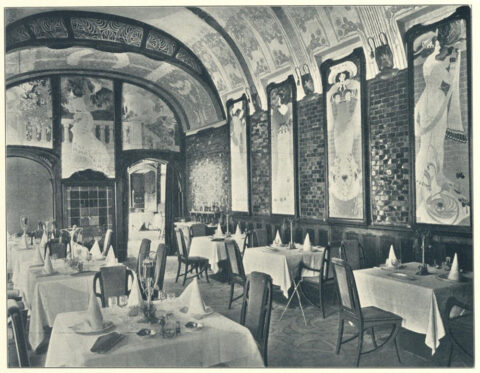
Bruno Möhring, green dining room of the Konss restaurant, first floor of 30 rue de Grammont in Paris, 1901, executed by La Maison Moderne, panels by Georges de Feure, Architektonische Monatshefte, VII. Jahrgang 1901, pl. 87, Leipzig/Vienna, Friedrich Wolfrum, 1901, online library of the University of Stuttgart.
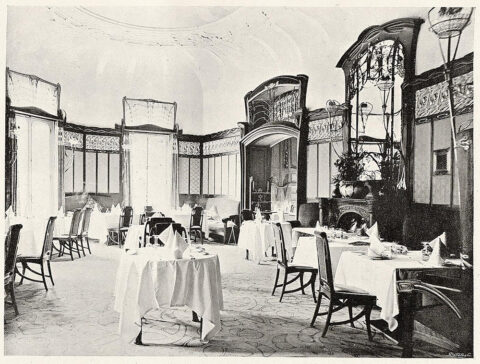
Bruno Möhring, lilac dining room of the Konss restaurant, on the first floor of 30 rue de Grammont in Paris, 1901, executed by La Maison Moderne, L’Art Décoratif, November 1901, article by G. M. Jacques (Julius Meier-Graefe). Online library of the University of Heidelberg.
La Maison Moderne’s operating model is very well thought out, reflecting its director’s careful consideration and innovative abilities. Aware of the behavior of French collectors, who treat art objects in the same way as paintings or sculptures, Meier-Graefe proposed an organization inspired by the Vereinigten Werkstätten für Kunst im Handwerk (United Workshops for Art and Craft) in Munich. While French decorative art remained primarily a commissioned art form, in which artists responded only to specific requests by creating unique models that could not be reproduced, Meier-Graefe proposed the opposite system: objects were no longer commissioned by individuals but were mass-produced by artists and craftsmen. However, production remained in the realm of craftsmanship and did not shift to industry. In the absence of administrative archives from the gallery, no precise figures can be given: the number of pieces produced for the same model must have been relatively small, but there were no unique works. Without even mentioning taste or style, it was first and foremost the way of thinking that the director of La Maison Moderne wanted to change.
There were exceptions to this system. Tapestries by Paul-Élie Ranson, handmade by his wife France Ranson-Rousseau in single copies, were offered for sale at La Maison Moderne[7].
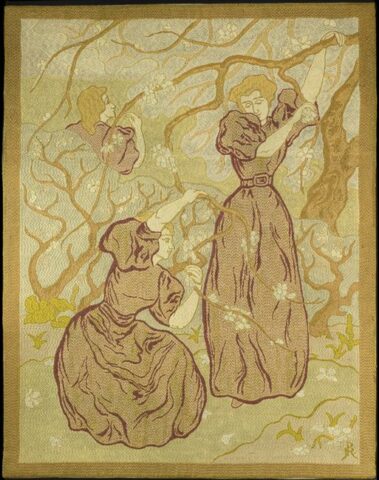
Paul-Élie Ranson, Printemps (Spring), wool tapestry on canvas executed by France Ranson-Rousseau, 1895, height 1.67 m, width 1.32 m, Musée d’Orsay, OAO 1788, rights reserved.
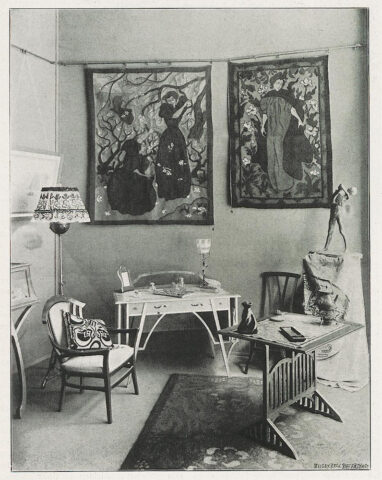
Interior design of La Maison Moderne by Van de Velde, 82 rue des Petits-Champs in Paris. On the wall, two tapestries by Paul-Élie Ranson: Printemps and Femme en rouge, Deutsche Kunst und Dekoration, October 1900, online library of the University of Heidelberg.
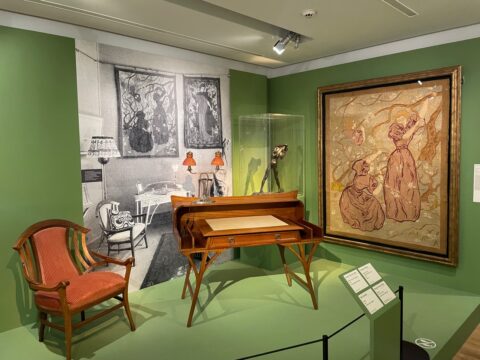
Exhibition Femmes chez les nabis. De fil en aiguille (Women among the Nabis. From thread to needle) at the Pont-Aven Museum (June 22 to November 3, 2024), evoking the room in La Maison Moderne where Ranson’s tapestries were displayed. Photo by Bertrand Mothes.
However, these objects were made before the gallery opened and therefore do not fall under the manufacturing method developed by Meier-Graefe. The principle is simple: artists create designs and grant production rights to the gallery, which is responsible for executing them. The artist receives a portion of the sale price—defined by mutual agreement—for each object sold[8]. The possibility of producing multiple copies also allows Meier-Graefe to sell his objects at a “reasonable price,” in his own words. The “reasonable price” encourages purchases and provides the artist with a comfortable income. Here, “reasonable” should not be confused with “low.” While the prices of the objects sold at La Maison moderne did not reach those seen at Bing, they were nonetheless accessible to fairly well-off individuals, rather than workers or low-paid employees.
The gallery had its own workshops for the production of objects. The only one that can be confirmed with certainty is the leather workshop[9], but it is possible that there were also workshops for cabinetmaking, tapestry, brasswork, jewelry, and watchmaking. The fire arts, which were difficult to set up on a large scale in the heart of the Parisian capital, came from manufacturers associated with La Maison Moderne. The vase Exposition 1900 Paris, from Germany, is a good example. Manufactured by Tonwerke in Kandern, run by Max Laüger, it is not part of the factory’s usual production but was made exclusively for LMM, as evidenced by the gallery mark incised under its base alongside Laüger’s monogram and the factory mark.
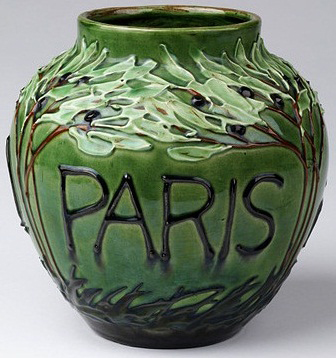
Max Laüger, Tonwerke workshop, Vase Exhibition 1900 Paris, circa 1900, painted earthenware under glaze, produced by La Maison Moderne, height 0.212 m, London, Victoria & Albert Museum. All rights reserved.
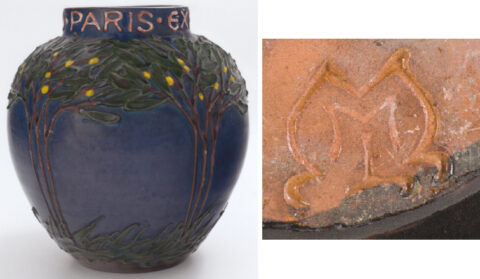
Max Laüger, Tonwerke workshop, Vase Exhibition 1900 Paris, circa 1900, painted earthenware under glaze, height 0.212 m, Paris, Musée d’Orsay. All rights reserved.
This approach to production and sales was complemented by a decisive choice of location for the gallery. 82 Rue des Petit-Champs is located just a few meters from Rue de la Paix, which remains one of the most prestigious shopping districts in Paris. In addition to being central, this location was frequented by a wealthy clientele receptive to artistic innovation. The street has since changed its name to Rue Danielle-Casanova. The former number 82 now corresponds to the current number 26, which is now occupied by a café.
As the director of a commercial establishment, Meier-Graefe naturally used all the means available to him at the time to promote his gallery. Two posters were the cornerstone of his advertising campaign. The first was designed by Maurice Biais. It depicts an elegant lady looking at objects displayed in one of the shop windows designed by Van de Velde, faithfully reproduced.
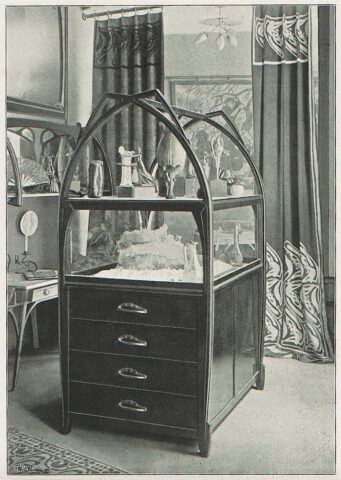
Interior design of La Maison Moderne by Van de Velde, 82 rue des Petits-Champs in Paris, Deutsche Kunst und Dekoration, October 1900, online library of the University of Heidelberg.
Maurice Biais, J. Minot printing house, poster for La Maison Moderne, 1899–1900, color lithograph on paper, height 114 cm, width 0.785 cm, Paris, Bibliothèque nationale de France.
The objects depicted on the poster are all the more easily recognizable as Maurice Biais used photographs that would later be incorporated in the La Maison Moderne catalog. Among other items, the poster features a flamed enamel inkwell by Jakob Rapoport designed by Maurice Dufrène, small bronze sculptures by Georges Minne, a porcelain cat from the Danish manufacturer Bing & Grøndahl, and a lamp by Dufrène.
Maurice Dufrène, electric lamp, patinated bronze, no. 1580-1, height 0.55 m, Documents sur l’Art Industriel au vingtième siècle (catalogue of La Maison Moderne), 1901, Lighting fixtures, p. 9. Private collection.
Interior design of La Maison Moderne by Van de Velde, 82 rue des Petits-Champs in Paris, Deutsche Kunst und Dekoration, October 1900, online library of the University of Heidelberg. To the left of the display case, Le Petit Blessé by Georges Minne.
Georges Minne, Le Petit Blessé, bronze, height 0.25 m, Nationalgalerie, Berlin. All rights reserved. This sculpture is reproduced in Documents sur l’Art Industriel au vingtième siècle (catalogue of La Maison Moderne), 1901, La Sculpture, bronze no. 308-1, p. 21.
The second poster is the work of Manuel Orazi (fig. 5). With a composition and atmosphere completely different from that of Biais, it also features objects that were sold there. We can recognize an inkwell bearing a bronze figure by Alexandre Charpentier on a base designed by Dufrène and made of flamed stoneware by Adrien Dalpayrat, an armchair by Van de Velde, a bronze lamp by Gustave Gurschner, a vase by Dufrène and Dalpayrat, and a monkey figurine by Joseph Mendes da Costa. The distinctive feature of this poster is obviously the large, hieratic female figure that adorns it. This is in fact the famous dancer Cléo de Mérode, who lent her image to the gallery as its muse[10].
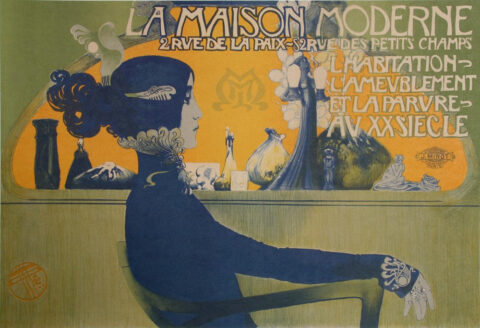
Manuel Orazi, J. Minot printing house, poster for La Maison Moderne, 1901, color lithograph on paper, height 0.83 m, width 1.175 m, Paris, Bibliothèque nationale de France.
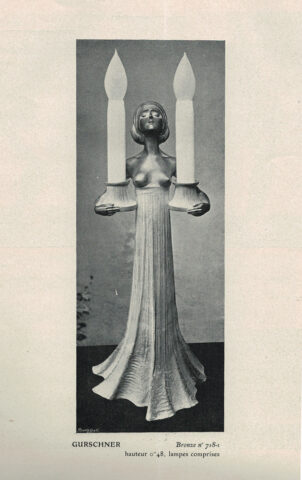
Gustav Gurschner, electric lamp, bronze, no. 718-1, height 0.48 m including lamps, Documents sur l’Art Industriel au vingtième siècle (catalogue of La Maison Moderne), 1901, La Sculpture, p. 13. Private collection.
In addition to these posters, Meier-Graefe also published small leaflets designed to promote his gallery. The invitation card for the opening was designed by Georges Lemmen.
Georges Lemmen, invitation card to the inauguration of La Maison Moderne, 1899, color print on paper, height 0.19 m, width 0.13 m. Private collection.
The composition was also used as an advertisement in the pages of L’Art Décoratif. The two women depicted are not anonymous, as they are actually Mrs. Meier-Graefe and Jenny, a young servant.
The second print was created by Manuel Orazi, who drew inspiration from his own poster for the design.
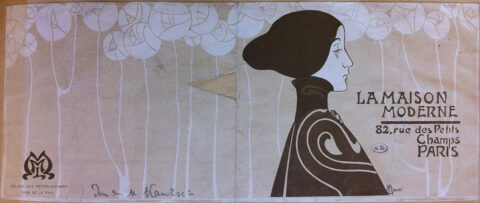
Manuel Orazi, brochure for La Maison Moderne, circa 1903, lithograph on paper, height 0.117 m, width 0.277 m, Paris, Bibliothèque des Arts Décoratifs.
Meier-Graefe also printed discount coupons from the same poster, either for his best customers or to attract new ones. One of his most important advertising tools remained the book Documents sur l’Art Industriel au vingtième siècle (Documents on Industrial Art in the Twentieth Century), published in 1901.
Paul Follot, Cover of Documents sur l’Art Industriel au vingtième siècle, Paris, Édition de La Maison Moderne, 1901, height 0.30 m, width 0.208 m. Private collection.
Presented as a collection of the most beautiful works of art of the period, it is in fact the gallery’s commercial catalog, containing many references to objects from La Maison Moderne.
Félix Aubert, Maison Georges Robert, Iris fan no. 54-V and its box, c. 1900, polychrome silk lace, horn, emerald, pearl, height 0.28 m, diameter 0.48 m, Caen, Musée de Normandie. All rights reserved. This fan is reproduced in Documents sur l’Art Industriel au vingtième siècle, 1901, La Dentelle, p. 4.
In addition to these independent advertisements, Meier-Graefe filled the magazines he edited with constant references to his gallery and collaborating artists. He also participated in events such as the International Exhibition of Modern Decorative Arts in Turin in 1902, for which he published a postcard featuring real objects from his shop.
Maurice Biais, Société Éditrice Cartoline, Main hall of “La Maison Moderne” at the Turin Exhibition, 1902, vintage postcard, Miami, The Wolfsonian-Florida International University. All rights reserved.
However, despite all its innovative ideas and pioneering role at the beginning of the 20th century, the gallery was a failure. Its director sold it in 1904 to Delrue et Cie, who took charge of liquidating the stock[12]. The climate of xenophobia in Paris was detrimental to both Meier-Graefe and Bing, as French collectors resented a German coming to lecture them on what their taste should be[13]. Furthermore, although its structure was ingenious, production costs remained too high for the gallery to remain viable.
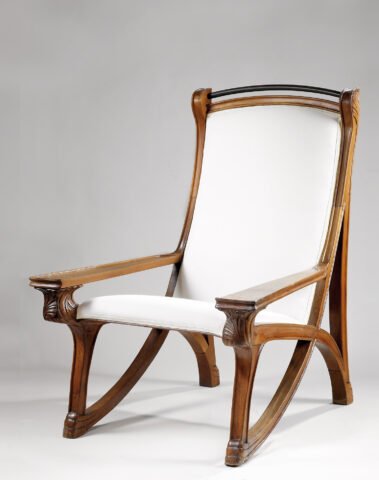
Abel Landry, armchair n° 43, produced by La Maison Moderne, mahogany, modern upholstery, height 1.04 m, width 0.75 m, depth 0.90 m, Zéhil gallery, Monaco. Photo: Zéhil gallery. This armchair is reproduced in Documents sur l’Art Industriel au vingtième siècle, 1901, Furniture and decoration, p. 16.
This gallery, led by an innovative director with impeccable taste, never managed to find its audience, but remains the only real attempt in 1900 to create an alliance between art, industry, and commerce.
Bertrand Mothes
Translation: Alan Bryden
Notes
[1] Roger CARDON, Georges Lemmen (1865-1916), Antwerp, Petraco-Pandora, 1990, p. 449.
[2] Cat. Exp Georges Lemmen 1865-1916, Brussels, Crédit Communal, Ghent, Snoeck-Ducaju & Zoon, Antwerp, Pandora, 1997, p. 58.
[3] R. [pseudonym Julius MEIER-GRAEFE], “Chronique de l’art décoratif, La ‘Maison Moderne’,” L’Art Décoratif, September 1899, no. 12, p. 277.
[4] It is likely that the doubling of the final “s” in the restaurant owner’s name was intended to make it sound German and avoid confusion with a French word that was a little too similar.
[5] In 1900, Möhring had already built the Restaurant allemand at the Universal Exhibition in Paris, which was a great success.
[6] G. M. JACQUES, “Un restaurant allemand à Paris,” L’Art décoratif, November 1901, no. 38, pp. 54-60.
[7] Documents sur l’Art Industriel au vingtième siècle. Photographic reproductions of the main works of the contributors to La Maison Moderne. Commented by R. [Raoul] AUBRY, H. [Henri] FRANTZ, G.-M. JACQUES [pseudonym Julius MEIER-GRAEFE], G. [Gustave] KAHN, J. [Julius] MEIER-GRAEFE, Gabriel MOUREY, Y. [Yvanhoé] RAMBOSSON, E. [Émile] SEDEYN, Gustave SOULIER, G. [Georges] BANS, with nine additional illustrations by Félix VALLOTTON Les Métiers d’Art. Paris, Édition de La Maison Moderne, 1901, L’Ameublement, p. 36.
[8] R., op. cit. in note 3, p. 277.
[9] Documents sur l’Art Industriel au vingtième siècle, op. cit. in note 7, La Maroquinerie, p. II.
[10] Alexandre Charpentier (1856-1909).Naturalisme et Art Nouveau, exhibition catalog, Paris, Musée d’Orsay, N. Chaudun, 2007, p. 126.
[11] Roger CARDON, Georges Lemmen (1865-1916), Antwerp, Petraco-Pandora, 1990, p. 449.
[12] Advertisement for La Maison Moderne, Delrue et Cie, Fermes et Châteaux, November 1905, no. 3, p. IX.
[13] Nancy J. TROY, Modernism and the Decorative Arts in France: Art Nouveau to Le Corbusier, New Haven and London, Yale University Press, 1991, p. 47.
List of artists mentioned in the Documents sur l’Art Industriel au XXème siècle (Documents on Industrial Art in the Twentieth Century)
Félix AUBERT
Henri BANS
Gyula BETLEN
Maurice BIAIS
Alexandre BIGOT
[manufacture] BING & GROENDAHLSofie BURGER HARTMANN
Alexandre CHARPENTIER
Cristallerie de Pantin
Jens DAHL-JENSEN
Pierre Adrien DALPAYRAT
Eugène DELATRE
Maurice DUFRÈNE
Paul FOLLOT
Édouard FORTINY
Maurin GAUTHIER
Gustave GURSCHNER
Bernhard HOETGER
Henry JOLLY
Emil KIEMLEN
G. KISS
Abel LANDRY
Georges LEMMEN
Hans Stoltenberg LERCHE
Clément MÈRE
Charles MILÈS
Georges MINNE
Koloman MOSER
Gabriel OLIVIER
Manuel ORAZI
Blanche ORY-ROBIN
Paul-Élie RANSON
Jakab RAPOPORT
Auguste RODIN
SAINT-YVES SCHLESINGER
Elisabeth SCHMIDT-PECHT
Tony SELMERSHEIM
Louis Comfort TIFFANY
Henry VAN DE VELDE
Heinrich VOGLER
Félix VOULOT
François WALDRAFF
To quote this article:
Bertrand MOTHES, “La Maison Moderne de Julius Meier-Graefe” in Catherine Méneux, Emmanuel Pernoud, and Pierre Wat (eds.), Proceedings of the Study Day Actualité de la recherche en XIXesiècle, Master 1, Years 2012 and 2013, Paris, HiCSA website, published online in January 2014.