

Vuitton fan of Guimard
This article is the translation of an article we published in 2014, which remains of current interest by illustrating the connections between Hector Guimard and Gaston-Louis Vuitton.
The press’s silence regarding Guimard in the 1920s contributed to the general public’s lack of knowledge about this late period in the architect’s career.
Except for a few rare examples of buildings that received significant media coverage, such as the model town hall in the Village Français, built for the 1925 International Exhibition of Decorative Arts, Guimard was then considered more of an architect of the past. Worse still, he was regularly cited as one of the leading representatives of Art Nouveau, that awful Modern Style that was all the rage around 1900 and whose dying legacy was often contested by journalists with supposedly modern tastes. In this context, which was not favorable to Art Nouveau, Gaston-Louis Vuitton’s tribute to Guimard on an evening in October 1932 was particularly unexpected and courageous. Indeed, reporting on a meeting of the Les amis des Champs-Élysées, the monthly newsletter published by this committee reported in detail a surprising scene.
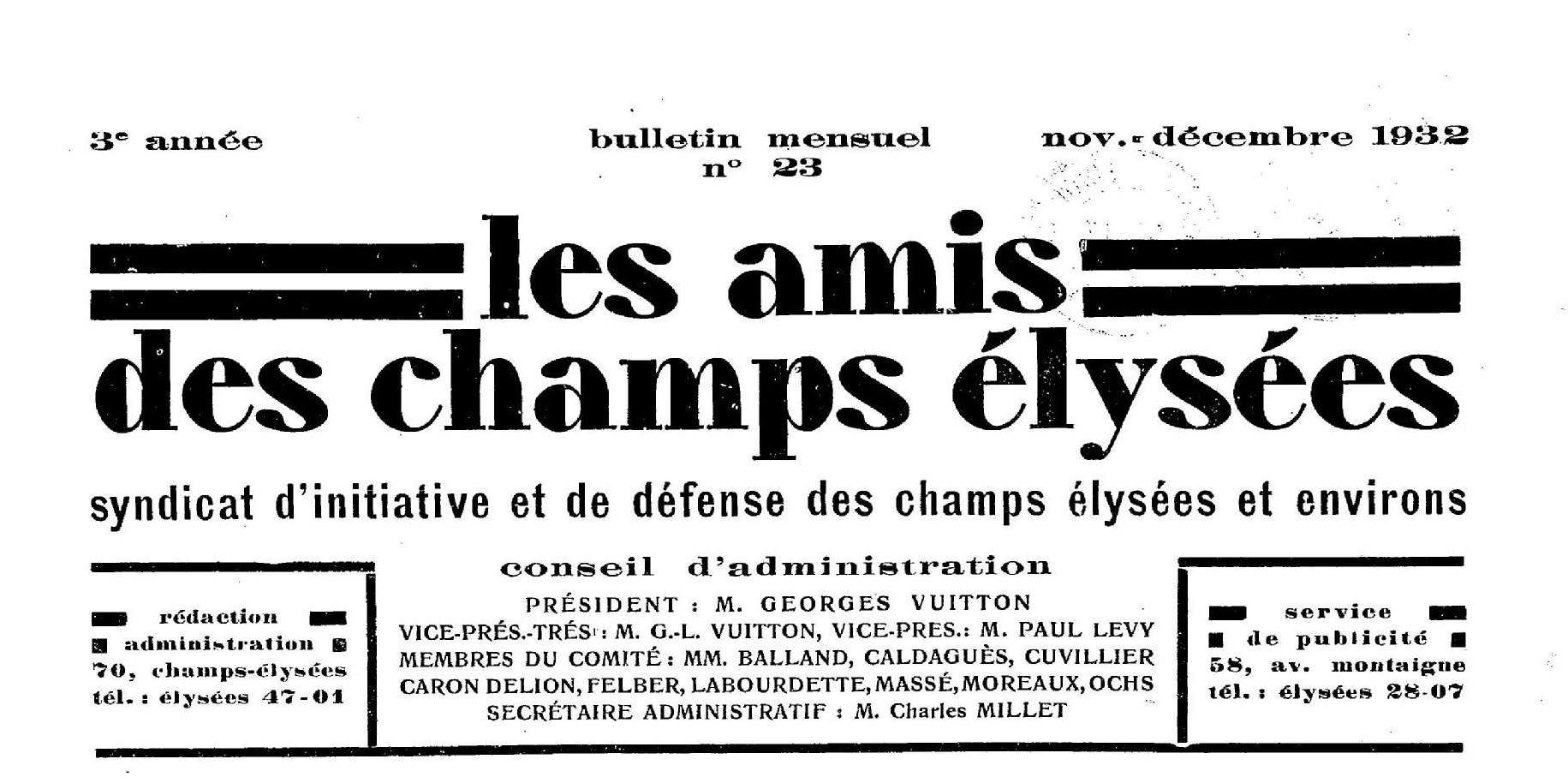
This monthly newsletter, published from 1930 to 1939, reflects the association’s goals: the beautification and development of the neighborhood. As the magazine’s masthead shows, the Vuitton family, who presumably founded it, had a definite influence, since Georges Vuitton (son of Louis Vuitton, founder of this dynasty of trunk makers) was its president and his own son, Gaston-Louis Vuitton, was both vice-president and treasurer. The Vuitton family’s interest in the Champs-Élysées is obviously linked to the construction of the brand’s headquarters by architect Louis Bigaux at 70 Avenue des Champs-Élysées in 1912 in a sober and elegant Art Nouveau style. They thus contributed to the transformation of the Champs-Élysées, which, from a bourgeois avenue, became a location for grand hotels and banks, as well as major French and international brands, from 1898 onwards.
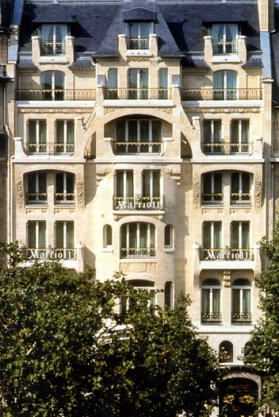
The « Vuitton Building », 70 avenue des Champs-Élysées, built 1912 byLouis Bigaux.
We learn that Guimard was invited to this dinner party by his friend Louis Bigaux. We should also note the presence of another old acquaintance of the architect: Frantz Jourdain, who presided over this lunch on October 21 at the Langer restaurant. The passionate debates focused mainly on the architecture of the new buildings constructed along the famous avenue, and in particular on the new building at 116 bis, recently built by Jean Desbouis. Supported by some, criticized by others, this commercial building was shocking due to its accordion-style curtain wall and its colors (dark blue granite on the first two floors, yellow travertine under the bow windows on the upper floors, chrome handrails), which contrasted sharply with the stone buildings in the neighborhood. Present at the lunch, Desbouis briefly explains his architectural choices.
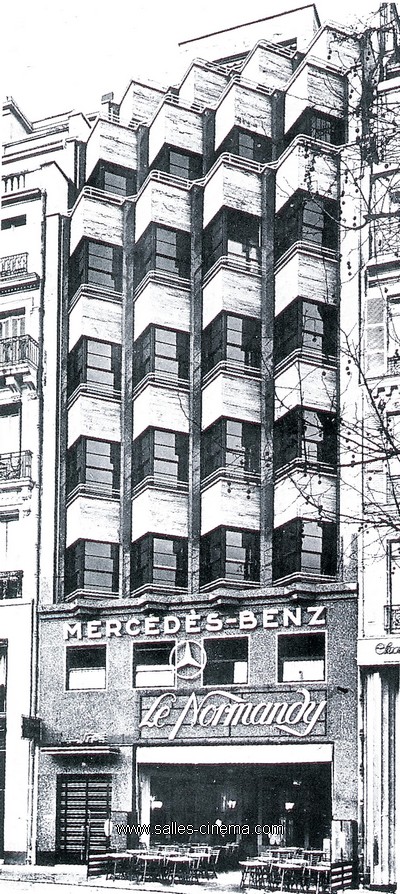
116 bis avenue des Champs-Élysées, built in 1930-1932 by Jean Desbouis.
The meeting was already well underway when Gaston-Louis Vuitton took the floor and addressed Guimard directly, saying:
I think we’ve pretty much exhausted the debate, because whatever arguments everyone puts forward, our minds are pretty much made up. We either like it or we don’t, and we’re not easily persuaded.
Thirty-four years ago, a building was constructed on Rue Lafontaine that was described at the time as appalling: Le Castel Béranger. I was 18 at the time, and I fought for that building. I had a boss who gave me a hundred sous. I saved up what I needed, went to see the bookseller, who asked me for a hundred francs for the book called “Le Castel Béranger”[1]. And one of my greatest joys in my youth was bringing home “Le Castel Béranger,” which everyone was railing against at the time.
The author of Le Castel Béranger, who is also the designer of the subway gates that are sometimes mentioned, is Maître Guimard, who is here today, one of our greatest architects, a pioneer, one of those who helped the modern movement and whose efforts and work have not been fully recognized. I am happy to express my feelings of admiration and affection for him.
In a few years’ time, Mr. Desbouis will no doubt have the pleasure of similar repairs.
Deeply touched by the words Mr. Vuitton has just addressed to him, Mr. Guimard was keen to thank him:
If I had known that by accepting the kind invitation of my friend Bigaux, the designer of the first modern building on the Champs-Élysées, which his client Mr. Vuitton had the merit of having it built, I would hear this admirer of Castel Béranger, I would have hesitated.
Taking you back to the now distant era of this construction, which was considered so revolutionary at the time, and for which you have come today to express your appreciation, I believed that my friend Vuitton, a modern artist, wanted the friends of the Champs-Élysées to recognize that the evolution of architecture must follow that of life and prosperity in this beautiful neighborhood. Those who described the Castel Béranger as an eyesore were, I believe, as wrong as its most sincere admirers. I thought, even then, that it was ahead of its time, and I simply wanted, very simply, I assure you, to give artistic expression to what I believed was logical and innovative, so that the construction of an apartment building would not be a barracks for all to see. I gave it the nick name “Castel” because it was a collective residence.
Today, I have just heard the facade of a building that an engineer, Mr. Desbouis, has just built on the Avenue des Champs-Elysées being described as horrible, even though it was designed to be logical and practical (…). You have just been shown this work by Mr. Desbouis, an engineer, but not an architect; this explains the criticism of those who dislike this facade, which I admit should have been given a more artistic touch to appease those who are shocked by the colored materials used.
There is also a question of getting use to the concept. What was said about the Eiffel Tower in 1889? It is, after all, a 300-meter monument that is less ugly than the first American skyscrapers.
I plead the case of my fellow engineer by asking you to wait a little before passing judgment, which time will confirm (…).”
Nothing obliged Gaston-Louis Vuitton to pay such tribute to Guimard, and we feel that he waited a long time for the right moment to reveal this childhood memory that seemed particularly dear to him.
But what perhaps strikes us as most important is the visionary spirit with which Vuitton delivers his speech: he considers Guimard to be one of the greatest architects of his time and a precursor of the modern movement, while expressing a particularly lucid regret that his work has not been sufficiently recognized. He draws a parallel between Desbouis’ building and the Castel Béranger to suggest to his audience that posterity will do justice to both, which captured the modernity of their time.
It is easy to imagine Guimard’s surprise, even emotion, upon hearing these words. But the interest in this article lies above all in his response: it sheds new light on his view of the beginning of his career. The architect did not regret the construction of Castel Béranger, but with the wisdom of age, he was able to accept its limitations. He had, in fact, long since renounced the forms of Art Nouveau, but the words he used in his speech leave no doubt as to his state of mind, even in the early 1930s: “expression of art,” “feeling of art,” “logic,” “practice”… these are the founding and eternal principles of Guimard’s work, which remains firmly rooted in his trilogy of Logic, Harmony, and Feeling.
His statement, “Those who described Castel Béranger as an eyesore were, I think, as wrong as its most sincere admirers,” may confuse contemporary readers. In our opinion, he is probably expressing the feeling of not having been understood at the time or of having been admired for superficial reasons of formal virtuosity (the very same reasons that appeal to us again today). He undoubtedly feared that posterity would never take him seriously, while architects such as Sauvage, who quickly abandoned Sentiment, would be more readily recognized.
Guimard does not merely evoke his own past but also lends his support to Desbouis. Having experienced opposition to the installation of some of his metro entrances and argued against the obligation to build in accordance with the architectural context, he could not help but feel solidarity with Desbouis in the face of those who would tolerate his architecture but would gladly confine it elsewhere, away from the Champs-Elysées.
In doing so, he nevertheless qualifies his remarks by saying that this façade should undoubtedly have been given a “sense of art,” i.e., more elaborate decoration. With these words, Guimard discreetly revives the corporatist opposition between architects and civil engineers that has existed since the 19th century. As the heir to Viollet-le-Duc, he had always believed that it was the duty of the former to make use of the technical advances brought about by the latter, but that it was solely up to architects, through their artistic talent, to elevate architecture above simple functional construction. By twice reminding Desbouis in his reply that he is an engineer and even adding that he “is not an architect,” Guimard willingly grants him the patents of Logic and Harmony, but denies him that of Sentiment. Half polite, half perfidious, he concludes by saying: “I plead the case of my fellow engineer (…). “. However, by recalling the scandal caused by the Eiffel Tower, Guimard implicitly acknowledges that engineers have, more often than architects, shown audacity to the point of provoking rejection, which time and familiarity have taken care of appeasing. The fact that he mentions the first American skyscrapers, also designed by engineer-architects, in the same sentence reminds us that Guimard had close ties with the United States and that a few years later he would leave France to settle there.
Olivier Pons,
with contributions from Frédéric Descouturelle
Translation: Alan Bryden
[1] This is the promotional album Le Castel Béranger – L’Art dans l’Habitation Moderne (Castel Béranger – Art in Modern Living), containing 65 illustrated plates of the interior and exterior of the Castel.