
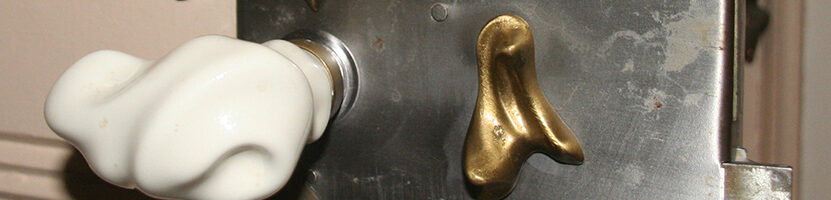
Hector Guimard’s hardware fittings — Part One: the locks and doorknobs of Castel Béranger
All photos belonging to the authors or to the Cercle Guimard Archives and Documentation Center must be approved by the Cercle Guimard in the event of a publication project, regardless of the medium
After compiling an inventory of the hardware fittings at the hôtel Mezzara and requesting an auction house that a new misattribution to Hector Guimard [1] be removed, we wanted to summarize what we know about the hardware fittings created by the architect. Our knowledge of this subject has progressed in recent years, but we may modify this article in the future. Despite the uncertainties that remain, we have chosen to work chronologically and by manufacturer. This study will eventually be included in a book devoted to Guimard’s fixed decorations.
During his early period of architectural creation, i.e., before Castel Béranger (1895-1898), Guimard does not seem to have created any specific hardware designs, unlike what he had done for his ceramic decorations produced by Muller & Cie[2]. He therefore used those available in the manufacturers’ extensive catalogs, simply avoiding historical styles.
The first “Guimard” models therefore appeared with Castel Béranger, his first modernist building, for which he insisted on designing every detail, taking on both an artistic and industrial challenge. In fact, apart from the hinges on the doors and cupboards, none of the hardware in Castel Béranger came from a pre-existing commercial catalog designed by an anonymous industrial artist. As with the other fixed decorative items (ceramics, fireplaces, moldings, wallpaper, Lincrusta-Walton, etc.), the number of apartments to be furnished (36) was sufficient to justify the financial investment in creating new designs.
As evidenced by the list of contractors provided by Guimard in the introduction to the Castel Béranger portfolio[3], the company chosen was the prestigious Maison Fontaine, which, in its current communications, claims to be the oldest artistic locksmith’s in Europe. It was founded in 1740 by Mr. Lavollée at 269 Rue Saint-Honoré in Paris, then taken over in 1842 or 1846 by François and Joseph Fontaine, moved in 1854 to 13 Rue Molière, then in 1866 to 181 Rue Saint-Honoré in Paris, where it is still located today. Through successive ownership changes and shareholder changes, it has had various names: Fontaine et Quintart in 1889, then H. E. et L. Fontaine in 1891, Maison Fontaine H. E. & L. Fontaine in 1895, and finally Maison H. et L. Fontaine frères et Vaillant in 1899[4]. When the Castel Béranger portfolio was printed in 1898, Guimard still referred to the company as “H. et L. Fontaine.”

Hector Guimard, L’Art dans l’Habitation moderne/Le Castel Béranger (portfolio of Castel Béranger), table of plates (detail), Librairie Rouam, 1898. Private collection.
Two years later, on the occasion of the World Exhibition in Paris, in August 1900, Fontaine published an extract from its catalog featuring numerous modern designs.
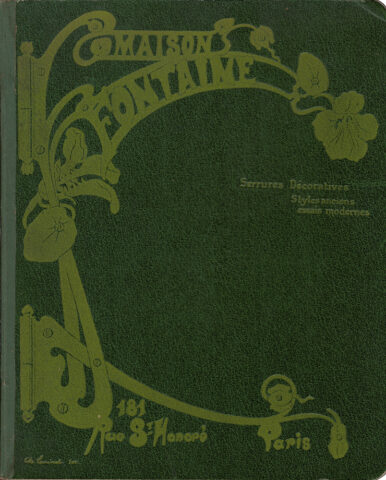
Cover of the Fontaine catalog published in August 1900. “Maison Fontaine/Decorative locks/Antique styles/Modern designs/181/Rue St-Honoré/Paris.” Private collection.
The first page gives the name of the company, which was then “Fontaine Frères & Vaillant,” and mentions the presence of the factory and modeling workshop in Boulogne-sur-Seine.
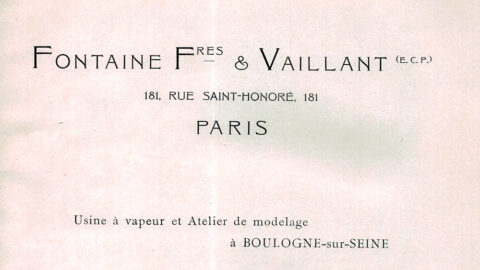
First page of the Fontaine catalogue (detail) published in August 1900. Private collection
On an invoice from 1912, the company name was simplified to “Fontaine & Vaillant.” For convenience, we will refer to the company as Fontaine in the rest of this article.
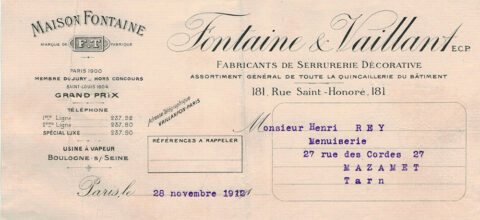
Letter head of an invoice by the Maison Fontaine, dated 28 November 1912 Private collection
A detail of this header shows the “F.T” mark constantly used by the Fontaine company, which had been acquired from the Fromentin company when its business was bought out.
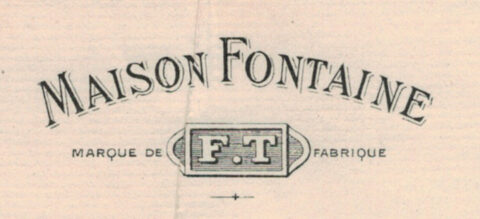
Detail of a header of an invoice by Maison Fontaine, dated 28 November 1912. Private collection
On commercially available parts, the “F.T” mark appears in the form of a plate similar to that on the header, or as a stamp.
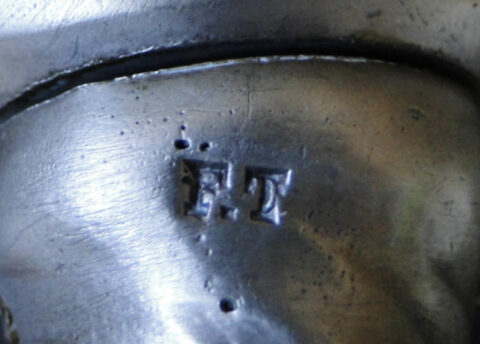
Stamp « F.T » on the handle of an Eriksson espagnolette edited by Fontaine Private collection
At the time of Castel Béranger, although the serial production of models for this building implicitly foreshadowed their reuse by Guimard for other contemporary buildings[5], the architect did not envisage publishing them in a catalog. He made an exception for the surface-mounted lock model that appears in the August 1900 extract from the Fontaine catalog.
This lock appears on plate 585 alongside other modern models. Five of them are by Alexandre Charpentier, who applied his talent as a medalist to rectangular surfaces. Three others were designed by Christian Eriksson, including two double lock models. One of them, entitled La Curiosité (No. 214), features a highly detailed, figurative, even symbolist decoration.

Plate 585 from the Fontaine catalog excerpt, August 1900. Private collection.
In contrast, Eriksson’s lock No. 244 is much simpler, as four mounting brackets are arranged around standard parallelepipedal steel safe and strike plate models.
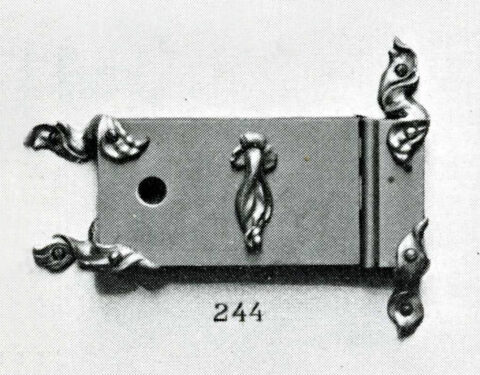
Christian Eriksson, lock n° 244, pl. 585 extract of the Fontaine catalogue, August 1900. Private collection
These spark-shaped brackets bear a strong resemblance to those created by Guimard for a similar lock model, listed in the Fontaine catalog with a later number (No. 276). Guimard’s, which are simpler, appear to be made of a malleable material that was applied and twisted by hand onto the lock and woodwork[6]. As for the door cover, it gives the impression of hanging from its fixing point.
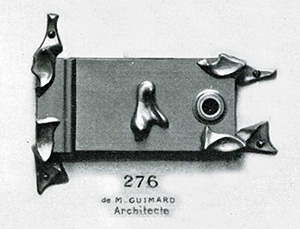
Hector Guimard, lock n° 276, pl. 585 extract from the Fontaine catalogue, August 1900. Private collection.
In the Castel Béranger portfolio, Guimard presents a colored version of his lock. The box and strike plate appear bordered by a gold trim that matches the color of the brass mounting brackets[7].
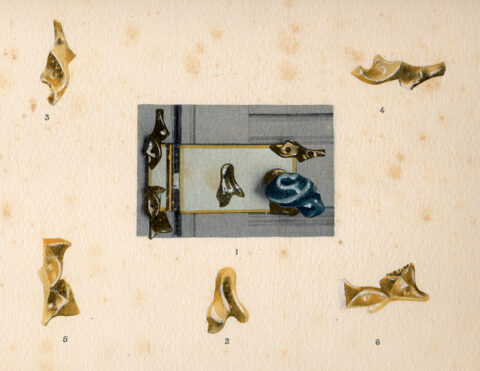
Hector Guimard, L’Art dans l’Habitation moderne/Le Castel Béranger (portfolio of Castel Béranger), pl. 56 (détail), Librairie Rouam, 1898. Private collection
These brackets appear to hold the lock in place, but in reality, they serve little more than a decorative purpose, as the safe and strike plate are actually secured to the door frame by sturdy screws that are not visible.
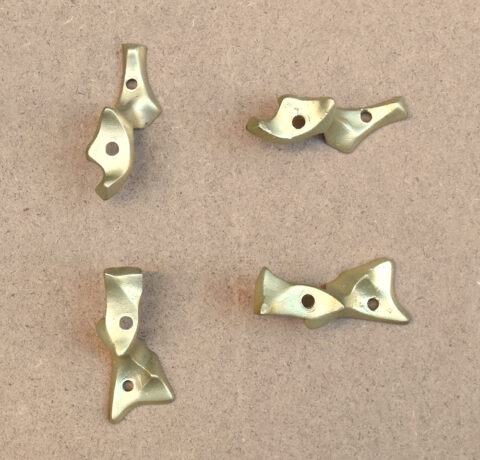
Stripped mounting brackets from Guimard lock no. 276, brass. Private Collection
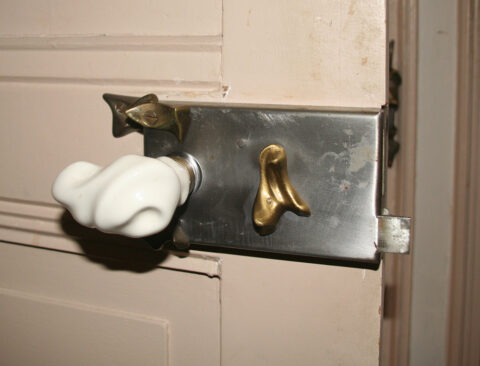
Guimard lock no. 276 with mounting brackets and entrance cover at Castel Béranger. The porcelain doorknob is a modern replica. Photo by Ondine Schneider.
For these locks at Castel Béranger, Guimard created a porcelain knob design in two colors: white and blue.
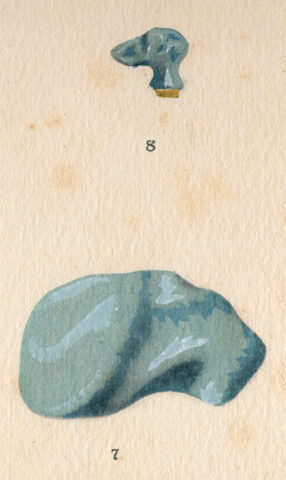
Hector Guimard, L’Art dans l’Habitation moderne/Le Castel Béranger (portfolio du Castel Béranger), pl. 56 (detail), Librairie Rouam, 1898. Private collection.
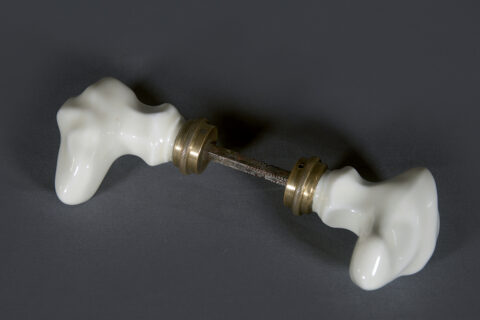
Two Guimard/Sauzin doorknobs, marked “S” and “Z” under the ferrule.
Private collection. Photo F. D.
These buttons were produced by Sauzin[8] but were not sold outside of Guimard’s orders. Sauzin was a fairly old company at the time, as two patents were filed in 1868 for a porcelain tap and a ceramic kiln, at two different addresses in the 10th arrondissement of Paris. The production plant already existed in Montreuil-sous-Bois in 1875, before going bankrupt in 1876. Twenty years later, in 1896—at the time of the construction of the Castel Béranger—Charles Sauzin filed a patent for a double knob with a claw and locking screw, which could not be removed. The company headquarters had then moved to 16 rue de la Folie-Méricourt in the 11th arrondissement. Louis Masson succeeded Charles Sauzin between 1899 and 1903, and later, the company came under the management of O. Vandenbossche, attested from 1921 onwards.
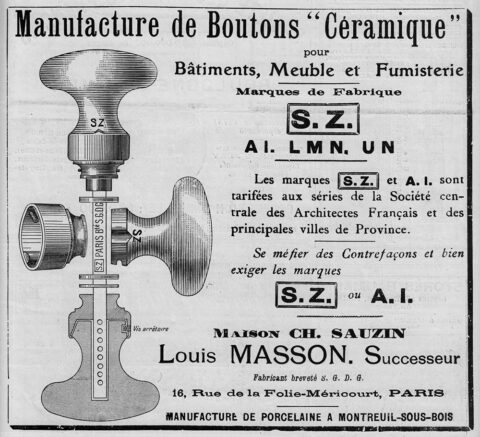
Ad for the Maison Sauzin published in La Construction Moderne 9 February 1913. Private collection.
These buttons (associated with Fontaine locks no. 276) can be found on two buildings chronologically close to Castel Béranger: Castel Henriette and the Hotel Roy. But unlike most of the other hardware items created for Castel Béranger, Guimard used them until World War I, even though they were gradually relegated from reception areas in favor of new brass door handle models. Their more innocuous form than his other creations from this early Art Nouveau period allowed them to blend seamlessly into his stylistic developments.
Guimard also had a brass (or bronze) version made for use at the Coilliot house in Lille. Due to their entirely metallic nature, it is possible that these knobs were produced by the Fontaine company.
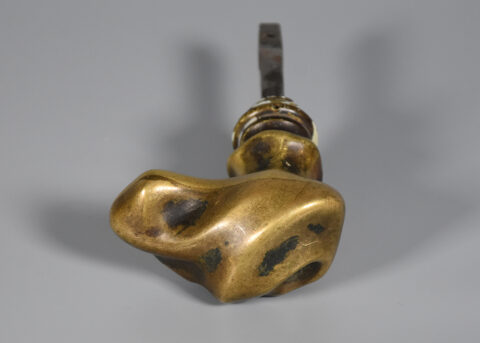
Brass (or bronze) doorknob from the Coilliot company in Lille (1898-1900). Coll. Hector Guimard Diffusion. Photo F. D.
A few years later, when fitting out buildings on Rue Gros, Rue La Fontaine, and Rue Agar, as well as the Hôtel Mezzara and then the Villa Hemsy in Saint-Cloud, Guimard wanted to market this porcelain knob. He therefore entrusted its production to another company: Paquet in Grenoble. Founded in 1872, we know about its production thanks to a catalog dated 1912, which reveals that the company specialized in metal items for the building industry. It offered only five models of doorknobs, only three of which were made of porcelain, which suggests that it probably sourced its porcelain from a subcontractor. Their assembly used the “LP mount” (probably the initials of the company’s founder), which was reputed to be indestructible. The company continued to operate at least until the 1930s.
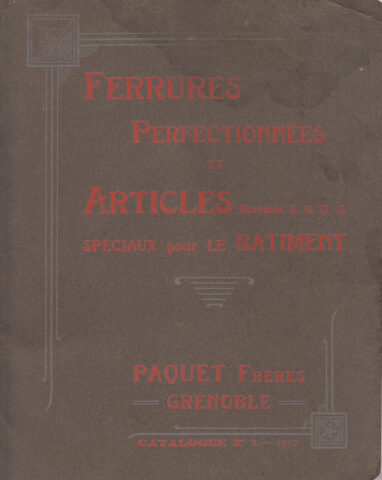
Catalogue n° 3 of the Maison Paquet in 1912, cover. Private collection.
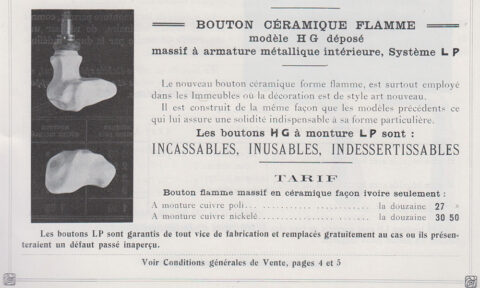
Catalogue n° 3 of the Maison Paquet in 1912, p. 63. Private collection.
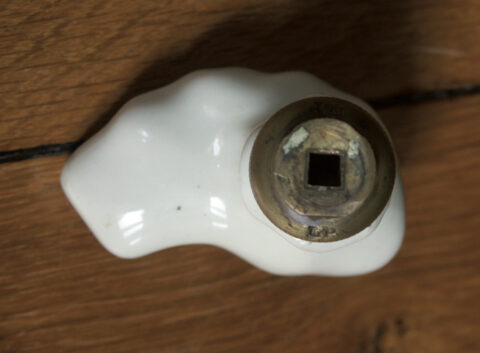
Guimard door knob /Paquet, marque « LP » on the ferrule, hôtel Mezzara. Photo F. D.
At Guimard’s request, Paquet undertook in letters dated February 22 and April 11, 1911, to refer to his knob as the “Modèle Style Nouveau H. G.”[9]. However, although the wording used in the published catalog retained the architect’s initials, the reference to “Style Nouveau” was removed. Paquet only offered it in ivory white and gave it the commercial name “flamed ceramic knob.” While this descriptive name is certainly satisfactory, the true explanation for the dynamic shape of this doorknob was not revealed until much later. In the obituary he wrote for him, published in the first issue of the magazine L’Architecture d’aujourd’hui in May-June 1945, Adolphe Dervaux, a colleague and friend of Guimard, wrote:
“So what was the doorknob supposed to be, if not an easy lever that fits in the hand? He would take a little soft clay and press his fingers into it: voilà, the doorknob! “
This experiment can easily be repeated: taking a lump of modeling clay in the left hand gives the general shape of the knob, before passing it to the right hand to imprint the thumb and middle finger. Despite its asymmetrical shape, this knob can thus be easily manipulated with both hands and used on either side of the door. With this simple hardware accessory, Guimard radically broke with tradition in the field of decorative art. Its regular presence on the art market [10] has made it one of Guimard’s best-known creations, and copies continue to be sold.
Around 1900, and undoubtedly also on the occasion of the World’s Exhibition, the Fontaine company, in addition to the catalog excerpt mentioned above, produced a portfolio, a prestigious publication bringing together some of the most beautiful models that had been the subject of collaboration.
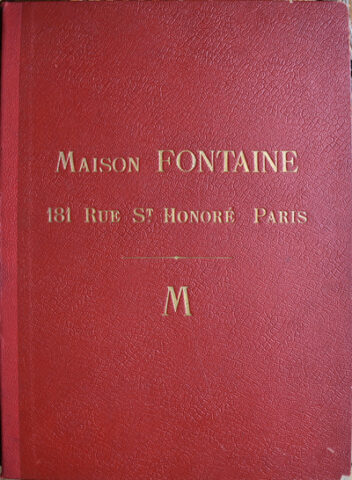
Portfolio Fontaine M, s.d. (c. 1900). Musée Fontaine. Photo F. D.
This time, the portfolio included several Guimard designs created for Castel Béranger, including the porcelain knobs for the locks, but without mentioning the name of their manufacturer.
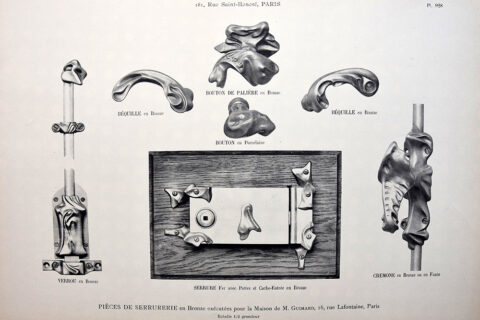
Portfolio plate Fontaine M, undated (c. 1900). Fontaine Museum. Photo F. D.
The other Guimard models featured in this illustration will be the subject of a future article.
Frédéric Descouturelle
in collaboration with Olivier Pons
We express our thanks to Christine Soulier, in charge of decorative hardware at the Maison Fontaine.
Notes
[1] See our article on Eriksson hardware.
[2] Many of the ceramic decorations in Guimard’s early villas are featured in the Muller & Cie catalog (see our article from 2020 on this subject). However, as this catalog dates from 1904, we do not know precisely when Guimard actually made his designs available to the public.
[3] Hector Guimard, L’Art dans l’Habitation moderne/Le Castel Béranger, Librairie Rouam, 1898.
[4] See the Musée d’Orsay entry on the Maison Fontaine. The initials H, E, and L refer to Henri, Émile, and Lucien Fontaine, sons of Joseph Fontaine.
[5] With the notable exception of the Villa Berthe in Le Vésinet.
[6] It would be risky to claim that Guimard simplified Eriksson’s door handles and door covers or that, on the contrary, Eriksson “enriched” Guimard’s. As we noted in our article on Eriksson’s hardware, the two artists followed parallel ideas that emphasized manual modeling; Eriksson, faithful to his training as a sculptor, remained more figurative, while Guimard was more abstract.
[7] The Castel Béranger portfolio and the Fontaine portfolio list them as being made of bronze.
[8] See Descouturelle, Frédéric; Pons, Olivier, La Céramique et la lave émaillée d’Hector Guimard, pp. 82-83, Éditions du Cercle Guimard, 2022.
[9] Adeline Oppenheim Guimard papers. New York Public Library.
[10] In the 1980s and 1990s, the prospect of easy money led the tenants of Castel Béranger to strip the building of all its doorknobs. All those currently in place are copies made around 2000 during restoration work.
Bibliography
Hector Guimard, L’Art dans l’Habitation moderne/Le Castel Béranger (portfolio of Castel Béranger), Librairie Rouam, 1898.
Fontaine catalog, “Maison Fontaine/Decorative locks/Antique styles/Modern designs/181/Rue St-Honoré/Paris,” August 1900.
Fontaine portfolio, “Maison Fontaine/181/Rue St-Honoré Paris/M,” undated (c. 1900).
Paquet catalog no. 3, 1912.
La Construction Moderne, February 9, 1913.
Dervaux, Adolphe, “Hector Guimard animateur,” L’Architecture d’aujourd’hui, no. 1, May-June 1945, p. 28.
Thiébaut, Philippe, collective work edited by, Guimard, catalog of the exhibition “Guimard” in Paris from April 13, 1992, to July 26, 1992, and in Lyon from September 23, 1992, to January 3, 1993, Paris, Musée d’Orsay/RMN, 1992.
Descouturelle, Frédéric; Pons Olivier, La Céramique et la Lave émaillée d’Hector Guimard, Éditions du Cercle Guimard, 2022.
Translation : Alan Bryden