
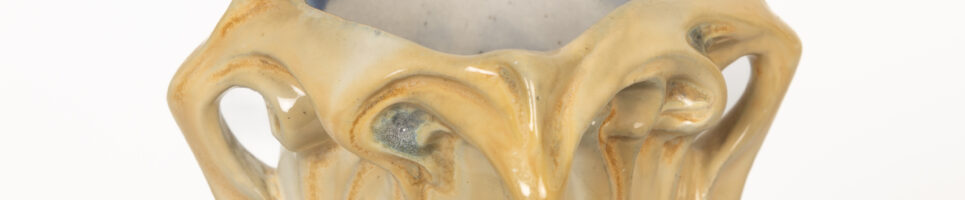
Acquisition of a previously unseen copy of a Hector Guimard’s Cerny vase
2 April, 2025
As the deadline for submitting bids for a long-term lease on the Hotel Mezzara was rapidly approaching we continued our efforts, with regard to enriching our collections. Following the purchase of a section of a candelabra and its glass cover from the metro by Le Cercle Guimard[1], it is now the turn of our partner Fabien Choné to acquire, this time at auction[2], a new work by Guimard: a period copy of the Cerny vase.
Cerny is one of three designs created by Guimard for the Manufacture de Sèvres around 1900[3]. Production spanned a decade, and our research in the institution’s archives has enabled us to estimate that no more than fifteen copies of the vase were manufactured by Sèvres during this period[4].
The appearance of an original copy of Cerny’s vase is therefore a minor event in itself, allowing us to identify and document the tenth copy to have survived to the present day. Made of glazed stoneware, it is characterized by a mustard yellow glaze enhanced by discreet blue crystallizations nestled in the hollows of the neck and highlighting its base, a color scheme that brings it closer to the examples preserved by the museums of Sèvres and Limoges.
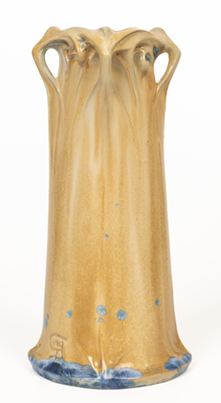
Cerny vase auctioned on 13 March 2025. Photo étude Metayer-Mermoz.
At its base is the traditional HG monogram—which adorns all of Guimard’s Sèvres productions—as well as the Manufacture’s own marks on the bottom: the triangular S 1904 stamp, which allows it to be dated, and the rectangular SÈVRES stamp.
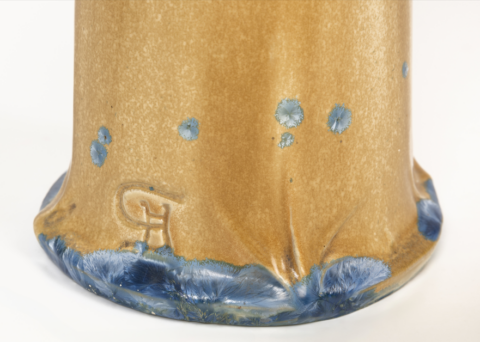
HG monogram engraved at the base of the vase. Photo étude Metayer-Mermoz.
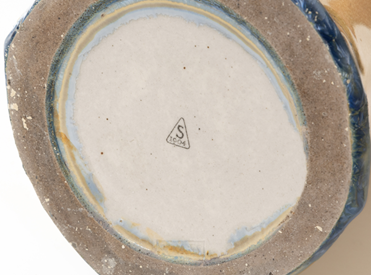
Base of the vase bearing the two marks of the Manufacture de Sèvres. Photo étude Metayer-Mermoz.
An accident in the past necessitated restoration work last year—which we will return to shortly—involving the partial reconstruction of one of the four handles forming the neck.
The originality of this vase lies in its history and provenance, which, unusually for this type of object, are known thanks to family accounts.
Through direct descent, this vase comes from the former collection of Mr. Numa Andoire (Coursegoules 1908 – Antibes 1994), a soccer player and professional coach, famous for winning the French Championship in 1951 and 1952 while coaching the Nice team, OGC Nice, as well as the French Cup in 1952.
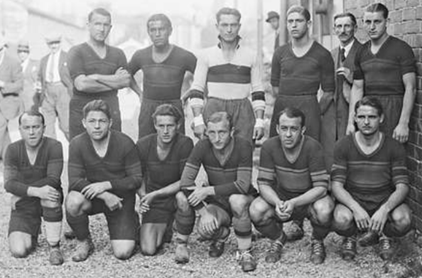
The Nice team in 1931. On the right, Numa is standing leaning on the wall. Photo all rights reserved.
The family story has it that the vase was given to Numa Andoire in 1927 by French President Gaston Doumergue (1863-1937) during a soccer tournament held to mark the unveiling of Antibes’ World War I memorial. The monument, whose centerpiece is a statue of a soldier sculpted by Bouchard[5], was built at the foot of Fort Carré and still overlooks the football field of the same name.
The regional and local press reported on the event, which took place on Sunday, July 3, 1927, with the usual patriotic speeches, troop parades, and medal ceremonies to the sound of the Marseillaise.
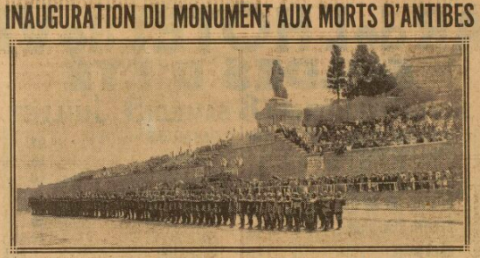
L’Excelsior 5 July 1927. Site internet BNF/Gallica
In attendance were a former undersecretary of state for war, who presided over the ceremony, a senator, a member of Parliament and a general representing the minister of defense, but no president of the republic… who was certainly represented by proxy, as is often the case for this type of event.
The presence of such a valuable Cerny vase as a gift from the state on the occasion of a relatively insignificant competition may seem surprising. But it should be seen in the context of the long (and sometimes unusual) history of generosity granted by the authorities on the occasion of cultural, scientific or sporting events. It should be remembered that the State, the sole shareholder of the “Manufacture de Sèvres”, used it primarily to provide valuable diplomatic gifts, but also a large number of art objects presented on behalf of the authorities at cultural and sporting events. World, international, and regional exhibitions were thus an opportunity to present numerous vases, statuettes, and other decorative dishes—most often with the famous blue background of Sèvres—whose size and decoration were more or less correlated with the importance of the prizes awarded to the winners, rewards that were variously appreciated by the artistic community…[6].
As for our Cerny vase, presented more than 15 years after the last one was made in Sèvres, this was probably one of the many occasions on which the State drew on the reserves of official manufacturers to award first prizes, when it was not the institutions or ministries themselves that disposed of certain acquisitions. In 1927, at a time when Art Nouveau was already well out of fashion, the authorities probably did not realize that they were offering an object that, a century later, would acquire such significant artistic and financial value.
Why did our vase become the property of Numa Andoire rather than another player? As the family story is not sufficiently clear on this point, we can only speculate. Was it to reward the short but promising career of the young prodigy player from Olympique d’Antibes, or rather to offer him a farewell gift as he completed his seventh and final season with the Antibes team before joining the Nice team? Probably a little of both… In any case, it is touching to note that this vase was kept for a long time as a family heirloom before the heirs finally decided to part with it.
This unique Cerny vase now features prominently in our museum layout project for the Mezzara hotel.
Olivier Pons
Notes
[1] https://www.lecercleguimard.fr/fr/une-verrine-en-verre-du-metro-de-guimard-pour-notre-projet-museal/
[2] Sale on March 23, 2025, Metayer-Mermoz auction house in Antibes, expert E. Eyraud.
[3] The other two forms are the Chalmont plant pot and the Binelles planter.
[4] For more information on the history of this collaboration, readers are referred to the book published in 2022 by Éditions du Cercle Guimard: F. Descouturelle, O. Pons, La Céramique et la Lave émaillée d’Hector Guimard.
[5] Henri Bouchard (1875-1960) had a studio built in 1924 at 25 rue de l’Yvette in Paris (75016), opposite the property of the painter Jacques-Emile Blanche, for whom Guimard carried out decorative work. The sculptor’s studio, which became the Bouchard Museum, closed its doors in 2007 before being transferred to La Piscine in Roubaix.
[6] One of the most famous cases is probably that of François-Rupert Carabin (1862-1932), a rebellious sculptor who, in 1912, received a blue-bottomed Sèvres vase as the “Prix du Président de la République” (President of the Republic Award), which he considered “very ugly and second-rate.” He then created a pedestal consisting of three female figures turning away in horror and exhibited it shortly afterwards at the Salon de la Société nationale des Beaux Arts in order to display it during the presidential visit. The pedestal and the vase now belong to the Perrier-Jouët collection in Épernay.
[7] In 1905, for example, the Ministry of the Navy acquired a Cerny vase that had left the Sèvres workshops a year earlier, and was therefore dated 1904, like our vase…Translation: Alan Bryden