
Month: April 2026
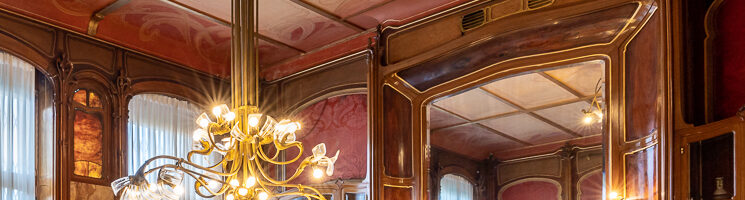
Victor Horta. The Solvay hotel, 224 Avenue Louise in Brussels. About a recent book published by Éditions Racine in Brussels.
Françoise Aubry, former curator of the Horta Museum in Brussels, had been a friend of the Cercle Guimard even before its founding in 2003. We met her on numerous occasions—in Paris, Brussels, and Barcelona—and corresponded with her frequently. Her expertise and experience guided us through the difficult journey toward establishing a Guimard Museum in Paris, and she graciously agreed to write the foreword for our first book dedicated to the Hôtel Mezzara in 2018, at a time when its future was highly uncertain.
Françoise was kind enough to respond to our request and send us a summary of the remarkable book she has just published on the Solvay hotel, one of Victor Horta’s masterpieces and undoubtedly his most luxurious work. On the occasion of the building’s repurposing—it has become a museum open two days a week following extensive restoration—she revisits the meticulous work of Yolande Oostens-Wittamer, published nearly thirty years ago.
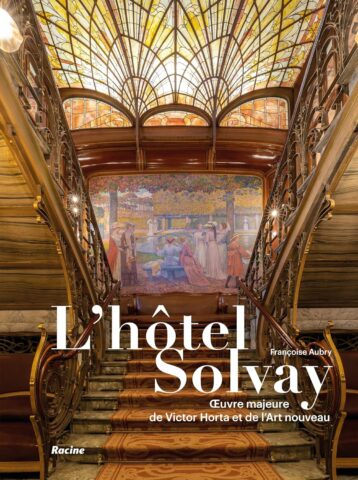
In 1894, Armand, son of the great inventor and industrialist Ernest Solvay, married Fanny Hunter. The young couple chose to settle on Avenue Louise, at the time Brussels’ most prestigious boulevard, and to have a mansion built on a 950-square-meter lot. He chose Horta as the architect. His name was suggested by engineer Émile Tassel, for whom he was building a house nearby at 6 Rue Paul-Émile Janson, and by Tassel’s friend, Charles Lefébure, Ernest Solvay’s personal secretary. Horta was not yet very well known, but the novelty of the Tassel mansion caused a sensation. He would undoubtedly be able to build a residence equipped with all modern comforts (central heating, a bathroom, electricity) that would highlight the young couple’s boldness in the eyes of Brussels’ “high society”—a conventional crowd enamored with eclecticism. The Solvays’ fortune was recent and owed to the entrepreneurial skills of Alfred and Ernest Solvay. They were not heirs to a family tradition that might have constrained their choices and forced them into conformity.
Horta won the family’s trust and was commissioned for various projects, ranging from the family tomb at the Ixelles cemetery to the company’s laboratories on Rue des Champs-Elysées in Ixelles, including a château in Chambley, Lorraine, for Alice, who was married to Baron Henri de Wangen.
On September 3, 1894, Horta presented his initial plans to Armand Solvay. The project promised to be monumental. In his Memoirs, he speaks of a “giant’s work,” as the architect was also responsible for the interior decoration, including all the furniture, each piece of which was unique and custom-designed.
The building permit was granted by the City of Brussels on August 20, 1895. The construction project would be lengthy and could be considered complete in 1902 when the large canvas by the painter Théo Van Rysselberghe, *Reading in the Park*, was hung in the stairwell, blending beautifully into the colorful world created by Horta.
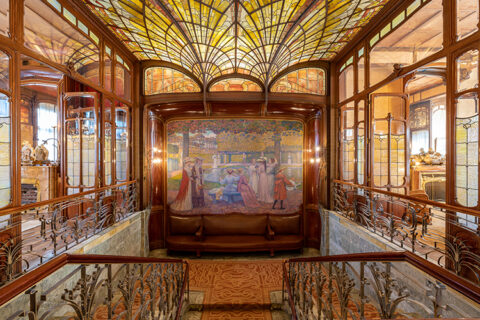
Solvay hotel at 224 Avenue Louise in Brussels, 1895–1902, landing of the staircase leading from the ground floor to the bel étage, painting *Reading in the Park* by Théo Van Rysselberghe. Photo by Gilles van den Abeele.
The Solvay hotel remained largely unchanged throughout much of the 20th century. During World War II, the glass roof covering the grand staircase was blown off when a bomb fell nearby. In the early 1950s, the Solvay family decided to sell the building, preferring to live in the green suburbs of Brussels. They offered to sell the mansion to the Belgian government at a reduced price. This generous offer was rejected, and it was not until late 1957 that the hotel was acquired by Mr. and Mrs. Wittamer-De Camps, who intended to establish their haute couture ateliers there. Various renovations were then carried out to adapt the mansion to its new purpose, and the skylight above the grand staircase was covered with a floor (today, the double-fan-shaped glass roof has been restored but is artificially lit, as the floor remains at the second-floor level). This alteration also deprived the winter garden of natural light (in the bedrooms on the first floor). The rooms on the second floor now form a single large space spanning the entire depth of the building.
Thanks are due to Mr. and Mrs. Wittamer, for it is likely that without them the Solvay hotel would have suffered the same fate as Horta’s other buildings on Avenue Louise: his second private home, at No. 136; the Aubecq hotel, at No. 520 (demolished in 1950); the Roger hotel, at No. 459 (completely renovated). After World War II, Avenue Louise was cut through by tunnels, and many of its mansions were replaced by apartment buildings.
The Solvay hotel was not designated a historic landmark until 1977, too late to prevent the construction of the two buildings that flank it today. After the death of Mr. and Mrs. Wittamer, their son Michel took over the management of the historic building. As for their daughter, Yolande Oostens-Wittamer, she devoted herself to research on Horta, culminating in a doctoral dissertation on the Solvay Mansion presented at the University of Louvain-la-Neuve (published in 1980). The current owner is Michel Wittamer’s son, Alexandre, who commissioned me in 2024 to write a book on the Hôtel Solvay, nearly thirty years after the one published by his aunt with Diane de Selliers in 1996. This book was published by Racine in 2025 and has been translated into Dutch and English, featuring photographs by Gilles van den Abeele and a series of plans by the firm Van der Wee Architects, which conducted a new survey of the mansion in preparation for its restoration.
The layout of the Solvay Mansion breaks with the tradition of Brussels mansions. The carriage entrance is still present and opens onto a driveway leading to the stables built at the rear of the lot. These were not commissioned from Horta by Armand Solvay but from architects who regularly worked for the Solvay firm (Constant Bosmans and Henry Vandeveld, 1898). The façade features two large bow windows, topped by balconies, which frame a curved central section. On the main floor, the living room balcony offered a view of the carriages heading to the Hippodrome or the Bois de la Cambre. The metal structures, painted in light ochre, are ubiquitous and radically new in the context of a luxurious mansion. Euville stone lends itself to subtle molding, while the more durable blue stone is used for the base, the frames of the balcony’s French doors, and a few horizontal bands.
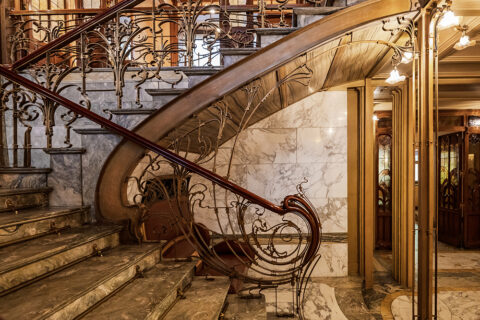
Victor Horta, Solvay hotel, 224 avenue Louise à Bruxelles, 1895-1902, the beginning of the railing of the stair case on the ground floor Photo Gilles van den Abeele
The interior layout is unique: the floor plan is organized around two stairwells, topped by a glass roof, situated against the shared walls. The grand staircase, preceded by a vast hall opening onto the carriage entrance, leads to a landing from which it splits into two branches leading to the main floor. One must then cross a large landing providing access to the row of salons on the street side and the dining room on the garden side, before taking a more discreet staircase to reach the private floors.
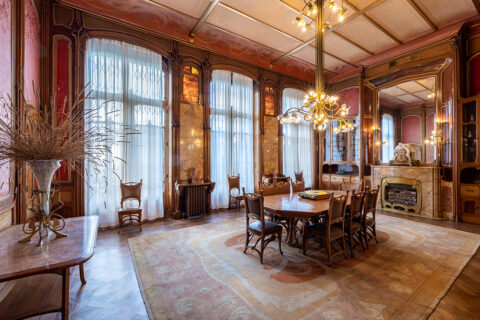
Victor Horta, Solvay hotel, 224 avenue Louise à Bruxelles, 1895-1902, dining room on the « bel étage » garden side , Photo Gilles van den Abeele
Thanks to glass doors, the living rooms and dining room can open completely onto the stairwell, which is transformed into a grand entrance hall on days when guests are hosted. The entire space of the main floor can be taken in at a glance. These doors also allow natural light from the street- and garden-facing facades to flood into the heart of the house. Horta masterfully controls the flow of light and maximizes natural light because it lends a shifting vitality to the colors of the stained-glass windows and creates multiple electric light fixtures in gilded brass, whose stems are oriented to highlight the colors of the stained-glass windows once night falls, the intricate carving of the woodwork, the gold accents of the ironwork and decorative paintings, and the brilliance of the beveled glass. He also adheres to the tradition of placing enormous mirrors above the fireplaces to enlarge the space and multiply the brilliance of the lamps.
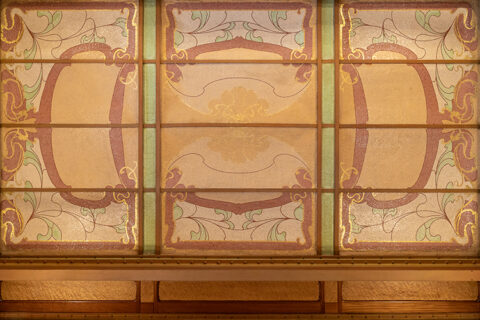
Victor Horta, Solvay hotel, 120 avenue Louise à Bruxelles, 1895-1902, mosaic ceiling of the “bel étage”. Photo Gilles van den Abeele
Horta was, of course, an confirmed architect, but he was also an accomplished artist when he combined colors in the manner of the painters of his time, applying Chevreul’s laws of complementary colors. In the wall decoration of the stairwell between the main floor and the first floor, orange gradually blends into green.
The first-floor landing separates the rooms reserved for the parents (the husband’s study, the wife’s boudoir, the bedroom) from those intended for family life (the study, the small, intimate dining room). The landing benefits from two sources of light thanks to the glass roof covering the second skylight and a second rounded glass roof that closes off an opening in the first skylight above the grand staircase. The landing is designed as a gathering place, an intimate space with its low sofas, metal floor lamps that evoke trees, and a garden represented by the floral stems frozen in the stained-glass window. This space invites timeless daydreams, as the real world seems so far away.
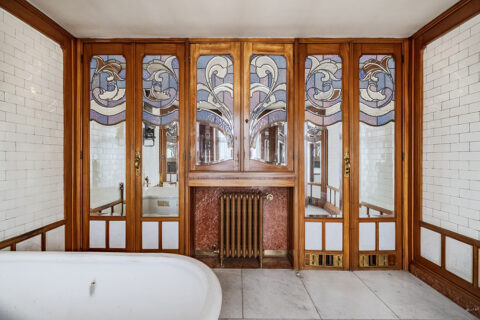
Victor Horta, Solvay hotel, 224 avenue Louise à Bruxelles, 1895-1902, bath room on the mezzanine Photo Gilles van den Abeele.
Between the first and second floors, Horta placed the bathroom on the mezzanine level. There, he boldly combines industrial materials such as white glazed brick with Carrara marble, set within American ash woodwork mounted on a red marble baseboard. Opposite the window, the door and cabinet panels are clad in beveled mirrors and frosted glass, used here for their texture and colors rather than to let in light, except in the door leading to the access corridor. The six panels form a splendid ornamental pattern. This bathroom exudes great refinement without being ostentatious. This is not the Hôtel de la Païva.
The walls of the final section of the stairwell are painted in an orange gradient fading to white as one approaches the glass roof. Bright orange arabesques outline a metal pergola, complemented by the glass roof and its foliage rendered in very soft yellow frosted glass. This arrangement highlights the fact that, in Horta’s work, the entire decorative system derives from the curve he imprinted on the metal. Rationally adapted to convey the material’s flexibility (in accordance with one of Viollet-le-Duc’s principles), the arabesque forms the basis of the wall decoration, which, in this case, represents architecture within the interior. The actual steel beams that frame the walls of the stairwell visually “support” painted arches, extended by the metal structure of the glass roof.
The service staircase, lit by a series of windows of various shapes on the garden side, provides access to a third floor, intended for the servants. The attic is spacious but cannot be fully utilized because its floor is pierced by the two skylights corresponding to the glass roofs set into the roof slope. This is a layout found in other buildings designed by Horta at the time: the stained-glass windows of the skylights crowning the stairwells must be protected from the elements by corresponding glazing in the roof.
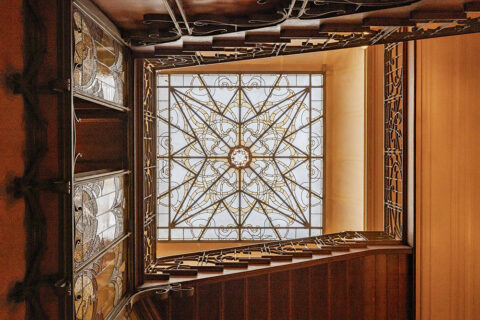
Victor Horta, Solvay hotel, 224 Avenue Louise in Brussels, 1895–1902, private staircase covered by the glass roof of the north skylight. Photo by Gilles van den Abeele.
When examining the rear facade, the division of functions is rational. The most prominent part is the kitchen, which protrudes from the main structure (here, Horta departs from the principle of the basement kitchen); its roof forms a large balcony for the dining room, which is flanked by two stories. The narrow, solid structure of the service staircase is attached to it. Above the driveway, the utility room with toilet, the master bathroom, and the guest bathroom are stacked one above the other.
Another element of “modern” comfort, the ventilation was carefully designed by Horta, and a constant flow of air circulates through the hotel without the need to open the windows. The steam heating system originally fed radiators that have now been converted to gas by plumber and heating engineer Pascal Desmee, a delicate modification that required months of work. Recently (2021–2025), Alexandre Wittamer commissioned architect Barbara Van der Wee (who, among other Horta buildings, oversaw the restoration of the Horta Museum and the Van Eetvelde Hotel) to restore the façade and roof of the Solvay hotel. The metal structures had deteriorated and required complex repairs carried out by metalworker Luc Reuse. Many other skilled craftsmen (roofers J.M. Tong and his son, painter Chr. Feuillaux, carpenter D. Lutjeharms, master glassmaker Cl. Van Veerdegem-Vosch, etc.) participated in this exemplary project, which was awarded an Europa Nostra Prize in 2025.
We must be aware today of the fragility of these Art Nouveau buildings, to which access must be strictly limited. The staircase at the Horta Museum had to be reinforced because it was sagging under the weight of visitors, and it lacks the precious wool carpets that Horta had designed for the Solvay hotel. The maintenance and restoration of these exceptional architectural works depend on the availability of well-trained craftsmen. One might wonder whether public authorities will continue in the future to fund “heritage schools” and the conservation of historic buildings. Will future generations be drawn to these often arduous and demanding trades, rooted in a long tradition of craftsmanship where manual skill and intellectual ability go hand in hand?
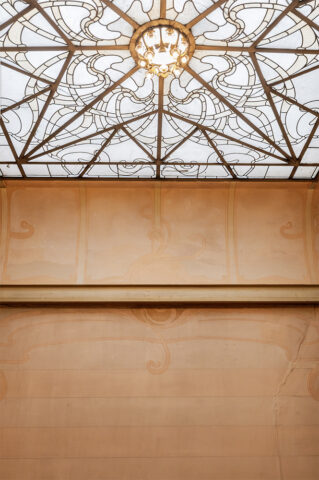
Victor Horta, Solvay hotel, 224 Avenue Louise in Brussels, 1895–1902, wall and glass roof of the private stairwell. Photo by Gilles van den Abeele.
The Solvay hotel, along with three other buildings designed by Horta (the Tassel hotel, the Van Eetvelde hotel, and Horta’s own home), were designated UNESCO World Heritage Sites in 2000—an international recognition of Horta’s work that unfortunately came too late to save the Maison du Peuple, which was demolished in 1965.
Françoise Aubry
Further Reading:
David DERNIE and Alastair CAREW-COX, Victor Horta. The Architect of Art Nouveau. Brussels, Fonds Mercator, 2018.
Michèle GOSLAR, Victor Horta 1861–1947. The Man – The Architect – Art Nouveau. Brussels, Fonds Mercator and the Pierre Lahaut Foundation, 2012.
Yolande OOSTENS-WITTAMER, Victor Horta. The Solvay Hotel. Louvain-la-Neuve, Higher Institute of Archaeology and Art History, Erasme College, 1980.
Yolande OOSTENS-WITTAMER, Horta. The Solvay Hotel. Paris, Diane de Selliers Editeur, 1996.
Victor Horta. Memoirs, edited by Cécile DULIERE. Brussels, Ministry of the French Community of Belgium, 1985.
Translation : Alan Bryden
Guimard’s rugs and carpets
27 Novembre 2025
Since his projects were aimed at creating a comprehensive interior design, Guimard took an interest in floor coverings, whether rugs or carpets. As early as the Castel Béranger period (1895–1898), he commissioned several large rugs from a manufacturer whose name is not yet known with certainty. The only bibliographic reference to these rugs that we are aware of is the frontispiece plate in the Castel Béranger portfolio published at the end of [1] 1898 and its caption (in the table of plates): “TITLE—composition for rugs.”
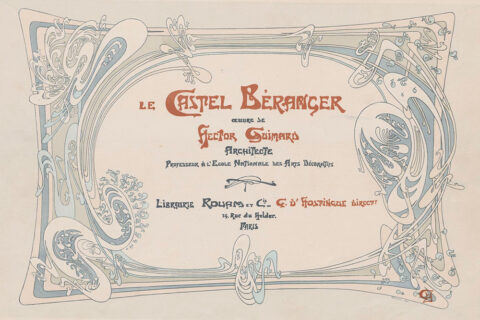
Frontispiece plate from the Castel Béranger portfolio, ETH Library, Zurich.
In fact, their design incorporates only part of the frontispiece’s design: the lower left corner, mirrored in the other three corners, as well as the central motif of the lower border, mirrored in the upper border. It is, of course, possible that Guimard instead expanded upon and refined an initial carpet design to create the frontispiece’s design.
These wool carpets, which are very likely the first Art Nouveau-style models to have appeared in France, are extremely rare. They were obviously not intended for the tenants of Castel Béranger, who had neither the means nor the space in their rather modestly sized rooms, but rather for a clientele of wealthy collectors. Two of them have been sold on the art market over the past decade. One is larger in size: 4 m x 6 m.
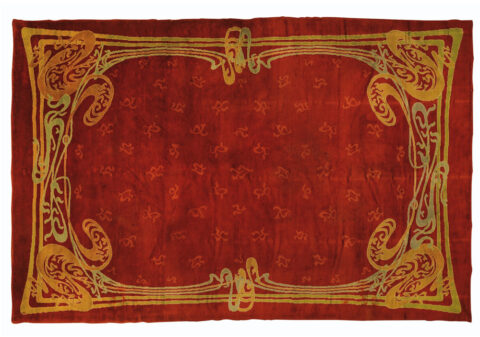
Rug by Guimard, maker unknown, 4 m wide, 6 m long. Sotheby’s Paris auction, November 24, 2015; knotted wool.
The other one, which is smaller, measuring 3.45 m by 4.93 m, is a scaled-down version of the first.
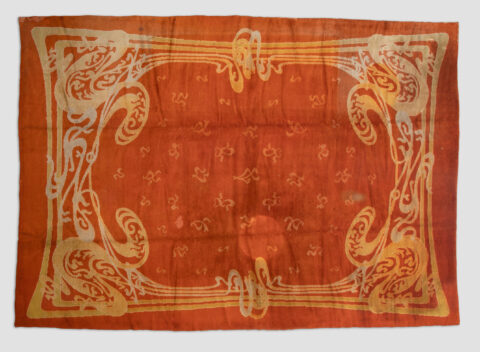
Carpet by Guimard, manufacturer unknown, width 3.45 m, length 4.93 m. Bonhams New York auction, December 19, 2024, lot 3w, knotted wool. Hector Guimard Diffusion Collection.
This last piece recently arrived from the United States, where it was acquired by our partner, Hector Guimard Diffusion. It is in good condition, but restoration work is needed in several areas.
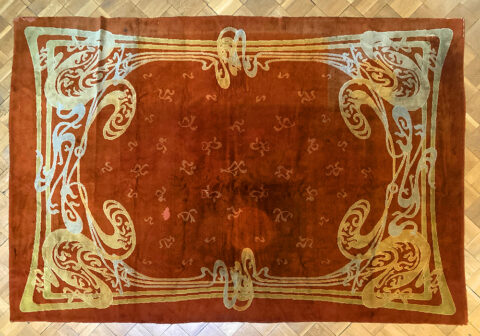
Carpet by Guimard, manufacturer unknown, width 3.45 m, length 4.93 m. Bonhams New York auction, December 19, 2024, lot 3w, knotted wool. Hector Guimard Diffusion Collection. Photo: F. D.
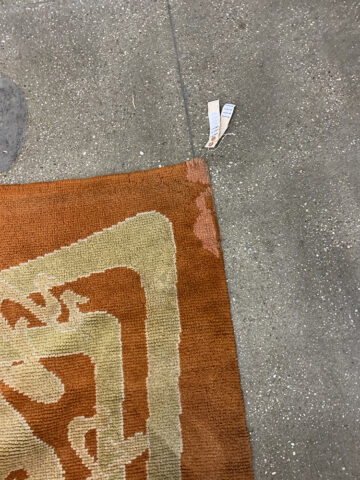
Rug by Guimard, manufacturer unknown, width 3.45 m, length 4.93 m. Bonhams New York auction, December 19, 2024, lot 3w, knotted wool. Hector Guimard Diffusion Collection. Photo: Bonhams NY.
Both carpets are made of knotted wool with a short pile. Their orange-red background is framed by yellow, light orange, and pale blue borders.
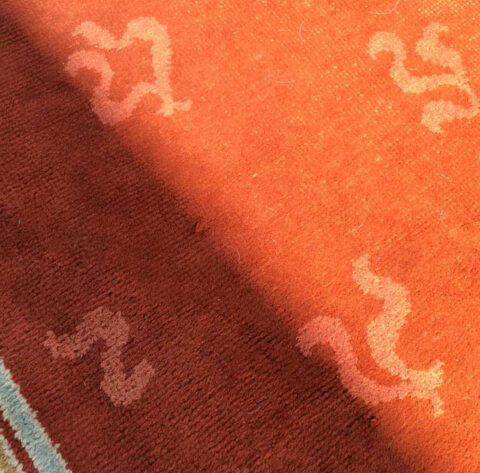
Carpet by Guimard, manufacturer unknown, width 3.45 m, length 4.93 m. Bonhams New York auction, December 19, 2024, lot 3w, knotted wool. Hector Guimard Diffusion Collection. Photo: Bonhams NY.
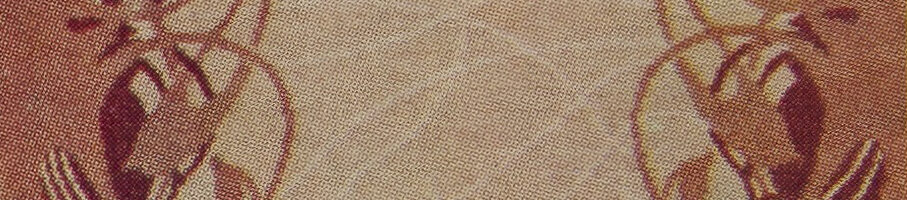
The reverse side of these carpets clearly reveals the technique used. The “pixelated” effect, caused by the thickness of the stitches, does not lend itself well to Guimard’s curves, but it is mitigated by the large size of these carpets.
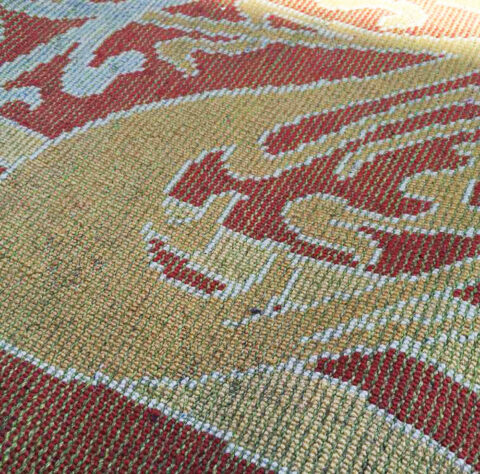
Carpet by Guimard, maker unknown, width 4 m, length 6 m. Sold at Sotheby’s Paris on November 24, 2015; knotted wool; restored by Rugs & Tapestries, Padua.
Neither of these two units bears a manufacturer’s mark, but they may have been produced by Honoré Frères in Tourcoing, the firm commissioned in 1897 to create the carpets for the three staircases of the Castel Béranger[2]. Their appearance is known from their reproduction in the Castel Béranger portfolio, where Guimard provided two color versions: one for the staircase facing the street (pl. 29) and the other for the staircase facing the courtyard (pl. 28). In these colorized reproductions, the surface texture is also consistent with that of knotted wool carpets. Given their narrow width and the delicacy of the patterns, their knots were necessarily small.
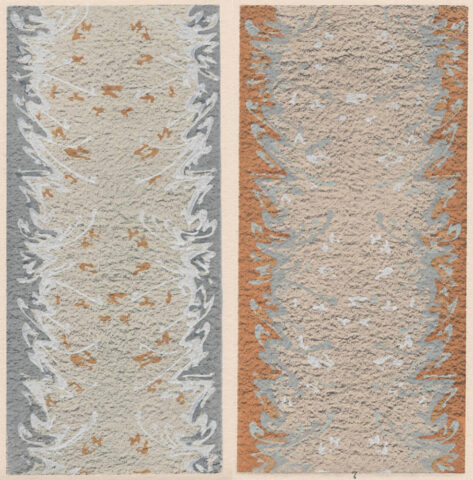
On the left, the carpet on the staircase facing the street; on the right, the carpet on the staircase facing the courtyard. Photomontage based on plates 28 and 29 from the Castel Béranger portfolio. Private collection.
On a single sheet of paper preserved in the Guimard collection at the Musée d’Orsay, there are two drawings for these rugs, which are symmetrical to one another, bearing the note “Delivered to the manufacturer on March 29, 1897, P. Honoré frères” as well as a simplified signature by Guimard.
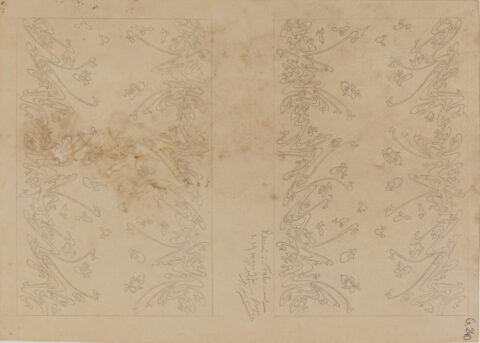
Drawings for the stair carpets at Castel Béranger, graphite pencil on heavy paper, height 0.342 m, width 0.244 m, handwritten pencil note: “Submitted to the Manufacturer/March 29, 1897/P. Honoré frères,” signed by Guimard. Gift of the Association for the Study and Preservation of 20th-Century Architecture and Decorative Arts, 1995, GP 240, Musée d’Orsay. © RMN-Grand Palais (Musée d’Orsay)/Jean-Gilles Berizzi.
But these are not exactly the same designs as those reproduced in the Castel Béranger portfolio. If we isolate one of the two designs—for example, the one on the right—and examine one of the two borders, we see that to create the opposite border, Guimard rotated it by 180 degrees.
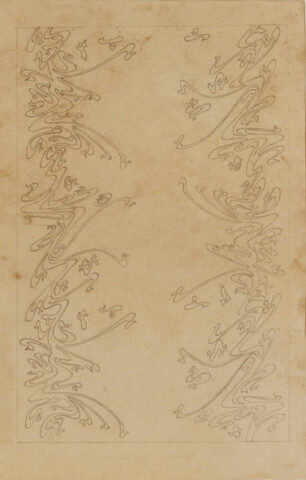
Right half of the design for the stair carpets at Castel Béranger, GP 240, Musée d’Orsay. The central motifs have been erased.
Whereas to obtain the design of the carpets as they were actually executed, he duplicated one of the two borders by reflecting it across a vertical axis.
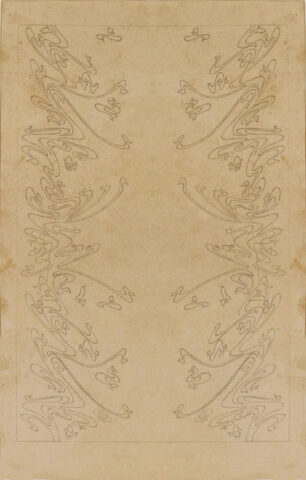
A photomontage on the right half of the drawing depicting the stair carpets of Castel Béranger, GP 240, Musée d’Orsay. The central motifs have been erased.
For these stair carpets at Castel Béranger, Guimard took his attention to detail to the point of designing a unique model of studs to secure the rails, of which we have several units.
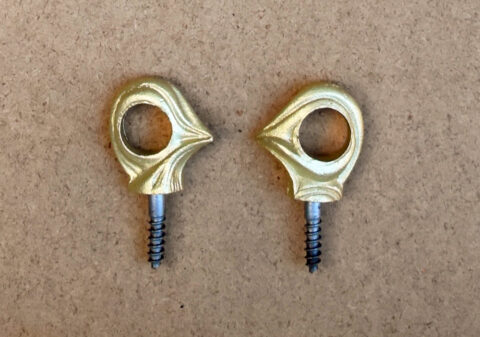
The studs on the stair runners at Castel Béranger. Private collection. Photo by F. D.
During the restoration work carried out in 2000, the stair carpets were roughly restored, and the wrong color was used for the staircase in the building’s street-facing lobby.
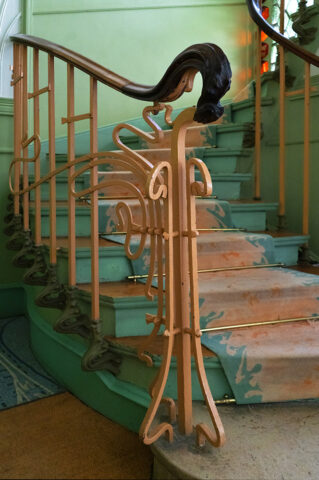
Current state of the staircase in the street facing lobby of Castel Béranger following restoration work. Photo by F. D.
Just as he had done in other fields, with the aim of making his designs more widely available and lowering their cost, Guimard wanted to have his carpet designs produced. He therefore approached the firm Parlant & Biron, which had its Paris office at 13 Rue Poissonnière. We had long noted that this company was also originally from Tourcoing, but it was only very recently that we were able to establish with certainty that Parlant & Biron was indeed the successor to the Honoré Frère firm, thanks to the acquisition of a promissory note from the Gaston Honoré company, dated March 31, 1911, and bearing the overprint “PARLANT & BIRON, Sucrs.” The fact that this succession is indicated by a stamped overprint suggests that, in March 1911, it was recent enough that updated documents had not yet been printed. This document also reveals that Gaston Honoré himself succeeded “Maison V. Straub, Ch. Gérardin, Honoré Frères, réunies”[3].
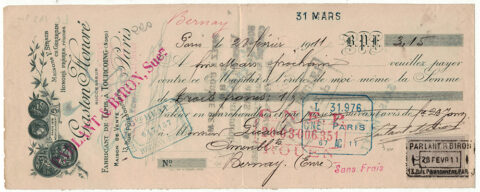
Promissory note from the firm Gaston Honoré, Parlant & Biron, successors, dated March 31, 1911. Private collection.
Guimard thus secured the publication of his designs in a catalog. The copy held at the Bibliothèque des Arts Décoratifs contains only four unnumbered plates, all of which feature Guimard’s designs. Since this copy was donated by his widow, it is likely that the other plates were removed from the catalog in order to document simply the architect’s work.
Cover of an undated Parlant & Biron catalog. Bibliothèque des Arts Décoratifs. Gift of Adeline Oppenheim-Guimard, 1948. Photo by Laurent Sully Jaulmes.
Six designs for Parlant & Biron are available as rugs with a fixed width of 70 cm and sold by the linear meter in three grades, priced at 7, 8, and 9 F-or. The material used and the type of weave are not specified.
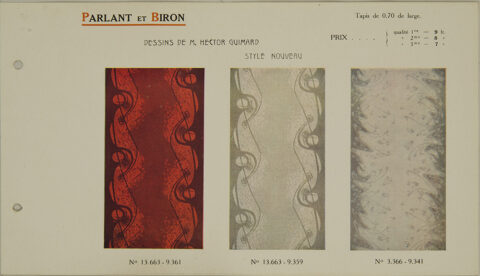
Plate from a Parlant & Biron catalog, undated. Bibliothèque des Arts décoratifs, models 13.663–9.359; 13.663–9.361; 3.366–9.341. Gift of Adeline Oppenheim-Guimard, 1948. Photo by Laurent Sully Jaulmes. The model of the Castel Béranger is on the right.
It is noticeable that the model shown on the right side of this plate appears to be that of the staircase at Castel Béranger, reproduced in shades of gray with greater clarity than in the two plates of the portfolio. In fact, however, this is the original drawing (GP 240), with its asymmetrical borders.
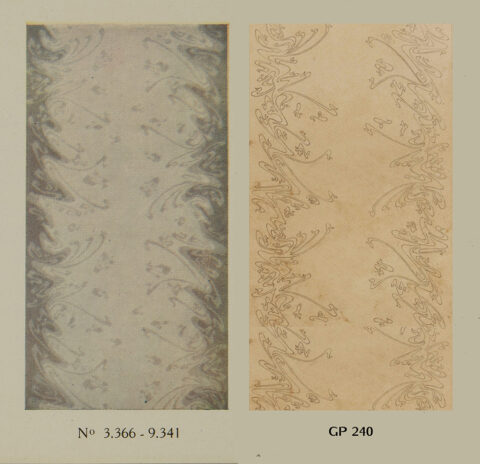
Composite image of model 3.366–9.341, created from a page in a Parlant & Biron catalog and part of drawing GP 240.
For the other model on this sheet, which is shown in two color variations, there are two watercolor studies by Guimard in the collection of documents donated by Adeline Oppenheim Guimard to the Bibliothèque des Arts décoratifs in 1948.
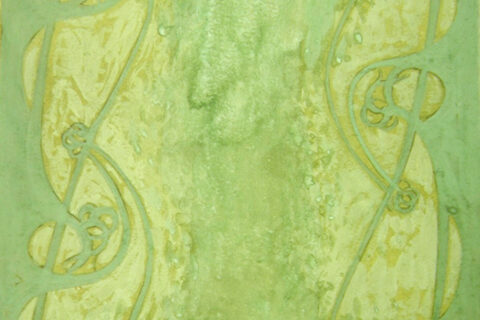
Design for a rug, unsigned, undated, watercolor on paper, Bibliothèque des Arts décoratifs, Gift of Adeline Oppenheim-Guimard, 1948. Photo by Laurent Sully Jaulmes.
On a second plate of the Parlant & Biron catalog, a third design is shown in three colors. As with the two designs presented above, its clearly defined borders indicate that it is intended as a stair carpet or a hallway rug.
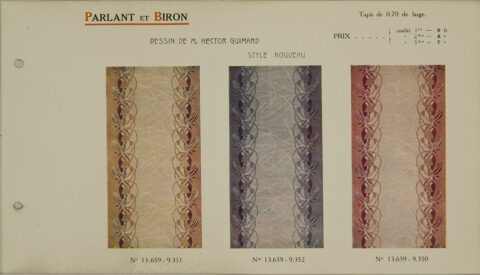
Plate from a Parlant & Biron catalog, undated. Bibliothèque des Arts décoratifs, models 13.659–9.350; 13.659–9.351; 13.659–9.352. Gift of Adeline Oppenheim-Guimard, 1948. Photo by Laurent Sully Jaulmes.
On the contrary, the three other patterns featured on the other two plates have no borders and are designed to be joined together (like wallpaper) so they can cover large areas and serve as a carpet. Once placed side by side, the strips are sewn together and then stretched out.
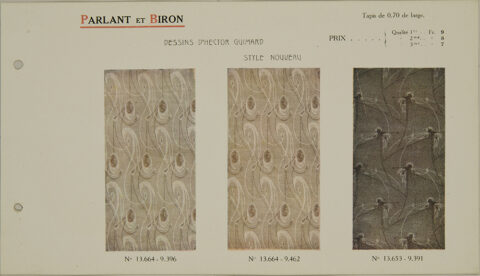
Plate from a Parlant & Biron catalog, undated. Bibliothèque des Arts décoratifs, models 13.664–9.396; 13.664–9.462; 13.653–9.391. Gift of Adeline Oppenheim-Guimard, 1948. Photo by Laurent Sully Jaulmes.
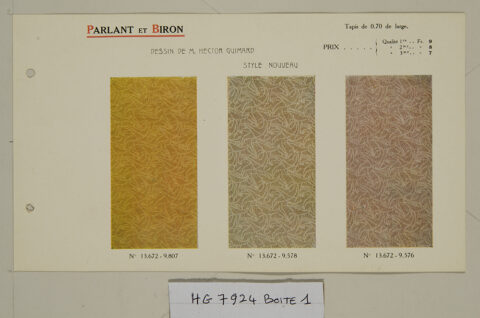
Plate from a Parlant & Biron catalog, undated. Bibliothèque des Arts Décoratifs, items 13.672–9.576; 13.672–9.578; 13.672–9.807. Gift of Adeline Oppenheim-Guimard, 1948. Photo by Laurent Sully Jaulmes.
We think it is worth taking a closer look at the reference numbers for these six models and their variants:
3.366 – 9.341 for the Castel Béranger model.
13.663 – 9.359 and 13.663 – 9.361 for the bordered model shown on the same plate.
13.659 – 9.350; 13.659 – 9.351; 13.659 – 9.352 for a bordered model on a second sheet.
13.664 – 9.396 and 13.664 – 9.462 for a pattern with a seam on a third sheet.
13.653 – 9.391 for a pattern with a seam on this third sheet.
13.672 – 9.576; 13.672 – 9.578 and 13.672 – 9.807 for a pattern with a seam on a fourth panel.
The last four digits after the hyphen distinguish the color variations of identical patterns. We do not know the meaning of the number 9. As for the groups of numbers before the hyphen, they designate the models. Furthermore, we propose the following hypothesis: the number(s) before the period could indicate the year the model was added to the manufacturer’s catalog (Honoré Frères, then Gaston Honoré, then Parlant & Biron). Thus, the Castel Béranger model (3.366) would have been added in 1903, and all other models would have been added in 1913—that is, at the time Guimard was designing his mansion. This would give us a sixteen-year timeframe (from 1897 to 1913) of collaboration between Guimard and the manufacturer. Keep in mind that the date of 1913 does not necessarily correspond to the creation of these five models and that Guimard may have had access to them before they were published in a catalog.
Several photographs show Guimard using these rugs. One of them, undated, is likely a view taken inside Guimard’s workshops. It clearly shows the bordered rug 13.659 and, less clearly, beneath the desk and chair, the pattern-matched rug 13.653.
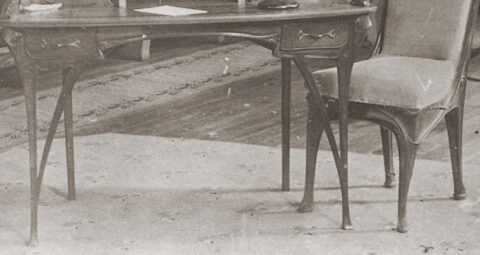
Probable interior arrangement in Guimard’s studios (detail) featuring rugs 13.659 and 13.653; early print on paper, undated. Donated by Adeline Guimard-Oppenheim, 1948. Bibliothèque des Arts décoratifs. Photo by Laurent Sully Jaulmes.
Pieces of the same pattern-matching rug (13.653) also appear in other photographs taken under similar conditions.
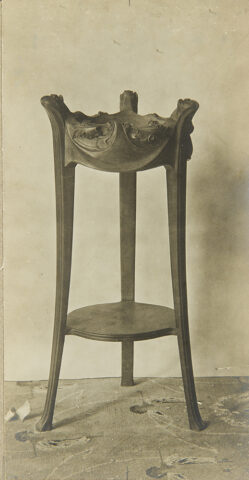
Probable set up in Guimard’s studio, featuring rug no. 13.653; an early print on paper, undated. Donated by Adeline Oppenheim-Guimard, 1948. Bibliothèque des Arts décoratifs. Photo by Laurent Sully Jaulmes.
Finally, two of these seamless carpet designs appear in photographs taken inside the Guimard Hotel: once again, the 13.653, used as wall-to-wall carpeting in the bedroom.
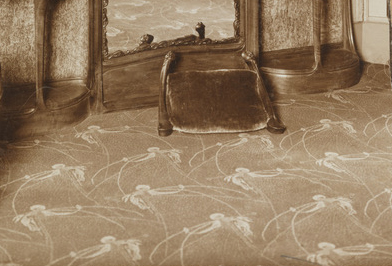
Detail from a photograph of the bedroom at the Hôtel Guimard, showing rug no. 13.653; vintage print on paper, ca. 1913. Private collection.
And 13.672, used for the dining room carpet.
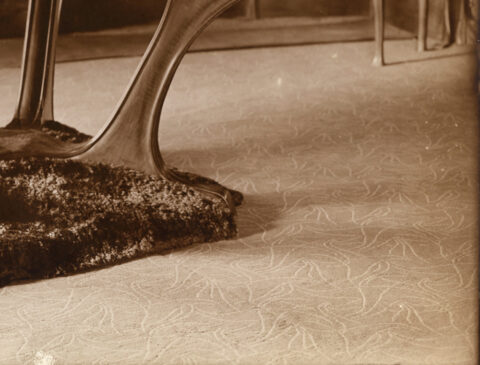
Detail from a photograph of the dining room at the Hôtel Guimard, showing rug no. 13.672; vintage print on paper, ca. 1913. Gift of Adeline Oppenheim-Guimard, 1948. Archives de Paris 3115W 10.
Alongside this production for commercial purposes, Guimard continued to design large rugs. We have evidence of this in the form of a watercolor sketch with a particularly rich, even evocative, design. Although undated, it can be dated to 1903 or later and is housed at the Bibliothèque des Arts décoratifs.
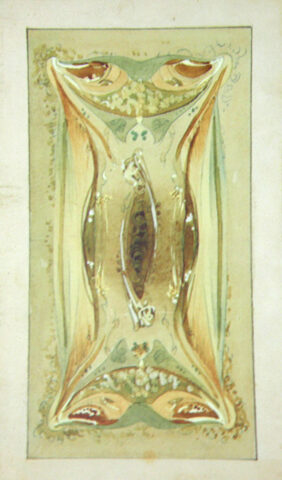
Design for a rug, unsigned, undated, watercolor on paper, Bibliothèque des Arts décoratifs, Gift of Adeline Oppenheim-Guimard, 1948. Photo by Laurent Sully Jaulmes.
We can see, then, that Guimard’s rugs and carpets reflected his stylistic evolution, with designs that, in some cases, could be seamlessly integrated into modern interiors.
Frédéric Descouturelle
in collaboration with Olivier Pons
Notes
[1] Guimard, Hector, Art in the Modern Home/Le Castel Béranger, Paris, Librairie Rouam, 1898.
[2] Their name appears in the list of suppliers at the beginning of the portfolio: “HONORÉ FRÈRES — Carpets.”
[3] The Honoré Frères company had borne this name since Gaston and Lodois Honoré took over the business in April 1893. Gaston continued on his own after his brother sold him all his shares in September 1904.
Translation: Alan Bryden
Hector Guimard’s hardware — Part Three: The last hardware at Castel Béranger
1 March 2026
All photos owned by the authors or by the Cercle Guimard Archives and Documentation Center must, without exception, be approved by the Cercle Guimard for any publication project, regardless of the medium.
Following two articles devoted to the door and window hardware of Castel Béranger, we continue our description of the other hardware pieces created by Guimard in collaboration with the Fontaine company or the Durenne foundry for his first apartment building. Some were produced for each apartment and can still occasionally be found in the building, though more often on the art market. Others were likely cast as one-of-a-kind pieces and have, for the time being, disappeared.
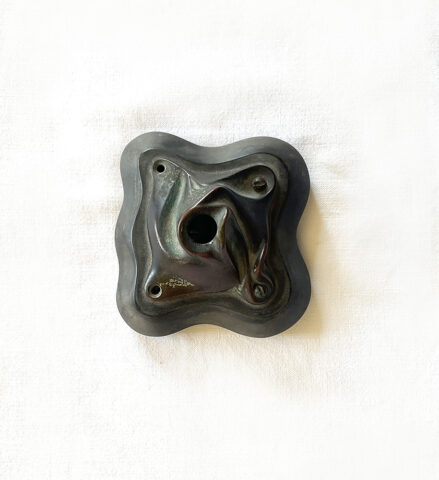
Found on every apartment landing door, the doorbell buttons feature a roughly square base plate whose central section appears crumpled and whose four corners seem flattened by the pressure exerted by the screws securing it to the wall. Guimard revisited this concept of material deformation on numerous occasions, such as in the transverse fasteners originally designed for the porticos of the metro’s open-air entrances.
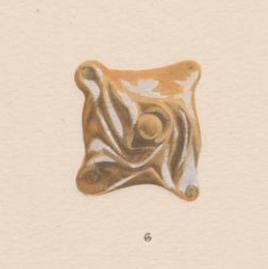
Doorbell button for the apartment doors at Castel Béranger. Hector Guimard, *Art in Modern Housing/Castel Béranger* (Castel Béranger portfolio), plate 35 (detail), Librairie Rouam, 1898. Private collection.
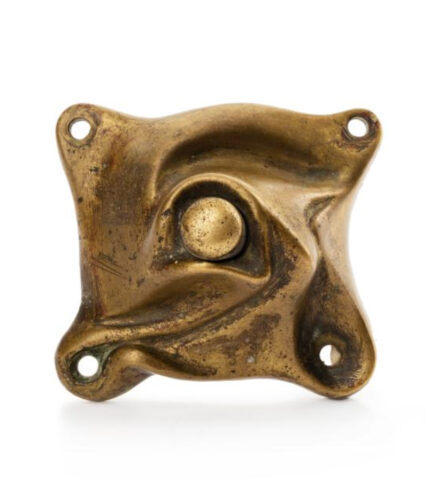
Doorbell button from the apartments at Castel Béranger. Height: 6 cm, width: 6.5 cm, depth: 3 cm. Private collection.
Their mechanism (a spring-loaded push button) and, even more so, the term used in the captions for Plate 35 of the Castel Béranger portfolio-“electric bell buttons”-leave no doubt that electricity was present within Castel Béranger. Although the principle of the electric doorbell was patented as early as 1852[1], this source of energy—which was particularly modern in 1895–1898—does not appear to have been used for lighting there. In his portfolio, Guimard remains, moreover, very discreet about the lighting fixtures in use in the building. The lantern in the courtyard, with its chimney protected by a cap, could have been gas-powered. But it cannot be ruled out that, at the time of their delivery, the apartments were simply lit by oil lamps suspended from the ceilings, as we will see later.
This model of doorbell button was used by Guimard at least for the Castel Henriette[2]. But other locations may have existed, as evidenced by this example set into a stone (slate?) plaque whose contours follow those of the plate, smoothing them out. It is possible that this is the doorbell for the gate leading to the parish hall of the Salle Humbert de Romans. In that case, the electrical wire emerging from the right side and running along a stone joint indicates how Guimard intended the button to be positioned (rotated 180° relative to the photo in the portfolio).
Electric doorbell button on a stone plaque. Private collection. Photo by Elisa Tenorio.
Most of the original pieces at Castel Béranger met the same fate as other Guimard hardware: they were stolen and then collected or resold. As a result, most of the doorbells currently installed in the apartments are replicas.
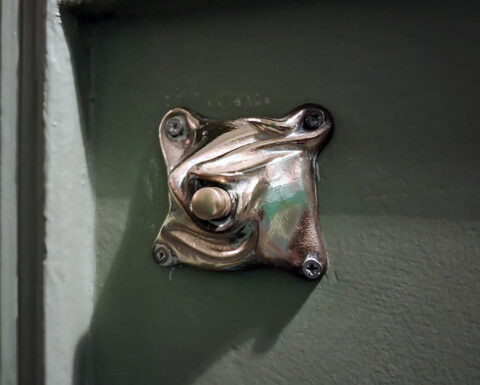
Copy of a doorbell button at Castel Béranger. Photo O. P.
Another type of electric doorbell appears on the same page of the Castel Béranger portfolio and is included under the same caption, “electric doorbell buttons.” This time, it is an electric bell, which was likely used to summon the servants. The apartments at Castel Béranger, which were intended for a clientele of the lower and middle classes, did not have a service area, but it was possible to rent maids’ rooms on the sixth floor. None of these bell pull handles are currently known to exist.
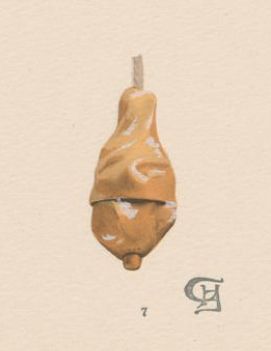
Electric doorbell pull in the apartments of the Castel Béranger. Hector Guimard, *Art in Modern Housing/The Castel Béranger* (Castel Béranger portfolio), plate 57 (detail), Librairie Rouam, 1898. Private collection.
A third doorbell mechanism is the “bronze slider for the main entrance on an enameled lava plate,” reproduced on plate 35 of the portfolio. It was likely produced in very limited numbers and was probably installed only at Castel Béranger.
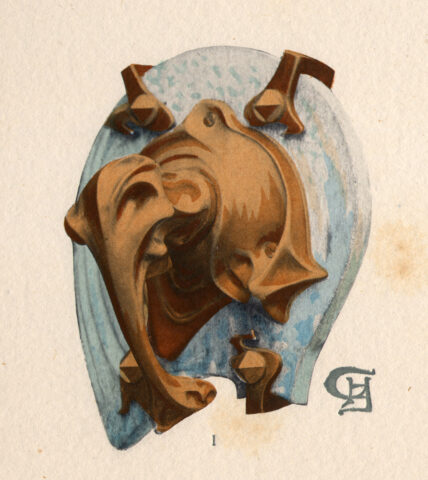
Doorbell slider at the entrance to the Castel Béranger. Hector Guimard, *Art in Modern Housing/The Castel Béranger* (Castel Béranger portfolio), plate 35 (detail), Librairie Rouam, 1898. Private collection.
The metal elements can be seen in item no. 628, in a photograph donated by Adeline Oppenheim-Guimard to the Bibliothèque des Arts décoratifs in 1948. They appear alongside other hardware pieces from the same period or later.
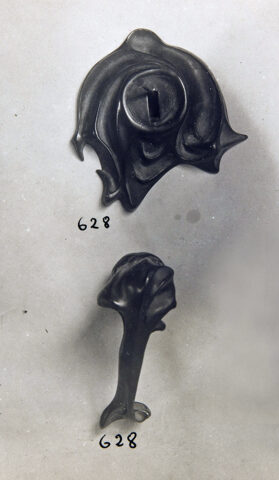
Bronze doorbell slider from Castel Béranger. Bibliothèque des Arts Décoratifs, gift of Adeline Oppenheim-Guimard, 1948, photo by Laurent Sully Jaulmes (detail).
This type of doorbell could operate mechanically (via a cable that rang a bell) or electrically [3]. Its position on the section of the gate between the gate leaf and the right-hand post suggests that it was likely an electrical mechanism, which takes up less space. The bell rang in the concierge’s lodge, where the concierge would then pull a cord to open the door.
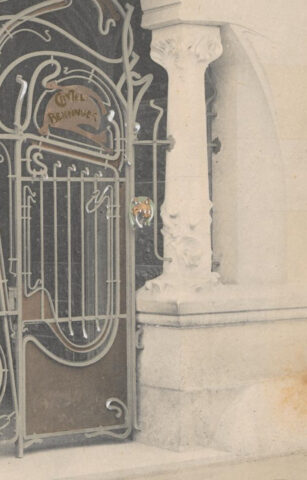
Gateway to the Castel Béranger. Hector Guimard, *Art in Modern Housing/The Castel Béranger* (Castel Béranger portfolio), plate 4 (detail), Librairie Rouam, 1898. ETH Library Zurich http://www.e-rara.ch/doi/10.3931/e-rara-27774
Unfortunately, this slider was gone by 1963. A photograph taken that year shows that it had already been replaced by a standard electric doorbell button.
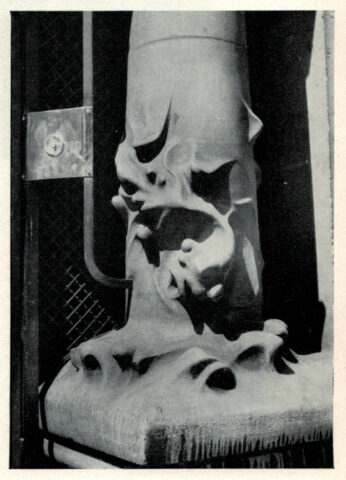
Detail of the gate at Castel Béranger featuring a standard electric doorbell button. Revue Bizarre No. 27, p. 9, 1st quarter 1963. Photo by P. Jahan.
Another hardware item that was likely produced as a one-off is the faucet on the courtyard fountain.
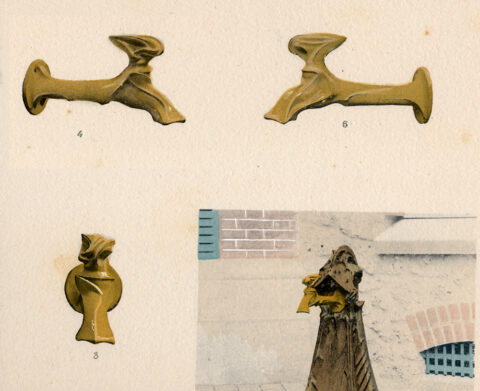
Fountain faucet in the courtyard of Castel Béranger. Hector Guimard, *Art in Modern Housing/Castel Béranger* (Castel Béranger portfolio), plate 14 (detail), Librairie Rouam, 1898. ETH Library Zurich http://www.e-rara.ch/doi/10.3931/e-rara-27774
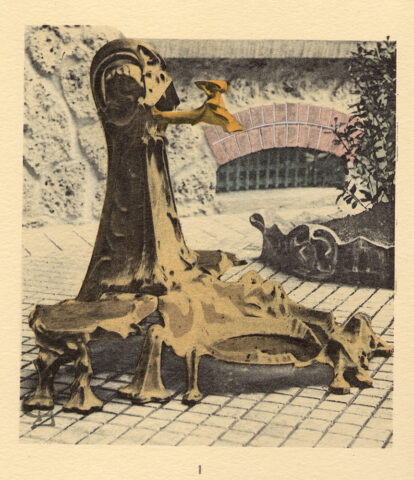
Fountain in the courtyard of Castel Béranger. Hector Guimard, *Art in Modern Housing/Castel Béranger* (Castel Béranger portfolio), plate 14 (detail), Librairie Rouam, 1898. Private collection.
Although the cast-iron fountain, which was likely originally bronze-plate, still exists, the faucet disappeared at some unknown point in time and was replaced by a plain faucet that is too short to fill a bucket placed in the central basin.
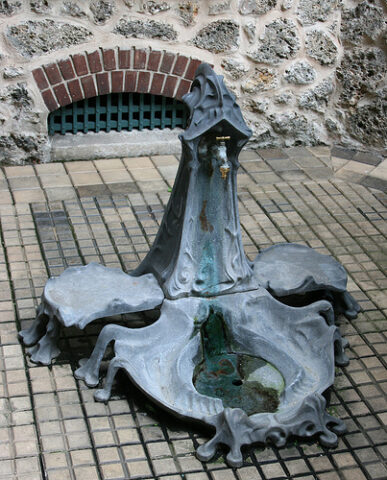
Fountain in the courtyard of Castel Béranger, current state Rights reserved
It is undoubtedly in the studs on the stair carpet rods that Guimard’s commitment to paying attention to every decorative detail is most evident (see our article on Guimard’s carpets and rugs). On what is necessarily a simple piece, Guimard incorporates a side pinch.
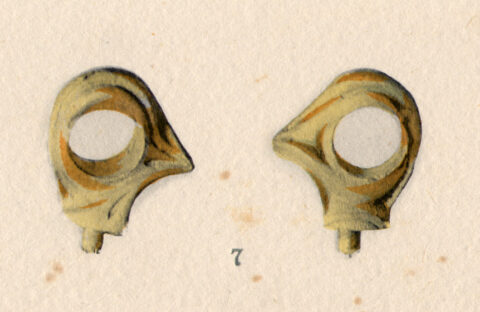
Carpet rod studs from the Castel Béranger. Hector Guimard, *Art in the Modern Home/The Castel Béranger* (Castel Béranger portfolio), pl. 51 (detail), Librairie Rouam, 1898. Private collection.
These studs were all removed at some unspecified time, but a significant number of them were recovered by Alain Blondel and Yves Plantin.
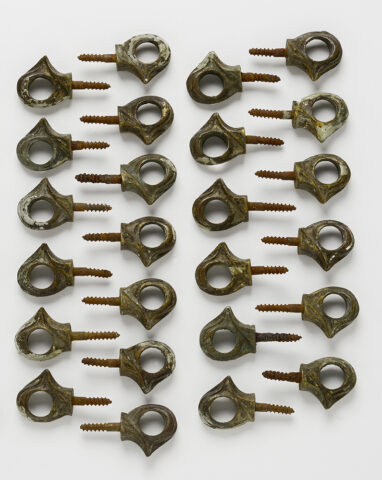
Set of 25 carpet rod studs from Castel Béranger, formerly part of the Yves Plantin collection, sold at Auction France, Paris, November 23, 2017. Photo: Auction France.
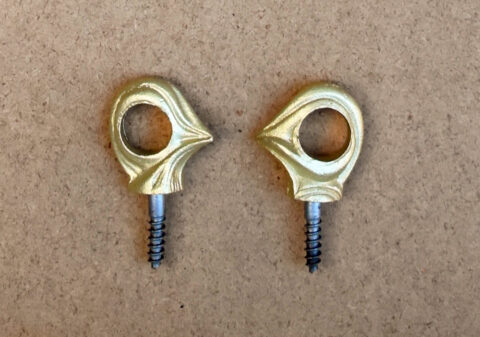
Two stripped carpet rod studs from Castel Béranger, from the former Yves Plantin collection, sold at Auction France, Paris, November 23, 2017. Private collection. Photo: F. D.
Currently, the stair carpets at Castel Béranger are held in place by rods secured with standard wall studs.
Originally, each apartment at Castel Béranger had a tiny bathroom equipped with a vanity unit designed by Guimard.
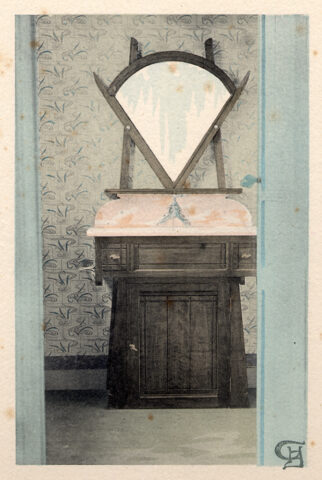
Vanity unit in an apartment at Castel Béranger. Hector Guimard, *Art in Modern Housing/Castel Béranger* (Castel Béranger portfolio), plate 59 (detail), Librairie Rouam, 1898. Private collection.
This economical piece of furniture, with its geometric lines, may have predated the Castel Béranger collection but was likely updated with metal hardware. The drawer knobs, towel rack brackets, and faucet base are made of “nickel-plated brass” and feature a design consistent with the other Castel Béranger styles.
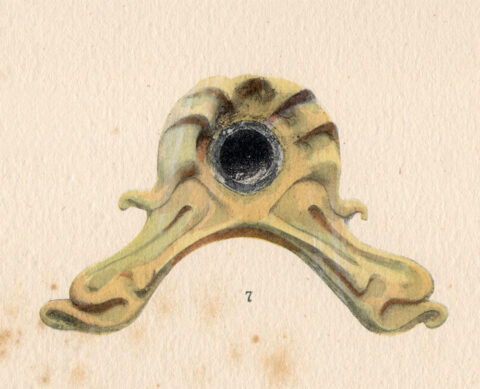
Faucet base from the vanity unit in the apartments of the Castel Béranger. Hector Guimard, *Art in Modern Housing/The Castel Béranger* (Castel Béranger portfolio), plate 59 (detail), Librairie Rouam, 1898. Private collection.
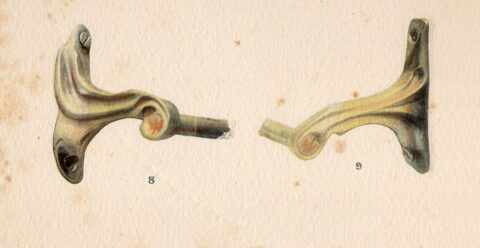
Brackets for the towel racks on the vanity unit in the apartments of the Castel Béranger. Hector Guimard, *Art in Modern Housing/The Castel Béranger* (Castel Béranger portfolio), plate 59 (detail), Librairie Rouam, 1898. Private collection.
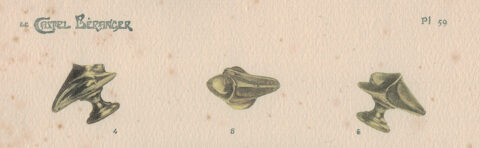
Knobs on the drawers of the vanity unit in the apartments of the Castel Béranger. Hector Guimard, *Art in Modern Housing/The Castel Béranger* (Castel Béranger portfolio), plate 59 (detail), Librairie Rouam, 1898. Private collection.
To the best of our knowledge, two wash basins from Castel Béranger have survived. One of them was purchased by Hector Guimard Diffusion and will be on display at the Guimard Museum inside the Hôtel Mezzara.
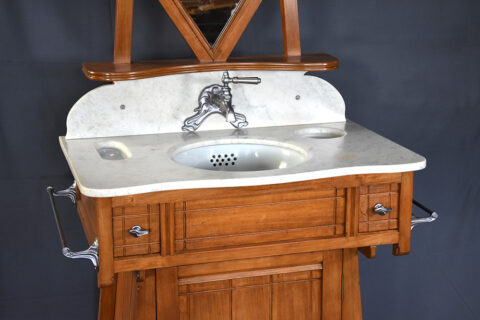
The washbasin at Castel Béranger, after restoration. Collection of Hector Guimard Diffusion. Photo by F. D.
During its restoration, it was necessary to reconstruct the faucet base using old photographs and to replicate the drawer knobs based on one of those from the other known example.
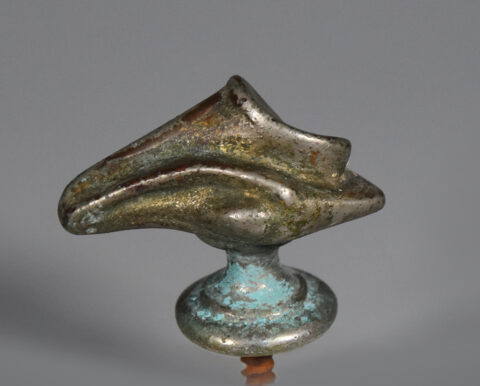
Drawer knob from a washbasin at Castel Béranger. Private collection. Photo by F. D…
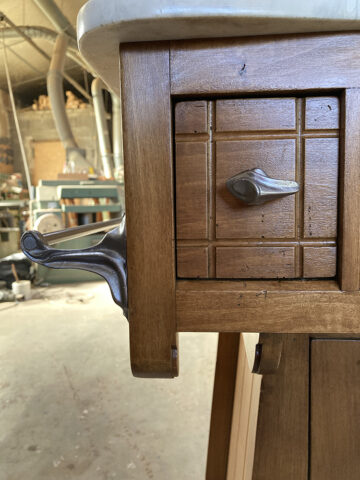
A drawer from a washbasin at Castel Béranger in François Derobe’s restoration workshop (Meuse) with a replica knob. Collection of Hector Guimard Diffusion. Photo by F. D.
Guimard used these drawer knobs around the same time on several pieces of furniture, including his own desk, which was originally located in his architectural office on the ground floor of Castel Béranger and later moved to his new office on the ground floor of his townhouse at 122 Avenue Mozart.
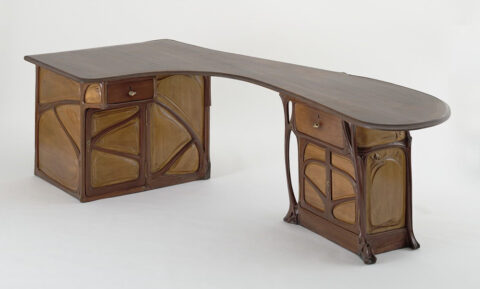
Hector Guimard’s office, on display at the Museum of Modern Art in New York. Photo: MoMA. All rights reserved.
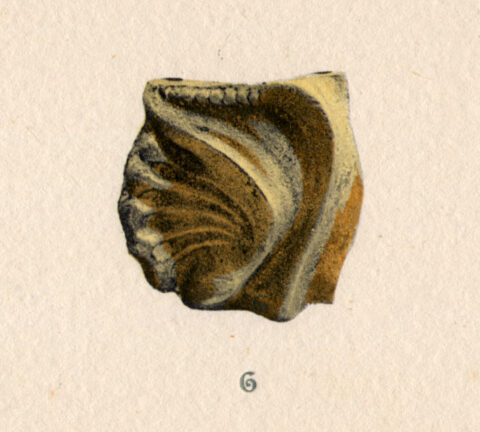
Even something as insignificant as the handle on the fireplace screens in the apartments was the subject of a design. It is listed in the Castel Béranger portfolio under the name “copper shell for fireplace screens.” We are currently unaware of any surviving examples.
Handle on the fireplace screens in the apartments of the Castel Béranger. Hector Guimard, *Art in Modern Housing/The Castel Béranger* (Castel Béranger portfolio), plate 51 (detail), Librairie Rouam, 1898. Private collection.
While there were fireplaces in the bedrooms, living rooms, and dining rooms of the apartments, the inclusion in the portfolio of a “bronze grid for the heat vents” indicates that Castel Béranger also had a supplementary heating system consisting of radiators in the basement and hot-air ducts.
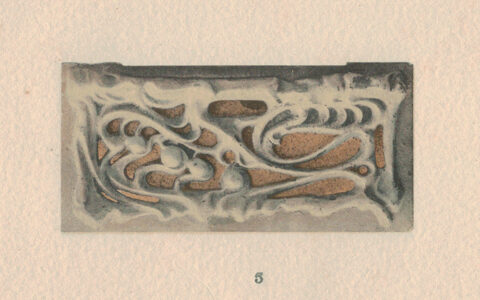
Bronze grids for the radiator vents in the apartments of the Castel Béranger. Hector Guimard, *Art in Modern Housing/The Castel Béranger* (Castel Béranger portfolio), pl. 51 (detail), Librairie Rouam, 1898. Private collection.
We are currently unaware of any surviving examples, but two were later used by Guimard as ventilation grilles and set into the masonry: one on the right-side facade of the Hôtel Deron-Levent in Paris (c. 1907), the other on the street-facing facade of the Villa d’Eaubonne (c. 1907–1908).
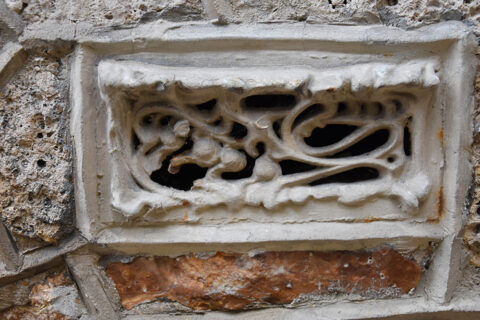
Ventilation grid on the right-side facade of the Deron-Levent Hotel (c. 1907), 8 Villa La Réunion, Paris 16th arrondissement. Photo by F. D.
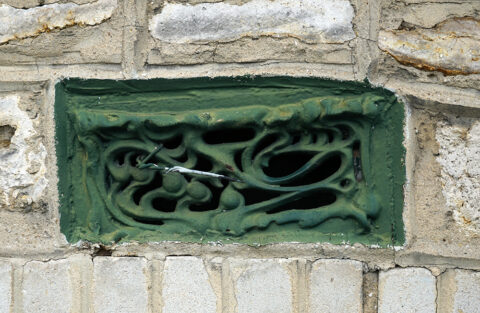
Ventilation grid on the street-facing facade of the villa in Eaubonne (c. 1907–1908), 16 Rue Jean-Doyen, Eaubonne, Val-d’Oise. Photo by F. D.
We conclude this article with a few cast-iron hardware items, which were likely cast by Durenne in Sommevoire, unlike all those presented above, which are made of copper alloys and were probably supplied by the Fontaine company.
As we mentioned earlier, it is likely that the apartments at Castel Béranger did not have electric lighting. Nor is there any evidence that they had a gas lighting system. However, the fact that cast-iron hooks remain in some apartments, attached to an iron joist in the center of the rooms, leads us to believe that they were used to hang oil lamps that could be raised and lowered using a pulley to adjust the lighting and refill the fuel reservoir.
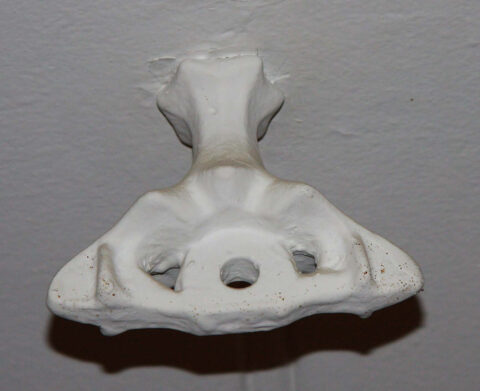
Ceiling anchor in a second-floor apartment facing the street at Castel Béranger. All rights reserved.
Only the model of the suspension hook intended for the living-rooms is mentioned in the portfolio. It was likely larger in size than those for other rooms. We are currently unaware of any surviving examples.
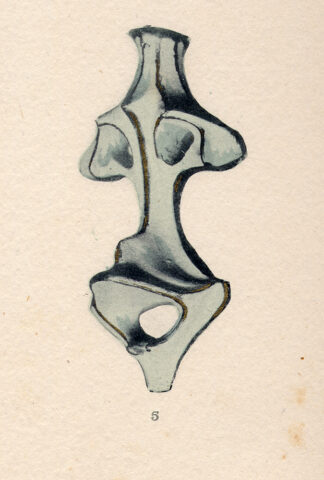
Suspension hook in the living-rooms of the Castel Béranger. Hector Guimard, *Art in the Modern Home/The Castel Béranger* (Castel Béranger portfolio), plate 52 (detail), Librairie Rouam, 1898. Private collection.
We currently know very little about other hardware items at Castel Béranger. These consist of decorative metal fasteners that punctuate the joists in certain rooms. They can be seen in two plates of the portfolio, on the ceilings of a bedroom (Pl. 40) and a living room (Pl. 49). These two rooms were part of the same street-facing apartment on the second floor that Guimard specifically used for the photographs reproduced in the portfolio. In the photo on plate 49, we can also see decorative fasteners on a metal lintel of the bay window, which Guimard took care to highlight with a touch of gold.
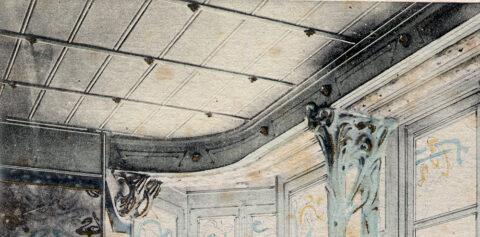
View of the living room in the apartment at the corner of Rue La Fontaine and Hameau Béranger on the second floor of Castel Béranger. Hector Guimard, *L’Art dans l’Habitation moderne/Le Castel Béranger* (Castel Béranger portfolio), plate 49 (detail), Librairie Rouam, 1898. ETH Library Zurich http://www.e-rara.ch/doi/10.3931/e-rara-27774 .
Though still present, these decorative cast-iron rings are less conspicuous and are not mentioned by Guimard in his portfolio; they adorn the joints between the balusters of the service staircase at Castel Béranger.
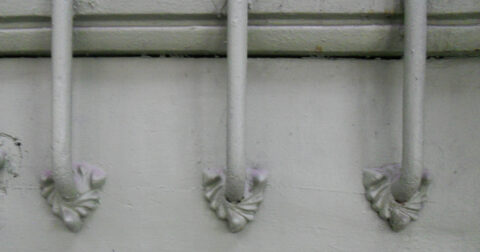
Decorative rings on the balusters of the service staircase at Castel Béranger. Photo by F. D.
In an upcoming article, we will discuss Guimard’s hardware produced outside of Castel Béranger and shortly thereafter.
Frédéric Descouturelle
In collaboration with Olivier Pons
Notes
[1] Patent filed on March 19, 1852, concerning the application of electric telegraphy to doorbells in residential buildings and hotels (INPI, patent no. 273684). At that time, no private individuals, nor even any companies or institutions, were connected to an electrical grid. These were not developed until the late 19th century by electric power companies. In Paris, the networks were interconnected in 1907. [2] The specimen from the Castel Henriette was donated to the Musée d’Orsay by Alain Blondel and Yves Plantin in 1979, OAO 485. [3] A patent filed on December 31, 1897, for an improvement to the return spring describes an electric variant of bell sliders (INPI, patent no. 273684).
Translation: Alan Bryden
Hector Guimard’s hardware Part Two: other hardware created for Castel Béranger
February 2026
All photos belonging to the authors or to the Cercle Guimard Archives and Documentation Center must be approved by the Cercle Guimard in the event of a publication project, regardless of the medium.
After an initial article devoted to the locks and porcelain knobs originally created for Castel Béranger, we continue our description of the other hardware created by Guimard with the Fontaine company, mainly to furnish the common areas and apartments of his first apartment building, but also several contemporary and later constructions up to the mid-1900s.
As we saw in the previous article, around 1900, Fontaine put together a prestigious portfolio featuring some of its most beautiful collaborative designs. The only plate relating to Guimard shows lock no. 276 (the only Guimard item to be published in Fontaine’s catalog) and the porcelain knob (which was actually produced by Sauzin) in the center. It also features other hardware from Castel Béranger: the bolt, the door handles in the common areas, the landing door handles in the apartments, and the handles and casings of the espagnolette locks, all photographed in much higher quality than in the Castel Béranger portfolio, where the appeal of the stencil coloring detracted from the sharpness of the photos.
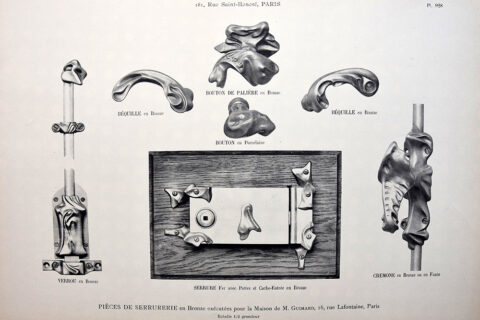
Portfolio plate Fontaine, s.d. (c. 1900). Musée Fontaine. Photo F. D.
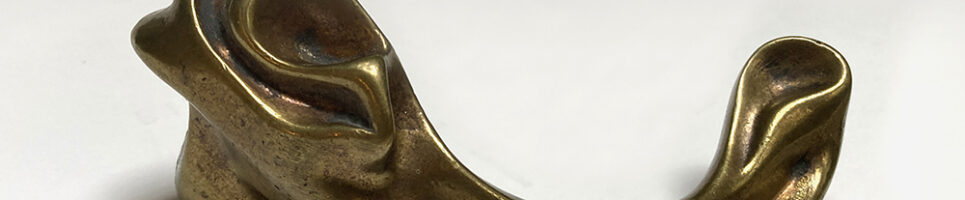
The brass (or bronze) door handle[1] is undoubtedly the most striking feature of this set. Found on apartment doors, it is fixed in place and is only used to pull the door shut by slamming it.
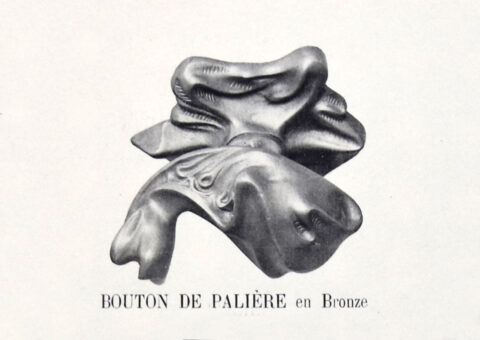
Portfolio plate Fontaine M (detail), s.d. (c. 1900). Musée Fontaine. Photo F. D
The Castel Béranger portfolio presents it from several angles.
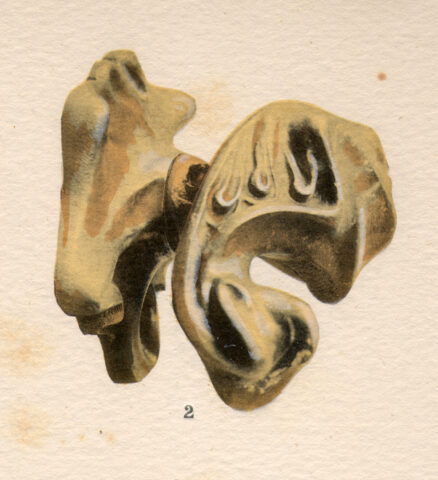
Door handle for apartments at Castel Béranger. Hector Guimard, L’Art dans l’Habitation moderne/Le Castel Béranger (Castel Béranger portfolio), pl. 35 (detail), Librairie Rouam, 1898. Private collection.
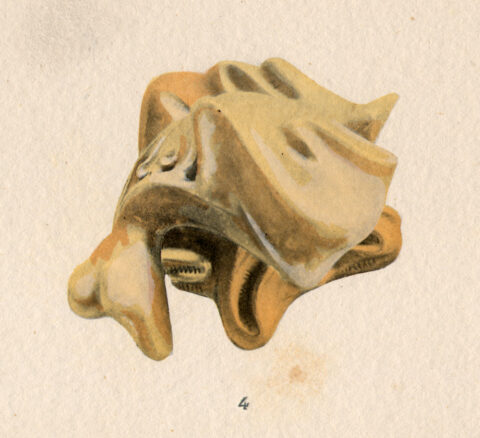
Door handle for apartments at Castel Béranger. Hector Guimard, L’Art dans l’Habitation moderne/Le Castel Béranger (Castel Béranger portfolio), pl. 35 (detail), Librairie Rouam, 1898. Private collection.
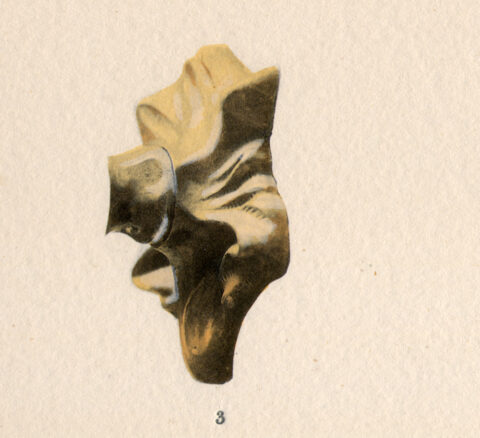
Escutcheon on the landing door handles of the apartments at Castel Béranger. Hector Guimard, L’Art dans l’Habitation moderne/Le Castel Béranger (Castel Béranger portfolio), pl. 35 (detail), Librairie Rouam, 1898. Private collection.
Like other common models of this type, it consists of three parts: first, a plate that is screwed onto the door and includes a threaded rod; second, a rosette with a hole in the center that overlaps the plate; and finally, a handle whose thread screws onto the rod of the plate before being locked in place by a through pin. The shape of this handle is complex, halfway between a knob, which it resembles in its compact form, and a lever, which it resembles in its distal end. At first glance, it seems less easy to grip than porcelain doorknobs, which do not have finger indentations, but whether placed upwards or downwards, its distal end fits perfectly between the thumb and index finger. Depending on the model, the F.T mark can be found on the plate or on the back of the rosette, where the number 630 also appears.
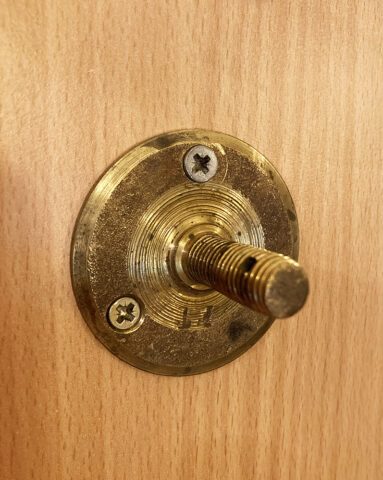
Plate from a landing handle at Castel Béranger. Private collection. Photo by F. D.
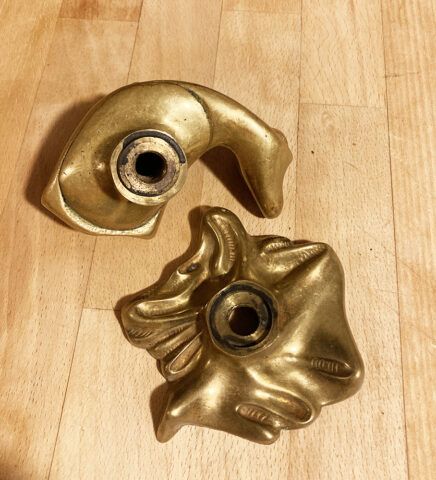
Door handle and escutcheon from a landing door at Castel Béranger. Private collection. Photo by F. D.
This landing handle was also present on the entrance door of the Castel Henriette in Sèvres (now destroyed).

Entrance door to Castel Henriette in Sèvres (1899–1903), portfolio Ferronneries de style Moderne, Ch. Schmid publisher, first edition, pl. XLIII (detail), undated (c. 1903), private collection.
Guimard also used it a little later for the doors of apartments in another apartment building: the Jassedé building (1903-1905) at 142 Avenue de Versailles in Paris, where it seems to have made its last appearance.
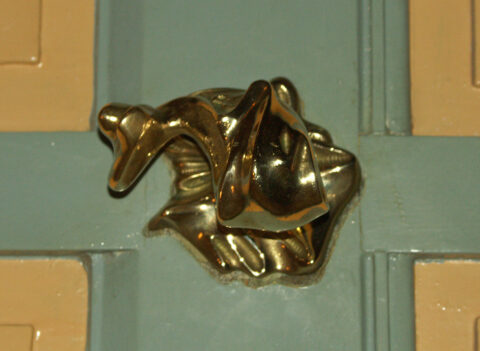
Door handle in the Jassedé building at 142 Avenue de Versailles. Photo F. D.
At Castel Béranger, they suffered the same fate as the porcelain knobs on the interior doors: they were stolen and resold. Those found in private collections, and which occasionally appear on the art market therefore mainly come from this building, where they were replaced by copies around 2000. The Cercle Guimard has also reissued a few of them in bronze, with the function of a door handle rather than a fixed knob.
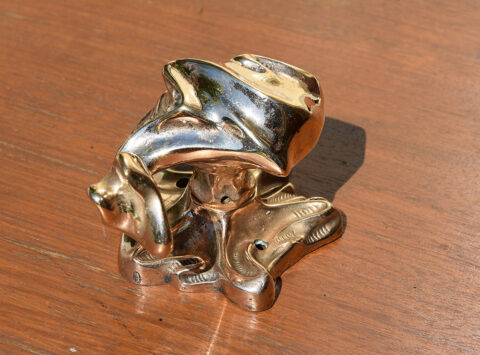
Copy of a door handle from Castel Béranger, reissued by the Cercle Guimard with the function of a door handle. Private collection. Photo F. D.
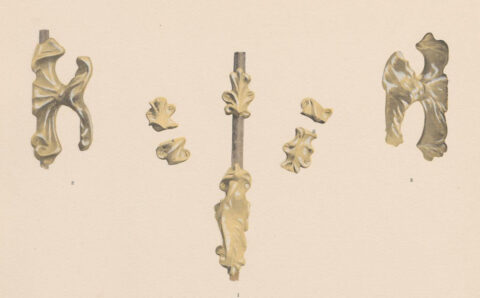
Also at Castel Béranger, Guimard installed brass (or bronze) door handles[2] in two different models, left and right, which are significantly different, on some of the doors in the common areas. The Fontaine M portfolio provides a beautiful photographic reproduction of these handles.
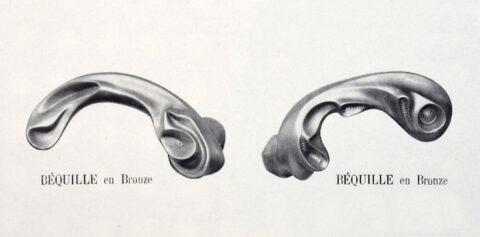
Right and left door handles of the Castel Béranger, plate from the Fontaine M portfolio (detail and photomontage), undated (c. 1900). The left door handle is on the right of the picture, and the right door handle is on the left of the image. Fontaine Museum. Photo F. D.
The Castel Béranger portfolio also provides a view of each model.
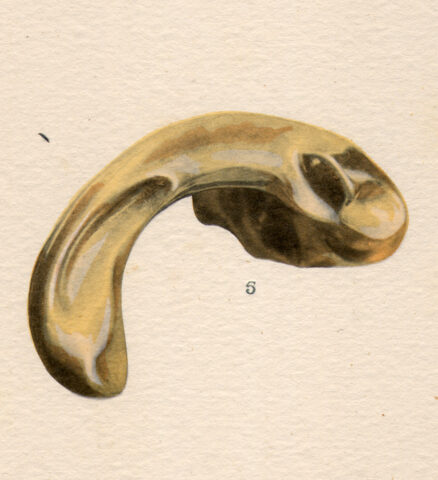
Right door handle from Castel Béranger. Hector Guimard, L’Art dans l’Habitation moderne/Le Castel Béranger (Castel Béranger portfolio), pl. 35 (detail), Librairie Rouam, 1898. Private collection.
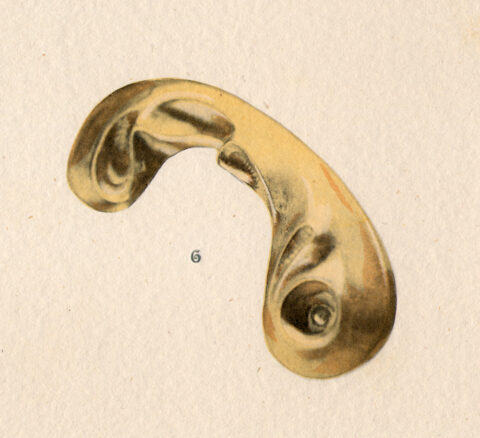
Left door handle from Castel Béranger. Hector Guimard, L’Art dans l’Habitation moderne/Le Castel Béranger (portfolio of Castel Béranger), pl. 35 (detail), Librairie Rouam, 1898. Private collection.
The right handle can be found in the series of photographs donated by Adeline Oppenheim-Guimard to the Bibliothèque des Arts Décoratifs in 1948.
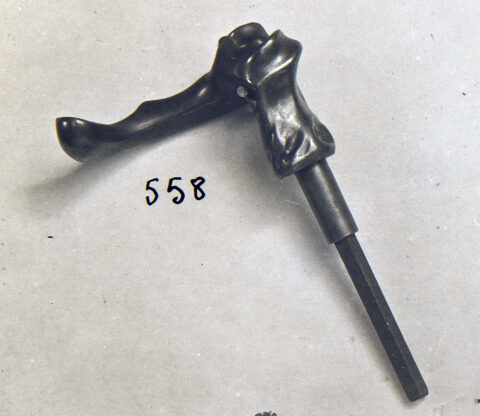
Right handle from the Castel Béranger. Bibliothèque des Arts Décoratifs, donated by Adeline Oppenheim-Guimard, 1948, photo by Laurent Sully Jaulmes (detail).
Guimard seems to have made relatively little use of these door handles. However, the left-hand model can be found on the front door of the Coutolleau store in Angers in 1897. The right-hand model was probably on the inside.
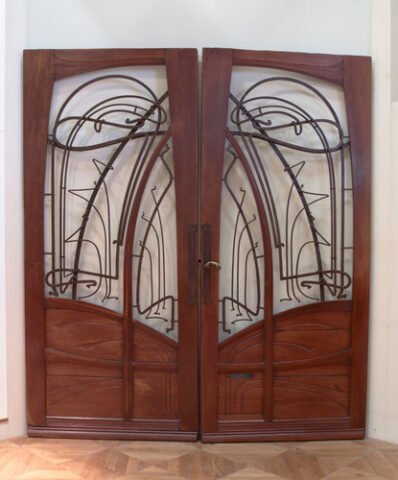
Double door from the front of the Coutolleau store in Angers, 1897. Musée d’Orsay, OAO 1194. Photo RMN-Grand Palais (Musée d’Orsay)/Hervé Lewandowski.
Similarly, these two models of handles were placed on either side of the front door of the Coilliot house in Lille (1898-1900).
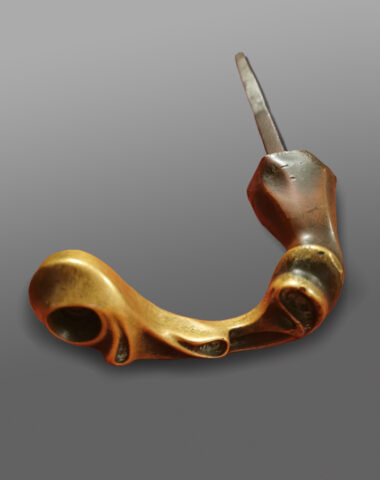
Left door handle from Castel Béranger, originally located outside the front door of the Maison Coilliot (1899–1900). Private collection.
These door handles are therefore much rarer than porcelain doorknobs, but a few have appeared on the art market and may have been purchased.
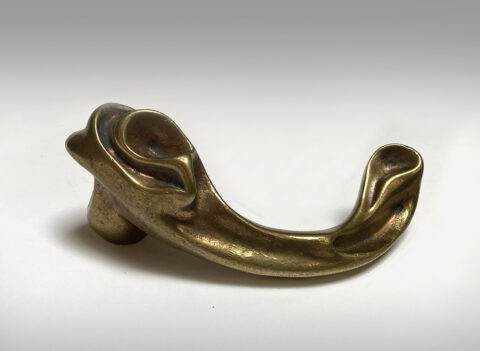
Right handle from Castel Béranger with the base cut off. Private collection. Photo F. D.
The Cercle Guimard has also reproduced a few bronze copies of the right handle.
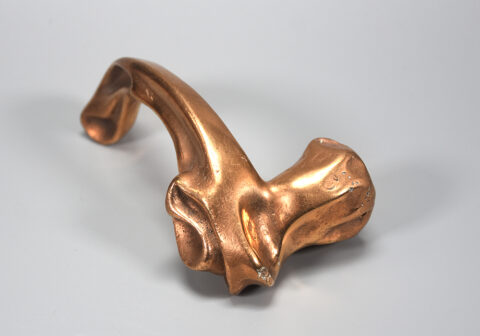
Copy of a right handle from Castel Béranger, reproduced by the Cercle Guimard. Coll. part. Photo F. D.
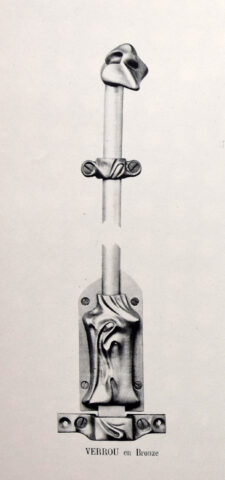
The brass (or bronze) lock model[3] used at Castel Béranger is little known. However, it was present on the upper and lower parts of many double doors in the building’s apartments.

Furniture and decorative objects by Guimard, photographed in the living room of an apartment in Castel Béranger, on the second floor, at the corner of Rue La Fontaine and Hameau Béranger. The locks on the double door are framed in red. Photograph published in Revue d’Art No. 1, November 1899. Private collection.
The Castel Béranger portfolio details the various components: upper bolt knob (9), lower bolt knob (10), rod guide (11), upper strike plate (12), strike plate (13)

Lock from Castel Béranger. Hector Guimard, L’Art dans l’Habitation moderne/Le Castel Béranger (portfolio of Castel Béranger), pl. 56 (photomontage), Librairie Rouam, 1898. Private collection.
There are actually two different models: an upper lock,
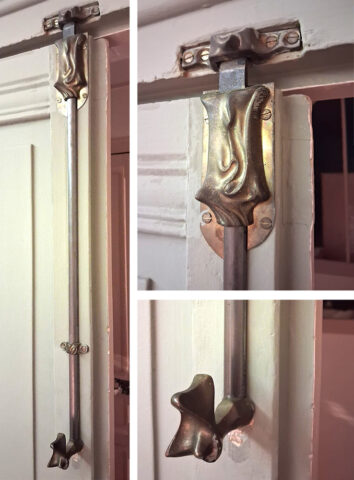
Upper lock of a door at Castel Béranger. Photos O. P.
and a lower lock. The plate and rod guide are common to both locks, while their knobs are different and only the upper lock has a strike plate (the lower lock’s strike plate is a simple metal plate screwed to the floor).
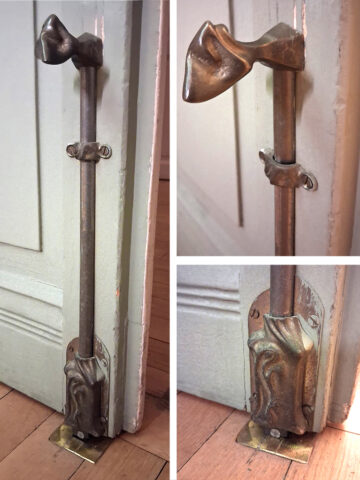
Lower lock of a door at Castel Béranger. Photos O. P.
Curiously, the Fontaine M portfolio features a lower lock with an upper strike plate.
Lower lock Castel Béranger (with an upper stike plate), portfolio Fontaine M (détail), s.d. (c. 1900). Musée Fontaine. Photo F. D.
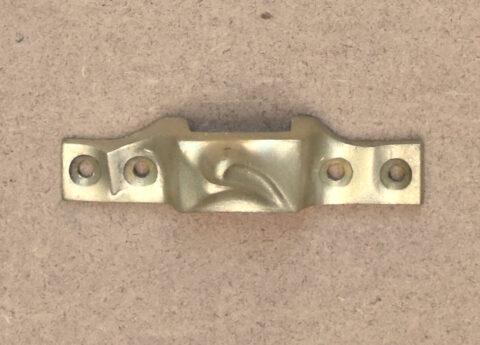
Upper strike plate stripped from the lock of Castel Béranger, brass. Private collection. Photo F. D.
These locks were most likely used by Guimard on buildings contemporary with or slightly later than the Castel Béranger. We know this for certain in the case of the Castel Henriette and the Castel Val in Auvers-sur-Oise.
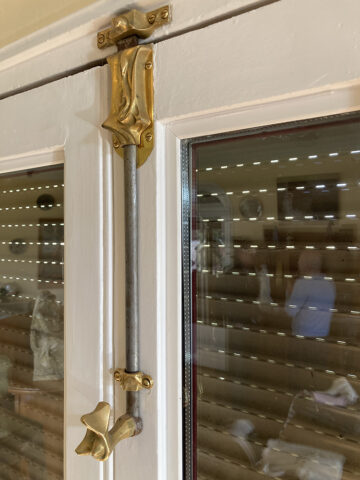
Upper lock on the French windows in the living room and dining room of the Castel Val in Auvers-sur-Oise. Photo F. D.
The espagnolette systems at Castel Béranger were also produced by Fontaine in large numbers, as they were used on all the windows, both interior and exterior, of the building. The rods are half-round with a width of 16 mm.
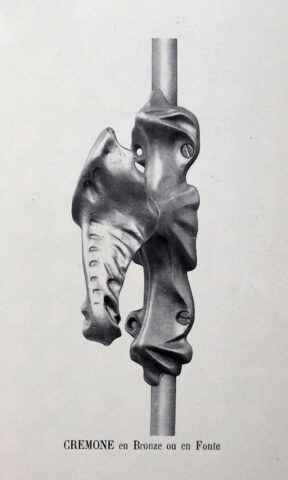
Casing and handle from Castel Béranger of an espagnolette, portfolio Fontaine M (detail), s.d. (c. 1900). Musée Fontaine. Photo F. D.
Espagnolette from Castel Béranger. Hector Guimard, L’Art dans l’Habitation moderne/Le Castel Béranger (portfolio of Castel Béranger), pl. 57 (photomontage), Librairie Rouam, 1898. Private collection.
As shown in the Fontaine M portfolio plate, their components were cast in two materials with different appearances and costs: cast iron and brass (or bronze)[4]. It is likely that the brass versions were intended for windows in reception rooms such as living rooms (below). The cast iron versions, intended to be painted, were probably relegated to other areas.
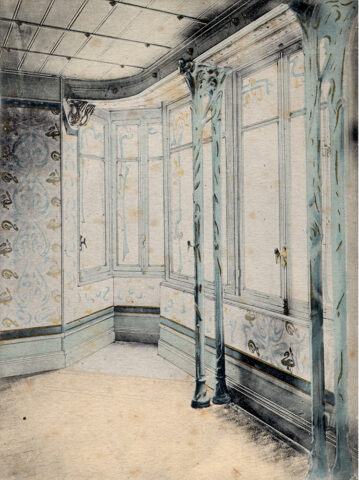
Living room of an apartment in Castel Béranger, on the second floor, at the corner of Rue La Fontaine and Hameau Béranger. Hector Guimard, L’Art dans l’Habitation moderne/Le Castel Béranger (portfolio of Castel Béranger), pl. 49 (detail), Librairie Rouam, 1898. Private collection.
However, brass handles are often found on cast iron systems, without it being possible to know whether they were originally placed there or whether they have been moved since.
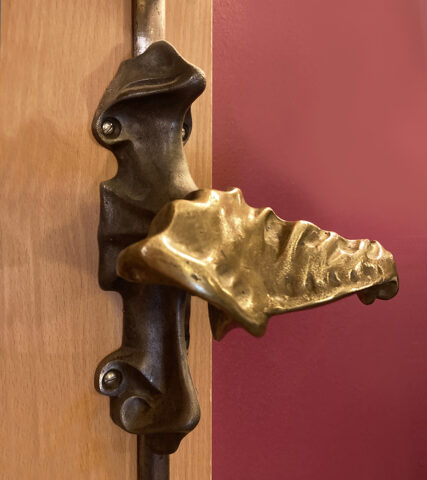
Cast iron casing and brass handle from a espagnolette bolt system from Castel Béranger. Private collection. Photo F. D.
When the components of the espagnolette systems are made of cast iron, their finish is unusually refined.
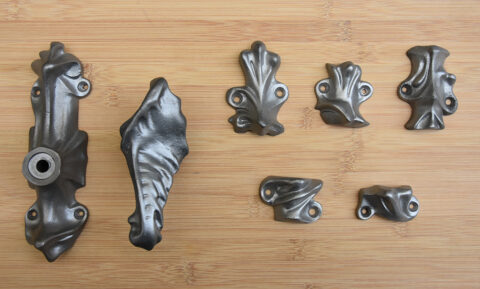
Stripped cast iron elements from an espagnolette system, possibly from Castel Henriette. From left to right: casing, handle; top: middle rod guide, upper rod guide, lower rod guide; bottom: lower strike plate and upper strike plate. Private collection. Photo F. D.
These espagnolette systems were most likely used by Guimard on buildings contemporary with or slightly later than the Castel Béranger. We know this to be true for the Castel Henriette and the Castel Val.
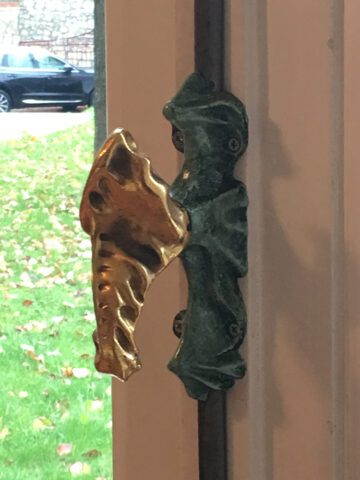
Cast iron casing and brass espagnolette handle at Castel Val. Photo F. D.
For the restoration of Castel Béranger in 2000, copies were made by the Rollinger foundry in Nouvion-sur-Meuse to replace the missing espagnolette systems.
The Cercle Guimard also reissued a few copies in bronze.
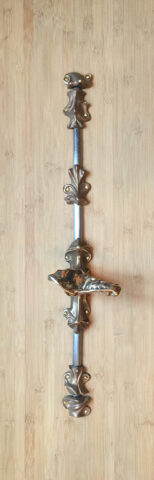
Copy of a bronze espagnolette system by the Cercle Guimard. Coll. part. Photo F. D.
In a future article, we will examine the latest hardware from Castel Béranger produced by Fontaine.
Frédéric Descouturelle
in collaboration with Olivier Pons
Notes
[1] The Castel Béranger portfolio lists them as copper, while the Fontaine M portfolio lists them as bronze. In the field of hardware, differences and confusion between the names of these alloys, whether commercial, customary, or scientific, are very common.
[2] Ibid.
[3] The Castel Béranger portfolio lists them as copper, while the Fontaine M portfolio lists them as bronze. Observation of an old model shows traces of gilding. The back plate of the lock is brass, and the half-round rods and bolts are iron.
[4] The Castel Béranger portfolio does not indicate the type of metal, while the Fontaine M portfolio lists them as bronze or cast iron.
Bibliography
Hector Guimard, L’Art dans l’Habitation moderne/Le Castel Béranger (Castel Béranger portfolio), Librairie Rouam, 1898.
Portfolio M Fontaine, “Maison Fontaine/181/Rue St-Honoré Paris/M,” undated (c. 1900).
Thiébaut, Philippe, collective work edited by, Guimard, catalog of the exhibition “Guimard” in Paris from April 13, 1992, to July 26, 1992, and in Lyon from September 23, 1992, to January 3, 1993, Paris, Musée d’Orsay/RMN, 1992.
Translation: Alan Bryden
Hector Guimard’s hardware fittings — Part One: the locks and doorknobs of Castel Béranger
All photos belonging to the authors or to the Cercle Guimard Archives and Documentation Center must be approved by the Cercle Guimard in the event of a publication project, regardless of the medium
After compiling an inventory of the hardware fittings at the hôtel Mezzara and requesting an auction house that a new misattribution to Hector Guimard [1] be removed, we wanted to summarize what we know about the hardware fittings created by the architect. Our knowledge of this subject has progressed in recent years, but we may modify this article in the future. Despite the uncertainties that remain, we have chosen to work chronologically and by manufacturer. This study will eventually be included in a book devoted to Guimard’s fixed decorations.
During his early period of architectural creation, i.e., before Castel Béranger (1895-1898), Guimard does not seem to have created any specific hardware designs, unlike what he had done for his ceramic decorations produced by Muller & Cie[2]. He therefore used those available in the manufacturers’ extensive catalogs, simply avoiding historical styles.
The first “Guimard” models therefore appeared with Castel Béranger, his first modernist building, for which he insisted on designing every detail, taking on both an artistic and industrial challenge. In fact, apart from the hinges on the doors and cupboards, none of the hardware in Castel Béranger came from a pre-existing commercial catalog designed by an anonymous industrial artist. As with the other fixed decorative items (ceramics, fireplaces, moldings, wallpaper, Lincrusta-Walton, etc.), the number of apartments to be furnished (36) was sufficient to justify the financial investment in creating new designs.
As evidenced by the list of contractors provided by Guimard in the introduction to the Castel Béranger portfolio[3], the company chosen was the prestigious Maison Fontaine, which, in its current communications, claims to be the oldest artistic locksmith’s in Europe. It was founded in 1740 by Mr. Lavollée at 269 Rue Saint-Honoré in Paris, then taken over in 1842 or 1846 by François and Joseph Fontaine, moved in 1854 to 13 Rue Molière, then in 1866 to 181 Rue Saint-Honoré in Paris, where it is still located today. Through successive ownership changes and shareholder changes, it has had various names: Fontaine et Quintart in 1889, then H. E. et L. Fontaine in 1891, Maison Fontaine H. E. & L. Fontaine in 1895, and finally Maison H. et L. Fontaine frères et Vaillant in 1899[4]. When the Castel Béranger portfolio was printed in 1898, Guimard still referred to the company as “H. et L. Fontaine.”

Hector Guimard, L’Art dans l’Habitation moderne/Le Castel Béranger (portfolio of Castel Béranger), table of plates (detail), Librairie Rouam, 1898. Private collection.
Two years later, on the occasion of the World Exhibition in Paris, in August 1900, Fontaine published an extract from its catalog featuring numerous modern designs.
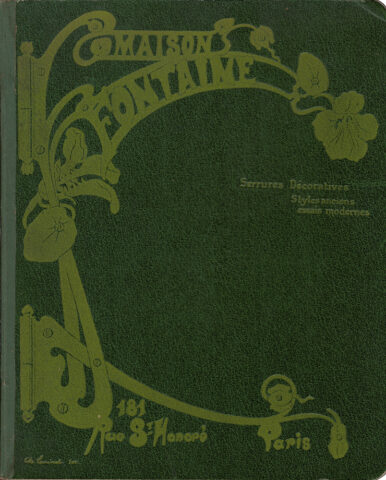
Cover of the Fontaine catalog published in August 1900. “Maison Fontaine/Decorative locks/Antique styles/Modern designs/181/Rue St-Honoré/Paris.” Private collection.
The first page gives the name of the company, which was then “Fontaine Frères & Vaillant,” and mentions the presence of the factory and modeling workshop in Boulogne-sur-Seine.
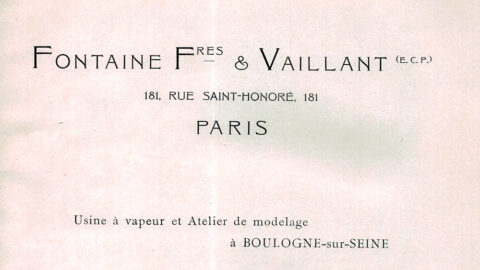
First page of the Fontaine catalogue (detail) published in August 1900. Private collection
On an invoice from 1912, the company name was simplified to “Fontaine & Vaillant.” For convenience, we will refer to the company as Fontaine in the rest of this article.
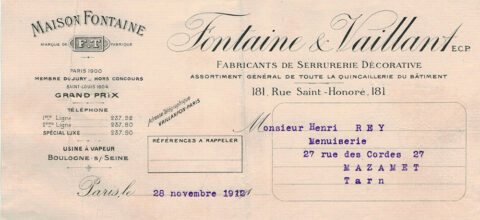
Letter head of an invoice by the Maison Fontaine, dated 28 November 1912 Private collection
A detail of this header shows the “F.T” mark constantly used by the Fontaine company, which had been acquired from the Fromentin company when its business was bought out.
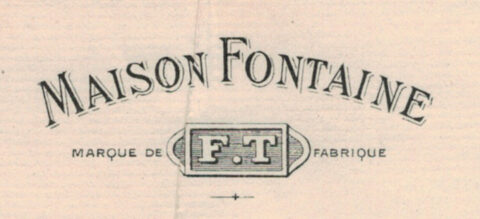
Detail of a header of an invoice by Maison Fontaine, dated 28 November 1912. Private collection
On commercially available parts, the “F.T” mark appears in the form of a plate similar to that on the header, or as a stamp.
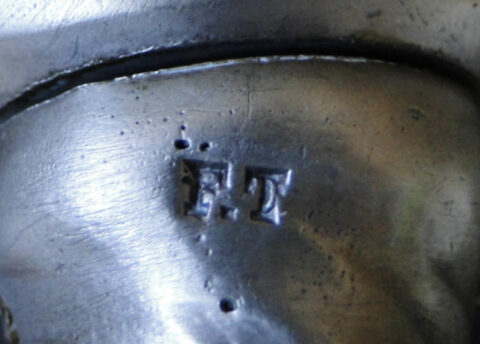
Stamp « F.T » on the handle of an Eriksson espagnolette edited by Fontaine Private collection
At the time of Castel Béranger, although the serial production of models for this building implicitly foreshadowed their reuse by Guimard for other contemporary buildings[5], the architect did not envisage publishing them in a catalog. He made an exception for the surface-mounted lock model that appears in the August 1900 extract from the Fontaine catalog.
This lock appears on plate 585 alongside other modern models. Five of them are by Alexandre Charpentier, who applied his talent as a medalist to rectangular surfaces. Three others were designed by Christian Eriksson, including two double lock models. One of them, entitled La Curiosité (No. 214), features a highly detailed, figurative, even symbolist decoration.

Plate 585 from the Fontaine catalog excerpt, August 1900. Private collection.
In contrast, Eriksson’s lock No. 244 is much simpler, as four mounting brackets are arranged around standard parallelepipedal steel safe and strike plate models.
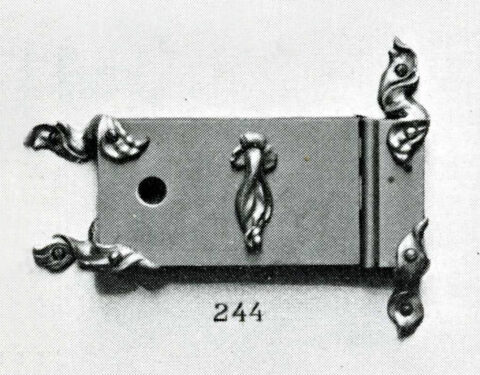
Christian Eriksson, lock n° 244, pl. 585 extract of the Fontaine catalogue, August 1900. Private collection
These spark-shaped brackets bear a strong resemblance to those created by Guimard for a similar lock model, listed in the Fontaine catalog with a later number (No. 276). Guimard’s, which are simpler, appear to be made of a malleable material that was applied and twisted by hand onto the lock and woodwork[6]. As for the door cover, it gives the impression of hanging from its fixing point.
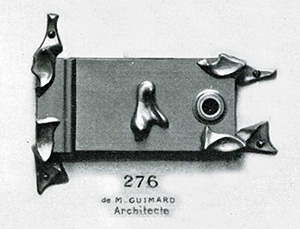
Hector Guimard, lock n° 276, pl. 585 extract from the Fontaine catalogue, August 1900. Private collection.
In the Castel Béranger portfolio, Guimard presents a colored version of his lock. The box and strike plate appear bordered by a gold trim that matches the color of the brass mounting brackets[7].
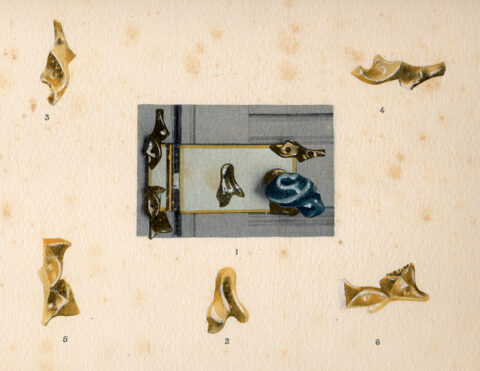
Hector Guimard, L’Art dans l’Habitation moderne/Le Castel Béranger (portfolio of Castel Béranger), pl. 56 (détail), Librairie Rouam, 1898. Private collection
These brackets appear to hold the lock in place, but in reality, they serve little more than a decorative purpose, as the safe and strike plate are actually secured to the door frame by sturdy screws that are not visible.
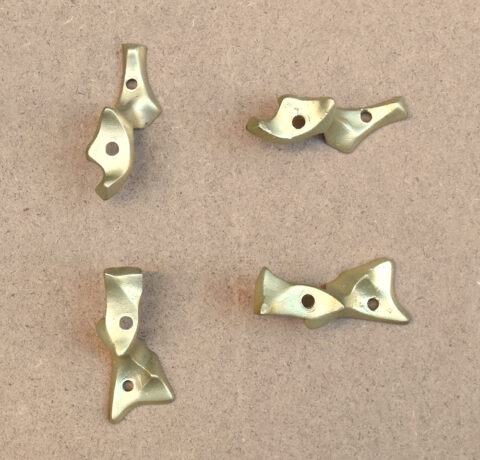
Stripped mounting brackets from Guimard lock no. 276, brass. Private Collection
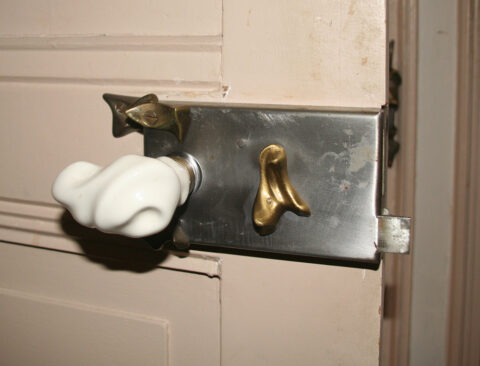
Guimard lock no. 276 with mounting brackets and entrance cover at Castel Béranger. The porcelain doorknob is a modern replica. Photo by Ondine Schneider.
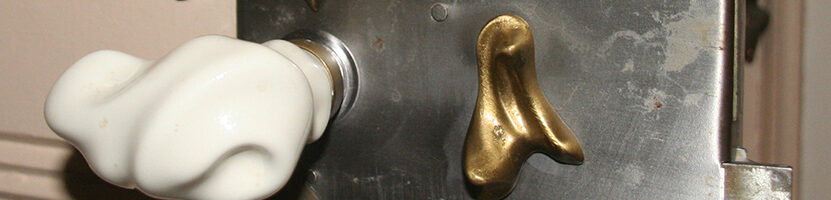
For these locks at Castel Béranger, Guimard created a porcelain knob design in two colors: white and blue.
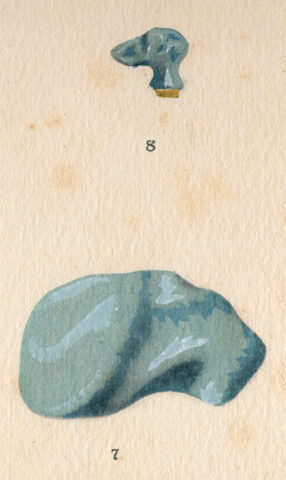
Hector Guimard, L’Art dans l’Habitation moderne/Le Castel Béranger (portfolio du Castel Béranger), pl. 56 (detail), Librairie Rouam, 1898. Private collection.
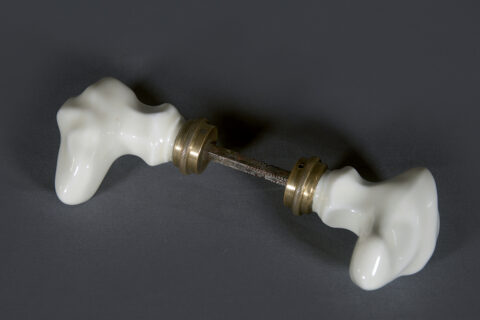
Two Guimard/Sauzin doorknobs, marked “S” and “Z” under the ferrule.
Private collection. Photo F. D.
These buttons were produced by Sauzin[8] but were not sold outside of Guimard’s orders. Sauzin was a fairly old company at the time, as two patents were filed in 1868 for a porcelain tap and a ceramic kiln, at two different addresses in the 10th arrondissement of Paris. The production plant already existed in Montreuil-sous-Bois in 1875, before going bankrupt in 1876. Twenty years later, in 1896—at the time of the construction of the Castel Béranger—Charles Sauzin filed a patent for a double knob with a claw and locking screw, which could not be removed. The company headquarters had then moved to 16 rue de la Folie-Méricourt in the 11th arrondissement. Louis Masson succeeded Charles Sauzin between 1899 and 1903, and later, the company came under the management of O. Vandenbossche, attested from 1921 onwards.
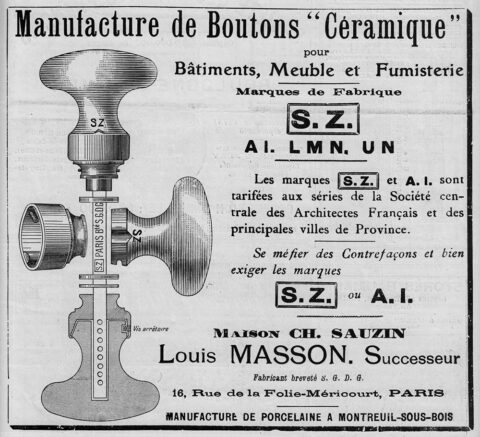
Ad for the Maison Sauzin published in La Construction Moderne 9 February 1913. Private collection.
These buttons (associated with Fontaine locks no. 276) can be found on two buildings chronologically close to Castel Béranger: Castel Henriette and the Hotel Roy. But unlike most of the other hardware items created for Castel Béranger, Guimard used them until World War I, even though they were gradually relegated from reception areas in favor of new brass door handle models. Their more innocuous form than his other creations from this early Art Nouveau period allowed them to blend seamlessly into his stylistic developments.
Guimard also had a brass (or bronze) version made for use at the Coilliot house in Lille. Due to their entirely metallic nature, it is possible that these knobs were produced by the Fontaine company.
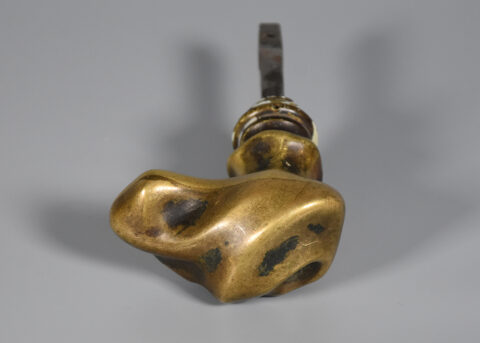
Brass (or bronze) doorknob from the Coilliot company in Lille (1898-1900). Coll. Hector Guimard Diffusion. Photo F. D.
A few years later, when fitting out buildings on Rue Gros, Rue La Fontaine, and Rue Agar, as well as the Hôtel Mezzara and then the Villa Hemsy in Saint-Cloud, Guimard wanted to market this porcelain knob. He therefore entrusted its production to another company: Paquet in Grenoble. Founded in 1872, we know about its production thanks to a catalog dated 1912, which reveals that the company specialized in metal items for the building industry. It offered only five models of doorknobs, only three of which were made of porcelain, which suggests that it probably sourced its porcelain from a subcontractor. Their assembly used the “LP mount” (probably the initials of the company’s founder), which was reputed to be indestructible. The company continued to operate at least until the 1930s.
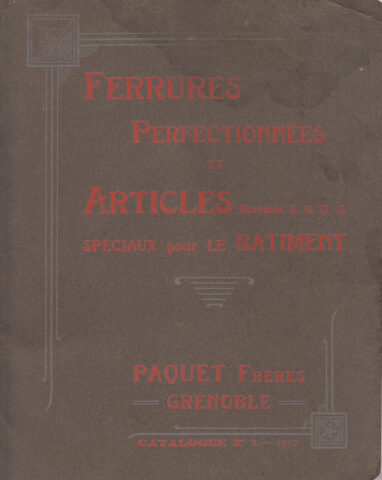
Catalogue n° 3 of the Maison Paquet in 1912, cover. Private collection.
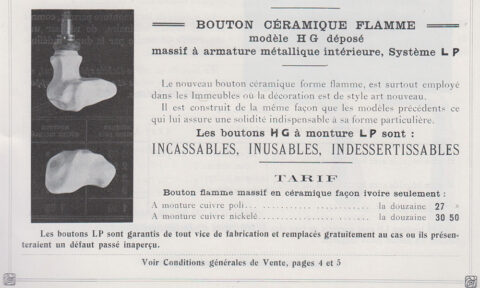
Catalogue n° 3 of the Maison Paquet in 1912, p. 63. Private collection.
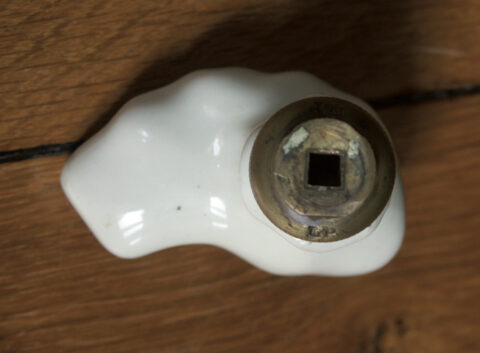
Guimard door knob /Paquet, marque « LP » on the ferrule, hôtel Mezzara. Photo F. D.
At Guimard’s request, Paquet undertook in letters dated February 22 and April 11, 1911, to refer to his knob as the “Modèle Style Nouveau H. G.”[9]. However, although the wording used in the published catalog retained the architect’s initials, the reference to “Style Nouveau” was removed. Paquet only offered it in ivory white and gave it the commercial name “flamed ceramic knob.” While this descriptive name is certainly satisfactory, the true explanation for the dynamic shape of this doorknob was not revealed until much later. In the obituary he wrote for him, published in the first issue of the magazine L’Architecture d’aujourd’hui in May-June 1945, Adolphe Dervaux, a colleague and friend of Guimard, wrote:
“So what was the doorknob supposed to be, if not an easy lever that fits in the hand? He would take a little soft clay and press his fingers into it: voilà, the doorknob! “
This experiment can easily be repeated: taking a lump of modeling clay in the left hand gives the general shape of the knob, before passing it to the right hand to imprint the thumb and middle finger. Despite its asymmetrical shape, this knob can thus be easily manipulated with both hands and used on either side of the door. With this simple hardware accessory, Guimard radically broke with tradition in the field of decorative art. Its regular presence on the art market [10] has made it one of Guimard’s best-known creations, and copies continue to be sold.
Around 1900, and undoubtedly also on the occasion of the World’s Exhibition, the Fontaine company, in addition to the catalog excerpt mentioned above, produced a portfolio, a prestigious publication bringing together some of the most beautiful models that had been the subject of collaboration.
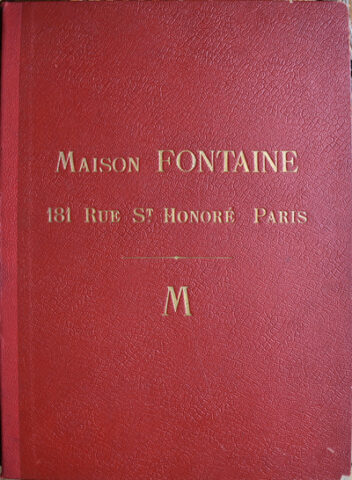
Portfolio Fontaine M, s.d. (c. 1900). Musée Fontaine. Photo F. D.
This time, the portfolio included several Guimard designs created for Castel Béranger, including the porcelain knobs for the locks, but without mentioning the name of their manufacturer.
Portfolio plate Fontaine M, undated (c. 1900). Fontaine Museum. Photo F. D.
The other Guimard models featured in this illustration will be the subject of a future article.
Frédéric Descouturelle
in collaboration with Olivier Pons
We express our thanks to Christine Soulier, in charge of decorative hardware at the Maison Fontaine.
Notes
[1] See our article on Eriksson hardware.
[2] Many of the ceramic decorations in Guimard’s early villas are featured in the Muller & Cie catalog (see our article from 2020 on this subject). However, as this catalog dates from 1904, we do not know precisely when Guimard actually made his designs available to the public.
[3] Hector Guimard, L’Art dans l’Habitation moderne/Le Castel Béranger, Librairie Rouam, 1898.
[4] See the Musée d’Orsay entry on the Maison Fontaine. The initials H, E, and L refer to Henri, Émile, and Lucien Fontaine, sons of Joseph Fontaine.
[5] With the notable exception of the Villa Berthe in Le Vésinet.
[6] It would be risky to claim that Guimard simplified Eriksson’s door handles and door covers or that, on the contrary, Eriksson “enriched” Guimard’s. As we noted in our article on Eriksson’s hardware, the two artists followed parallel ideas that emphasized manual modeling; Eriksson, faithful to his training as a sculptor, remained more figurative, while Guimard was more abstract.
[7] The Castel Béranger portfolio and the Fontaine portfolio list them as being made of bronze.
[8] See Descouturelle, Frédéric; Pons, Olivier, La Céramique et la lave émaillée d’Hector Guimard, pp. 82-83, Éditions du Cercle Guimard, 2022.
[9] Adeline Oppenheim Guimard papers. New York Public Library.
[10] In the 1980s and 1990s, the prospect of easy money led the tenants of Castel Béranger to strip the building of all its doorknobs. All those currently in place are copies made around 2000 during restoration work.
Bibliography
Hector Guimard, L’Art dans l’Habitation moderne/Le Castel Béranger (portfolio of Castel Béranger), Librairie Rouam, 1898.
Fontaine catalog, “Maison Fontaine/Decorative locks/Antique styles/Modern designs/181/Rue St-Honoré/Paris,” August 1900.
Fontaine portfolio, “Maison Fontaine/181/Rue St-Honoré Paris/M,” undated (c. 1900).
Paquet catalog no. 3, 1912.
La Construction Moderne, February 9, 1913.
Dervaux, Adolphe, “Hector Guimard animateur,” L’Architecture d’aujourd’hui, no. 1, May-June 1945, p. 28.
Thiébaut, Philippe, collective work edited by, Guimard, catalog of the exhibition “Guimard” in Paris from April 13, 1992, to July 26, 1992, and in Lyon from September 23, 1992, to January 3, 1993, Paris, Musée d’Orsay/RMN, 1992.
Descouturelle, Frédéric; Pons Olivier, La Céramique et la Lave émaillée d’Hector Guimard, Éditions du Cercle Guimard, 2022.
Translation : Alan Bryden