
Hector Guimard’s hardware — Part Three: The last hardware at Castel Béranger
1 March 2026
All photos owned by the authors or by the Cercle Guimard Archives and Documentation Center must, without exception, be approved by the Cercle Guimard for any publication project, regardless of the medium.
Following two articles devoted to the door and window hardware of Castel Béranger, we continue our description of the other hardware pieces created by Guimard in collaboration with the Fontaine company or the Durenne foundry for his first apartment building. Some were produced for each apartment and can still occasionally be found in the building, though more often on the art market. Others were likely cast as one-of-a-kind pieces and have, for the time being, disappeared.
Found on every apartment landing door, the doorbell buttons feature a roughly square base plate whose central section appears crumpled and whose four corners seem flattened by the pressure exerted by the screws securing it to the wall. Guimard revisited this concept of material deformation on numerous occasions, such as in the transverse fasteners originally designed for the porticos of the metro’s open-air entrances.
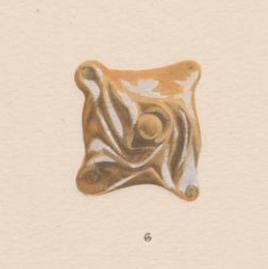
Doorbell button for the apartment doors at Castel Béranger. Hector Guimard, *Art in Modern Housing/Castel Béranger* (Castel Béranger portfolio), plate 35 (detail), Librairie Rouam, 1898. Private collection.
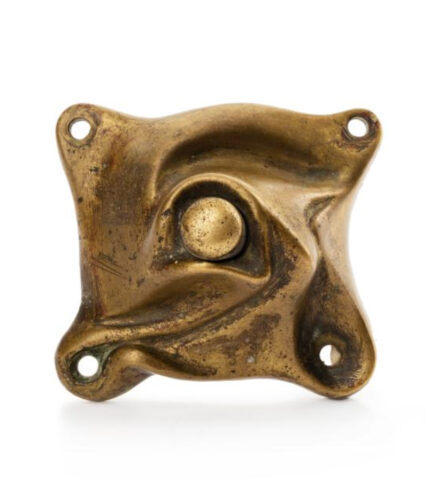
Doorbell button from the apartments at Castel Béranger. Height: 6 cm, width: 6.5 cm, depth: 3 cm. Private collection.
Their mechanism (a spring-loaded push button) and, even more so, the term used in the captions for Plate 35 of the Castel Béranger portfolio-“electric bell buttons”-leave no doubt that electricity was present within Castel Béranger. Although the principle of the electric doorbell was patented as early as 1852[1], this source of energy—which was particularly modern in 1895–1898—does not appear to have been used for lighting there. In his portfolio, Guimard remains, moreover, very discreet about the lighting fixtures in use in the building. The lantern in the courtyard, with its chimney protected by a cap, could have been gas-powered. But it cannot be ruled out that, at the time of their delivery, the apartments were simply lit by oil lamps suspended from the ceilings, as we will see later.
This model of doorbell button was used by Guimard at least for the Castel Henriette[2]. But other locations may have existed, as evidenced by this example set into a stone (slate?) plaque whose contours follow those of the plate, smoothing them out. It is possible that this is the doorbell for the gate leading to the parish hall of the Salle Humbert de Romans. In that case, the electrical wire emerging from the right side and running along a stone joint indicates how Guimard intended the button to be positioned (rotated 180° relative to the photo in the portfolio).
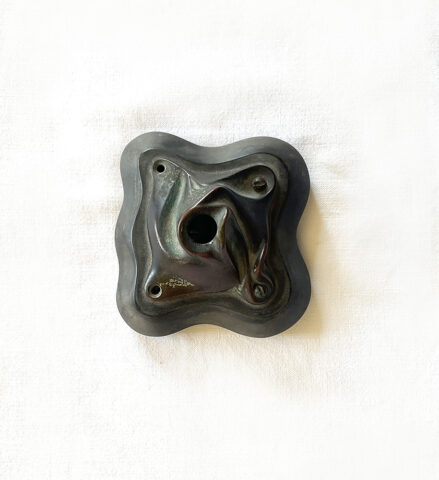
Electric doorbell button on a stone plaque. Private collection. Photo by Elisa Tenorio.
Most of the original pieces at Castel Béranger met the same fate as other Guimard hardware: they were stolen and then collected or resold. As a result, most of the doorbells currently installed in the apartments are replicas.
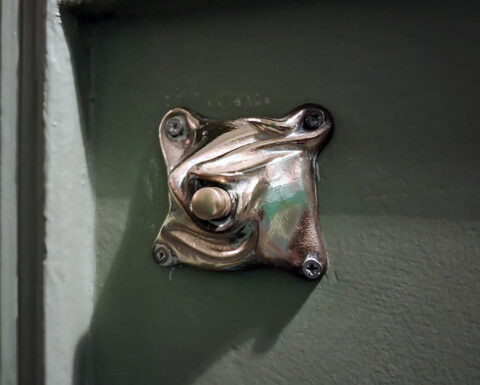
Copy of a doorbell button at Castel Béranger. Photo O. P.
Another type of electric doorbell appears on the same page of the Castel Béranger portfolio and is included under the same caption, “electric doorbell buttons.” This time, it is an electric bell, which was likely used to summon the servants. The apartments at Castel Béranger, which were intended for a clientele of the lower and middle classes, did not have a service area, but it was possible to rent maids’ rooms on the sixth floor. None of these bell pull handles are currently known to exist.
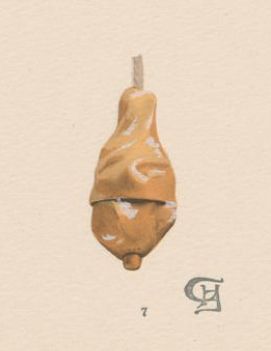
Electric doorbell pull in the apartments of the Castel Béranger. Hector Guimard, *Art in Modern Housing/The Castel Béranger* (Castel Béranger portfolio), plate 57 (detail), Librairie Rouam, 1898. Private collection.
A third doorbell mechanism is the “bronze slider for the main entrance on an enameled lava plate,” reproduced on plate 35 of the portfolio. It was likely produced in very limited numbers and was probably installed only at Castel Béranger.
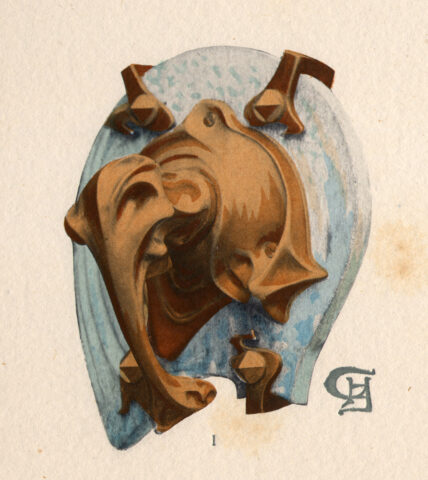
Doorbell slider at the entrance to the Castel Béranger. Hector Guimard, *Art in Modern Housing/The Castel Béranger* (Castel Béranger portfolio), plate 35 (detail), Librairie Rouam, 1898. Private collection.
The metal elements can be seen in item no. 628, in a photograph donated by Adeline Oppenheim-Guimard to the Bibliothèque des Arts décoratifs in 1948. They appear alongside other hardware pieces from the same period or later.
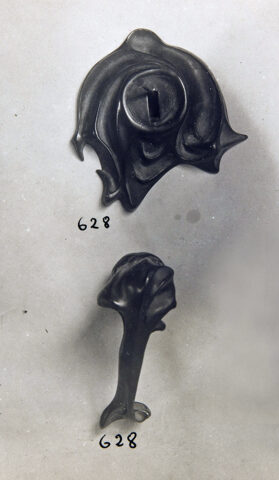
Bronze doorbell slider from Castel Béranger. Bibliothèque des Arts Décoratifs, gift of Adeline Oppenheim-Guimard, 1948, photo by Laurent Sully Jaulmes (detail).
This type of doorbell could operate mechanically (via a cable that rang a bell) or electrically [3]. Its position on the section of the gate between the gate leaf and the right-hand post suggests that it was likely an electrical mechanism, which takes up less space. The bell rang in the concierge’s lodge, where the concierge would then pull a cord to open the door.
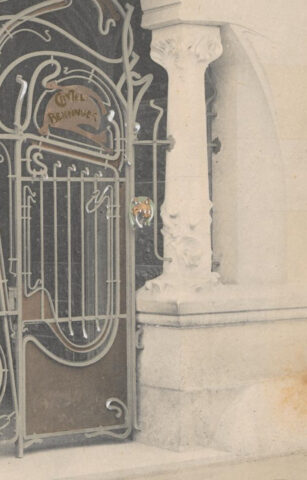
Gateway to the Castel Béranger. Hector Guimard, *Art in Modern Housing/The Castel Béranger* (Castel Béranger portfolio), plate 4 (detail), Librairie Rouam, 1898. ETH Library Zurich http://www.e-rara.ch/doi/10.3931/e-rara-27774
Unfortunately, this slider was gone by 1963. A photograph taken that year shows that it had already been replaced by a standard electric doorbell button.
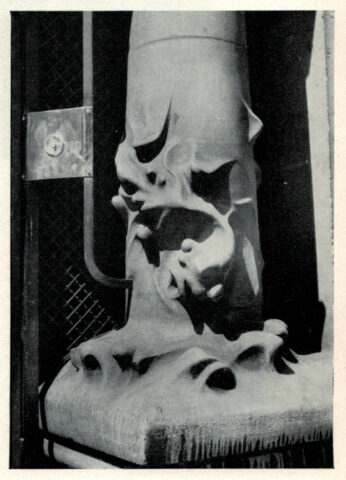
Detail of the gate at Castel Béranger featuring a standard electric doorbell button. Revue Bizarre No. 27, p. 9, 1st quarter 1963. Photo by P. Jahan.
Another hardware item that was likely produced as a one-off is the faucet on the courtyard fountain.
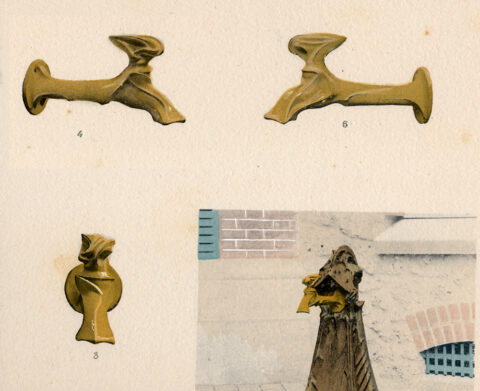
Fountain faucet in the courtyard of Castel Béranger. Hector Guimard, *Art in Modern Housing/Castel Béranger* (Castel Béranger portfolio), plate 14 (detail), Librairie Rouam, 1898. ETH Library Zurich http://www.e-rara.ch/doi/10.3931/e-rara-27774
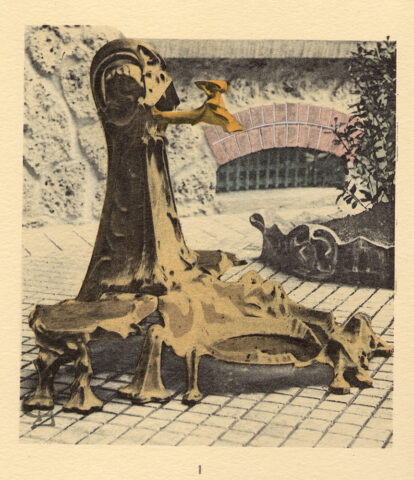
Fountain in the courtyard of Castel Béranger. Hector Guimard, *Art in Modern Housing/Castel Béranger* (Castel Béranger portfolio), plate 14 (detail), Librairie Rouam, 1898. Private collection.
Although the cast-iron fountain, which was likely originally bronze-plate, still exists, the faucet disappeared at some unknown point in time and was replaced by a plain faucet that is too short to fill a bucket placed in the central basin.
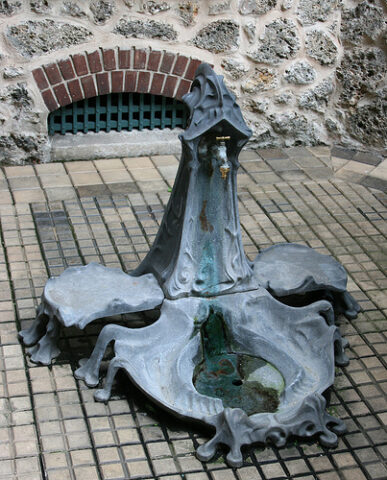
Fountain in the courtyard of Castel Béranger, current state Rights reserved
It is undoubtedly in the studs on the stair carpet rods that Guimard’s commitment to paying attention to every decorative detail is most evident (see our article on Guimard’s carpets and rugs). On what is necessarily a simple piece, Guimard incorporates a side pinch.
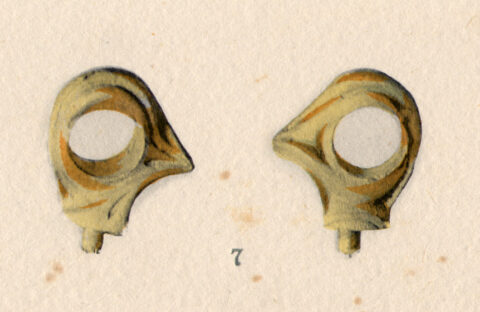
Carpet rod studs from the Castel Béranger. Hector Guimard, *Art in the Modern Home/The Castel Béranger* (Castel Béranger portfolio), pl. 51 (detail), Librairie Rouam, 1898. Private collection.
These studs were all removed at some unspecified time, but a significant number of them were recovered by Alain Blondel and Yves Plantin.
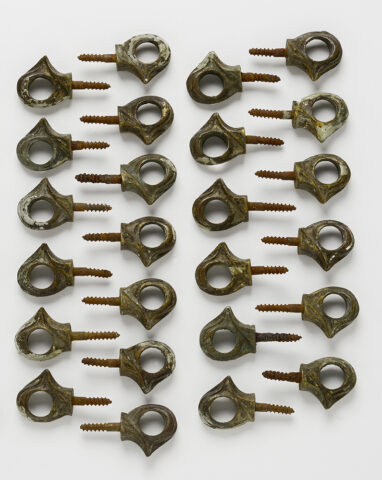
Set of 25 carpet rod studs from Castel Béranger, formerly part of the Yves Plantin collection, sold at Auction France, Paris, November 23, 2017. Photo: Auction France.
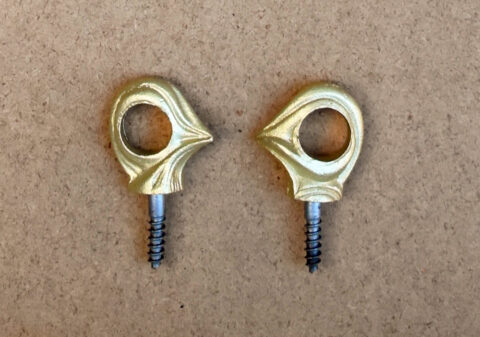
Two stripped carpet rod studs from Castel Béranger, from the former Yves Plantin collection, sold at Auction France, Paris, November 23, 2017. Private collection. Photo: F. D.
Currently, the stair carpets at Castel Béranger are held in place by rods secured with standard wall studs.
Originally, each apartment at Castel Béranger had a tiny bathroom equipped with a vanity unit designed by Guimard.
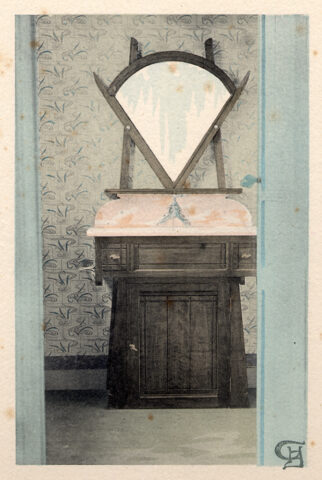
Vanity unit in an apartment at Castel Béranger. Hector Guimard, *Art in Modern Housing/Castel Béranger* (Castel Béranger portfolio), plate 59 (detail), Librairie Rouam, 1898. Private collection.
This economical piece of furniture, with its geometric lines, may have predated the Castel Béranger collection but was likely updated with metal hardware. The drawer knobs, towel rack brackets, and faucet base are made of “nickel-plated brass” and feature a design consistent with the other Castel Béranger styles.
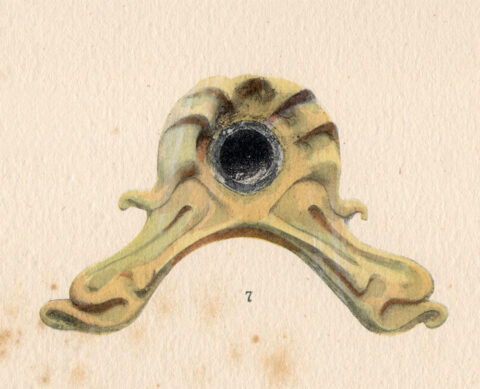
Faucet base from the vanity unit in the apartments of the Castel Béranger. Hector Guimard, *Art in Modern Housing/The Castel Béranger* (Castel Béranger portfolio), plate 59 (detail), Librairie Rouam, 1898. Private collection.
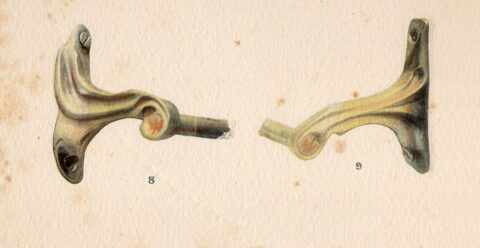
Brackets for the towel racks on the vanity unit in the apartments of the Castel Béranger. Hector Guimard, *Art in Modern Housing/The Castel Béranger* (Castel Béranger portfolio), plate 59 (detail), Librairie Rouam, 1898. Private collection.
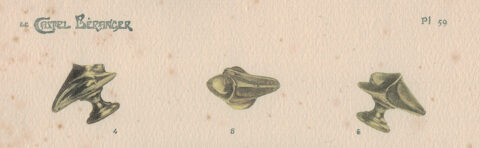
Knobs on the drawers of the vanity unit in the apartments of the Castel Béranger. Hector Guimard, *Art in Modern Housing/The Castel Béranger* (Castel Béranger portfolio), plate 59 (detail), Librairie Rouam, 1898. Private collection.
To the best of our knowledge, two wash basins from Castel Béranger have survived. One of them was purchased by Hector Guimard Diffusion and will be on display at the Guimard Museum inside the Hôtel Mezzara.
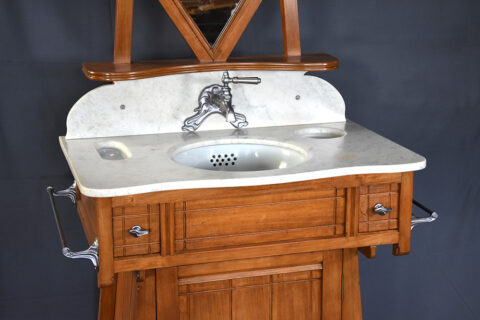
The washbasin at Castel Béranger, after restoration. Collection of Hector Guimard Diffusion. Photo by F. D.
During its restoration, it was necessary to reconstruct the faucet base using old photographs and to replicate the drawer knobs based on one of those from the other known example.
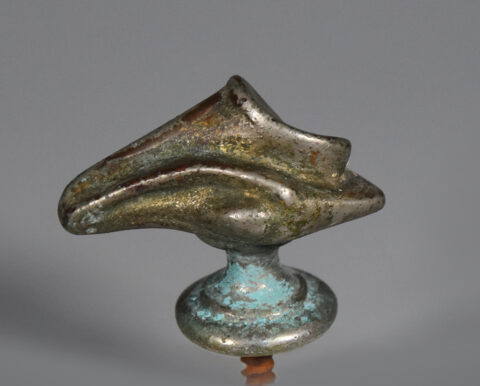
Drawer knob from a washbasin at Castel Béranger. Private collection. Photo by F. D…
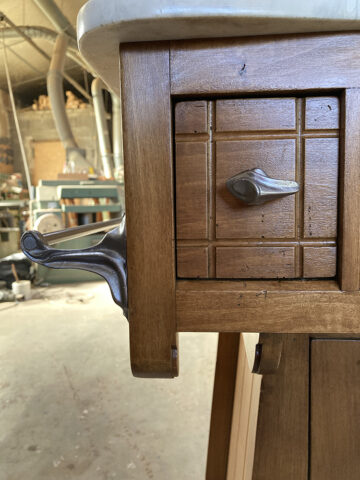
A drawer from a washbasin at Castel Béranger in François Derobe’s restoration workshop (Meuse) with a replica knob. Collection of Hector Guimard Diffusion. Photo by F. D.
Guimard used these drawer knobs around the same time on several pieces of furniture, including his own desk, which was originally located in his architectural office on the ground floor of Castel Béranger and later moved to his new office on the ground floor of his townhouse at 122 Avenue Mozart.
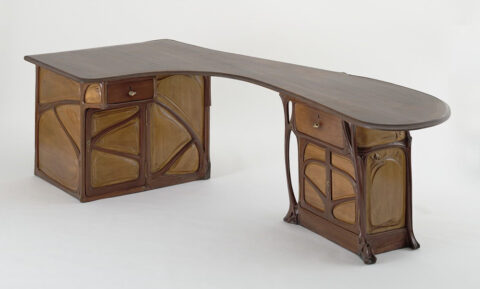
Hector Guimard’s office, on display at the Museum of Modern Art in New York. Photo: MoMA. All rights reserved.
Even something as insignificant as the handle on the fireplace screens in the apartments was the subject of a design. It is listed in the Castel Béranger portfolio under the name “copper shell for fireplace screens.” We are currently unaware of any surviving examples.
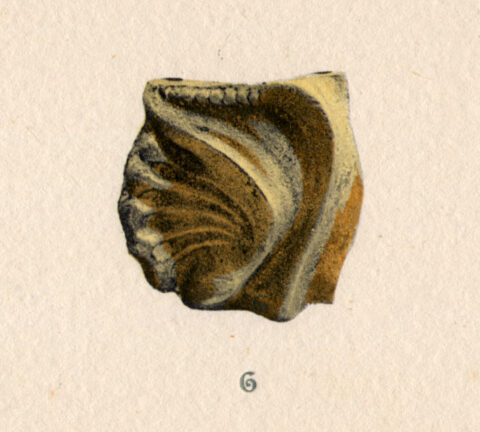
Handle on the fireplace screens in the apartments of the Castel Béranger. Hector Guimard, *Art in Modern Housing/The Castel Béranger* (Castel Béranger portfolio), plate 51 (detail), Librairie Rouam, 1898. Private collection.
While there were fireplaces in the bedrooms, living rooms, and dining rooms of the apartments, the inclusion in the portfolio of a “bronze grid for the heat vents” indicates that Castel Béranger also had a supplementary heating system consisting of radiators in the basement and hot-air ducts.
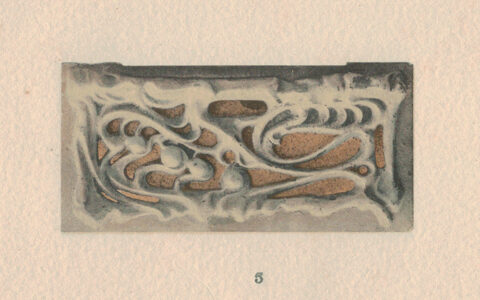
Bronze grids for the radiator vents in the apartments of the Castel Béranger. Hector Guimard, *Art in Modern Housing/The Castel Béranger* (Castel Béranger portfolio), pl. 51 (detail), Librairie Rouam, 1898. Private collection.
We are currently unaware of any surviving examples, but two were later used by Guimard as ventilation grilles and set into the masonry: one on the right-side facade of the Hôtel Deron-Levent in Paris (c. 1907), the other on the street-facing facade of the Villa d’Eaubonne (c. 1907–1908).
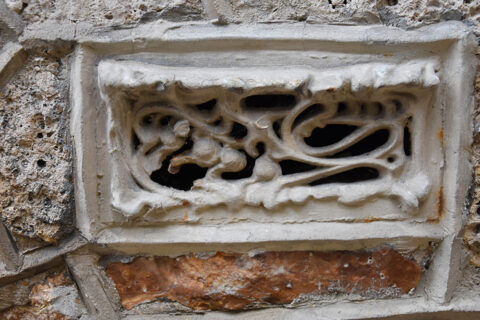
Ventilation grid on the right-side facade of the Deron-Levent Hotel (c. 1907), 8 Villa La Réunion, Paris 16th arrondissement. Photo by F. D.
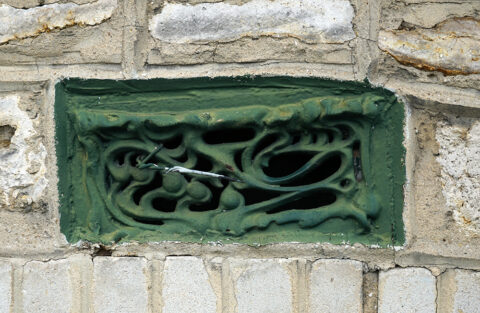
Ventilation grid on the street-facing facade of the villa in Eaubonne (c. 1907–1908), 16 Rue Jean-Doyen, Eaubonne, Val-d’Oise. Photo by F. D.
We conclude this article with a few cast-iron hardware items, which were likely cast by Durenne in Sommevoire, unlike all those presented above, which are made of copper alloys and were probably supplied by the Fontaine company.
As we mentioned earlier, it is likely that the apartments at Castel Béranger did not have electric lighting. Nor is there any evidence that they had a gas lighting system. However, the fact that cast-iron hooks remain in some apartments, attached to an iron joist in the center of the rooms, leads us to believe that they were used to hang oil lamps that could be raised and lowered using a pulley to adjust the lighting and refill the fuel reservoir.
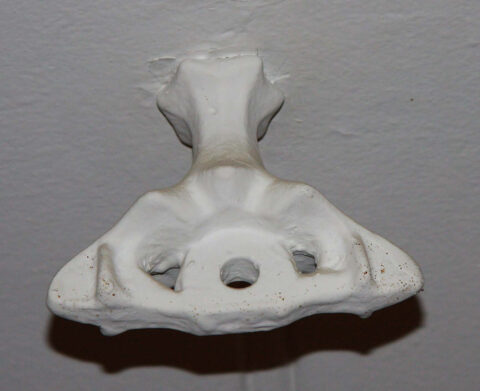
Ceiling anchor in a second-floor apartment facing the street at Castel Béranger. All rights reserved.
Only the model of the suspension hook intended for the living-rooms is mentioned in the portfolio. It was likely larger in size than those for other rooms. We are currently unaware of any surviving examples.
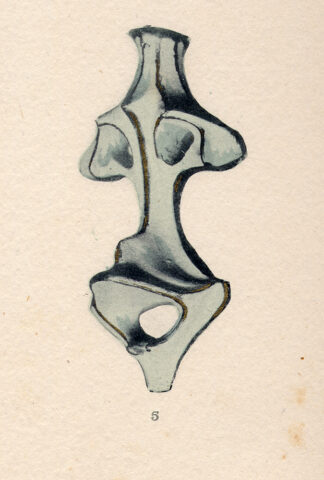
Suspension hook in the living-rooms of the Castel Béranger. Hector Guimard, *Art in the Modern Home/The Castel Béranger* (Castel Béranger portfolio), plate 52 (detail), Librairie Rouam, 1898. Private collection.
We currently know very little about other hardware items at Castel Béranger. These consist of decorative metal fasteners that punctuate the joists in certain rooms. They can be seen in two plates of the portfolio, on the ceilings of a bedroom (Pl. 40) and a living room (Pl. 49). These two rooms were part of the same street-facing apartment on the second floor that Guimard specifically used for the photographs reproduced in the portfolio. In the photo on plate 49, we can also see decorative fasteners on a metal lintel of the bay window, which Guimard took care to highlight with a touch of gold.
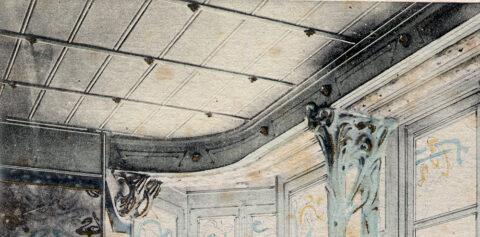
View of the living room in the apartment at the corner of Rue La Fontaine and Hameau Béranger on the second floor of Castel Béranger. Hector Guimard, *L’Art dans l’Habitation moderne/Le Castel Béranger* (Castel Béranger portfolio), plate 49 (detail), Librairie Rouam, 1898. ETH Library Zurich http://www.e-rara.ch/doi/10.3931/e-rara-27774 .
Though still present, these decorative cast-iron rings are less conspicuous and are not mentioned by Guimard in his portfolio; they adorn the joints between the balusters of the service staircase at Castel Béranger.
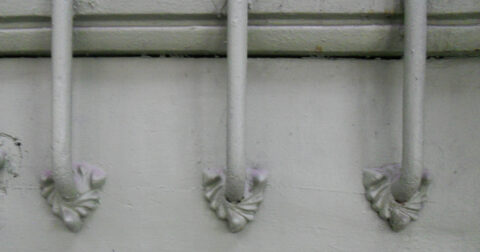
Decorative rings on the balusters of the service staircase at Castel Béranger. Photo by F. D.
In an upcoming article, we will discuss Guimard’s hardware produced outside of Castel Béranger and shortly thereafter.
Frédéric Descouturelle
In collaboration with Olivier Pons
Notes
[1] Patent filed on March 19, 1852, concerning the application of electric telegraphy to doorbells in residential buildings and hotels (INPI, patent no. 273684). At that time, no private individuals, nor even any companies or institutions, were connected to an electrical grid. These were not developed until the late 19th century by electric power companies. In Paris, the networks were interconnected in 1907. [2] The specimen from the Castel Henriette was donated to the Musée d’Orsay by Alain Blondel and Yves Plantin in 1979, OAO 485. [3] A patent filed on December 31, 1897, for an improvement to the return spring describes an electric variant of bell sliders (INPI, patent no. 273684).
Translation: Alan Bryden