
Guimard’s rugs and carpets
27 Novembre 2025
Since his projects were aimed at creating a comprehensive interior design, Guimard took an interest in floor coverings, whether rugs or carpets. As early as the Castel Béranger period (1895–1898), he commissioned several large rugs from a manufacturer whose name is not yet known with certainty. The only bibliographic reference to these rugs that we are aware of is the frontispiece plate in the Castel Béranger portfolio published at the end of [1] 1898 and its caption (in the table of plates): “TITLE—composition for rugs.”
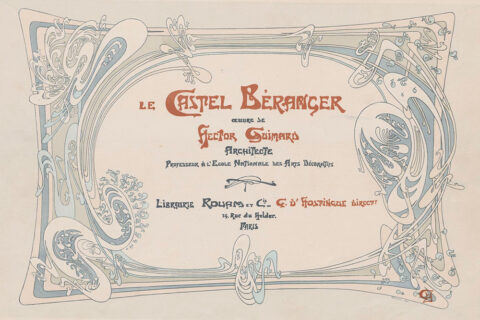
Frontispiece plate from the Castel Béranger portfolio, ETH Library, Zurich.
In fact, their design incorporates only part of the frontispiece’s design: the lower left corner, mirrored in the other three corners, as well as the central motif of the lower border, mirrored in the upper border. It is, of course, possible that Guimard instead expanded upon and refined an initial carpet design to create the frontispiece’s design.
These wool carpets, which are very likely the first Art Nouveau-style models to have appeared in France, are extremely rare. They were obviously not intended for the tenants of Castel Béranger, who had neither the means nor the space in their rather modestly sized rooms, but rather for a clientele of wealthy collectors. Two of them have been sold on the art market over the past decade. One is larger in size: 4 m x 6 m.
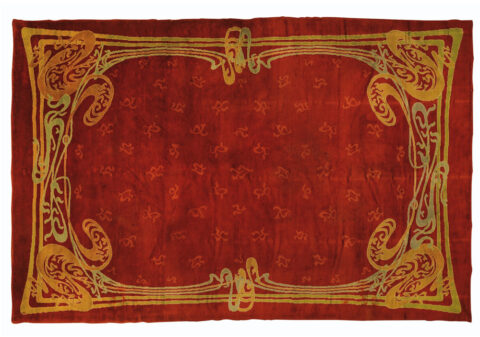
Rug by Guimard, maker unknown, 4 m wide, 6 m long. Sotheby’s Paris auction, November 24, 2015; knotted wool.
The other one, which is smaller, measuring 3.45 m by 4.93 m, is a scaled-down version of the first.
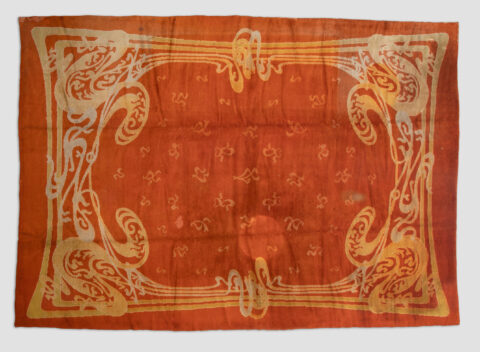
Carpet by Guimard, manufacturer unknown, width 3.45 m, length 4.93 m. Bonhams New York auction, December 19, 2024, lot 3w, knotted wool. Hector Guimard Diffusion Collection.
This last piece recently arrived from the United States, where it was acquired by our partner, Hector Guimard Diffusion. It is in good condition, but restoration work is needed in several areas.
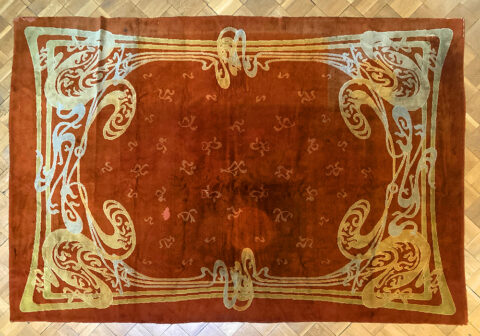
Carpet by Guimard, manufacturer unknown, width 3.45 m, length 4.93 m. Bonhams New York auction, December 19, 2024, lot 3w, knotted wool. Hector Guimard Diffusion Collection. Photo: F. D.
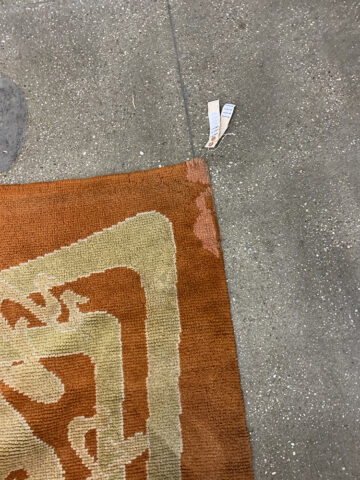
Rug by Guimard, manufacturer unknown, width 3.45 m, length 4.93 m. Bonhams New York auction, December 19, 2024, lot 3w, knotted wool. Hector Guimard Diffusion Collection. Photo: Bonhams NY.
Both carpets are made of knotted wool with a short pile. Their orange-red background is framed by yellow, light orange, and pale blue borders.
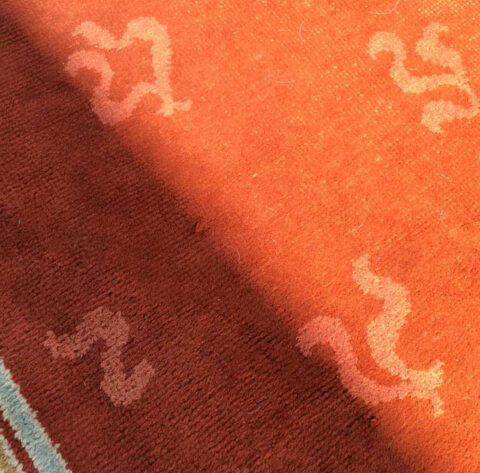
Carpet by Guimard, manufacturer unknown, width 3.45 m, length 4.93 m. Bonhams New York auction, December 19, 2024, lot 3w, knotted wool. Hector Guimard Diffusion Collection. Photo: Bonhams NY.
The reverse side of these carpets clearly reveals the technique used. The “pixelated” effect, caused by the thickness of the stitches, does not lend itself well to Guimard’s curves, but it is mitigated by the large size of these carpets.
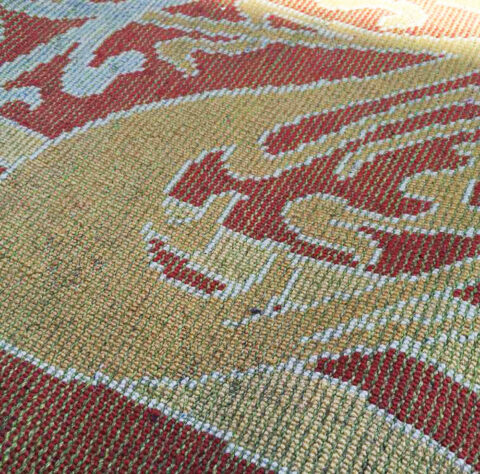
Carpet by Guimard, maker unknown, width 4 m, length 6 m. Sold at Sotheby’s Paris on November 24, 2015; knotted wool; restored by Rugs & Tapestries, Padua.
Neither of these two units bears a manufacturer’s mark, but they may have been produced by Honoré Frères in Tourcoing, the firm commissioned in 1897 to create the carpets for the three staircases of the Castel Béranger[2]. Their appearance is known from their reproduction in the Castel Béranger portfolio, where Guimard provided two color versions: one for the staircase facing the street (pl. 29) and the other for the staircase facing the courtyard (pl. 28). In these colorized reproductions, the surface texture is also consistent with that of knotted wool carpets. Given their narrow width and the delicacy of the patterns, their knots were necessarily small.
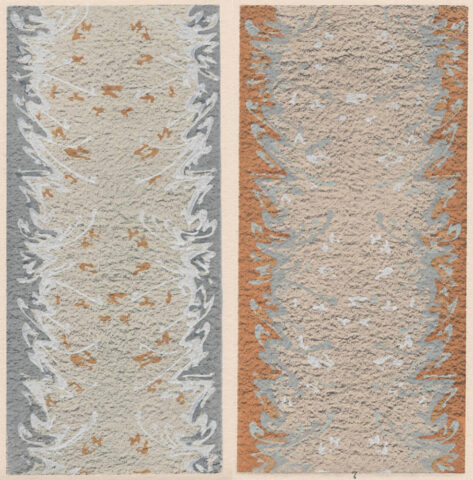
On the left, the carpet on the staircase facing the street; on the right, the carpet on the staircase facing the courtyard. Photomontage based on plates 28 and 29 from the Castel Béranger portfolio. Private collection.
On a single sheet of paper preserved in the Guimard collection at the Musée d’Orsay, there are two drawings for these rugs, which are symmetrical to one another, bearing the note “Delivered to the manufacturer on March 29, 1897, P. Honoré frères” as well as a simplified signature by Guimard.
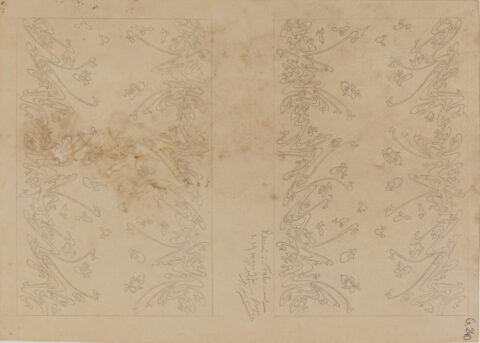
Drawings for the stair carpets at Castel Béranger, graphite pencil on heavy paper, height 0.342 m, width 0.244 m, handwritten pencil note: “Submitted to the Manufacturer/March 29, 1897/P. Honoré frères,” signed by Guimard. Gift of the Association for the Study and Preservation of 20th-Century Architecture and Decorative Arts, 1995, GP 240, Musée d’Orsay. © RMN-Grand Palais (Musée d’Orsay)/Jean-Gilles Berizzi.
But these are not exactly the same designs as those reproduced in the Castel Béranger portfolio. If we isolate one of the two designs—for example, the one on the right—and examine one of the two borders, we see that to create the opposite border, Guimard rotated it by 180 degrees.
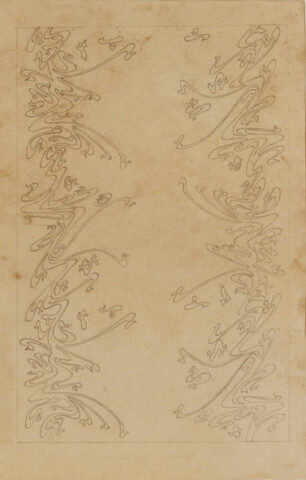
Right half of the design for the stair carpets at Castel Béranger, GP 240, Musée d’Orsay. The central motifs have been erased.
Whereas to obtain the design of the carpets as they were actually executed, he duplicated one of the two borders by reflecting it across a vertical axis.
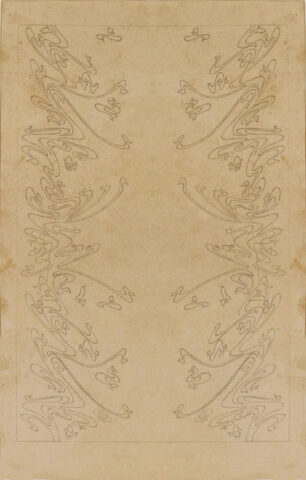
A photomontage on the right half of the drawing depicting the stair carpets of Castel Béranger, GP 240, Musée d’Orsay. The central motifs have been erased.
For these stair carpets at Castel Béranger, Guimard took his attention to detail to the point of designing a unique model of studs to secure the rails, of which we have several units.
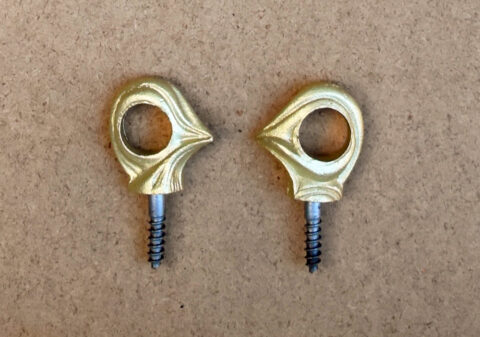
The studs on the stair runners at Castel Béranger. Private collection. Photo by F. D.
During the restoration work carried out in 2000, the stair carpets were roughly restored, and the wrong color was used for the staircase in the building’s street-facing lobby.
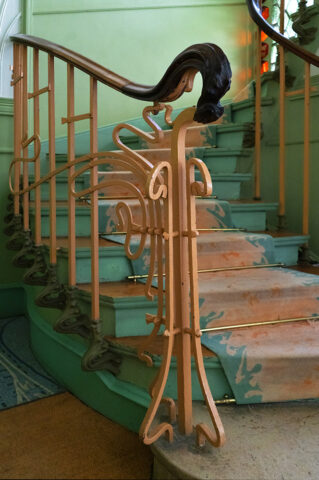
Current state of the staircase in the street facing lobby of Castel Béranger following restoration work. Photo by F. D.
Just as he had done in other fields, with the aim of making his designs more widely available and lowering their cost, Guimard wanted to have his carpet designs produced. He therefore approached the firm Parlant & Biron, which had its Paris office at 13 Rue Poissonnière. We had long noted that this company was also originally from Tourcoing, but it was only very recently that we were able to establish with certainty that Parlant & Biron was indeed the successor to the Honoré Frère firm, thanks to the acquisition of a promissory note from the Gaston Honoré company, dated March 31, 1911, and bearing the overprint “PARLANT & BIRON, Sucrs.” The fact that this succession is indicated by a stamped overprint suggests that, in March 1911, it was recent enough that updated documents had not yet been printed. This document also reveals that Gaston Honoré himself succeeded “Maison V. Straub, Ch. Gérardin, Honoré Frères, réunies”[3].
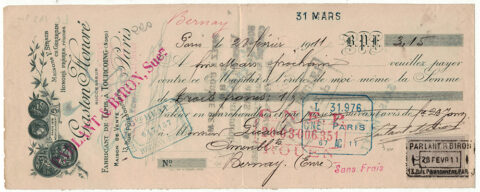
Promissory note from the firm Gaston Honoré, Parlant & Biron, successors, dated March 31, 1911. Private collection.
Guimard thus secured the publication of his designs in a catalog. The copy held at the Bibliothèque des Arts Décoratifs contains only four unnumbered plates, all of which feature Guimard’s designs. Since this copy was donated by his widow, it is likely that the other plates were removed from the catalog in order to document simply the architect’s work.
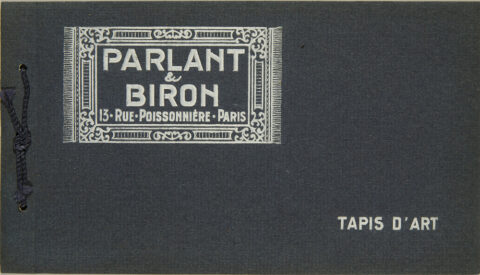
Cover of an undated Parlant & Biron catalog. Bibliothèque des Arts Décoratifs. Gift of Adeline Oppenheim-Guimard, 1948. Photo by Laurent Sully Jaulmes.
Six designs for Parlant & Biron are available as rugs with a fixed width of 70 cm and sold by the linear meter in three grades, priced at 7, 8, and 9 F-or. The material used and the type of weave are not specified.
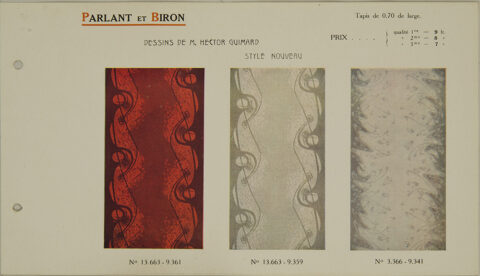
Plate from a Parlant & Biron catalog, undated. Bibliothèque des Arts décoratifs, models 13.663–9.359; 13.663–9.361; 3.366–9.341. Gift of Adeline Oppenheim-Guimard, 1948. Photo by Laurent Sully Jaulmes. The model of the Castel Béranger is on the right.
It is noticeable that the model shown on the right side of this plate appears to be that of the staircase at Castel Béranger, reproduced in shades of gray with greater clarity than in the two plates of the portfolio. In fact, however, this is the original drawing (GP 240), with its asymmetrical borders.
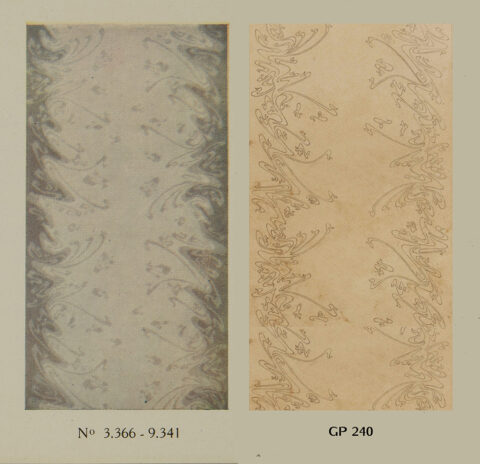
Composite image of model 3.366–9.341, created from a page in a Parlant & Biron catalog and part of drawing GP 240.
For the other model on this sheet, which is shown in two color variations, there are two watercolor studies by Guimard in the collection of documents donated by Adeline Oppenheim Guimard to the Bibliothèque des Arts décoratifs in 1948.
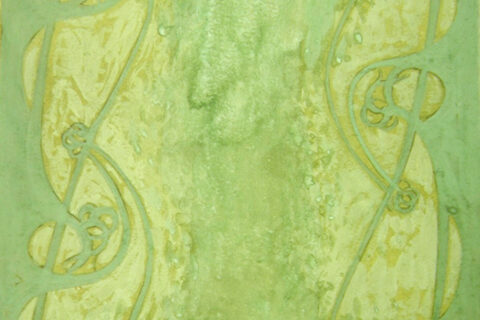
Design for a rug, unsigned, undated, watercolor on paper, Bibliothèque des Arts décoratifs, Gift of Adeline Oppenheim-Guimard, 1948. Photo by Laurent Sully Jaulmes.
On a second plate of the Parlant & Biron catalog, a third design is shown in three colors. As with the two designs presented above, its clearly defined borders indicate that it is intended as a stair carpet or a hallway rug.
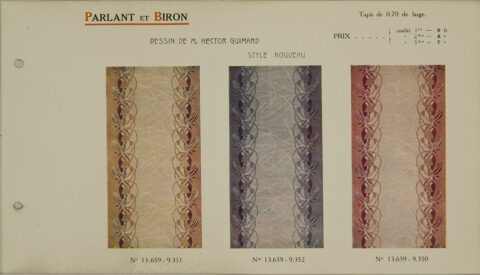
Plate from a Parlant & Biron catalog, undated. Bibliothèque des Arts décoratifs, models 13.659–9.350; 13.659–9.351; 13.659–9.352. Gift of Adeline Oppenheim-Guimard, 1948. Photo by Laurent Sully Jaulmes.
On the contrary, the three other patterns featured on the other two plates have no borders and are designed to be joined together (like wallpaper) so they can cover large areas and serve as a carpet. Once placed side by side, the strips are sewn together and then stretched out.
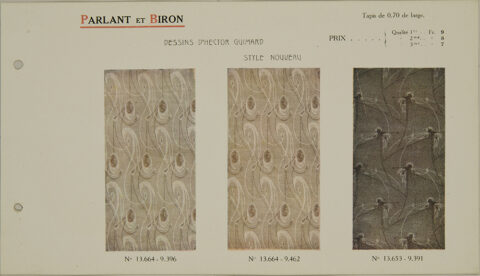
Plate from a Parlant & Biron catalog, undated. Bibliothèque des Arts décoratifs, models 13.664–9.396; 13.664–9.462; 13.653–9.391. Gift of Adeline Oppenheim-Guimard, 1948. Photo by Laurent Sully Jaulmes.
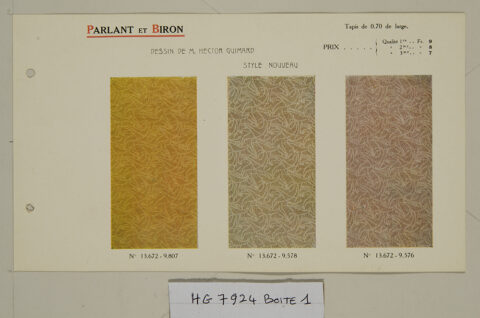
Plate from a Parlant & Biron catalog, undated. Bibliothèque des Arts Décoratifs, items 13.672–9.576; 13.672–9.578; 13.672–9.807. Gift of Adeline Oppenheim-Guimard, 1948. Photo by Laurent Sully Jaulmes.
We think it is worth taking a closer look at the reference numbers for these six models and their variants:
3.366 – 9.341 for the Castel Béranger model.
13.663 – 9.359 and 13.663 – 9.361 for the bordered model shown on the same plate.
13.659 – 9.350; 13.659 – 9.351; 13.659 – 9.352 for a bordered model on a second sheet.
13.664 – 9.396 and 13.664 – 9.462 for a pattern with a seam on a third sheet.
13.653 – 9.391 for a pattern with a seam on this third sheet.
13.672 – 9.576; 13.672 – 9.578 and 13.672 – 9.807 for a pattern with a seam on a fourth panel.
The last four digits after the hyphen distinguish the color variations of identical patterns. We do not know the meaning of the number 9. As for the groups of numbers before the hyphen, they designate the models. Furthermore, we propose the following hypothesis: the number(s) before the period could indicate the year the model was added to the manufacturer’s catalog (Honoré Frères, then Gaston Honoré, then Parlant & Biron). Thus, the Castel Béranger model (3.366) would have been added in 1903, and all other models would have been added in 1913—that is, at the time Guimard was designing his mansion. This would give us a sixteen-year timeframe (from 1897 to 1913) of collaboration between Guimard and the manufacturer. Keep in mind that the date of 1913 does not necessarily correspond to the creation of these five models and that Guimard may have had access to them before they were published in a catalog.
Several photographs show Guimard using these rugs. One of them, undated, is likely a view taken inside Guimard’s workshops. It clearly shows the bordered rug 13.659 and, less clearly, beneath the desk and chair, the pattern-matched rug 13.653.
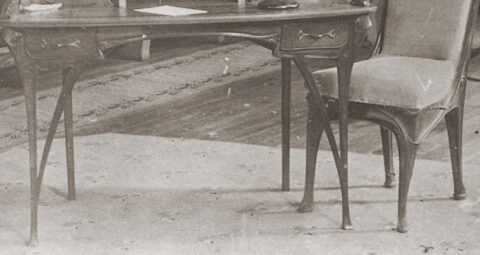
Probable interior arrangement in Guimard’s studios (detail) featuring rugs 13.659 and 13.653; early print on paper, undated. Donated by Adeline Guimard-Oppenheim, 1948. Bibliothèque des Arts décoratifs. Photo by Laurent Sully Jaulmes.
Pieces of the same pattern-matching rug (13.653) also appear in other photographs taken under similar conditions.
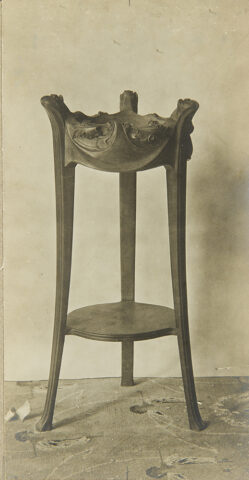
Probable set up in Guimard’s studio, featuring rug no. 13.653; an early print on paper, undated. Donated by Adeline Oppenheim-Guimard, 1948. Bibliothèque des Arts décoratifs. Photo by Laurent Sully Jaulmes.
Finally, two of these seamless carpet designs appear in photographs taken inside the Guimard Hotel: once again, the 13.653, used as wall-to-wall carpeting in the bedroom.
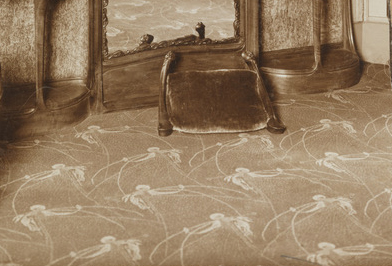
Detail from a photograph of the bedroom at the Hôtel Guimard, showing rug no. 13.653; vintage print on paper, ca. 1913. Private collection.
And 13.672, used for the dining room carpet.
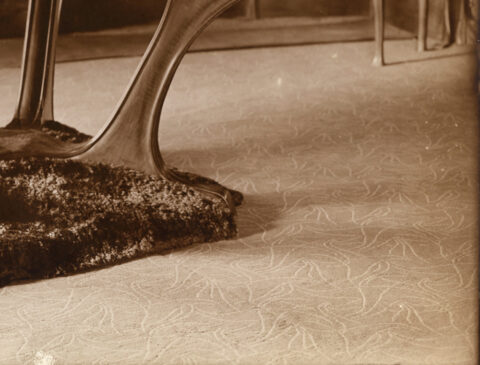
Detail from a photograph of the dining room at the Hôtel Guimard, showing rug no. 13.672; vintage print on paper, ca. 1913. Gift of Adeline Oppenheim-Guimard, 1948. Archives de Paris 3115W 10.
Alongside this production for commercial purposes, Guimard continued to design large rugs. We have evidence of this in the form of a watercolor sketch with a particularly rich, even evocative, design. Although undated, it can be dated to 1903 or later and is housed at the Bibliothèque des Arts décoratifs.
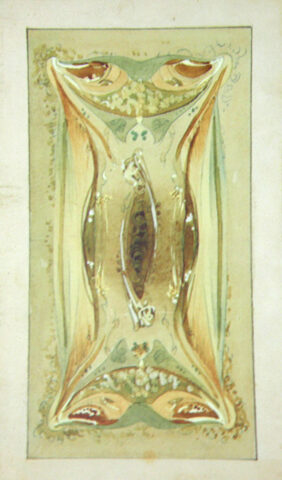
Design for a rug, unsigned, undated, watercolor on paper, Bibliothèque des Arts décoratifs, Gift of Adeline Oppenheim-Guimard, 1948. Photo by Laurent Sully Jaulmes.
We can see, then, that Guimard’s rugs and carpets reflected his stylistic evolution, with designs that, in some cases, could be seamlessly integrated into modern interiors.
Frédéric Descouturelle
in collaboration with Olivier Pons
Notes
[1] Guimard, Hector, Art in the Modern Home/Le Castel Béranger, Paris, Librairie Rouam, 1898.
[2] Their name appears in the list of suppliers at the beginning of the portfolio: “HONORÉ FRÈRES — Carpets.”
[3] The Honoré Frères company had borne this name since Gaston and Lodois Honoré took over the business in April 1893. Gaston continued on his own after his brother sold him all his shares in September 1904.
Translation: Alan Bryden