
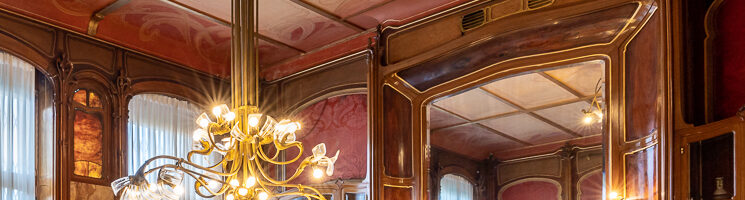
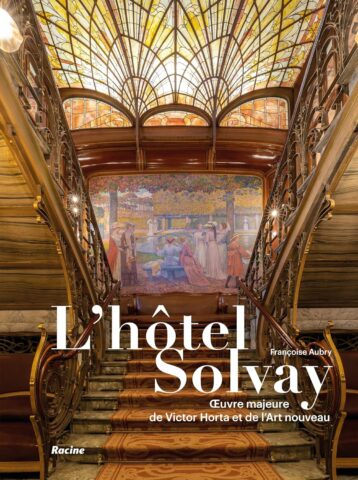
Victor Horta. The Solvay hotel, 224 Avenue Louise in Brussels. About a recent book published by Éditions Racine in Brussels.
Françoise Aubry, former curator of the Horta Museum in Brussels, had been a friend of the Cercle Guimard even before its founding in 2003. We met her on numerous occasions—in Paris, Brussels, and Barcelona—and corresponded with her frequently. Her expertise and experience guided us through the difficult journey toward establishing a Guimard Museum in Paris, and she graciously agreed to write the foreword for our first book dedicated to the Hôtel Mezzara in 2018, at a time when its future was highly uncertain.
Françoise was kind enough to respond to our request and send us a summary of the remarkable book she has just published on the Solvay hotel, one of Victor Horta’s masterpieces and undoubtedly his most luxurious work. On the occasion of the building’s repurposing—it has become a museum open two days a week following extensive restoration—she revisits the meticulous work of Yolande Oostens-Wittamer, published nearly thirty years ago.
In 1894, Armand, son of the great inventor and industrialist Ernest Solvay, married Fanny Hunter. The young couple chose to settle on Avenue Louise, at the time Brussels’ most prestigious boulevard, and to have a mansion built on a 950-square-meter lot. He chose Horta as the architect. His name was suggested by engineer Émile Tassel, for whom he was building a house nearby at 6 Rue Paul-Émile Janson, and by Tassel’s friend, Charles Lefébure, Ernest Solvay’s personal secretary. Horta was not yet very well known, but the novelty of the Tassel mansion caused a sensation. He would undoubtedly be able to build a residence equipped with all modern comforts (central heating, a bathroom, electricity) that would highlight the young couple’s boldness in the eyes of Brussels’ “high society”—a conventional crowd enamored with eclecticism. The Solvays’ fortune was recent and owed to the entrepreneurial skills of Alfred and Ernest Solvay. They were not heirs to a family tradition that might have constrained their choices and forced them into conformity.
Horta won the family’s trust and was commissioned for various projects, ranging from the family tomb at the Ixelles cemetery to the company’s laboratories on Rue des Champs-Elysées in Ixelles, including a château in Chambley, Lorraine, for Alice, who was married to Baron Henri de Wangen.
On September 3, 1894, Horta presented his initial plans to Armand Solvay. The project promised to be monumental. In his Memoirs, he speaks of a “giant’s work,” as the architect was also responsible for the interior decoration, including all the furniture, each piece of which was unique and custom-designed.
The building permit was granted by the City of Brussels on August 20, 1895. The construction project would be lengthy and could be considered complete in 1902 when the large canvas by the painter Théo Van Rysselberghe, *Reading in the Park*, was hung in the stairwell, blending beautifully into the colorful world created by Horta.
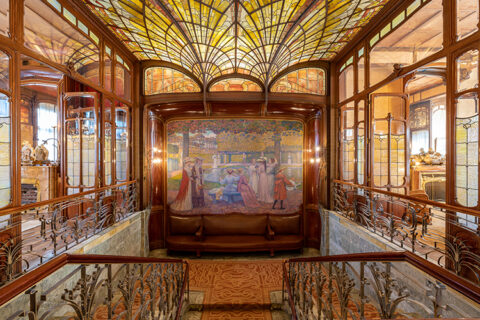
Solvay hotel at 224 Avenue Louise in Brussels, 1895–1902, landing of the staircase leading from the ground floor to the bel étage, painting *Reading in the Park* by Théo Van Rysselberghe. Photo by Gilles van den Abeele.
The Solvay hotel remained largely unchanged throughout much of the 20th century. During World War II, the glass roof covering the grand staircase was blown off when a bomb fell nearby. In the early 1950s, the Solvay family decided to sell the building, preferring to live in the green suburbs of Brussels. They offered to sell the mansion to the Belgian government at a reduced price. This generous offer was rejected, and it was not until late 1957 that the hotel was acquired by Mr. and Mrs. Wittamer-De Camps, who intended to establish their haute couture ateliers there. Various renovations were then carried out to adapt the mansion to its new purpose, and the skylight above the grand staircase was covered with a floor (today, the double-fan-shaped glass roof has been restored but is artificially lit, as the floor remains at the second-floor level). This alteration also deprived the winter garden of natural light (in the bedrooms on the first floor). The rooms on the second floor now form a single large space spanning the entire depth of the building.
Thanks are due to Mr. and Mrs. Wittamer, for it is likely that without them the Solvay hotel would have suffered the same fate as Horta’s other buildings on Avenue Louise: his second private home, at No. 136; the Aubecq hotel, at No. 520 (demolished in 1950); the Roger hotel, at No. 459 (completely renovated). After World War II, Avenue Louise was cut through by tunnels, and many of its mansions were replaced by apartment buildings.
The Solvay hotel was not designated a historic landmark until 1977, too late to prevent the construction of the two buildings that flank it today. After the death of Mr. and Mrs. Wittamer, their son Michel took over the management of the historic building. As for their daughter, Yolande Oostens-Wittamer, she devoted herself to research on Horta, culminating in a doctoral dissertation on the Solvay Mansion presented at the University of Louvain-la-Neuve (published in 1980). The current owner is Michel Wittamer’s son, Alexandre, who commissioned me in 2024 to write a book on the Hôtel Solvay, nearly thirty years after the one published by his aunt with Diane de Selliers in 1996. This book was published by Racine in 2025 and has been translated into Dutch and English, featuring photographs by Gilles van den Abeele and a series of plans by the firm Van der Wee Architects, which conducted a new survey of the mansion in preparation for its restoration.
The layout of the Solvay Mansion breaks with the tradition of Brussels mansions. The carriage entrance is still present and opens onto a driveway leading to the stables built at the rear of the lot. These were not commissioned from Horta by Armand Solvay but from architects who regularly worked for the Solvay firm (Constant Bosmans and Henry Vandeveld, 1898). The façade features two large bow windows, topped by balconies, which frame a curved central section. On the main floor, the living room balcony offered a view of the carriages heading to the Hippodrome or the Bois de la Cambre. The metal structures, painted in light ochre, are ubiquitous and radically new in the context of a luxurious mansion. Euville stone lends itself to subtle molding, while the more durable blue stone is used for the base, the frames of the balcony’s French doors, and a few horizontal bands.
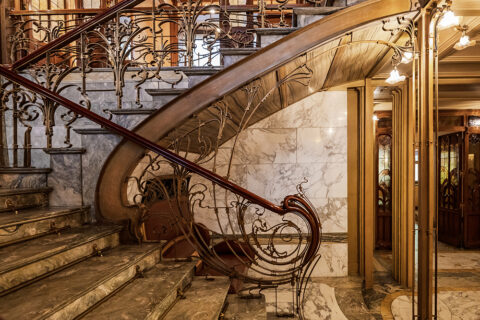
Victor Horta, Solvay hotel, 224 avenue Louise à Bruxelles, 1895-1902, the beginning of the railing of the stair case on the ground floor Photo Gilles van den Abeele
The interior layout is unique: the floor plan is organized around two stairwells, topped by a glass roof, situated against the shared walls. The grand staircase, preceded by a vast hall opening onto the carriage entrance, leads to a landing from which it splits into two branches leading to the main floor. One must then cross a large landing providing access to the row of salons on the street side and the dining room on the garden side, before taking a more discreet staircase to reach the private floors.
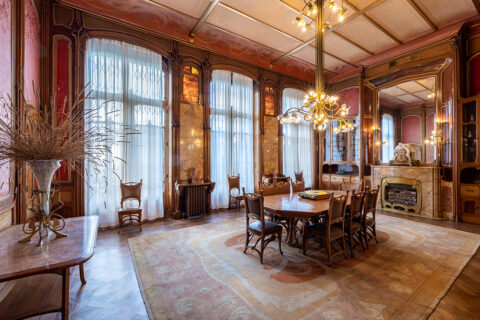
Victor Horta, Solvay hotel, 224 avenue Louise à Bruxelles, 1895-1902, dining room on the « bel étage » garden side , Photo Gilles van den Abeele
Thanks to glass doors, the living rooms and dining room can open completely onto the stairwell, which is transformed into a grand entrance hall on days when guests are hosted. The entire space of the main floor can be taken in at a glance. These doors also allow natural light from the street- and garden-facing facades to flood into the heart of the house. Horta masterfully controls the flow of light and maximizes natural light because it lends a shifting vitality to the colors of the stained-glass windows and creates multiple electric light fixtures in gilded brass, whose stems are oriented to highlight the colors of the stained-glass windows once night falls, the intricate carving of the woodwork, the gold accents of the ironwork and decorative paintings, and the brilliance of the beveled glass. He also adheres to the tradition of placing enormous mirrors above the fireplaces to enlarge the space and multiply the brilliance of the lamps.
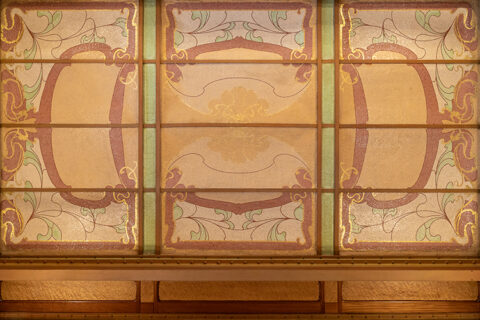
Victor Horta, Solvay hotel, 120 avenue Louise à Bruxelles, 1895-1902, mosaic ceiling of the “bel étage”. Photo Gilles van den Abeele
Horta was, of course, an confirmed architect, but he was also an accomplished artist when he combined colors in the manner of the painters of his time, applying Chevreul’s laws of complementary colors. In the wall decoration of the stairwell between the main floor and the first floor, orange gradually blends into green.
The first-floor landing separates the rooms reserved for the parents (the husband’s study, the wife’s boudoir, the bedroom) from those intended for family life (the study, the small, intimate dining room). The landing benefits from two sources of light thanks to the glass roof covering the second skylight and a second rounded glass roof that closes off an opening in the first skylight above the grand staircase. The landing is designed as a gathering place, an intimate space with its low sofas, metal floor lamps that evoke trees, and a garden represented by the floral stems frozen in the stained-glass window. This space invites timeless daydreams, as the real world seems so far away.
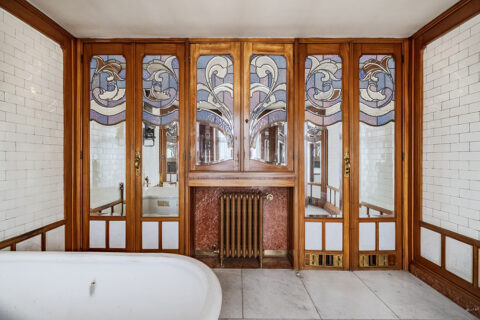
Victor Horta, Solvay hotel, 224 avenue Louise à Bruxelles, 1895-1902, bath room on the mezzanine Photo Gilles van den Abeele.
Between the first and second floors, Horta placed the bathroom on the mezzanine level. There, he boldly combines industrial materials such as white glazed brick with Carrara marble, set within American ash woodwork mounted on a red marble baseboard. Opposite the window, the door and cabinet panels are clad in beveled mirrors and frosted glass, used here for their texture and colors rather than to let in light, except in the door leading to the access corridor. The six panels form a splendid ornamental pattern. This bathroom exudes great refinement without being ostentatious. This is not the Hôtel de la Païva.
The walls of the final section of the stairwell are painted in an orange gradient fading to white as one approaches the glass roof. Bright orange arabesques outline a metal pergola, complemented by the glass roof and its foliage rendered in very soft yellow frosted glass. This arrangement highlights the fact that, in Horta’s work, the entire decorative system derives from the curve he imprinted on the metal. Rationally adapted to convey the material’s flexibility (in accordance with one of Viollet-le-Duc’s principles), the arabesque forms the basis of the wall decoration, which, in this case, represents architecture within the interior. The actual steel beams that frame the walls of the stairwell visually “support” painted arches, extended by the metal structure of the glass roof.
The service staircase, lit by a series of windows of various shapes on the garden side, provides access to a third floor, intended for the servants. The attic is spacious but cannot be fully utilized because its floor is pierced by the two skylights corresponding to the glass roofs set into the roof slope. This is a layout found in other buildings designed by Horta at the time: the stained-glass windows of the skylights crowning the stairwells must be protected from the elements by corresponding glazing in the roof.
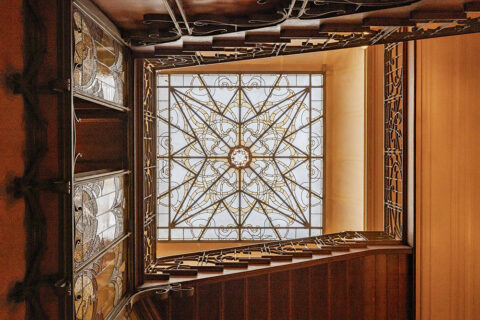
Victor Horta, Solvay hotel, 224 Avenue Louise in Brussels, 1895–1902, private staircase covered by the glass roof of the north skylight. Photo by Gilles van den Abeele.
When examining the rear facade, the division of functions is rational. The most prominent part is the kitchen, which protrudes from the main structure (here, Horta departs from the principle of the basement kitchen); its roof forms a large balcony for the dining room, which is flanked by two stories. The narrow, solid structure of the service staircase is attached to it. Above the driveway, the utility room with toilet, the master bathroom, and the guest bathroom are stacked one above the other.
Another element of “modern” comfort, the ventilation was carefully designed by Horta, and a constant flow of air circulates through the hotel without the need to open the windows. The steam heating system originally fed radiators that have now been converted to gas by plumber and heating engineer Pascal Desmee, a delicate modification that required months of work. Recently (2021–2025), Alexandre Wittamer commissioned architect Barbara Van der Wee (who, among other Horta buildings, oversaw the restoration of the Horta Museum and the Van Eetvelde Hotel) to restore the façade and roof of the Solvay hotel. The metal structures had deteriorated and required complex repairs carried out by metalworker Luc Reuse. Many other skilled craftsmen (roofers J.M. Tong and his son, painter Chr. Feuillaux, carpenter D. Lutjeharms, master glassmaker Cl. Van Veerdegem-Vosch, etc.) participated in this exemplary project, which was awarded an Europa Nostra Prize in 2025.
We must be aware today of the fragility of these Art Nouveau buildings, to which access must be strictly limited. The staircase at the Horta Museum had to be reinforced because it was sagging under the weight of visitors, and it lacks the precious wool carpets that Horta had designed for the Solvay hotel. The maintenance and restoration of these exceptional architectural works depend on the availability of well-trained craftsmen. One might wonder whether public authorities will continue in the future to fund “heritage schools” and the conservation of historic buildings. Will future generations be drawn to these often arduous and demanding trades, rooted in a long tradition of craftsmanship where manual skill and intellectual ability go hand in hand?
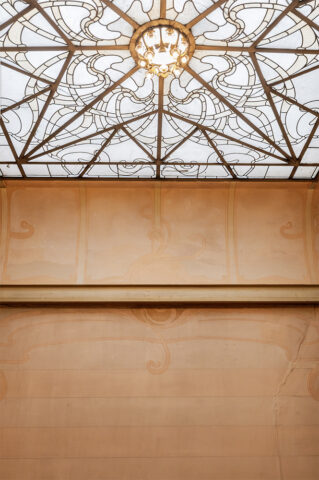
Victor Horta, Solvay hotel, 224 Avenue Louise in Brussels, 1895–1902, wall and glass roof of the private stairwell. Photo by Gilles van den Abeele.
The Solvay hotel, along with three other buildings designed by Horta (the Tassel hotel, the Van Eetvelde hotel, and Horta’s own home), were designated UNESCO World Heritage Sites in 2000—an international recognition of Horta’s work that unfortunately came too late to save the Maison du Peuple, which was demolished in 1965.
Françoise Aubry
Further Reading:
David DERNIE and Alastair CAREW-COX, Victor Horta. The Architect of Art Nouveau. Brussels, Fonds Mercator, 2018.
Michèle GOSLAR, Victor Horta 1861–1947. The Man – The Architect – Art Nouveau. Brussels, Fonds Mercator and the Pierre Lahaut Foundation, 2012.
Yolande OOSTENS-WITTAMER, Victor Horta. The Solvay Hotel. Louvain-la-Neuve, Higher Institute of Archaeology and Art History, Erasme College, 1980.
Yolande OOSTENS-WITTAMER, Horta. The Solvay Hotel. Paris, Diane de Selliers Editeur, 1996.
Victor Horta. Memoirs, edited by Cécile DULIERE. Brussels, Ministry of the French Community of Belgium, 1985.
Translation : Alan Bryden