
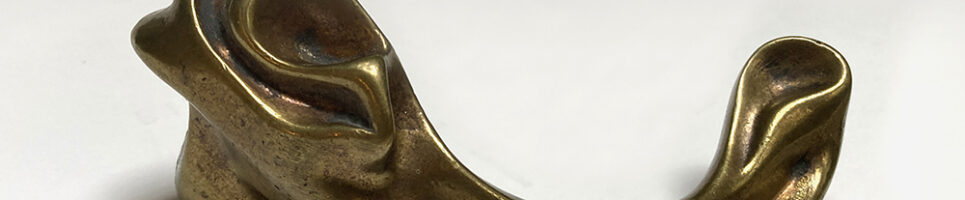
Hector Guimard’s hardware Part Two: other hardware created for Castel Béranger
February 2026
All photos belonging to the authors or to the Cercle Guimard Archives and Documentation Center must be approved by the Cercle Guimard in the event of a publication project, regardless of the medium.
After an initial article devoted to the locks and porcelain knobs originally created for Castel Béranger, we continue our description of the other hardware created by Guimard with the Fontaine company, mainly to furnish the common areas and apartments of his first apartment building, but also several contemporary and later constructions up to the mid-1900s.
As we saw in the previous article, around 1900, Fontaine put together a prestigious portfolio featuring some of its most beautiful collaborative designs. The only plate relating to Guimard shows lock no. 276 (the only Guimard item to be published in Fontaine’s catalog) and the porcelain knob (which was actually produced by Sauzin) in the center. It also features other hardware from Castel Béranger: the bolt, the door handles in the common areas, the landing door handles in the apartments, and the handles and casings of the espagnolette locks, all photographed in much higher quality than in the Castel Béranger portfolio, where the appeal of the stencil coloring detracted from the sharpness of the photos.
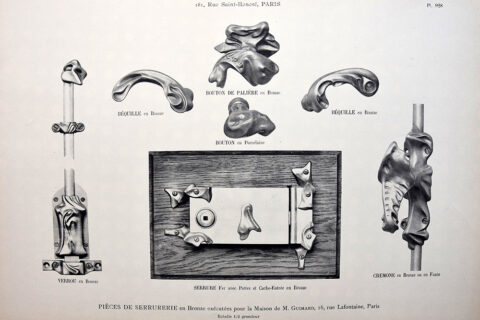
Portfolio plate Fontaine, s.d. (c. 1900). Musée Fontaine. Photo F. D.
The brass (or bronze) door handle[1] is undoubtedly the most striking feature of this set. Found on apartment doors, it is fixed in place and is only used to pull the door shut by slamming it.
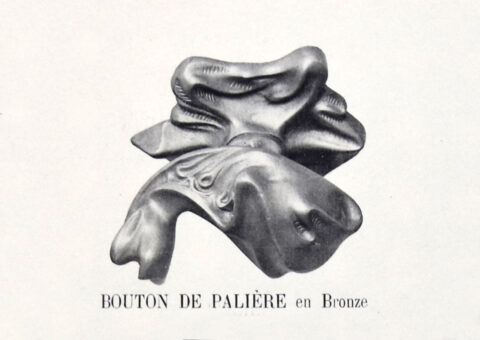
Portfolio plate Fontaine M (detail), s.d. (c. 1900). Musée Fontaine. Photo F. D
The Castel Béranger portfolio presents it from several angles.
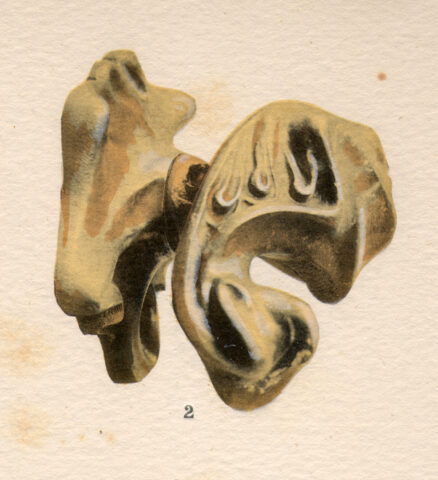
Door handle for apartments at Castel Béranger. Hector Guimard, L’Art dans l’Habitation moderne/Le Castel Béranger (Castel Béranger portfolio), pl. 35 (detail), Librairie Rouam, 1898. Private collection.
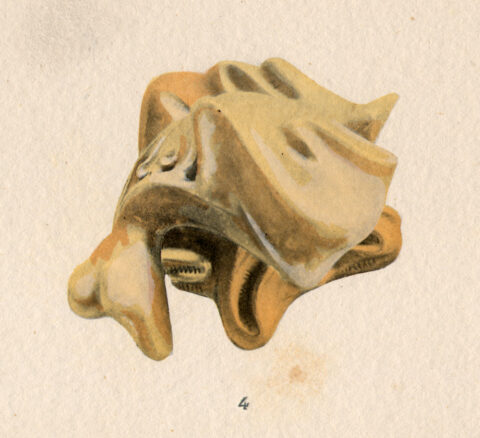
Door handle for apartments at Castel Béranger. Hector Guimard, L’Art dans l’Habitation moderne/Le Castel Béranger (Castel Béranger portfolio), pl. 35 (detail), Librairie Rouam, 1898. Private collection.
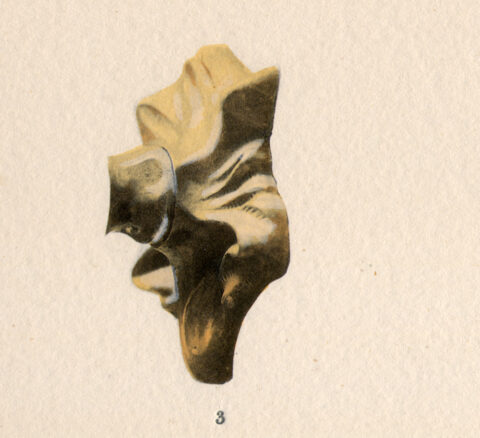
Escutcheon on the landing door handles of the apartments at Castel Béranger. Hector Guimard, L’Art dans l’Habitation moderne/Le Castel Béranger (Castel Béranger portfolio), pl. 35 (detail), Librairie Rouam, 1898. Private collection.
Like other common models of this type, it consists of three parts: first, a plate that is screwed onto the door and includes a threaded rod; second, a rosette with a hole in the center that overlaps the plate; and finally, a handle whose thread screws onto the rod of the plate before being locked in place by a through pin. The shape of this handle is complex, halfway between a knob, which it resembles in its compact form, and a lever, which it resembles in its distal end. At first glance, it seems less easy to grip than porcelain doorknobs, which do not have finger indentations, but whether placed upwards or downwards, its distal end fits perfectly between the thumb and index finger. Depending on the model, the F.T mark can be found on the plate or on the back of the rosette, where the number 630 also appears.
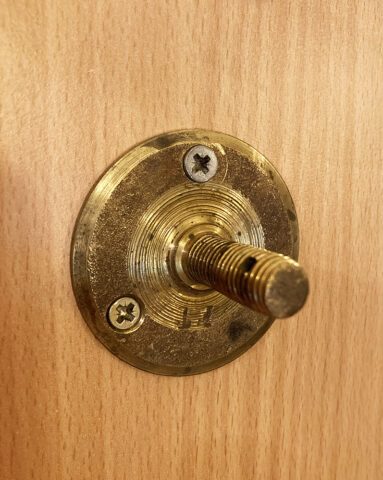
Plate from a landing handle at Castel Béranger. Private collection. Photo by F. D.
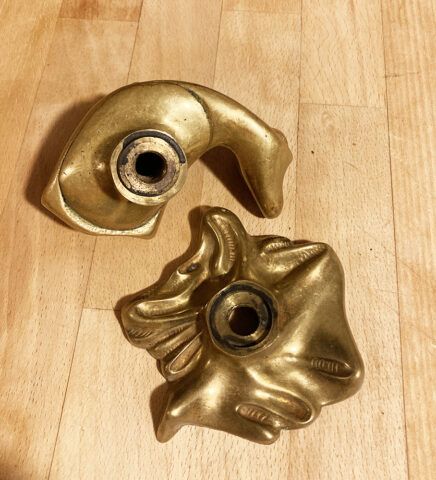
Door handle and escutcheon from a landing door at Castel Béranger. Private collection. Photo by F. D.
This landing handle was also present on the entrance door of the Castel Henriette in Sèvres (now destroyed).

Entrance door to Castel Henriette in Sèvres (1899–1903), portfolio Ferronneries de style Moderne, Ch. Schmid publisher, first edition, pl. XLIII (detail), undated (c. 1903), private collection.
Guimard also used it a little later for the doors of apartments in another apartment building: the Jassedé building (1903-1905) at 142 Avenue de Versailles in Paris, where it seems to have made its last appearance.
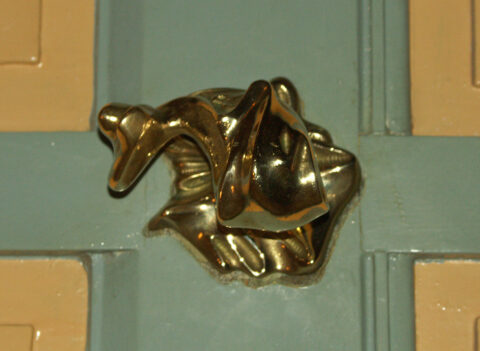
Door handle in the Jassedé building at 142 Avenue de Versailles. Photo F. D.
At Castel Béranger, they suffered the same fate as the porcelain knobs on the interior doors: they were stolen and resold. Those found in private collections, and which occasionally appear on the art market therefore mainly come from this building, where they were replaced by copies around 2000. The Cercle Guimard has also reissued a few of them in bronze, with the function of a door handle rather than a fixed knob.
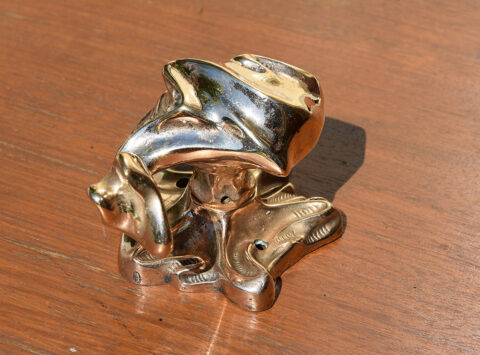
Copy of a door handle from Castel Béranger, reissued by the Cercle Guimard with the function of a door handle. Private collection. Photo F. D.
Also at Castel Béranger, Guimard installed brass (or bronze) door handles[2] in two different models, left and right, which are significantly different, on some of the doors in the common areas. The Fontaine M portfolio provides a beautiful photographic reproduction of these handles.
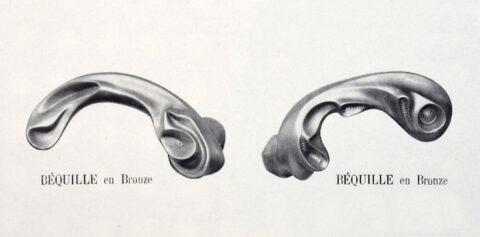
Right and left door handles of the Castel Béranger, plate from the Fontaine M portfolio (detail and photomontage), undated (c. 1900). The left door handle is on the right of the picture, and the right door handle is on the left of the image. Fontaine Museum. Photo F. D.
The Castel Béranger portfolio also provides a view of each model.
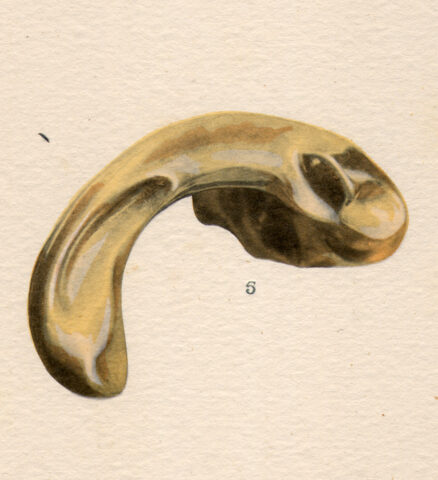
Right door handle from Castel Béranger. Hector Guimard, L’Art dans l’Habitation moderne/Le Castel Béranger (Castel Béranger portfolio), pl. 35 (detail), Librairie Rouam, 1898. Private collection.
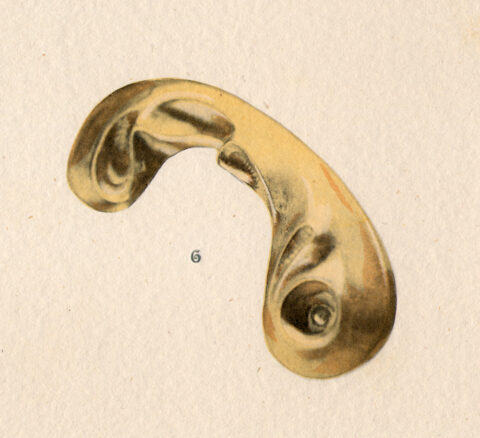
Left door handle from Castel Béranger. Hector Guimard, L’Art dans l’Habitation moderne/Le Castel Béranger (portfolio of Castel Béranger), pl. 35 (detail), Librairie Rouam, 1898. Private collection.
The right handle can be found in the series of photographs donated by Adeline Oppenheim-Guimard to the Bibliothèque des Arts Décoratifs in 1948.
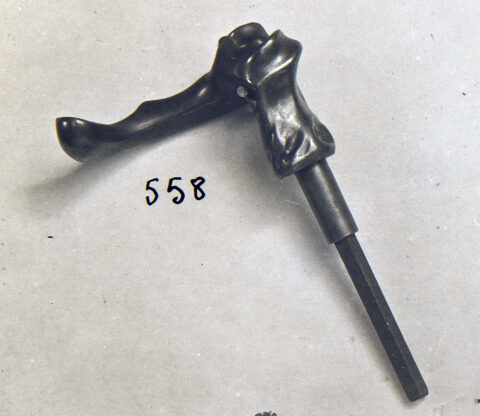
Right handle from the Castel Béranger. Bibliothèque des Arts Décoratifs, donated by Adeline Oppenheim-Guimard, 1948, photo by Laurent Sully Jaulmes (detail).
Guimard seems to have made relatively little use of these door handles. However, the left-hand model can be found on the front door of the Coutolleau store in Angers in 1897. The right-hand model was probably on the inside.
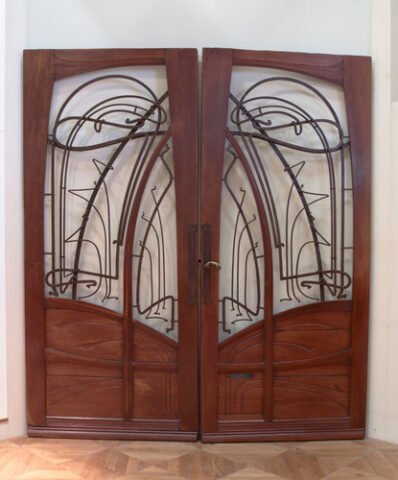
Double door from the front of the Coutolleau store in Angers, 1897. Musée d’Orsay, OAO 1194. Photo RMN-Grand Palais (Musée d’Orsay)/Hervé Lewandowski.
Similarly, these two models of handles were placed on either side of the front door of the Coilliot house in Lille (1898-1900).
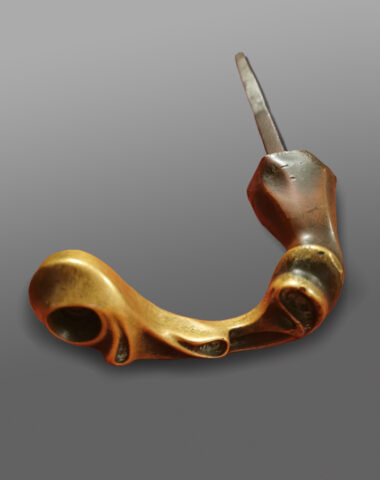
Left door handle from Castel Béranger, originally located outside the front door of the Maison Coilliot (1899–1900). Private collection.
These door handles are therefore much rarer than porcelain doorknobs, but a few have appeared on the art market and may have been purchased.
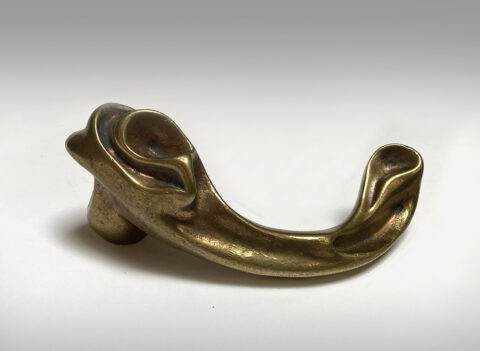
Right handle from Castel Béranger with the base cut off. Private collection. Photo F. D.
The Cercle Guimard has also reproduced a few bronze copies of the right handle.
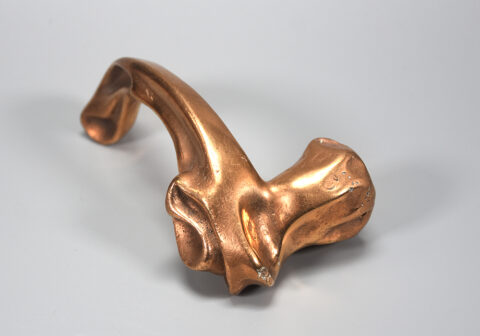
Copy of a right handle from Castel Béranger, reproduced by the Cercle Guimard. Coll. part. Photo F. D.
The brass (or bronze) lock model[3] used at Castel Béranger is little known. However, it was present on the upper and lower parts of many double doors in the building’s apartments.

Furniture and decorative objects by Guimard, photographed in the living room of an apartment in Castel Béranger, on the second floor, at the corner of Rue La Fontaine and Hameau Béranger. The locks on the double door are framed in red. Photograph published in Revue d’Art No. 1, November 1899. Private collection.
The Castel Béranger portfolio details the various components: upper bolt knob (9), lower bolt knob (10), rod guide (11), upper strike plate (12), strike plate (13)

Lock from Castel Béranger. Hector Guimard, L’Art dans l’Habitation moderne/Le Castel Béranger (portfolio of Castel Béranger), pl. 56 (photomontage), Librairie Rouam, 1898. Private collection.
There are actually two different models: an upper lock,
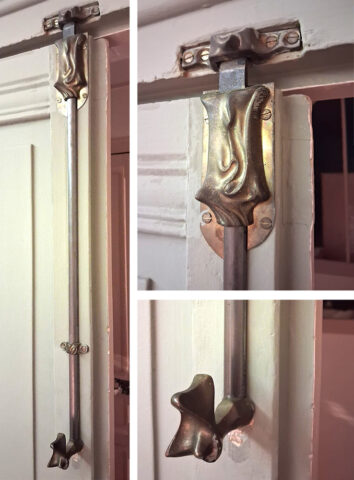
Upper lock of a door at Castel Béranger. Photos O. P.
and a lower lock. The plate and rod guide are common to both locks, while their knobs are different and only the upper lock has a strike plate (the lower lock’s strike plate is a simple metal plate screwed to the floor).
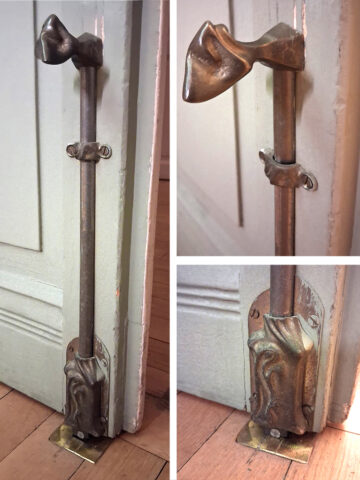
Lower lock of a door at Castel Béranger. Photos O. P.
Curiously, the Fontaine M portfolio features a lower lock with an upper strike plate.
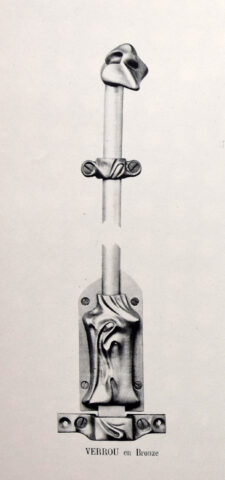
Lower lock Castel Béranger (with an upper stike plate), portfolio Fontaine M (détail), s.d. (c. 1900). Musée Fontaine. Photo F. D.
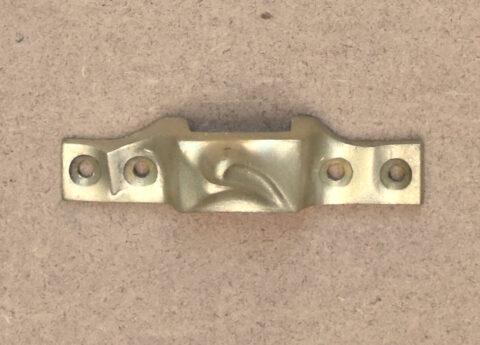
Upper strike plate stripped from the lock of Castel Béranger, brass. Private collection. Photo F. D.
These locks were most likely used by Guimard on buildings contemporary with or slightly later than the Castel Béranger. We know this for certain in the case of the Castel Henriette and the Castel Val in Auvers-sur-Oise.
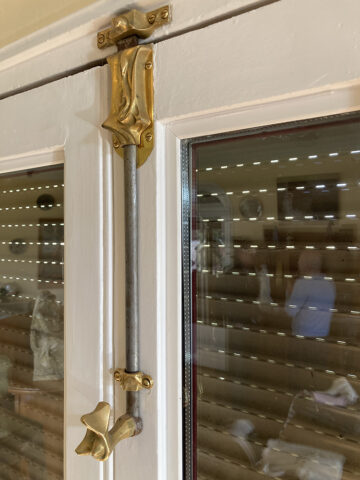
Upper lock on the French windows in the living room and dining room of the Castel Val in Auvers-sur-Oise. Photo F. D.
The espagnolette systems at Castel Béranger were also produced by Fontaine in large numbers, as they were used on all the windows, both interior and exterior, of the building. The rods are half-round with a width of 16 mm.
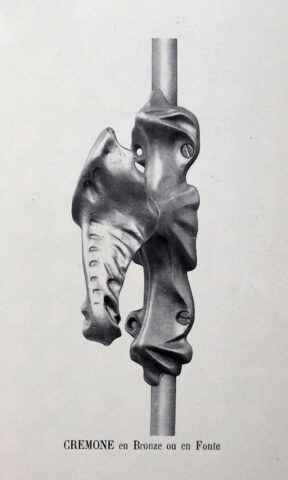
Casing and handle from Castel Béranger of an espagnolette, portfolio Fontaine M (detail), s.d. (c. 1900). Musée Fontaine. Photo F. D.
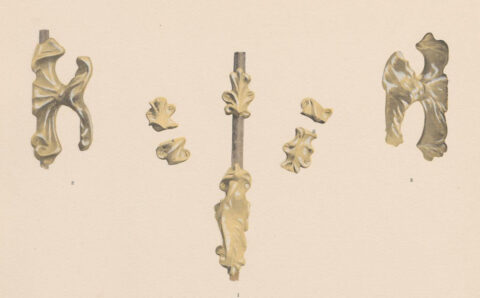
Espagnolette from Castel Béranger. Hector Guimard, L’Art dans l’Habitation moderne/Le Castel Béranger (portfolio of Castel Béranger), pl. 57 (photomontage), Librairie Rouam, 1898. Private collection.
As shown in the Fontaine M portfolio plate, their components were cast in two materials with different appearances and costs: cast iron and brass (or bronze)[4]. It is likely that the brass versions were intended for windows in reception rooms such as living rooms (below). The cast iron versions, intended to be painted, were probably relegated to other areas.
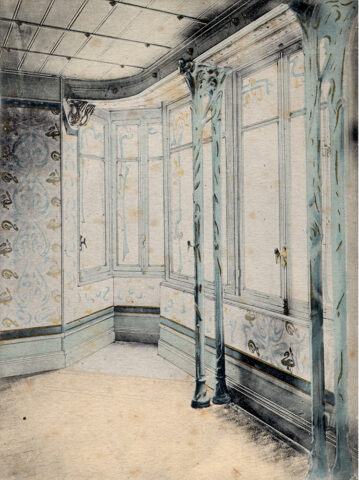
Living room of an apartment in Castel Béranger, on the second floor, at the corner of Rue La Fontaine and Hameau Béranger. Hector Guimard, L’Art dans l’Habitation moderne/Le Castel Béranger (portfolio of Castel Béranger), pl. 49 (detail), Librairie Rouam, 1898. Private collection.
However, brass handles are often found on cast iron systems, without it being possible to know whether they were originally placed there or whether they have been moved since.
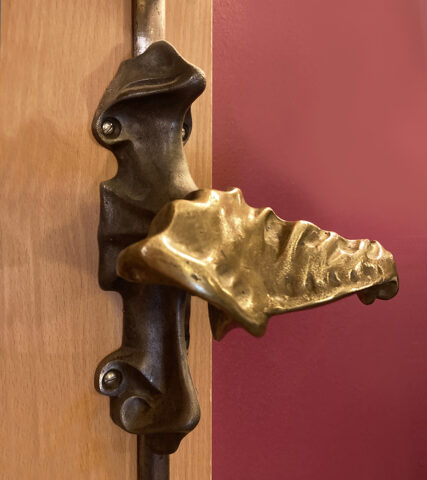
Cast iron casing and brass handle from a espagnolette bolt system from Castel Béranger. Private collection. Photo F. D.
When the components of the espagnolette systems are made of cast iron, their finish is unusually refined.
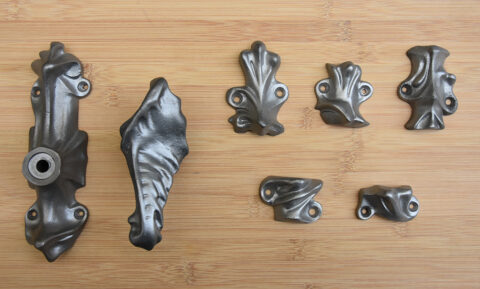
Stripped cast iron elements from an espagnolette system, possibly from Castel Henriette. From left to right: casing, handle; top: middle rod guide, upper rod guide, lower rod guide; bottom: lower strike plate and upper strike plate. Private collection. Photo F. D.
These espagnolette systems were most likely used by Guimard on buildings contemporary with or slightly later than the Castel Béranger. We know this to be true for the Castel Henriette and the Castel Val.
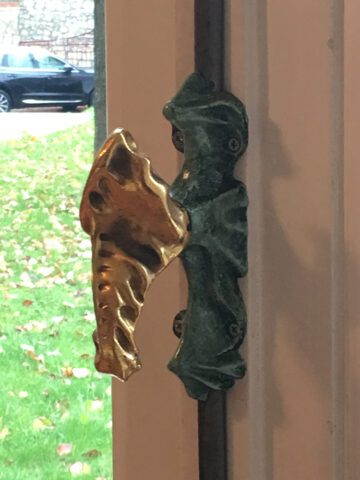
Cast iron casing and brass espagnolette handle at Castel Val. Photo F. D.
For the restoration of Castel Béranger in 2000, copies were made by the Rollinger foundry in Nouvion-sur-Meuse to replace the missing espagnolette systems.
The Cercle Guimard also reissued a few copies in bronze.
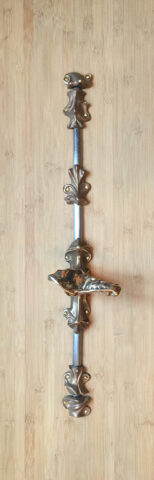
Copy of a bronze espagnolette system by the Cercle Guimard. Coll. part. Photo F. D.
In a future article, we will examine the latest hardware from Castel Béranger produced by Fontaine.
Frédéric Descouturelle
in collaboration with Olivier Pons
Notes
[1] The Castel Béranger portfolio lists them as copper, while the Fontaine M portfolio lists them as bronze. In the field of hardware, differences and confusion between the names of these alloys, whether commercial, customary, or scientific, are very common.
[2] Ibid.
[3] The Castel Béranger portfolio lists them as copper, while the Fontaine M portfolio lists them as bronze. Observation of an old model shows traces of gilding. The back plate of the lock is brass, and the half-round rods and bolts are iron.
[4] The Castel Béranger portfolio does not indicate the type of metal, while the Fontaine M portfolio lists them as bronze or cast iron.
Bibliography
Hector Guimard, L’Art dans l’Habitation moderne/Le Castel Béranger (Castel Béranger portfolio), Librairie Rouam, 1898.
Portfolio M Fontaine, “Maison Fontaine/181/Rue St-Honoré Paris/M,” undated (c. 1900).
Thiébaut, Philippe, collective work edited by, Guimard, catalog of the exhibition “Guimard” in Paris from April 13, 1992, to July 26, 1992, and in Lyon from September 23, 1992, to January 3, 1993, Paris, Musée d’Orsay/RMN, 1992.
Translation: Alan Bryden